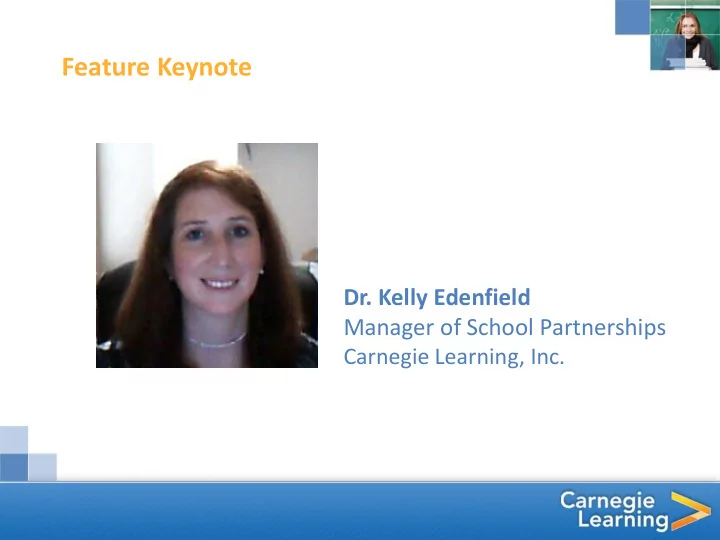
SLIDE 1
Manager of School Partnerships
Carnegie Learning, Inc.
Feature Keynote
SLIDE 2 You Want Me to Simulate What?
Middle School Probability Standards
Manager of School Partnerships Carnegie Learning
SLIDE 3
- Review various methods for conducting
probability simulations.
- Design and carry out simulations of
compound events, as described in the example in 7.SP.8c.
- Discuss possible student misconceptions
when conducting simulations.
Webinar Goals
SLIDE 4 Common Core 7th Grade Probability Standards
- Develop an understanding of probability
– 0 ≤ 𝑄(𝐵) ≤ 1
- Approximate probabilities by observing
long-run relative frequencies from gathered data.
- Develop and use probability models
– Uniform model by assigning probabilities – By observing gathered data
SLIDE 5 Focus Standards
MCC7.SP.8 Find probabilities of compound events using
- rganized lists, tables, tree diagrams, and simulation.
- 8a. Understand that, just as with simple events, the
probability of a compound event is the fraction of outcomes in the sample space for which the compound event occurs.
- 8b. Represent sample spaces for compound events
using methods such as organized lists, tables and tree
- diagrams. For an event described in everyday language
(e.g., “rolling double sixes”), identify the outcomes in the sample space which compose the event.
- 8c. Design and use a simulation to generate
frequencies for compound events.
SLIDE 6 Focus Standards
MCC7.SP.8 Find probabilities of compound events using
- rganized lists, tables, tree diagrams, and simulation.
- 8a. Understand that, just as with simple events, the
probability of a compound event is the fraction of outcomes in the sample space for which the compound event occurs.
- 8b. Represent sample spaces for compound events
using methods such as organized lists, tables and tree
- diagrams. For an event described in everyday language
(e.g., “rolling double sixes”), identify the outcomes in the sample space which compose the event.
- 8c. Design and use a simulation to generate
frequencies for compound events.
SLIDE 7 Simulation
Today, we will conduct mathematical simulations.
- A simulation is when we construct a
mathematical model for our situation in
- rder to estimate probability.
- What are some different simple events we
could simulate? How could we simulate the events?
SLIDE 8 Simulation Tools
- Spinners
- Decks of cards
- Homemade cards
- Colored objects
- Dice (Number Cubes)
- Random number generators (e.g., digital,
tables)
SLIDE 9
SLIDE 10
Random Number Table
SLIDE 11 Compound Events
- Two or more simple events
- A few examples
– Rolling a die twice (or a set of dice) – Rolling a die and drawing a card from a deck – Drawing two cards from a deck – Flipping a coin three times
SLIDE 12
Teenage Mutant Ninja Turtles
SLIDE 13 Teenage Mutant Ninja Turtles
Suppose each box of a popular brand of cereal contains a Teenage Mutant Ninja Turtle as a prize. There are 4 Ninja Turtles: Leonardo, Donatello, Michelangelo, and Raphael. Each turtle is equally likely to appear in any box of cereal. Design and carry out a simulation to help you answer the following question:
- What is the probability of having to buy at least five boxes
- f cereal to get a Leonardo (blue mask)?
SLIDE 14
SLIDE 15 Teenage Mutant Ninja Turtles
- What is the probability of having to buy at
least five boxes of cereal to get a Leonardo (blue mask)?
Trial Number Number of Boxes Until First Leonardo 1 2 3 … 10
SLIDE 16 TMNT
Trial Number Number of Cereal Boxes Until First Leonardo 1 1 2 7 3 1 4 4 5 6 6 2 7 3 8 3 9 1 10 2
SLIDE 17 Teenage Mutant Ninja Turtles
- What is the probability of having to buy at
least five boxes of cereal to get a Leonardo (blue mask)?
– My results: 20%
SLIDE 18 Teenage Mutant Ninja Turtles: Extension
Design and carry out a simulation to help you answer the following questions.
- What is the probability of having to buy at
least ten boxes of cereal to get a full set of TMNTs (all four turtles)?
SLIDE 19 Teenage Mutant Ninja Turtles: Extension
What is the probability of having to buy at least ten boxes of cereal to get a full set of TMNTs (all four turtles)?
Trial Number Results Number of Boxes for Full Set 1 LLMRD 5 2 MRRDDMML 8 … 10 MMMRRRLLMRLLRD 14
SLIDE 20 Teenage Mutant Ninja Turtles: Extensions
- Based on our simulations, how many boxes
would you expect to buy
– before getting a Leonardo? – before getting a whole set of TMNTs?
- How would we justify our answer using our
shared results?
SLIDE 21 Teenage Mutant Ninja Turtles
- What is the expected number of boxes you
need to buy to get a Leonardo?
– My results: 3 boxes
Group Number Number of Boxes Until First Leonardo 1 2 3 … 10
SLIDE 22
Up Next: Not Equally Likely Outcomes
SLIDE 23
Course 2, Section 17.4
Overall, the percent of people in the U.S. having each blood group is given in the following table.
Blood Groups A B O AB Percent of U.S. Population 42% 10% 44% 4%
SLIDE 24
Blood Types Simulation
Suppose the Red Cross is having a blood drive at the Community Center. Determine the probability that out of the next 5 people to donate blood, at least 1 person has type A blood.
– How could you assign numbers to people to account for the different blood types? – Describe one trial of a simulation of this situation.
SLIDE 25 Blood Types Simulation
- Random Number Table (or Generator)
– Let 0 – 41 = Type A Blood – Let 42 – 99 = All other Blood Types
– Generate 5 two-digit numbers. – Count the number of two-digit numbers for Type A Blood.
SLIDE 26
Blood Types Simulation
SLIDE 27 Blood Types Simulation
Determine the probability that out of the next 5 people to donate blood, at least 1 person has type A blood.
– Conduct 10 trials of the simulation and record your results in a table. – Out of 10 trials, how many had at least 1 person with A blood? – According to your simulation, what is the probability that out of the next 5 people to donate blood, at least
- ne of them has type A blood?
SLIDE 28
Blood Types Simulation
SLIDE 29 Blood Types Simulation
Trial Number Number (out of 5) with Type A Blood 1 1 2 4 3 2 4 3 5 1 6 3 7 3 8 3 9 1 10
SLIDE 30 Blood Types Simulation
Determine the probability that out of the next 5 people to donate blood, at least 1 person has type A blood.
– Conduct 10 trials of the simulation and record your results in a table. – Out of 10 trials, how many had at least 1 person with A blood? (9 trials had at least 1 person with Type A.) – According to your simulation, what is the probability that out of the next 5 people to donate blood, at least
- ne of them has type A blood? (90%)
SLIDE 31
Blood Types Simulation
Extension: Design a simulation to determine how many people you would expect to enter the Community Center before you found a donor with type AB blood (4% of US population).
SLIDE 32
- Review various methods for conducting
probability simulations.
- Design and carry out simulations of
compound events, as described in the example in 7.SP.8c.
- Discuss possible student misconceptions
when conducting simulations.
Webinar Goals
SLIDE 33 kedenfield@carnegielearning.com 888.851.7094 ext 425 Follow me on Twitter @CLkedenfield pd@carnegielearning.com sales@carnegielearning.com www.carnegielearning.com
For More Information, Contact us:
SLIDE 34
Thank you for joining us!
@carnegielearn
Follow us! Contact me: rclawson@carnegielearning.com
Want more?
Check out upcoming and archived webinars at
http://www.carnegielearning.com/webinars/