X-ray Diffraction Data X-ray Diffraction Data & Crystal - - PowerPoint PPT Presentation

x ray diffraction data x ray diffraction data crystal
SMART_READER_LITE
LIVE PREVIEW

X-ray Diffraction Data X-ray Diffraction Data & Crystal - - PowerPoint PPT Presentation

4/2/2015 X-ray Diffraction (continued) X-ray Diffraction Data & Crystal Structure 1. Peak positions 3. X-ray Detector Using Bragg's Law, the peak (200) positions can be calculated. = 2d sin( ) Intensity = arcsin ( ) (220)


slide-1
SLIDE 1

4/2/2015 1

X-ray Diffraction (continued)

  • 3. X-ray Detector
  • W. Kanitpanyacharoen

I mage so urc e http:/ / www.h-and-m-analytic al.c o m/ image s/ se rvic e s/ x-ray-po wde r-diffrac tio n.jpg

  • 1. X-ray source
  • 2. Sample holder

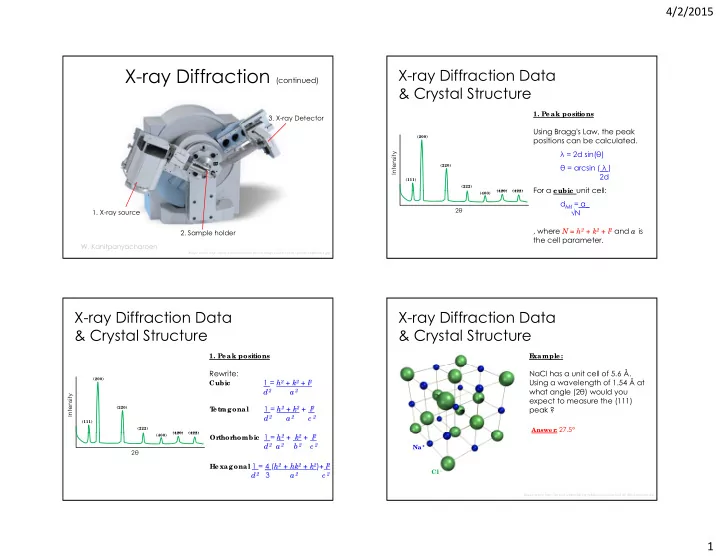
X-ray Diffraction Data & Crystal Structure

  • 1. Peak positions

(111) (200) (220) (222) (420) (422)

Intensity

Using Bragg's Law, the peak positions can be calculated. λ = 2d sin(θ) θ = arcsin ( λ ) 2d For a c ubic unit cell:

(400) (420) (422)

For a c ubic unit cell: dhkl = a_ √N , where N = h2 + k2 + l

2 and a is

the cell parameter.

X-ray Diffraction Data & Crystal Structure

  • 1. Peak positions

(111) (200) (220) (222) (420) (422)

Intensity

Rewrite:

Cubic

1 = h2 + k2 + l

2

d2 a 2

T etr agonal

1 = h2 + k2 + l

2

d2 a 2 c 2

(400) (420) (422)

Or thor hombic 1 = h2 + k2 + l

2

d2 a 2 b 2 c 2

Hexagonal 1 = 4 (h2 + hk2 + k2)+ l

2

d2 3 a 2 c 2

X-ray Diffraction Data & Crystal Structure

E xample:

NaCl has a unit cell of 5.6 Å. Using a wavelength of 1.54 Å at what angle (2θ) would you expect to measure the (111) peak ?

Answer : 27.5°

I mage so urc e http:/ / uplo ad.wikime dia.o rg/ wikipe dia/ c o mmo ns/ d/ de / Nac l-struc ture .jpg

Na + Cl -

slide-2
SLIDE 2

4/2/2015 2

X-ray Diffraction Data & Crystal Structure

E xample:

Zircon has a unit cell of a = 3.2 Å and c = 7.8 Å. Using a wavelength of 1.54 Å at what angle (2θ) would you expect to measure the (002) peak ?

Answer : 22.6°

I mage so urc e http:/ / uplo ad.wikime dia.o rg/ wikipe dia/ c o mmo ns/ d/ de / Nac l-struc ture .jpg

Na + Cl -

X-ray Diffraction Data & Crystal Structure

  • 2. Peak intensities

Intensity

The intensity of a peak Ihkl is given by: , where structure factor (F

hkl)

describes how an atom scatters incident X-ray It is dependent on Ihkl α l Fhkl l2

I mage so urc e http:/ / ipo .lbl.go v/ wp-c o nte nt/ uplo ads/ site s/ 8/ 2014/ 08/ 2080fig2.jpg

incident X-ray. It is dependent on the type of atoms and their positions (x, y, z) in the unit cell. It also tells us which {hkl} peak to appear in the XRD data. When Fhkl

2 = 0, there is no peak.

X-ray Diffraction Data & Crystal Structure

Intensity

fi is the scattering factor for atom iand is related to its atomic number Differences in X-ray intensity relate to changes in chemistry Fhkl = ∑ fiexp 2πi(hxi + kyi + lzi)

I mage so urc e http:/ / ipo .lbl.go v/ wp-c o nte nt/ uplo ads/ site s/ 8/ 2014/ 08/ 2080fig2.jpg

relate to changes in chemistry (scattering factor). For multiphase samples, changes in X-ray intensities are related to the amount of each mineral present in the sample.

X-ray Diffraction Data & Crystal Structure

  • 3. Peak widths

The peak width (β) in radians (measured at full width at half maximum, FWHM) is inversely proportional to the crystallite size (L

hkl)perpendicular to hkl plane.

Lhkl = ____λ____ β cos θ

Intensity

Peak width at FWHM

I mage so urc e http:/ / ipo .lbl.go v/ wp-c o nte nt/ uplo ads/ site s/ 8/ 2014/ 08/ 2080fig2.jpg

Small crystals are the most common cause of line broadening but other defects can also cause peak widths to increase. βFWHMcos θ

slide-3
SLIDE 3

4/2/2015 3

APS Sync hr

  • tr
  • n

Argonne, IL, USA

Source: http://www.lynceantech.com/images/aps.jpg

Your c ar !

‐ Synchrotron X‐ray is the electromagnetic radiation emitted when electrons, moving at velocities close to the speed of light, are forced to change direction by a magnetic field. ‐ Synchrotron light has a number of unique properties such as: High brightness: synchrotron light is extremely intense High brightness: synchrotron light is extremely intense (hundreds of thousands of times more intense than that from conventional x‐ray tubes) and highly collimated. Wide energy spectrum: synchrotron light is emitted with energies ranging from infrared light to hard x‐rays. Tunable: it is possible to obtain an intense beam of any selected wavelength

I mage so urc e http:/ / ipo .lbl.go v/ wp-c o nte nt/ uplo ads/ site s/ 8/ 2014/ 08/ 2080fig2.jpg

wavelength. Highly polarised: the synchrotron emits highly polarised radiation, which can be linear, circular or elliptical. Emitted in very short pulses: pulses emitted are typically less than a nano‐second (a billionth of a second), enabling time‐ resolved (real time!) studies.

Inside the APS Synchrotron X-ray diffraction

High pressure, temperature experiment in the “Diamond Anvil Cell (DAC)”

Source: http://topicstock.pantip.com/wahkor/topicstock/2009/12/X8704611/X8704611-52.jpg; http://umet.univ-lille1.fr/Mineraux/Ressources/diamants_h.jpg

slide-4
SLIDE 4

4/2/2015 4

Synchrotron X-ray diffraction: Study Earth’s interiors

post post-

  • perovskite

perovskite + + ferropericlase ferropericlase Discovered by Olivine Wadsleyite Discovered by Murakami et al. S c ie nc e (2004) Ringwoodite Perovskite Post-perovskite

Source: http://www.quranandscience.com/images/stories/earth_layers.jpg

Lab This Week

  • Presentation < 10 mins
  • Report < 3 pages
  • 2 samples analysis
  • Single phase: calculate d-spacing,

{hkl}, etc.

I mage so urc e http:/ / ipo .lbl.go v/ wp-c o nte nt/ uplo ads/ site s/ 8/ 2014/ 08/ 2080fig2.jpg

  • Multiple phases: search peaks

from database

Useful website: http://webmineral.com/help/XRayDiffraction.shtml#.VRtm_vmUd8E