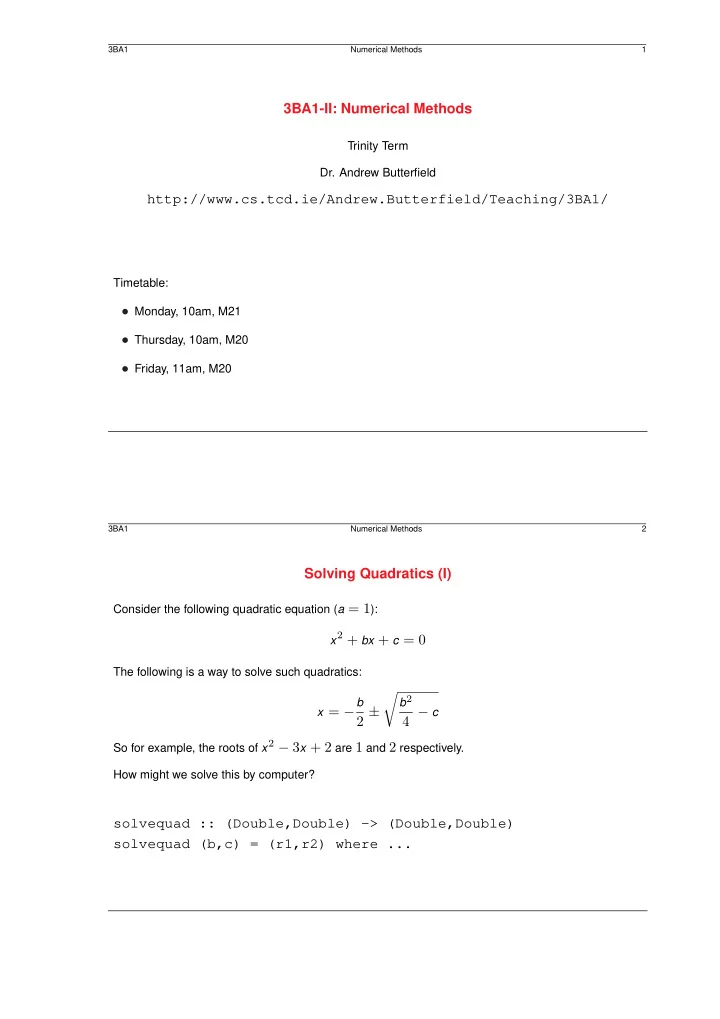
x 2 + bx + c = 0 The following is a way to solve such quadratics: - - PDF document

x 2 bx c 0
SMART_READER_LITE
LIVE PREVIEW

x 2 + bx + c = 0 The following is a way to solve such quadratics: - - PDF document

3BA1 Numerical Methods 1 3BA1-II: Numerical Methods Trinity Term Dr. Andrew Butterfield http://www.cs.tcd.ie/Andrew.Butterfield/Teaching/3BA1/ Timetable: Monday, 10am, M21 Thursday, 10am, M20 Friday, 11am, M20 3BA1 Numerical


slide-1
SLIDE 1

3BA1 Numerical Methods 1

3BA1-II: Numerical Methods

Trinity Term

  • Dr. Andrew Butterfield

http://www.cs.tcd.ie/Andrew.Butterfield/Teaching/3BA1/

Timetable:

  • Monday, 10am, M21
  • Thursday, 10am, M20
  • Friday, 11am, M20

3BA1 Numerical Methods 2

Solving Quadratics (I)

Consider the following quadratic equation (a = 1): x2 + bx + c = 0 The following is a way to solve such quadratics: x = − b

2 ±

  • b2

4 − c

So for example, the roots of x2 − 3x + 2 are 1 and 2 respectively. How might we solve this by computer?

solvequad :: (Double,Double) -> (Double,Double) solvequad (b,c) = (r1,r2) where ...

slide-2
SLIDE 2

3BA1 Numerical Methods 3

Solving Quadratics (II)

The following is a way to solve such quadratics:

solvequad :: (Double,Double) -> (Double,Double) solvequad (b,c) = (r1,r2) where b’ = -b/2 d = b’*b’-c e = sqrt d e’ = if b < 0.0 then -e else e r1 = b’+e r2 = b’-e Experiments> solvequad (-3.0,2.0) (2.0,1.0) :: (Double,Double)

How can we test this ?

3BA1 Numerical Methods 4

Making Quadratics

Given two roots, r1 and r2, we can derive a quadratic with those roots by

= (x − r1)(x − r2) =

x2 − (r1 + r2)x + r1r2

=

x2 + bx + c where b

= −(r1 + r2)

c

=

r1r2

mkquad :: (Double,Double) -> (Double,Double) mkquad (r1,r2) = (-(r1+r2),r1*r2) Experiments> mkquad (2.0,1.0) (-3.0,2.0) :: (Double,Double)

slide-3
SLIDE 3

3BA1 Numerical Methods 5

Some examples (I)

Try a quadratic with roots 1 and 10:

Experiments> mkquad (10,1) (-11.0,10.0) :: (Double,Double) Experiments> solvequad (-11.0,10.0) (10.0,1.0) :: (Double,Double)

Looks OK

3BA1 Numerical Methods 6

Some examples (II)

Try roots 1 and 10−8:

Experiments> mkquad (1,1.0e-8) (-1.0,1.0e-008) :: (Double,Double) Experiments> solvequad (1.0,2.98023e-008) (1.0,2.98023e-008) :: (Double,Double)

The answer is almost 3 times too large!

slide-4
SLIDE 4

3BA1 Numerical Methods 7

Some examples (III)

Try roots 1 and 10−9:

Experiments> mkquad (1,1.0e-9) (-1.0,1.0e-009) :: (Double,Double) Experiments> solvequad (-1.0,1.0e-009) (1.0,0.0) :: (Double,Double)

One root is zero! What is going wrong?

3BA1 Numerical Methods 8

Repeated Summing (I)

Let us try lots of additions

100,000

  • i=1

0.1 = 10, 000 ksum k i = ksum’ k i 0 where ksum’ k i s | i <= 0 = s | otherwise = ksum’ k (i-1) $! (s+k)

slide-5
SLIDE 5

3BA1 Numerical Methods 9

Repeated Summing (II)

Add 1

10 a hundred thousand times to get ten thousand:

Experiments> ksum 0.1 100000 9998.56

The correct answer is 10,000 — why the (small) error?

3BA1 Numerical Methods 10

Repeated Summing (III)

Try adding

1 100 a million times to get 10,000:

Experiments> ksum 0.01 1000000 9865.22 :: Double

Why the (large) error?

slide-6
SLIDE 6

3BA1 Numerical Methods 11

Addition is Associative

It is well known that a + (b + c) = (a + b) + c The following program tests this law:

> test_assoc a b c > = ((x,y),(y-x,x==y)) > where > x = a+(b+c) > y = (a+b)+c

It takes in a, b and c, and returns the two sums, their difference, and a boolean indicating if they are equal.

3BA1 Numerical Methods 12

Testing Associativity (I)

Let’s try a = 1 with b = 2 and c = 3:

Experiments> test_assoc 1.0 2.0 3.0 ((6.0,6.0),(0.0,True))

This look OK — Let us try another.

slide-7
SLIDE 7

3BA1 Numerical Methods 13

Testing Associativity (II)

Let’s try a = 1 with b = c = 3 × 10⁻⁷:

Experiments> test_assoc 1.0 3.0e-7 3.0e-7 ((1.0,1.0),(1.19209e-007,False))

The values print the same, but if fact differ, so we have seen that in this case a + (b + c) = (a + b) + c i.e.

1 + (3 × 10⁻⁷ + 3 × 10⁻⁷) = (1 + 3 × 10⁻⁷) + 3 × 10⁻⁷

3BA1 Numerical Methods 14

Summing Harmonic Series

Consider computing the following: H(n) =

n

  • i=1

1

i2

slide-8
SLIDE 8

3BA1 Numerical Methods 15

Summing 1 . . . n

We can accumulate the sum starting with i = 1 and working up to i = n:

hsumup n = hsum’ n 1 0 where hsum’ n i s | i > n = s | otherwise = hsum’ n (i+1) $! (s+r*r) where r = 1/i

3BA1 Numerical Methods 16

Summing n . . .1

We can accumulate the sum starting with i = n and working down to i = 1:

hsumdn n = hsum’ n 0 where hsum’ n s | n<1 = s | otherwise = hsum’ (n-1) $! (s+r*r) where r = 1/n

slide-9
SLIDE 9

3BA1 Numerical Methods 17

Try H(100, 000)

Let us try both functions:

Experiments> hsumup 100000 1.64473 Experiments> hsumdn 100000 1.64492

They differ! Which one is more accurate?

3BA1 Numerical Methods 18

What is going wrong?

We have tried some simple calculations using a computer. We keep getting strange errors/results! What is the reason for this? How should we have done things differently?

slide-10
SLIDE 10

3BA1 Numerical Methods 19

Numerical Methods

Numerical Methods is the study of how to cope with the limitations of Computer Arithmetic, in order to get results in which we can be reasonably confident. This is the topic of 3BA1 Part II

3BA1 Numerical Methods 20

Lecture 1

This course concerns itself with:

  • performing arithmetic with real numbers
  • using computing machinery
  • computer arithmetic involves finite approximations to infinitely precise quantities
slide-11
SLIDE 11

3BA1 Numerical Methods 21

Consider the various number types: Naturals

N 0, 1, 2, 3, . . .

Integers

Z . . . , −2, −1, 0, 1, 2, . . .

Rationals

Q 0, ±1/1, ±1/2, ±2/1, ±1/3, ±3/1, ±2/3, ±3/2, . . .

Each of these contains an infinite number of numbers, but each number is itself finite.

3BA1 Numerical Methods 22

However, the reals are different: Reals

R

Each real number is itself an infinite object:

1 = 1.0000000000000000 . . . 1/3 = 0.33333333333333333333 . . . π = 3.14159 . . .

e

= 2.717 . . .

We can only handle finite quantities in reality, either when using computers, or calculating by hand !

slide-12
SLIDE 12

3BA1 Numerical Methods 23

Consider the simple law of the associativity of addition: a + (b + c) = (a + b) + c This holds for all numbers, whether natural, integer, rational, or real. But what happens if we are representing real numbers using some finite encoding scheme such as floating point ?

3BA1 Numerical Methods 24

Consider a scheme which represents real numbers using 3 decimal digits, plus an decimal exponent in the range −9, . . . , +9:

±d0.d1d2d3 · 10e

where di ∈ 0, 1, . . . , 9, d0 = 0 and −9 ≤ e ≤ 9. Let a = 1.000 · 100 and b = c = 3.000 · 10−4.

slide-13
SLIDE 13

3BA1 Numerical Methods 25

Consider a + b: a + b

=

“ values of a and b ”

1.000 · 100 + 3.000 · 10−4 =

“ align and extend digits, noting largest exponent ”

1.000 0 + 0.000 3 100 =

“ add ”

1.000 3 100 =

“ round to 3 decimals, and link in exponent ”

1.000 · 100

So we have a + b = a even though b = 0 !. We can also see clearly that (a + b) + c will also equal a in this case.

3BA1 Numerical Methods 26

Now consider b + c: b + c

=

“ values of b and c ”

3.000 · 10−4 + 3.000 · 10−4 =

“ align and extend digits, noting largest exponent ”

3.000 0 + 3.000 0 10−4 =

“ add ”

6.000 0 10−4 =

“ round to 3 decimals, and link in exponent ”

6.000 · 10−4

slide-14
SLIDE 14

3BA1 Numerical Methods 27

We now add a and b + c: a + (b + c)

=

“ values of a and b + c ”

1.000 · 100 + 6.000 · 10−4 =

“ align and extend digits, noting largest exponent ”

1.000 0 + 0.000 6 100 =

“ add ”

1.000 6 100 =

“ round to 3 decimals, and link in exponent ”

1.001 · 100

3BA1 Numerical Methods 28

So for this floating point arithmetic scheme we get

1.000 · 100 + (3.000 · 10−4 + 3.000 · 10−4) = 1.001 · 100 = 1.000 · 100 = (1.000 · 100 + 3.000 · 10−4) + 3.000 · 10−4

We have seen that in general for finite floating point arithmetic that in general a + (b + c)

= (a + b) + c

b = 0

a + b = a From our example above we can see that the best approach when adding numbers together is to add the smallest first, were this information is available.

slide-15
SLIDE 15

3BA1 Numerical Methods 29

Consider the following sum:

n

  • k=1

1

k = 1

1 + 1 2 + · · · 1

n The best way to compute this is to start with k = n and work down to 1, adding the smallest numbers first:

s :=0 ; for( k=n, k>=1; k--) s += 1/k ;

Numerical Analysis and Methods are the “science” of performing these numerical calculations in a fashion that ensures that accuracy is maintained with algorithms that are also efficient.

3BA1 Numerical Methods 30

Sources of Error

  • Input data error — measurement error, or reals reported with fixed no. of digits
  • rounding error — computation using fixed number of digits
  • truncation error — replacing infinite process by a finite one (infinite series by partial sum, or

function by polynomial approximation.

slide-16
SLIDE 16

3BA1 Numerical Methods 31

Key Definitions (I)

Exact value : a e.g. a =

√ 2.

Approximation : ¯ a e.g. ¯ a = 1.414. Absolute error in ¯ a : ∆a = ¯ a − a, or ¯ a = a + ∆a

∆a = −0.0002135 . . ..

Absolute error (Magnitude) : |∆a|

|∆a| ≤ 0.00022 ≤ 0.0003 (always round up).

Relative error in ¯ a :

∆a

a ,

(a = 0)

∆a

a = −0.0002135

√ 2

≈ −0.000151011 . . .

Relative error (Magnitude) :

  • ∆a

a

  • ,

(a = 0)

  • ∆a

a

  • ≤ 0.00016 ≤ 0.0002 (again,

always round up).

3BA1 Numerical Methods 32

The following 3 statements are equivalent:

¯

a

= 1.414, |∆a| ≤ 0.22 · 10−3

a

= 1.414 ± 0.22 · 10−3 1.41378 ≤

a

≤ 1.41422

Decimal Digits are the digits to the right of the decimal point. Chopping to t decimal digits means dropping all digits after the tth (error: ≤ 10−t). Rounding to even to t (decimal) digits means that if the number to the right of the tth digit is less that 0.5 · 10−t, we chop, if greater, we increase the tth digit by 1, and if equal, we chop if the tth digit is even, and increase by 1 if odd (error: ≤ 0.5 · 10−t). If approximate value is rounded or chopped, then add in that error.

slide-17
SLIDE 17

3BA1 Numerical Methods 33

Example

Consider the following example: b

= 11.2376 ± 0.1 11.1376 ≤

b

≤ 11.3376

As the error is in the first decimal digit it makes no sense to keep the 3 least significant digits in the approximation, so we round to one decimal digit: brounded = 11.2 It is not the case that 11.1 ≤ b ≤ 11.3 — we cannot use original error bound alone with rounded

  • number. We need to estimate the rounding error |RB|:

|RB| = |brounded − ¯

b|

= |11.2 − 11.2376| = 0.0376 < 0.04

3BA1 Numerical Methods 34

Why does error = 0.0376 get reported as < 0.04?

There is little point having a rounding error with so many significant digits, so we round it up to one significant digit. We round up (and not “to even”) to be safe — overestimating errors is safer than underestimating them.

slide-18
SLIDE 18

3BA1 Numerical Methods 35

Example (cont.)

We obtain our sensible approximation of b with error bounds by adding the original error bound (±0.1) magnitude to that rounding error (±0.04) magnitude: b

= 11.2 ± 0.14 11.06 ≤

b

≤ 11.34

3BA1 Numerical Methods 36

Key Definitions (II)

A number has t correct decimals, if |∆a| ≤ 0.5 · 10−t. Note a number only has (any) correct decimals if the error is ≤ 0.5. In a number where |∆a| ≤ 0.5 · 10e, then a significant digit is one which is not a leading zero and whose unit is greater than or equal to 10e. Examples Approx Correct Decimals Significant Digits

0.00065437 ± 0.5 · 10−6 6 3 312.538 ± 0.5 · 10−2 2 5 675000 ± 500 3

slide-19
SLIDE 19

3BA1 Numerical Methods 37

Error Propagation

Consider feeding a number x = ¯ x ± ǫ into a function f. What is the error bound on the result ? (We assume for now that we can calculate f with perfect accuracy). We can define the function error at ¯ x as

∆f = f(¯

x) − f(x) However, usually we only know bounds on the error (±ǫ). How do we get an error estimate?

3BA1 Numerical Methods 38

A simple answer can be given if the function is monotonic over an interval including the approximation and all error values. Given knowledge of ¯ x and ǫ, then the range of values that x could have is

¯

x − ǫ ≤ x ≤ ¯ x + ǫ If the function is monotone over this interval, then the largest and smallest values that f takes must be at each end of the interval, so we can calculate:

|∆f| = |f(¯

x) − f(x)|

≤ max    |f(¯

x + ǫ) − f(¯ x)|

|f(¯

x − ǫ) − f(¯ x)|

  

slide-20
SLIDE 20

3BA1 Numerical Methods 39

Mean Value Theorem

How do we deal with more general functions ? If they are non-monotonic in general, but are differentiable, then we can use the Mean Value Theorem: If f is continuous over interval (a, b), then there exists c, with a ≤ c ≤ b such that f ′(c) = f(b) − f(a) b − a We apply the theorem with a = x, b = ¯ x and replacing c by ξ. f ′(ξ)

=

f(¯ x) − f(x)

¯

x − x

= ∆f ∆x ⇓ ∆f =

f ′(ξ)∆x for some ξ between x and ¯ x.

3BA1 Numerical Methods 40

In calculations, we don’t know ξ, so we use ¯ x as an approximation, and compute magnitudes:

¯ ∆f ≤ f ′(¯

x) |∆x| If our number is expressed as ¯ x ± ǫ, then this formula becomes:

|∆f| ≤ f ′(¯

x)ǫ We usually then add something to the error bound for safety.

slide-21
SLIDE 21

3BA1 Numerical Methods 41

Example

f(x)

=

  • (x)

a

= 2.05 ± 0.01 ∆f =

f ′(ξ)∆a

= 1 2√ξ ∆a |∆f|

  • 1

2 · √ 2.05 |∆a| ≤ 0.01 2 · √ 2.05 ≤ 0.0036 ≤ 0.04

If we compute

√ 2.05 we get 1.4317821063276353154439601231034 . . . so we can express

  • ur result as

√ 2.05 ± 0.01 = 1.43 ± 0.04

3BA1 Numerical Methods 42

(Common) Functions of two variables

We now consider the error propagation properties of addition, subtraction, multiplication and division.

slide-22
SLIDE 22

3BA1 Numerical Methods 43

Error propagation by Addition

Let y = x1 + x2, and assume we know ¯ x1 and ¯

  • x2. Then

∆y = ¯

y − y = ¯ x1 + ¯ x2 − x1 − x2 = ∆x1 + ∆x2 If we only know bounds for absolute error, then we obtain:

|∆y| = |∆x1 + ∆x2| ≤ |∆x1| + |∆x2|

3BA1 Numerical Methods 44

Error propagation by Subtraction

For y = x1 − x2 we get

∆y = ∆x1 − ∆x2

and

|∆y| ≤ |∆x1| + |∆x2|

In general, if y = n

i=1 xi we get

|∆y| ≤

n

  • i=1

|∆xi|

slide-23
SLIDE 23

3BA1 Numerical Methods 45

Error propagation by Multiplication

For multiplication (y = x1x2):

∆y = ¯

x1 ¯ x2 − x1x2 = (x1 + ∆x1)(x2 + ∆x2) − x1x2

=

x1∆x2 + x2∆x1 + ∆x1∆x2 We can disregard the last term if errors are small, and get relative errors:

∆y

y

≈ ∆x1

x1

+ ∆x2

x2 and taking absolute values:

  • ∆y

y

  • ∆x1

x1

  • +
  • ∆x2

x2

  • 3BA1

Numerical Methods 46

Error propagation by Division (I)

For division: y

=

x1/x2

∆y = ¯

x1/ ¯ x2 − x1/x2

= (x1 + ∆x1)/(x2 + ∆x2) − x1/x2 = (x1 + ∆x1)x2 − x1(x2 + ∆x2) (x2 + ∆x2)x2 =

x1x2 + x2∆x1 − x1x2 − x1∆x2 x2x2 + ∆x2x2

=

x2∆x1 − x1∆x2 x2x2 + ∆x2x2

x2∆x1 − x1∆x2 x2x2

slide-24
SLIDE 24

3BA1 Numerical Methods 47

Error propagation by Division (II)

For division:

∆y ≈

x2∆x1 − x1∆x2 x2x2

∆y

y

x2∆x1 − x1∆x2 x2x2(x1/x2)

=

x2∆x1 − x1∆x2 x2x1

=

x2∆x1 x1x2

x1∆x2 x1x2

∆y

y

≈ ∆x1

x1

− ∆x2

x2

  • ∆y

y

  • ∆x1

x1

  • +
  • ∆x2

x2

  • 3BA1

Numerical Methods 48

Error Propagation Summary

So, for multiplicative operators we find that relative error magnitudes add, whereas for additive

  • perators it is absolute error magnitudes that add.

When dealing with mixed expressions (like polynomials), and in general situations, which errors are more important: absolute or relative ? The answer depends on the specific application, but in most cases, we find that relative errors are more useful that absolute ones. We will also find that floating point systems act to maintain predictable levels of relative error magnitude.

slide-25
SLIDE 25

3BA1 Numerical Methods 49

The problem with subtraction

Subtracting is a problem (either subtracting two quantities with the same sign, or adding two quantities with different signs) if the magnitudes of the quantities are close: x1

= 10.123455 ± 0.5 · 10−6

x2

= 10.123789 ± 0.5 · 10−6

  • ∆xi

xi

±0.5 · 10−7

y

=

x1 − x2

= −0.000334 ± 1 · 10−6 |∆y|

y

≤ 10−6 0.000334 < 3 · 10−3

We see that subtracting two high-precision numbers with similar magnitudes results in a value whose (relative) precision is much smaller. By “underlying subtraction” is meant any additive operation were the signs of the values are such that the underlying numbers get subtracted — i.e. when subtracting two numbers of the same sign,

  • r adding two numbers of different sign.

3BA1 Numerical Methods 50

Solving Quadratic Equations

Consider ax2 + bx + c = 0 with solutions x = −b ±

b2 − 4ac

2a

Try the case a = 1, b = 18, c = 1, i.e.x2 + 18x + 1 = 0. The first solution is x1 = −18 +

√ 182 − 4 2 = −9 + √ 80

The second solution is x2 = −18 −

√ 182 − 4 2 = −9 − √ 80

where

√ 80 = 8.9943 ± 0.5 · 10−4.

slide-26
SLIDE 26

3BA1 Numerical Methods 51

When we calculate values we get: x1

= −0.0057 ± 0.5 · 10−4

x2

= −17.9943 ± 0.5 · 10−4

While the absolute error in each case is the same (0.5 ± 0.5 · 10−4), the relative error for x1 is much larger than for x2, with x1 having only 2 significant digits.

3BA1 Numerical Methods 52

When |b| ≈

b2 − 4ac, we find that one solution is OK, as addition occurs, but the other involves

  • subtraction. We can get an alternative solution which allows us to avoid such subtractions:

−b − √

b2 − 4ac

2a =

“ multiply above and below by other solution ”

−b − √

b2 − 4ac

2a · −b + √

b2 − 4ac

2a · 2a −b + √

b2 − 4ac

=

“ cancel 2a, and multiply out top line ” b2 − b

b2 − 4ac + b

b2 − 4ac − (b2 − 4ac)

2a(−b + √

b2 − 4ac)

=

“ simplify topline ”

4ac 2a(−b + √

b2 − 4ac)

=

“ Cancel −2a ”

−2c

b −

b2 − 4ac

slide-27
SLIDE 27

3BA1 Numerical Methods 53

So an alternative way to compute the solutions is: x =

−2c

b ∓

b2 − 4ac We can now use the standard equation for x2 and the alternative version for x1: x1 =

−2 18 + √ 182 − 4 = −1 9 + √ 80 = −1 17.9943 ± 0.5 · 10−4

We can then get the reciprocal (0.0555731537 . . .) and give the result as x1 = 5.55731 · 10−2 ± 0.5 · 10−7 The relative error after division is the same as that before, given that −1 is known here with perfect accuracy.

3BA1 Numerical Methods 54

Summary

So, to solve ax2 + bx + c = 0, we have two possibilities: b ≤ 0 : x1

= −b + √

b2 − 4ac

2a

x2

= −2c

b −

b2 − 4ac b ≥ 0 : x1

= −2c

b +

b2 − 4ac x2

= −b − √

b2 − 4ac

2a

In each case, we are avoiding underlying subtraction of b and

b2 − 4ac. In fact, the calculation involving these quantities is always the same for both solutions!

slide-28
SLIDE 28

3BA1 Numerical Methods 55

Representation of Numbers in Computers

Decimal number system is a position system with base 10. Let β be natural number greater than 1

β : N β ≥ 2

Any real number can be written:

( ±dndn−1 . . . d1d0.d−1d−2 . . . )β

where each di is a digit between 0 and β − 1: di

: N ≤

di

< β

The value of such a number is

±

  • dn · βn + dn−1 · βn−1 + . . . + d1 · β1 + d0 · β0 + d−1 · β−1 + d−2 · β−2 + . . .
  • 3BA1

Numerical Methods 56

However, real processors used fixed world length (typically 32 or 64 bits). Fixed point representation:

( ±dndn−1 . . . d1d0.d−1d−2 . . . dm)β

Difficult to handle both large and small numbers with this method. Consider a decimal system with n = 2, m = 3. The numbers we get range from 000.001 to 999.999, all viewed as accurate to ±0.5 · 10−3. However the corresponding relative error ranges from about ±0.5 · 10−6 (for 999.999) up to

±0.5 · 10−0 (for 000.001).

Small numbers lack significant digits, so relative error gets larger as numbers get smaller. A floating point representation aims to get around this relative error problem, by enabling us to represent small quantities with as many significant digits as large ones have.

slide-29
SLIDE 29

3BA1 Numerical Methods 57

Floating Point Representations (Infinite)

X

=

M · βe

β

(Base) e (Exponent) M

= ±D0.D1D2D3 . . .

(Mantissa)

0 ≤

Di

< β

D0

=

3BA1 Numerical Methods 58

Floating Point Representations (Finite)

x

=

m · βe

β : N, β > 1

(Base) e

: Z

(Exponent) m

= ±d0.d1d2 . . . dt 0 ≤

di

< β

d0

=

Here m is M rounded to t + 1 digits (t after the point, one before) — |∆m| ≤ 1

2β−t

We normalise, so 1 ≤ |m| < β. We give limits to e: L ≤ e ≤ U If the result requires e > U, we have overflow. If the result requires e < L, we have underflow.

slide-30
SLIDE 30

3BA1 Numerical Methods 59

The floating point system (β, t, L, U) is the set of normalised floating point numbers, satisfying: m

= ±d0.d1d2 . . . dt 0 ≤

di

< β

d0

= 1 ≤ |m| < β

L

e

U x

=

m · βe

3BA1 Numerical Methods 60

Examples β

t L U IBM 3090

16 5 −65 +62

IEEE Single Precision

2 23 −126 +127

IEEE Single Precision Extended

2 ≥ 32 ≤ −1023 ≥ 1024

IEEE Double Precision

2 52 −1022 +1023

IEEE Double Precision Extended

2 ≥ 63 ≤ −1023 ≥ 1024

slide-31
SLIDE 31

3BA1 Numerical Methods 61

Rounding Errors in Floating Point Arithmetic

Assume x can be written exactly as mβe. Let xr = mrβe, where mr is m rounded to t + 1 digits.

|∆m| = |mr − m| ≤ 1 2β−t |xr − x| ≤ 1 2β−tβe |xr − x| |x| ≤

1 2β−tβe

|m| βe =

1 2β−t

|m| ≤

“ normalisation: 1 ≤ |m| ”

1 2β−t

3BA1 Numerical Methods 62

The relative rounding error is estimated as

|xr − x| |x| ≤ µ

where µ = 1

2β−t is called the unit roundoff.

All (normalised) numbers in floating point representations have a relative accuracy accuracy bounded above by the unit-roundoff, regardless of the size of the number.

slide-32
SLIDE 32

3BA1 Numerical Methods 63

Arithmetic with Floating Point Numbers

We want to ensure, when implementing floating point arithmetic, that the relative error in the result is less than the unit roundoff error (µ):

µ = 1 2β−t

We shall take the following floating point system, with 3 decimal digits, as a working example:

(β, t, L, U) = (10, 3, −9, +9)

The value (x) of the number with mantissa m and exponent e is x = m · βe Remember that we have the following conditions: L

e

U

1 ≤ |m| < β

The mantissa has length t + 1, and the first digit (the one before the decimal point) is always 1 or greater.

3BA1 Numerical Methods 64

The key idea: internally we use longer mantissas in order to retain accuracy. We shall convert input numbers to the longer format, do the calculation in that format, and then round the result to the

  • riginal length before outputting it.

input f.p. numbers (β, t, L, U)

expand t + 1 digits to ?? digits ;

compute

round result to t + 1 digits

  • utput f.p. number (β, t, L, U)

(??) To how many digits must we expand in order to not lose any accuracy ?

slide-33
SLIDE 33

3BA1 Numerical Methods 65

It can be shown that using 2t + 4 digits will allow us to evaluate the standard four operations (+, −, ×, /) to unit roundoff accuracy. Consider that multiplying two t + 1 digit strings will give an answer that requires up to 2t + 2 digits. The extra two digits are required to keep errors smaller than the rounding error.

3BA1 Numerical Methods 66

We now consider each operation in turn. In each case, we assume we are calculating z = x ⊙ y where x

=

mx · βex y

=

my · βey z

=

mz · βez The goal is, given mx, ex, my, ey to determine mz, ez. We assume that mx and my have been expanded to 2t + 4 digits by adding t + 3 zeros on the right.

slide-34
SLIDE 34

3BA1 Numerical Methods 67

Floating Point Addition/Subtraction

As in computer integer arithmetic, we handle addition and subtraction together. We assume ex ≥ ey to simplify the presentation (if not, swap them around): Add/Sub(mx, ex, my, ey)

  • =

ez := ex; if ex − ey ≥ t + 3 then mz := mx else my := shift my (ex − ey) digits to the right; mz := mx ± my endif; TidyUp(mz, ez) We need to tidy-up the result by rounding to t + 1 digits, and ensuring the result is normalised (1 ≤ |mz| < β).

3BA1 Numerical Methods 68

Floating Point Multiplication

Multiplication is very straightforward: Mul(mx, ex, my, ey)

  • =

ez := ex + ey; mz := mx × my; TidyUp(mz, ez)

slide-35
SLIDE 35

3BA1 Numerical Methods 69

Floating Point Division

So is division: Div(mx, ex, my, ey)

  • =

ez := ex − ey; mz := mx / my; TidyUp(mz, ez)

3BA1 Numerical Methods 70

Tidying Up

We have to take the mantissa from the calculation of length 2t + 4 and round it down to the output length of t + 1, and also ensure that the number is normalised. We normalise first, before rounding (why ?).

slide-36
SLIDE 36

3BA1 Numerical Methods 71

TidyUp(m, e)

  • =

if |m| > β then Shift m right one place; e := e + 1 else while |m| < 1 Shift m left one place; e := e − 1 endwhile endif; Round m to t + 1 digits; if |m| = β then Shift m right one place; e := e + 1 endif; Finalise(m, e)

3BA1 Numerical Methods 72

Finalise

Once we have normalised our number, we need to ensure that it is actually representable in our floating point scheme: Finalise(m, e)

  • =

if e > U then OVERFLOW elsif e < L then UNDERFLOW; z := 0 else z := m · βe endif

slide-37
SLIDE 37

3BA1 Numerical Methods 73

Here we have set z = 0 in the case of underflow. Another option is to return the number in un-normalised form. Then we find that the relative error is now greater that the unit roundoff, but less than it would be if we simply returned zero (in which case the relative error is infinite). For example, if the answer obtained was

1.234 · 10−11

we could return this un-normalised as

0.012 · 10−9

However we can see that our result now has only 2 significant digits, rather than 4. The IEEE Standard allows un-normalised numbers in this situation.

3BA1 Numerical Methods 74

Key Result re Arithmetic Error

Our key result is that for any operation ⊙, where ⊙ ∈ { +, −, ×, / }, that the floating point version can be implemented with error bounded by the unit roundoff:

|ǫ| =

  • x ⊙ y − fl[x ⊙ y]

x ⊙ y

  • ≤ µ = 1

2β−t

Here fl[x ⊙ y] denotes the approximate result of the floating point implementation of x ⊙ y. An alternative formulation expresses this in terms of ǫ, where |ǫ| ≤ µ: fl[x ⊙ y] = (x ⊙ y)(1 + ǫ) This makes it easier to perform certain forms of analysis.

slide-38
SLIDE 38

3BA1 Numerical Methods 75

Accumulated Errors

Consider summing some series: S =

n

  • k=1

xk using floating point addition. Let Si denote the (partial sum) result of adding the first i terms Si =

i

  • k=1

xk and we use ˆ Si to denote the result of computing Si using floating point arithmetic with its errors.

3BA1 Numerical Methods 76

Consider the first few sums:

ˆ

S1

=

x1

(strictly x1(1 + ǫ1), but ǫ1 = 0) ˆ

S2

= (ˆ

S1 + x2)(1 + ǫ2)

= (x1 + x2)(1 + ǫ2) ˆ

S3

= (ˆ

S2 + x3)(1 + ǫ3)

= ((x1 + x2)(1 + ǫ2) + x3)(1 + ǫ3) =

x1(1 + ǫ2)(1 + ǫ3) + x2(1 + ǫ2)(1 + ǫ3) + x3(1 + ǫ3)

ˆ

S4

= (ˆ

S3 + x4)(1 + ǫ4)

= ((x1(1 + ǫ2)(1 + ǫ3) + x2(1 + ǫ2)(1 + ǫ3) + x3(1 + ǫ3)) + x4)(1 + ǫ4) =

x1(1 + ǫ2)(1 + ǫ3)(1 + ǫ4)

+

x2(1 + ǫ2)(1 + ǫ3)(1 + ǫ4)

+

x3(1 + ǫ3)(1 + ǫ4)

+

x4(1 + ǫ4) . . .

slide-39
SLIDE 39

3BA1 Numerical Methods 77

The general case:

ˆ

Sn

= (ˆ

Sn−1 + xn)(1 + ǫn)

=

x1(1 + ǫ1)(1 + ǫ2)(1 + ǫ3) · · · (1 + ǫn)

+

x2(1 + ǫ2)(1 + ǫ3) · · · (1 + ǫn)

+

x3(1 + ǫ3) · · · (1 + ǫn) . . .

+

xi(1 + ǫi) · · · (1 + ǫn) . . .

+

xn(1 + ǫn)

3BA1 Numerical Methods 78

We see that terms summed earlier have larger relative errors, so if i < j then we have

ˆ

xi

=

xi(1 + ǫi) · · · (1 + ǫj−1)(1 + ǫj)(1 + ǫj+1) · · · (1 + ǫn)

ˆ

xj

=

xi(1 + ǫj)(1 + ǫj+1) · · · (1 + ǫn) This is why it is better to add series starting with the smallest terms first. These suffer the greatest relative error, but since they are small it contributes much less to the overall absolute error.

ˆ

xi

=

xi(1 + ǫi)(1 + ǫi+1) · · · (1 + ǫn−1)(1 + ǫn)

∆xi = ˆ

xi − xi

=

xi ((1 + ǫi)(1 + ǫi+1) · · · (1 + ǫn−1)(1 + ǫn) − 1)

  • relative error
  • absolute error
slide-40
SLIDE 40

3BA1 Numerical Methods 79

IEEE Floating Point Standard

Discussions regarding a standard for floating point arithmetic began around 1979 and was adopted by the IEEE in 1985. Most computer manufacturers and designers now adhere to this standard. Basically the standard precisely defines two main formats — single and double precision floating point, and gives somewhat looser specifications for two extended versions of these formats. The standard mandates that the operations +, −, ×, / and √ be provided, implemented to unit roundoff accuracy. The extended formats are designed to be able to support the implementation of the operations to this level of accuracy. IEEE allows four types of rounding: to +∞; to −∞; to 0; and to nearest (which is “rounding to even”).

3BA1 Numerical Methods 80

The format of a single precision IEEE floating point number is:

σ

1 8

e

9 31

m where σ denotes the sign (±), and values of e and m are interpreted as follows: e m value

> 0 0.m · 2−126 1 . . . 254 1.m · 2e−127 255 ∞ 255 > 0

NaN NaN — Not a Number — used to flag errors such as divide by zero or overflow. The double precision format is similar, but uses 11 bits for e and 52 bits for m.

slide-41
SLIDE 41

3BA1 Numerical Methods 81

Function Evaluation

We consider techniques for evaluating functions such as polynomials, sin, cos, tan, etc. First we consider polynomials of degree n: anxn + an−1xn−1 + · · · + a2x2 + a1x1 + a0x0 The obvious algorithm to evaluate this given an array a indexed from 0 to n is:

sum := 0; for i := 0 to n do sum := sum + a[i] * power(x,i) endfor

This involves n additions and n

k=0 k multiplies (assuming power(x,i) requires i − 1

multiplications), for a total of n2+3n

2

floating point operations.

3BA1 Numerical Methods 82

Horner’s Rule

We compute the polynomial much more efficiently, using n adds, and only n multiplies, using “Horner’s Rule”:

(((· · · ((anx + an−1)x + an−2) · · · )x + a2)x + a1)x + a0

  • r as an algorithm:

sum := a[n]; for i := n-1 downto 0 do sum := x * sum + a[i] endfor

slide-42
SLIDE 42

3BA1 Numerical Methods 83

Truncation Error

Polynomials of finite degree are straightforward, because they are finite. However many other functions such as sin, cos, etc, can be shown to be equivalent to polynomials of infinite degree, e.g.:

sin(x) =

  • k=0

(−1)kx(2k+1) (2k + 1)! = x −

x3

3! +

x5

5! −

x7

7! +

x9

9! − · · ·

In order to compute using these series, we must stop at some point, and hope that the remaining terms are insignificant. We need some way to estimate the error caused by using such a finite approximation — this error is known as the Truncation Error.

3BA1 Numerical Methods 84

Consider summing an infinite series: S =

  • k=0

xk and the result if we truncate at k = N: SN =

N

  • k=0

xk Then the truncation error (remainder) at N (called RN) is defined as RN = S − SN =

  • k=N+1

xk What we want are methods to estimate RN, given suitable knowledge about the series S = x0 + x1 + x2 + · · · .

slide-43
SLIDE 43

3BA1 Numerical Methods 85

Alternating Series

Consider a series where each successive terms has opposite sign and is smaller in magnitude than its predecessor: S = a1 − a2 + a3 − a4 + a5 + · · ·

|an| > |an+1|

The sums are then: S1

=

a1 S2

=

a1 − a2 S3

=

a1 − a2 + a3 . . .

3BA1 Numerical Methods 86

If we plot Si against i we get the following, where we see that the sums converge towards the limit S:

✻ ✲

S N − 1 N N + 1 N + 2 N + 3

aN

aN+1

aN+2

aN+3

aN+4 We see that if we stop at SN, having just added aN, then that the error is bounded by the next term aN+1, as all successive terms simply move us closer to the limit S. So for such an alternating series we can conclude: RN = S − SN

|RN| ≤ |aN+1|

The error bound is the size of the first term we ignore.

slide-44
SLIDE 44

3BA1 Numerical Methods 87

Example (i)

Compute (−1)n+1

n2

accurate to 3 decimal places. We want |RN| ≤ ±0.5 · 10−3, so we calculate

|RN| ≤ |aN+1| ≤ 1 (N + 1)2 ≤ ±0.5 · 10−3

We solve this to get N ≥

√ 2000 − 1 ≈ 43.7, so we need 44 iterations.

3BA1 Numerical Methods 88

Example (ii)

If we modify our algorithm to compute S′

N = SN + 1

2aN+1 as our approximation, then the error is

reduced by half:

✻ ✲

S N − 1 N N + 1 N + 2 N + 3

aN

S′

N

✻ ❄ ✻

So we get |R′

N| = |S − S′ N| ≤ 1

2aN+1 If we solve this for |R′

N| ≤ ±0.5 · 10−3 we

get:N ≥

√ 1000 − 1 ≈ 30.6, so only 31 iterations are required.

slide-45
SLIDE 45

3BA1 Numerical Methods 89

Bounded Monotonic Sequences

Consider a series whose elements are all positive in magnitude, but are strictly decreasing: S =

  • an

an ≥ 0 an > an+1 If this series converges, then an tend to zero as n goes to infinity. How can we estimate the error bound in this case ?

3BA1 Numerical Methods 90

If we can express the an as functions of n, we have a possibility. Consider a function f from reals to reals such that f(n) = an. Then, the series sum is equivalent to summing the areas of blocks of width 1 and height an: S =

  • an =

  • f(n)∆x where ∆x = 1

This is bounded from above by the corresponding integral of f: S ≤

f(x)dx If we sum the first N terms then the remainder term RN corresponds to RN =

  • N+1

an ≤

N+1

f(x)dx = −F(N + 1) where F is the integral of f.

slide-46
SLIDE 46

3BA1 Numerical Methods 91

Example

Estimate the error in summing 1

n4 to N terms.

RN

≤ ∞

N+1

dx x4

≤ −3

x3

N+1

≤ 3 (N + 1)3

So if we sum 9 terms, the error bound is

3 (9 + 1)3 = 3 103 = 3 · 10−3

For 99 terms, we get error bound 3 · 10−6

3BA1 Numerical Methods 92

An efficient implementation of √

Or goal is to calculate square roots both efficiently and accurately ! How accurate ? — to the unit roundoff level, which for IEEE single precision is 2−24 (or approx. 6 · 10−8). The key algorithm we use is Newton-Raphson: For √ a we start with an an initial guess (x0) and then iterate according to the following formula: xn+1 = 1

2

  • xn +

a xn

  • The trick to finding an efficient answer is to get a good initial guess x0.
slide-47
SLIDE 47

3BA1 Numerical Methods 93

Range Reduction

We shall exploit our knowledge about the underlying representation, in this case IEEE floating point using binary digits. Consider finding the square-root of A where A = 1.b1b2 . . . bt−1bt · 2e

  • Noting that

√ 22n = 2n, we realise that it would be convenient if the exponent was even

(e = 2k).

  • If the exponent is odd, however, we can make it even by subtracting one from it, and shifting the

mantissa to the left to compensate.

  • If the exponent is even, we leave it alone, but add a zero to the left of the mantissa,
  • In each case we have a binary number with 2 digits to the left of the point:

e originally even e = 2k A = 01 . b1b2 . . . bt−1bt × 22k e orignally odd e = 2k + 1 A = 1b1 . b2 . . . bt−1bt0 × 22k

3BA1 Numerical Methods 94

In either case we have A of the form a · 22k where a is a bit-string of length t + 2 with 2 digits to the left of the point. So now we can reason that

A =

a · 22k = √ a ·

√ 22k = √

a · 2k So the process of getting the root of the exponent simply involved dividing by two, which in binary is a simple shift right. All that remains is to find the root of a, which can in range in value from

01.00 . . . 00

to

11.11 . . . 10

In essence the general problem of finding the square root of an arbitrary number has been reduced to finding the root of a number between 1 and 4:

1 ≤ a < 4

slide-48
SLIDE 48

3BA1 Numerical Methods 95

This process of reducing the range of values for which we have to actually compute the function under consideration is called Range Reduction. It is a very commonly used technique in numerical computation of functions. As another example, consider computing sin(x) for arbitrary x. As sin is a periodic function we know that

sin(x) = sin(x ± 2π) = sin(x ± 4π) = · · · = sin(x ± 2nπ)

So, given arbitrary x we simply add or subtract multiples of 2π until we get a value in the range

0 . . . 2π, and compute the sin of that.

3BA1 Numerical Methods 96

Generating a good guess

We now have 1 ≤ a < 4, which means that the answer must be constrained to 1 ≤ √ a < 2. This seems to give us good scope for an initial guess. However, we very quickly get an even better guess, by using some of the most significant bits of a to lookup a table of exact (pre-computed) solutions for those values. These then provide an initial guess very close to the desired result.

slide-49
SLIDE 49

3BA1 Numerical Methods 97

If we use four bits we get a table with 12 entries (01.00 . . . 11.11):

01.002 → √1.0010 01.012 → √1.2510

. . .

→ 11.102 → √3.5010 11.112 → √3.7510

Given that the interval between these entries is 2−2, we can say our initial guess is accurate to this level This is in fact quite conservative — a more detailed analysis using the mean value theorem gives an error of size 2−4 — remember the above value is the error in a, whereas what matters is the error in

a, which will be smaller). Note that table lookup can be implemented very rapidly in hardware, and as an array lookup in software (multiply by 4, drop fraction, to get index between 4 and 15).

3BA1 Numerical Methods 98

Applying Newton-Raphson

With our initial guess x0 obtained from the lookup table, to accuracy 2−(w+2) (where w is no of bits used to index the table), we can now proceed to use Newton-Raphson. We would like to estimate how many iterations we need to reach the desired accuracy. The error at each step is

  • xn − √

a

  • How does this behave as n grows ?
slide-50
SLIDE 50

3BA1 Numerical Methods 99

Analysis

We initially examine a tougher question — how do we know that we get the right answer at all ? The following theorem gives our result: Theorem: For any x0 such that 0 < x0 < ∞, we find (using Newton-Raphson) that x1 ≥ x2 ≥ x3 ≥ · · · ≥ xn ≥ xn+1 ≥ √ a In other words all the values we compute descend from above down towards the root, and so converge to it.

3BA1 Numerical Methods 100

Proof (i)

First, assuming that xn > √ a we derive an equation for xn+1 − √ a: xn+1 − √ a

=

“ defn. xn+1 ”

1 2

  • xn +

a xn

  • − √

a

=

“ place all over 2xn ” x2

n + a − 2xn

a

2xn =

“ rearrange ” x2

n − 2xn

a + a

2xn

slide-51
SLIDE 51

3BA1 Numerical Methods 101

Proof (ii)

x2

n − 2xn

a + a

2xn =

“ (z − b)2 = z2 − 2zb + b2 with z = xn and b = √ a ”

1 2xn (xn − √

a)2

“ xn positive implies expression is non-zero and positive ”

“ x − y ≥ 0 means that x ≥ y ” xn+1 ≥ √ a

3BA1 Numerical Methods 102

Proof (iii)

We now show that the sequence is decreasing: xn − xn+1

=

“ defn. xn+1 ” xn − 1

2

  • xn +

a xn

  • =

“ place all over 2xn ”

2x2

n − x2 n − a

2xn =

“ simplify ” x2

n − a

2xn ≥

“ xn > √ a means that x2

n ≥ a ”

“ x − y ≥ 0 means that x ≥ y ” xn ≥ xn+1

slide-52
SLIDE 52

3BA1 Numerical Methods 103

Error Estimate for √ a

We can now use the expression for xn+1 − √ a to get an error estimate:

  • xn+1 − √

a

  • =
  • 1

2xn (xn − √

a)2

  • Given our initial guess from our table is accurate to about 2−4, we can say then that:
  • x0 − √

a

  • ≈ 2−4

We can now substitute this into the equations for n = 1, 2, 3, . . ., assuming as a worst case that all xi ≈ 1 (as this gives the largest error estimates:

  • x1 − √

a

  • 1

2x0 (x0 − √

a)2

  • 1

2(2−4)2

  • =
  • 2−9
  • x2 − √

a

  • 1

2x1 (x1 − √

a)2

  • 1

2(2−9)2

  • =
  • 2−19
  • x3 − √

a

  • 1

2x2 (x2 − √

a)2

  • 1

2(2−19)2

  • =
  • 2−39
  • We see that after 3 iterations that the truncation error is less than 2−24, the unit roundoff error, so

three iterations will suffice.

3BA1 Numerical Methods 104

Exercise

If we use 6 bits to index the table:

  • 1. how many entries do we need ?
  • 2. how many iterations do we need to get a sufficiently accurate result ?
slide-53
SLIDE 53

3BA1 Numerical Methods 105

Answer

If we use 6 bits to index the table:

  • 1. we need 48 entries
  • 2. we only need two iterations.

3BA1 Numerical Methods 106

Tutorial 1 — Exercise 1

Consider the following data: a = 1.234 · 103 ± 0.5 · 10−0 and b = 6.789 · 10−2 ± 0.5 · 10−5 Estimate the absolute and relative errors of the following calculations (assuming that the implementation of the arithmetic operations is fully accurate):

  • 1. a + b
  • 2. a − b
  • 3. b − a
  • 4. a · b
  • 5. a / b

Additive operators add absolute error magnitudes. Multiplicative operators add relative error magnitudes.

slide-54
SLIDE 54

3BA1 Numerical Methods 107

Tutorial 1 — Exercise 2

Estimate the error in computing the following series out to four terms: 1.

sin(x) =

  • k=0

(−1)kx(2k+1) (2k + 1)! = x −

x3

3! +

x5

5! −

x7

7! +

x9

9! − · · ·

where x = 0.1 2. S =

  • k=1

(−1)k

k3 If series is positive, but strictly decreasing, with function f such that f(n) = an, then

|Rn| = −F(n + 1) where F =

  • f(x)dx.

If series is alternating and decreasing, |Rn| ≤ |an+1|

3BA1 Numerical Methods 108

Tutorial 1 — Exercise 3

How many terms of the following series do we need to compute in order to get an accuracy of

±0.5 · 10−6 ?

  • n=1

1 + n

n3 If series is positive, but strictly decreasing, with function f such that f(n) = an, then

|Rn| = −F(n + 1) where F =

  • f(x)dx.

If series is alternating and decreasing, |Rn| ≤ |an+1|

slide-55
SLIDE 55

3BA1 Numerical Methods 109

Tutorial 1 — Exercise 4

If we use a lookup table for √ x based on the first two bits of the value 1 ≤ a < 4, what size table do we require, and how many iterations of Newton-Raphson are required to get to a precision of 2−24? Note that:

  • xn+1 − √

a

  • =
  • 1

2xn (xn − √

a)2

  • 3BA1

Numerical Methods 110

Root Finding

We are trying to find an x such that f(x) = 0 for non-linear f, which we know how to compute. We shall assume two things to make life simpler: that f is differentiable, and that that the root is simple (f ′(x) = 0 at root). We shall let x∗ denote the root. Technique:

  • 1. Make a good guess (x0)
  • 2. Use iterative technique to improve the guess, generating series

x0, x1, x2, . . . , xn, . . . → x∗

slide-56
SLIDE 56

3BA1 Numerical Methods 111

There are two broad classes of iterative techniques:

  • 1. Intervals — we attempt to bracket the root in an interval and then shrink the interval around the

root until the desired accuracy is reached.

  • 2. Points — we take a single guess and try to move it closer to the root

We will find that most interval techniques are safe, but slow, while point techniques tend to be faster, but run the risk of diverging (moving away from the solution). In the sequel, we shall use the following running example: x − e−x = 0

3BA1 Numerical Methods 112

Generating initial guesses

One technique is to plot the graph of the function. In this case, we note that we are in fact solving x = e−x, and so it is easiest to plot e−x and x and to see where they intersect. Another technique is to tabulate values and look for a change in sign (this technique is easier to automate than the graphing one). If we do that for our example, we will discover that a root lies between 0.5 and 0.6: For x − e−x, we have 0.5 < x∗ < 0.6.

slide-57
SLIDE 57

3BA1 Numerical Methods 113

Interval Techniques

Interval techniques bracket the solution between lower and upper limits which then get moved in incrementally closer to the solution.

3BA1 Numerical Methods 114

Bisection

Given an initial interval, we determine subsequent intervals by:

  • 1. finding the mid-point
  • 2. evaluating f at that point
  • 3. producing a new interval with the mid-point as one end, and the original end-point where f has a

different sign at the other end Given interval [xn−1, xn], sign(f(xn−1)) = sign(f(xn)) we compute xn+1 = xn−1 + xn

2

If sign(f(xn+1)) = sign(f(xn)) then the new interval is [xn−1, xn+1], otherwise it is [xn, xn+1]. This technique is robust — if the starting interval encloses the root, then all subsequent intervals will.

slide-58
SLIDE 58

3BA1 Numerical Methods 115

Bisection is slow — the interval size (accuracy of result) halves at each iteration. Consider the starting interval [0.5, 0.6], of size 10−1, or about 2−3. To get to an interval of width approximately 10−6 (IEEE Single precision) we need about 17 iterations. As a general principle, we hope to find that we can get faster algorithms, by making more use of the information we have about f. The bisection technique only makes use of the sign of f(x).

3BA1 Numerical Methods 116

Regula Falsi

The Regula Falsi technique exploits knowledge about the approximate slope of the function around the root to improve the next guess. Given interval [xn−1, xn], sign(f(xn−1)) = sign(f(xn)), we can determine two points as

(xn−1, f(xn−1)) and (xn, f(xn)). We determine the equation of the straight-line between them as :

y − f(xn) x − xn

=

f(xn−1) − f(xn) xn−1 − xn We shall let our next interval end-point (x = xn+1) be where this line intersects the x-axis (y = 0). If we make these substitutions we get:

0 − f(xn)

xn+1 − xn

=

f(xn−1) − f(xn) xn−1 − xn We multiply both sides by the reciprocal of the righthand side to get:

−f(xn)

xn+1 − xn

·

xn−1 − xn f(xn−1) − f(xn) = 1

slide-59
SLIDE 59

3BA1 Numerical Methods 117

We multiply both sides by xn+1 − xn to get:

−f(xn)(xn−1 − xn)

f(xn−1) − f(xn)

= xn+1 − xn

and a final re-arrangement gives: xn+1 = xn − f(xn)(xn − xn−1) f(xn) − f(xn−1) Once we have computed xn+1 in this way, we determine the new interval exactly as we did for the bisection method. This method is robust, but is still slow.

3BA1 Numerical Methods 118

Secant

The secant method uses the same formula as Regula Falsi, but it does not attempt to keep the interval surrounding the root. Instead the new interval is [xn, xn+1], regardless of the signs of the functions at those points. The secant method converges faster than Regula Falsi, when it converges at all. It is not robust. A key idea is to use the robust (but slow) techniques to improve initial guesses to the point were the faster, less robust techniques can be safely used. Usually this point occurs where we are close enough to the root that the function is “well-behaved” with no great changes in value or slope.

slide-60
SLIDE 60

3BA1 Numerical Methods 119

Point Techniques

Point techniques don’t use intervals — rather we have a single point as our initial guess, and we repeatedly make it better (we hope !).

3BA1 Numerical Methods 120

Newton-Raphson

An example of a point method is the Newton-Raphson technique: we use the slope and value of f at

  • ur guess to provide us with a better guess.

We take the point (xn, f(xn)), and determine the tangent line at that point to find its intersection with the x-axis.

✻ ❄ ✲

xn f(xn)

☞ ☞ ☞ ☞ ☞ ☞ ☞

xn+1 f

slope = f ′(xn)

slide-61
SLIDE 61

3BA1 Numerical Methods 121

The slope of the line is f(xn) − f(xn+1) xn − xn+1 where f(xn+1) = 0 and this slope equals f ′(xn). So we get f ′(xn) = f(xn) xn − xn+1 Re-arranging gives: xn+1 = xn − f(xn) f ′(xn) This is the iteration formula for Newton-Raphson. This method is very fast, and quickly reaches a solution, if it converges. However it is not completely robust. When it does converge, it is very fast, typically doubling the number of significant digits in the answer with each iteration.

3BA1 Numerical Methods 122

Fixed Point Iteration

Another approach is to compute so-called fixed-point solutions. We take an equation of the form f(x) = 0 and transform it into one of the form ϕ(x) = x, where ϕ is related to f in such a way that f(x∗) = 0 iff ϕ(x∗) = x∗. First example, consider

ϕ1(x) = e−x

So we are solving x = e−x, which as we have already observed, is equivalent to solving x − e−x = 0.

slide-62
SLIDE 62

3BA1 Numerical Methods 123

We simply start with our initial guess x0 and repeatedly apply ϕ: xn+1 = ϕ(xn) We generate a series we hope converges to the solution x∗: x0, ϕ(x0), ϕ(ϕ(x0)), ϕ3(x0), ϕ4(x0), . . . → x∗ If we try this with x0 = 0.5 we see that it converges to the required result, but quite slowly.

3BA1 Numerical Methods 124

As another example, consider

ϕ2(x) = −logx

We show that the solution to −logx = x is the same as that for x − e−x = 0 by plugging this value in: it into the equation for f: f(−logx)

= −logx − e−(−logx) = −logx − elogx = −logx − x

If x∗ is a solution to −logx − x = 0, then it means that x∗ = −logx∗, and it is a solution to f(−logx) = 0 as we have just shown, so f(−logx∗) = 0 = f(x∗) and x∗ = −logx∗ However, if we try this fixed-point equation with x0 = 0.5, we find that the values rapidly diverge.

slide-63
SLIDE 63

3BA1 Numerical Methods 125

Finally, we note that Newton-Raphson can be formulated as a a fixed point iteration: assume that f(x∗) = 0. Then, if

ϕ3(x) = x −

f(x) f ′(x) we see that:

ϕ3(x∗) =

“ defn. ϕ3 ” x∗ − f(x∗) f ′(x∗)

=

“ x∗ is a root of f, root is simple, so f ′(x∗) = 0 ” x∗ − f ′(x∗)

=

“ clean up ” x∗ We have shown that ϕ3(x∗) = x∗, i.e. that it is a fixed point of ϕ3.

3BA1 Numerical Methods 126

The Big Question

Is there a general theory that predicts if and how fast these fixed-points converge ?

slide-64
SLIDE 64

3BA1 Numerical Methods 127

Analysis of Iterative Methods

The point-based method of finding roots by solving fixed-point equations is amenable to analysis in

  • rder to establish criteria for convergence.

We are finding solutions to f(x) = 0, by solving ϕ(x) = x for φ related appropriately to f. The idea is that the solution (x∗) implies that f(x∗) = 0

⇔ ϕ(x∗) = x∗

The example we worked with was f(x) = x − e−x and experimentation with initial guess x0 = 0.5 and three different versions of ϕ gave the following

  • utcomes:

ϕ

equation

  • utcome

ϕ1(x) = e−x

x = e−x OK, slow

ϕ2(x) = −logx

x = −logx NOT OK, diverges

ϕ3(x) = x −

f(x) f ′(x)

OK, FAST Is there a theory to account for these observations ?

3BA1 Numerical Methods 128

Convergence Analysis

We start with the basic fixed-point iteration step: xn+1 = ϕ(xn) We define the error at the nth iteration (ǫn) as:

ǫn = xn − x∗

We observe that xn → x∗ if and only if ǫn → 0, as n → ∞.

slide-65
SLIDE 65

3BA1 Numerical Methods 129

We now develop the expression for ǫn:

ǫn =

“ defn. ǫn ” xn − x∗

=

“ iteration step ”

ϕ(xn−1) − x∗ =

“ x∗ is a fixed-point of ϕ ”

ϕ(xn−1) − ϕ(x∗) =

“ Mean Value Theorem, for ξ between xn−1 and x∗ ”

ϕ′(ξ)(xn−1 − x∗) =

“ defn. ǫn−1 ”

ϕ′(ξ)ǫn−1

3BA1 Numerical Methods 130

Mean Value Theorem

f ∈ C[a, b] ∧ f ′ defined over (a,b)

⇒ ∃ c ∈ (a, b) • f ′(c) =

f(b)−f(a) b−a

slide-66
SLIDE 66

3BA1 Numerical Methods 131

We have shown that

ǫn = ϕ′(ξ)ǫn−1

In order for ǫn to be smaller than ǫn−1, we impose the following convergence criteria, that there exists m such that:

|ϕ′(ξ)| ≤ m < 1

for all ξ close to x∗.

3BA1 Numerical Methods 132

If this is the case then we can conclude:

|ǫn| ≤ |ϕ′(ξ)| |ǫn−1| ≤

m |ǫn−1|

m2 |ǫn−2|

≤ · · · ≤

mn−1 |ǫ1|

mn |ǫ0| So we have

|ǫn| ≤ mn |ǫ0|

and mn → 0 as n → ∞, so we can conclude that ǫn → 0.

slide-67
SLIDE 67

3BA1 Numerical Methods 133

The quantity ϕ′(ξ) is the slope of ϕ close to x∗. If this slope’s magnitude is less than one, we converge to the fixed point. If we look at our first two examples, we we take ξ = 0.567 (close to the root):

ϕ1(x) = e−x ϕ′

1(x) = −e−x

|ϕ′

1(0.567)| ≈ 0.567 < 1

ϕ2(x) = −logx ϕ′

2(x) = −1/x

|ϕ′

2(0.567)| ≈ 1/0.567 > 1

The convergence criteria matches our experimental observations. Note that the convergence described here is linear — the error is reduced by a constant factor times itself at each iteration.

3BA1 Numerical Methods 134

Convergence for Newton-Raphson

Now we turn our attention to Newton-Raphson:

ϕ3(x) =

x − f(x) f ′(x)

ϕ′

3(x)

=

f(x)f ′′(x)

(f ′(x))2

slide-68
SLIDE 68

3BA1 Numerical Methods 135

The derivative of ϕ3 is calculated as follows:

ϕ′

3(x)

=

“ defn. ϕ3 ” d(x − f(x)/f ′(x)) dx

=

“ laws of differentiation ”

1 −

d(f(x)/f ′(x)) dx

=

“ d u v = vdu − udv v2 ”

1 − (f ′(x))2 − f(x)f ′′(x)

f ′(x)f ′(x)

=

“ algebra ”

1 − (f ′(x))2 (f ′(x))2 +

f(x)f ′′(x)

(f ′(x))2

(cont. overleaf)

3BA1 Numerical Methods 136

(cont. from prev.)

1 − (f ′(x))2 (f ′(x))2 +

f(x)f ′′(x)

(f ′(x))2 =

“ simplify ”

1 − 1 +

f(x)f ′′(x)

(f ′(x))2 =

“ simplify ” f(x)f ′′(x)

(f ′(x))2

slide-69
SLIDE 69

3BA1 Numerical Methods 137

We compute at the fixed point:

ϕ′

3(x∗)

=

“ defn. ϕ′

3 ”

f(x∗)f ′′(x∗)

(f ′(x∗))2 =

“ Root is simple (f ′(x∗) = 0, and f(x∗) = 0 ” So ϕ′

3(ξ) (ξ near (x∗)) is very small, so we get rapid convergence, as observed.

Our method of convergence analysis up to this point suggests to us that m is close to zero for Newton-Raphson. Can we get a more precise estimate than “close to zero” ?

3BA1 Numerical Methods 138

Detailed Analysis of Newton-Raphson

We have already established that

ǫn+1 = xn+1 − x∗ = ϕ(xn) − ϕ(x∗)

So we start with righthand-most expression:

ϕ(xn) − ϕ(x∗) =

“ Taylor’s Law, expanding around x∗, for ξ between xn and x∗ ”

ϕ′(x∗)(xn − x∗) + ϕ′′(ξ) 2! (xn − x∗)2 =

“ ϕ′(x∗) = 0, as already shown ”

ϕ′′(ξ) 2! (xn − x∗)2 =

“ defn. ǫn ”

ϕ′′(ξ) 2! ǫ2

n

slide-70
SLIDE 70

3BA1 Numerical Methods 139

Taylor’s Theorem

f ∈ Cn+1[a, b] ∧ x0 ∈ [a, b]

⇒ ∀ x ∈ (a, b) • ∃ c between x and x0 • f(x) = Pn(x) + Rn(x)

where Pn(x) =

n

  • k=0

f (k)(x0) k!

(x − x0)k

and Rn(x) = f (n+1)(c)

(n + 1)! (x − x0)n+1

3BA1 Numerical Methods 140

We have shown that, for Newton-Raphson:

ǫn+1 = ϕ′′(ξ)ǫ2

n

for some ξ close to the fixed point. The key feature to note is that the error reduces quadratically, with the next error being a constant time the previous error squared.

|ǫn+1| ≤ k |ǫn|2

This justifies the statement made previously that typically (i.e when k is not too large) Newton-Raphson doubles the number of significant digits per iteration. It also explains why Newton-Raphson converges faster than general fixed point iterations.

slide-71
SLIDE 71

3BA1 Numerical Methods 141

Finding Roots - Summary

So overall, the best technique for finding roots, in most cases, is to make an good initial guess (graphing, tabulating), then use Regula Falsi or bisection to narrow down the interval to a well-behaved section around the root, and then apply Newton-Raphson to finish off quickly and accurately.

3BA1 Numerical Methods 142

Numerical Differentiation

We assume that we can compute a function f, but that we have no information about how to compute f ′. We want ways of estimating f ′(x), given what we know about f. Reminder: definition of differentiation: df dx = lim

∆x→0

f(x + ∆x) − f(x)

∆x

We can use this formula, by taking ∆x equal to some small value h, to get the following approximation, known as the Forward Difference (D+(h)): f ′(x) ≈ D+(h) = f(x + h) − f(x) h

slide-72
SLIDE 72

3BA1 Numerical Methods 143

Alternatively we could use the interval on the other side of x, to get the Backward Difference (D−(h)): f ′(x) ≈ D−(h) = f(x) − f(x − h) h A more symmetric form, the Central Difference (D0(h)), uses intervals on either side of x: f ′(x) ≈ D0(h) = 1

2(D+(h) + D−(h)) =

f(x + h) − f(x − h)

2h

All of these give (different) approximations to f ′(x).

3BA1 Numerical Methods 144

For second derivatives, we have the definition: d2f dx2 = lim

∆x→0

f ′(x + ∆x) − f ′(x)

∆x

The simplest way is to get a symmetrical equation about x by using both the forward and backward differences to estimate f ′(x + ∆x) and f ′(x) respectively: f ′′(x) ≈ D+(h) − D−(h) h

=

f(x + h) − 2f(x) + f(x − h) h2

slide-73
SLIDE 73

3BA1 Numerical Methods 145

Error Estimation

We shall see that the error involved in using these differences is a form of truncation error (RT ).

3BA1 Numerical Methods 146

We first look at the error associated with forward difference: RT

=

“ difference between estimate and true value ” D+(h) − f ′(x)

=

“ defn. D+(h) ”

1

h(f(x + h) − f(x)) − f ′(x)

=

“ Taylor’s Theorem: f(x + h) = f(x) + f ′(x)h + f ′′(x)h2/2! + f (3)(x)h3/3! + · · · ”

1

h(f ′(x)h + f ′′(x)h2/2! + f ′′′(x)h3/3! + · · · ) − f ′(x)

=

“ algebra ”

1

h f ′(x)h + 1 h(f ′′(x)h2/2! + f ′′′(x)h3/3! + · · · )) − f ′(x)

=

“ more algebra ” f ′′(x)h/2! + f ′′′(x)h2/3! + · · ·

=

“ Mean Value Theorem, for some ξwithin h of x ”

1 2

f ′′(ξ)h

slide-74
SLIDE 74

3BA1 Numerical Methods 147

We have that RT = D+(h) − f ′(x) = 1

2

f ′′(ξ)h We don’t know the value of either f ′′ or ξ, but we can say that the error is order h: RT for D+(h) is O(h) So the error is proportional to the step size — as one might naively expect. For D−(h) we get a similar result for the truncation error — also O(h). Note we can say D+(h) = f ′(x) + RT , or in general, D+(h) = f ′(x) ± |RT|

3BA1 Numerical Methods 148

Error analysis of Central Difference

We consider the error in the Central Difference estimate (D0(h)) of f ′(x): D0(h) = f(x + h) − f(x − h)

2h

We apply Taylor’s Theorem, f(x + h) = f(x) + f ′(x)h + f ′′(x)h2

2! + · · · +

f (n)(x)hn n!

+ · · ·

creatively: f(x + h)

=

f(x) + f ′(x)h + f ′′(x)h2

2! +

f ′′′(x)h3

3! +

f (4)(x)h4

4! + · · · (A)

f(x − h)

=

f(x) − f ′(x)h + f ′′(x)h2

2! −

f ′′′(x)h3

3! +

f (4)(x)h4

4! + · · · (B) (A) − (B) = 2f ′(x)h + 2

f ′′′(x)h3

3! + 2

f (5)(x)h5

5! + · · · (A) − (B) 2h =

f ′(x)

+

f ′′′(x)h2

3! +

f (5)(x)h4

5! + · · ·

slide-75
SLIDE 75

3BA1 Numerical Methods 149

We see that the difference can be written as D0(h) = f ′(x) + f ′′(x)

6

h2 + f (4)(x)

24 + · · ·

  • r alternatively, as

D0(h) = f ′(x) + b1h2 + b2h4 + · · · where we know how to compute b1, b2, etc. We see that the error (RT = D0(h) − f ′(x)) is O(h2).

3BA1 Numerical Methods 150

Does this theory work ? Let us try an example: f(x) = ex f ′(x) = ex We evaluate f ′(1) = e1 ≈ 2.71828..., starting with h = 0.4, and halving the interval each time. D0(h) = f(1 + h) − f(1 − h)

2h

h D0(h) D0(h) − e

0.4 2.791352 7.31 · 10−2 0.2 2.736440 1.82 · 10−2 0.1 2.722815 4.53 · 10−3 0.05 2.719414 1.13 · 10−3

We see that as the value of h halves, that the error drops by about a quarter in each case. So, can we assume that RT → 0 as h → 0

?

slide-76
SLIDE 76

3BA1 Numerical Methods 151

Let us consider values of h closer to the unit-roundoff. If we perform this experiment on a machine with unit roundoff 2−27 (≈ 7.5 · 10−9), using h = 7.5 · 10−x for x = 1, . . . , 9, we get: h D0(h) D0(h) − e

7.5 · 10−1 2.976847 2.59×10⁻¹ 7.5 · 10−2 2.720797 2.52×10⁻³ 7.5 · 10−3 2.718306 2.42×10⁻⁵ 7.5 · 10−4 2.718300 1.82×10⁻⁵ ! 7.5 · 10−5 2.718200 −8.18×10⁻⁵ !! 7.5 · 10−6 2.718000 −2.82×10⁻⁴ 7.5 · 10−7 2.720000 1.72×10⁻³ 7.5 · 10−8 2.800000 8.17×10⁻² 7.5 · 10−9 4.000000 1.28 !!!

3BA1 Numerical Methods 152

  • We can see that the error shrinks initially by about a factor of 100 each time.
  • However, at 7.5 · 10−4(!), where the shrinkage rate drops by half.
  • It gets worse at the next drop in h, because the error actually gets larger (!!)
  • This gets worse as h shrinks further , until we see the error for the smallest h is almost 50% of

the true value (!!!). What we are observing is the limit imposed by the unit roundoff error, i.e. the best precision available from the floating point number system in use.

slide-77
SLIDE 77

3BA1 Numerical Methods 153

When presenting the iterative techniques for root-finding, we ignored rounding errors, and paid no attention to the potential error problems with performing subtraction. This did not matter for such techniques because:

  • 1. the techniques are “self-correcting”, and tend to cancel out the accumulation of rounding errors
  • 2. the iterative equation xn+1 = xn − cn where cn is some form of “correction” factor has a

subtraction which is safe because we are subtracting a small quantity (cn) from a large one.

3BA1 Numerical Methods 154

Rounding Error in Difference Equations

However, when using a difference equation like D0(h) = f(x + h) − f(x − h)

2h

we seek a situation where h is small compared to everything else, in order to get a good approximation to the derivative. This means that x + h and x − h are very similar in magnitude, and this means that for most (well-behaved) f that f(x + h) will be very close to f(x − h). So we have the worst possible case for subtraction: the difference between two large quantities whose values are very similar. We cannot “re-arrange” the equation to get rid of the subtraction, as this difference is inherent in what it means to compute an approximation to a derivative — differentiation uses the concept of difference in a deeply intrinsic way.

slide-78
SLIDE 78

3BA1 Numerical Methods 155

We see now that the total error in using D0(h) to estimate f ′(x) has two components

  • the truncation error RT which we have already calculated
  • and a function calculation error RXF which we now examine.

When calculating D0(h), we are not using totally accurate computations of f, but instead we actually compute an approximation¯ f, to get

¯

D0(h) =

¯

f(x + h) −¯ f(x − h)

2h

We shall assume that the error in computing f near to x is bounded in magnitude by ǫ:

f(x) − f(x)| ≤ ǫ

3BA1 Numerical Methods 156

The calculation error is then given as RXF

= ¯

D0(h) − D0(h)

=

“ defn. ¯ D0, D0 ”

¯

f(x + h) −¯ f(x − h)

2h −

f(x + h) − f(x − h)

2h =

“ common denominator ”

¯

f(x + h) −¯ f(x − h) − (f(x + h) − f(x − h))

2h =

“ re-arrange ”

¯

f(x + h) − f(x + h) − (¯ f(x − h) − f(x − h))

2h

“ take magnitudes, triangle inequality ”

|RXF| ≤ |¯

f(x + h) − f(x + h)| + |¯ f(x − h) − f(x − h)|

2h ≤

“ error bounds for f ”

ǫ + ǫ 2h = ǫ

h

slide-79
SLIDE 79

3BA1 Numerical Methods 157

So we see that RXF is proportional to 1/h, so as h shrinks, this error grows, unlike RT which shrinks quadratically as h does. We see that the total error R is bounded by |RT| + |RXF|, which expands out to

|R| ≤

  • f ′′′(ξ)

6

h2

  • +
  • ǫ

h

  • So we see that to minimise the overall error we need to find the value of h = hopt which minimises

the following expression: f ′′′(ξ)

6

h2 + ǫ h Unfortunately, we do not know f ′′′ or ξ ! Many techniques exist to get a good estimate of hopt, most of which estimate f ′′′ numerically

  • somehow. These are complex and not discussed here.

3BA1 Numerical Methods 158

Richardson Extrapolation

We present a technique for improving our difference estimate by making use of the variation in estimates we get using different values of h, plus knowledge about the behaviour of truncation errors in order to improve our estimate. The trick is to compute D(h) for 2 different values of h, and combine the results in some appropriate manner, as guided by our knowledge of the error behaviour.

slide-80
SLIDE 80

3BA1 Numerical Methods 159

Task: Given D(h) computable for h = 0, determine

lim

h→0 D(h)

If we know RT as a function of h, we can use this to get a good approximation to the limit. We shall let D be D0 for this example (this works just as well for D+ and D−). In this case we have already established that D0(h) = f(x + h) − f(x − h)

2h = f ′(x) + b1h2 + O(h4)

We now consider using twice the value of h: D0(2h) = f(x + 2h) − f(x − 2h)

4h = f ′(x) + b14h2 + O(h4)

3BA1 Numerical Methods 160

We can subtract these to get: D0(2h) − D0(h) = 3b1h2 + O(h4) Note: the O(h4) terms do not disappear when subtracting as in each of the equations they denote unknown and almost certainly different values whose magnitude is of order h4. We divide across by 3 to get: D0(2h) − D0(h)

3 = 3b1h2 + O(h4)

The righthand side of this equation is simply D0(h) − f ′(x), so we can substitute to get D0(2h) − D0(h)

3 = D0(h) − f ′(x)

This re-arranges (carefully) to obtain f ′(x) = D0(h) + D0(h) − D0(2h)

3 + O(h4)

slide-81
SLIDE 81

3BA1 Numerical Methods 161

We see that D0(h) + D0(h) − D0(2h)

3 = 4D0(h) − D0(2h) 3

is an estimate for f ′(x) whose truncation error is O(h4), and so is an improvement over D0 used alone. This technique of using calculations with different h values to get a better estimate is known as Richardson Extrapolation. An analysis of calculation error in this case also shows an improvement, if we iterate this technique in a certain fashion, until successive answers do not change. — we find in this case that the total error ends up being about 2ǫ, rather than ǫ/h.

3BA1 Numerical Methods 162

Solving Differential Equations Numerically

We shall consider 1st order differential equations (D.E.s). Problem: we want to find y as a function of x (y(x)) given that we know that y′ = f(x, y) Here f is a function describing the differential equation — it is not the solution, or its derivative. Alternative ways of writing y′ = f(x, y) are: y′(x)

=

f(x, y) dy(x) dx

=

f(x, y)

slide-82
SLIDE 82

3BA1 Numerical Methods 163

Working Example

We shall take the following D.E. as an example: f(x, y) = y

  • r

y′ = y Like most D.E.s, this has an infinite number of solutions: y(x) = C · ex

∀ C ∈ R

We can single out one solution by supplying an initial condition y(a) = α So, in our example, if we say that y(0) = 1, then we find that C = 1 and out solution is y = ex. We can now define the Initial Condition Problem as finding the solution y(x) of y′ = f(x, y) y(a) = α

3BA1 Numerical Methods 164

The following graph shows some of the many solutions, and how the initial condition singles one out:

x y 1 15 2 10 3 5 20 30 25 1

  • Initial Condition

The dashed lines show the many solutions for different values of C. The solid line shows the solution singled out by the initial condition that y(0) = 1.

slide-83
SLIDE 83

3BA1 Numerical Methods 165

The Lipschitz Condition

We can give a condition that determines when the initial condition is sufficient to ensure a unique solution, known as the Lipschitz Condition: For a ≤ x ≤ b, for all −∞ < y, y∗ < ∞, If there is an L such that

|f(x, y) − f(x, y∗)| ≤ L |y − y∗|

Then the solution to y′ = f(x, y) is unique, given an initial condition. L is often referred to as the Lipschitz Constant. A useful estimate for L is to take

  • ∂f

∂y

  • ≤ L, for x in (a, b).

3BA1 Numerical Methods 166

Example: given our example of y′ = y = f(x, y), then we can see do we get a suitable L.

∂f ∂y = ∂(y) ∂(y) = 1

So we shall try L = 1

|f(x, y) − f(x, y∗)| = |y − y∗| ≤ 1 · |y − y∗|

So we see that we satisfy the Lipschitz Condition with a Constant L = 1.

slide-84
SLIDE 84

3BA1 Numerical Methods 167

Numerically solving y′ = f(x, y)

We assume we are trying to find values of y for x ranging over the interval [a, b]. We shall solve this iteratively, starting with the one point were we have the exact answer, namely the initial condition: x0 = a y0 = y(x0) = y(a) = α We shall generate a series of x-points from a to b, separated by a small step-interval h: x0

=

a xi

=

a + ih h

=

b − a N xN

=

b So yi will be the approximation to y(xi), the true value.

3BA1 Numerical Methods 168

The technique works by using applying f at the current point (xn, yn) to get an estimate of y′ at that point.

.

xn yn h

.

xn+1 yn+1

h · slope This is then used to compute yn+1 as follows: yn+1 = yn + h · f(xn, yn) This technique for solving D.E.’s is known as Euler’s Method. It is simple, slow and inaccurate, with experimentation showing that the error is O(h).

slide-85
SLIDE 85

3BA1 Numerical Methods 169

In our example, we have y′ = y f(x, y) = y yn+1 = yn + h · yn At each point after x0, we accumulate an error, because we are using the slope at xn to estimate yn+1, which assumes that the slope doesn’t change over interval [xn, xn+1].

3BA1 Numerical Methods 170

Truncation Errors

The error introduced at each step is called the Local Truncation Error. The error introduced at any given point, as a result of accumulating all the local truncation errors up to that point, is called the Global Truncation Error.

slide-86
SLIDE 86

3BA1 Numerical Methods 171

We observe that the effect of each local truncation error is move our calculation from the correct solution, to one that is close by:

xn+1

n

x yn yn+1 y( x )

n+1

In the diagram above, the local truncation error is y(xn+1) − yn+1

3BA1 Numerical Methods 172

We can estimate the local truncation error, by assuming the value yn for xn is exact as follows: as follows: y(xn+1)

=

“ xn+1 = xn + h ” y(xn + h)

=

“ Taylor expansion about x = xn ” y(xn) + hy′(xn) + h2

2

y′′(ξ)

=

“ Assuming yn is exact (yn = y(xn)), so y′(xn) = f(xn, yn) ” y(xn) + hf(xn, yn) + h2

2

y′′(ξ)

slide-87
SLIDE 87

3BA1 Numerical Methods 173

We then look at yn+1: yn+1

=

“ Euler’s Method ” yn + hf(xn, yn) We subtract the two results above to get y(xn+1) − yn+1 = − h2

2

y′′(ξ) = O(h2) as y′′ is independent of h. So we see that the local truncation error for Euler’s Method is O(h2). So halving h reduces the local error by a quarter, but we now require twice as many steps to get to a particular x-value, so the net effect is that the global error is only halved, and hence is O(h). As a general principle, we find that if the Local Truncation Error is O(hp+1), then the Global Truncation Error is O(hp).

3BA1 Numerical Methods 174

Improved Differentiation Techniques

We can improve on Euler’s technique to get better estimates for yn+1. The idea is to use the equation y′ = f(x, y) to estimate the slope at xn+1 as well, and then average these two slopes to get a better result.

slide-88
SLIDE 88

3BA1 Numerical Methods 175

xn+1

n

x yn yn+1

(e) k1 k2

yn+1

0.5 ( k1+k2)

We let y(e)

n+1 denote the value computed using Euler’s Method. Here we see that

y′(xn, yn) = f(xn, yn) is the slope at xn, while y′(xn+1, y(e)

n+1) = f(xn+1, y(e) n+1) is the slope at xn+1.

We use k1 and k2 to denote the changes in y due to multiplying the slopes by h in each case.

3BA1 Numerical Methods 176

We define the quantities as follows: k1

=

hf(xn, yn) y(e)

n+1

=

yn + k1 k2

=

hf(xn+1, y(e)

n+1)

=

hf(xn + h, yn + k1) We then compute yn+1 as yn+1 = yn + 1

2(k1 + k2)

This technique is known as Heun’s Method. It can be shown to have a global truncation error that is O(h2). The cost of this improvement in error behaviour is that we evaluate f twice on each h-step.

slide-89
SLIDE 89

3BA1 Numerical Methods 177

Runge-Kutta Techniques

We could repeat this exercise, trying to evaluate k3 by applying f to xn+1 and the best value of yn+1

  • nce more. We could do more, getting k4, k5, and so on.

This leads to a large class of improved differentiation techniques which evaluate f many times at each h-step, in order to get better error performance. This class of techniques is referred to collectively as Runge-Kutta techniques, of which Heun’s Method is the simplest example. The classical Runge-Kutta technique evaluates f four times at each xi, to get a method with global truncation error of O(h4).

3BA1 Numerical Methods 178

Interpolation

Consider that we have been given n + 1 data points:

(x1, f1), (x2, f2), . . . (xn, fn), (xn+1, fn+1)

and we want to find a function P such that P(xi) = fi

∀ i ∈ 1..n + 1

We hope that P(x) will be a good approximation to some underlying (unknown) function f that generated or describes the data. If we use P to evaluate f(x) inside the interval formed by x1..xn+1, then we are doing Interpolation. If we evaluate for x outside this interval, then we are performing Extrapolation.

slide-90
SLIDE 90

3BA1 Numerical Methods 179

Polynomial Interpretation

Usually, P is a polynomial, of degree n a0 + a1x + a2x2 + · · · + anxn where n is chosen suitably. Exploring a few examples (n + 1 = 2, n + 1 = 3,..) soon makes it clear that in general we need a polynomial of degree n to fit data with n + 1 points. It also becomes clear that with polynomials of higher degree than this, there are infinitely many which fit the data supplied, which is not helpful, as we do not then know which polynomial best matches f for values of x not in the data-set. We exploit the following theorem: Given n + 1 data-points, there is a unique polynomial of degree ≤ n that passes through these points. It is clear that this unique polynomial is the most useful one to find.

3BA1 Numerical Methods 180

How do we determine the coefficients of this polynomial ? We could take the polynomial as a0 + a1x + a2x2 + · · · + anxn and plug in our data-values to get fi = a0 + a1xi + a2x2

i + · · · + anxn i

∀ i ∈ 1..n + 1

which would give us n + 1 equations in n + 1 unknowns (a0, .., an) which we could then solve in the usual fashion. An easier approach is best illustrated by considering the cases of n + 1 = 2 and n + 1 = 3:

slide-91
SLIDE 91

3BA1 Numerical Methods 181

Case n + 1 = 2

P will be of degree 1, and so we write P in the following form: P(x) = C0 + C1(x − x1) We then insert x = x1 to get: f1 = P(x1) = C0 + C1(x1 − x1) = C0 We can then substitute for C0 in P and then evaluate at x2 to get: f2 = P(x2) = f1 + C1(x2 − x1) which can be manipulated to solve for C1 as follows: C1 = f2 − f1 x2 − x1

3BA1 Numerical Methods 182

Case n + 1 = 2

P will be of degree 2, and so we write P in the following form: P(x) = C0 + C1(x − x1) + C2(x − x1)(x − x2) We then insert x = x1 to get f1 = P(x1) = C0 + C1(x1 − x1) + C2(x1 − x1)(x1 − x2) = C0 We can then substitute for C0 in P and then evaluate at x2 to get: f2

=

P(x2)

=

f1 + C1(x2 − x1) + C2(x2 − x1)(x2 − x2)

= = f1 + C1(x2 − x1)

which can be manipulated to solve for C1 as follows C1 = f2 − f1 x2 − x1

slide-92
SLIDE 92

3BA1 Numerical Methods 183

Case n + 1 = 2 (cont.)

Finally we insert x = x3 to get f3

=

P(x3)

=

C0 + C1(x3 − x1) + C2(x3 − x1)(x3 − x2)

=

f1 + f2 − f1 x2 − x1

(x3 − x1) + C2(x3 − x1)(x3 − x2)

This can be manipulated to solve for C2 as follows: C2 = f3 − f1

(x3 − x1)(x3 − x2) −

f2 − f1

(x2 − x1)(x3 − x2)

3BA1 Numerical Methods 184

We notice two things — the derivation of C0 and C1 is the same regardless of n, and the equations get quite complex. In general, to get an interpolating polynomial of degree n we start with the form: P(x) = C0 +

n

  • i=1

Ci(x − x1)(x − x2) · · · (x − xn) and use x = xi to solve for the Ci as described above.

slide-93
SLIDE 93

3BA1 Numerical Methods 185

Using Talyor’s and Rolle’s Theorem, it is possible to show that the truncation error RT is RT

=

f(x) − P(x)

=

f (n+1)(ξ) n + 1! (x − x1)(x − x2) · · · (x − xn) where ξ is somewhere in the interval x1..xn+1. Note that it is a consequence of this error expression that RT = 0 for x = xi, for i = 1..n + 1.

3BA1 Numerical Methods 186

Interpolating known functions

Sometime we use interpolation to get a polynomial approximation to known functions. Why? Often the polynomial approximation is much easier to compute ! Given f, are we better of using polynomials of higher degree, in order to get better accuracy ?

slide-94
SLIDE 94

3BA1 Numerical Methods 187

The answer surprisingly is No. Runge found that the function f(x) =

1 1 + 25x2

  • n the interval [−1, +1] has the surprising property, that as the degree of the interpolating

polynomial rises, so does the error at points in between the interpolation points. In fact he found that the error tends to infinity as n → ∞.

3BA1 Numerical Methods 188

An even stronger result shows that for any interpolating polynomial P, there is a function ψ such that

ψ(x) = P(x) at the interpolation points, but that the difference ψ(x) − P(x) gets arbitrarily large at

some in-between points. The consequence of this is that we should only use P of low degree for interpolation. In practise we n = 1 (linear interpolation) or n = 2 (quadratic interpolation) and us this to repeatedly approximate f over short sections.

slide-95
SLIDE 95

3BA1 Numerical Methods 189

The following diagram shows a function f(x) being interpolated in a piecewise linear fashion by straight-line segments P1(x), P2(x), . . . Pn(x), each of degree 1.

f(x) Pi (x) P1 P5 P6 P4 P3 P2 P7

3BA1 Numerical Methods 190

Numerical Integration

Remember integrating f means finding F such that:

b

a

f(x)dx = F(x)|

b a = F(b) − F(a)

Two possible reasons for integrating numerically are that

  • the function F is expensive to compute
  • the function F has no analytic form (e.g. f = e−x2

). In practise, we divide the interval b − a by n to get slots of width h h = b − a n xi = a + ih We let fi denote f(xi), and set x0 = a and xn = b.

slide-96
SLIDE 96

3BA1 Numerical Methods 191

In general we evaluate integrals piecewise, by taking k slots at a time (k + 1 data points) and using an interpolating polynomial Pk of degree k to approximate f over that interval. We can then integrate the polynomial to get Ik, and evaluate this at the end-points to get an approximation to the integral: Pk

=

a0 + a1x + a2x2 + · · · + anxn Ik

=

a0x + a1x2

2 +

a2x3

3 + · · · +

anxn+1 n + 1

b

a

Pk(x)dx

=

Ik(b) − Ik(a) Having done this for x0..xk, we then repeat for xk..x2k, and then for x2k..x3k, an so on, until we reach xn.

3BA1 Numerical Methods 192

Best Choice of k for Integration

As with polynomial interpolation, we find that polynomials of high degree do not give better accuracy. Indeed, for Runge’s formula: f(x) =

1 1 + 25x2

we find that the error when integrating increases as k gets larger. In practise we restrict k to 1 or 2.

slide-97
SLIDE 97

3BA1 Numerical Methods 193

Trapezoidal Rule (k = 1)

We have one slot, with two data points, and we approximate the integral by the trapezoidal shape formed by those two points:

f(x) x0 x1 f 1 f

3BA1 Numerical Methods 194

The area under the straight line is the area of the box of height f0 plus that if the triangle on top of height x1 − x0, both of width h: area

=

h · f0 + 1

2

h · (f1 − f0)

=

hf0 + 1

2

hf1 − 1

2

hf0

=

h

2(f0 + f1)

So the trapezoidal rule states that

x1

x0

f(x)dx = h

2(f1 + f0) + RT

where RT is the truncation error.

slide-98
SLIDE 98

3BA1 Numerical Methods 195

We can adapt the law from the previous lecture that gave RT for Pk to get a law giving RT for Ik: RT =

xk

x0

(x − x0)(x − x1) · · · (x − xk)

f (k+1)(ξ) n + 1! dx For the trapezoidal rule (k = 1) this gives us: RT =

x1

x0

(x − x0)(x − x1)

f ′′(ξ)

2!

dx

3BA1 Numerical Methods 196

We solve this as follows:

x1

x0

(x − x0)(x − x1)

f ′′(ξ)

2!

dx

=

“ change of variable x = x0 + ph, nothing that x1 = x0 + h ” h

1

ph(p − 1)h f ′′(ξ)

2

dp

=

“ Mean Value Theorem, Integral Version ” h3f ′′(η)

2 1

p(p − 1)dp

=

“ flatten integrand ” h3f ′′(η)

2 1 (p2 − p)dp =

“ integrate ” h3f ′′(η)

2 (

p3

3 −

p2

2 )

  • 1
slide-99
SLIDE 99

3BA1 Numerical Methods 197

h3f ′′(η)

2 (

p3

3 −

p2

2 )

  • 1

=

“ evaluate ” h3f ′′(η)

2 (1 3 − 1 2) =

“ simplify ” h3f ′′(η)

12

So we see that the truncation error per trapezoidal step is O(h3).

3BA1 Numerical Methods 198

We can apply the trapezoidal rule over the entire range x0..xn in one go:

xn

x0

f(x)dx = h(1

2

f0 + f1 + f2 + · · · + fn−1 + 1

2

fn) In fact given n + 1 data points, it is much easier to integrate the function they represent than to interpolate to find that function !

slide-100
SLIDE 100

3BA1 Numerical Methods 199

Simpson’s Rule (k = 2)

Simpson’s rule uses a parabola (polynomial of degree 2) to fit three points: The resulting formula obtained is:

x2

x0

f(x)dx = h

3(f0 + 4f1 + f2) + RT

3BA1 Numerical Methods 200

Romberg’s Method

Romberg’s Method is based on combining the above methods with Richardson Extrapolation to improve the error bounds. It has the nice property that the calculation rounding error RXF for the integral

b

a

f(x)dx is bounded by (b − a)ǫ:

|RXF| ≤ |b − a| ǫ

where ǫ is the relative rounding error of the arithmetic system in use. This error bound is about as good as it is reasonably possible to expect. We do not cover Romberg’s methods here.

slide-101
SLIDE 101

3BA1 Numerical Methods 201

Solving The Diffusion Equation

Recall that from 3BA4, when analysing signal flow, we came up with the following differential equation: rc ∂V

∂t = ∂2V ∂x2

for V(x, t) as a function of both space (x ≥ 0) and time (t ≥ 0), subject to the following initial and boundary conditions: V(x, 0)

= 0V,

x > 0 V(0, t)

= 5V,

t ≥ 0 This is the Diffusion Equation, which has no analytic solution. We are now in a position to solve this numerically, and to backup the assertion made in 3BA4 that propagation along a thin wire is O(ℓ2).

3BA1 Numerical Methods 202

We split the line of length ℓinto n segments, each of length ∆x, so that ℓ = n∆x. We let xi = i∆x denote the ith segment. We choose a time interval of ∆t, and define our unit of time in terms of this, so t + 1 denotes the time slot ∆t seconds after time t. We denote the voltage at xi at time t by V(i, t). How do we transform our differential equation to work with this scheme ?

slide-102
SLIDE 102

3BA1 Numerical Methods 203

We shall use Forward difference for ∂V/∂t and the (symmetric) difference equation for ∂2V/∂x2: rc V(i, t + 1) − V(i, t)

∆t =

V(i + 1, t) − 2V(i, t) + V(i − 1, t)

∆x2

Rearrange, keeping all terms at time t together: V(i, t + 1) = V(i, t) +

∆t

rc∆x2 (V(i + 1, t) − 2V(i, t) + V(i − 1, t)) This is our finite approximation to the differential equation. We note that we have the voltage at point i during the next time step (t + 1) expressed solely in terms of voltages at this an neighbouring point during this time-step (t). Hence, we can start at t = 0 and compute values successively for t = 1, 2, . . ..

3BA1 Numerical Methods 204

We want to solve this, subject to the boundary conditions:

  • Left end held at 5V

V(0, t) = 5V

  • Wire initially at 0V (except at extreme left)

V(i, 0) = 0V, i > 0 How do we implement this ?

slide-103
SLIDE 103

3BA1 Numerical Methods 205

What data structures should we use ?

3BA1 Numerical Methods 206

Data-Structures

We can represent the state (voltage) of the line at time t by an array indexed 0 to n, the i th entry corresponding to V(i, t). We could then have an array of these, indexed by time, from 0 upwards, to some limit. Assume we have an array v[0..n,0..tmax]

slide-104
SLIDE 104

3BA1 Numerical Methods 207

How do we initialise the system ?

3BA1 Numerical Methods 208

Initialising

We simply set: Left Boundary v[0,0] = 5.0 Initial Wire State v[i,0] = 0.0, for i in range 1 . . . n

slide-105
SLIDE 105

3BA1 Numerical Methods 209

How do we compute the next time step ? v[i,t+1] = ?

3BA1 Numerical Methods 210

Computing the next time step

Given that we have computed v(i,t), for all i in range 1 . . . n, we compute for the next time-slot using the following formula:

v[i,t+1] = v[i,t] + k*(v[i+1,t]-2*v[i,t]+v[i-1,t])

where k is the pre-computed value of

∆t

rc∆x2 .

How do we handle the extreme ends of the line (i = 0 or n) ?

slide-106
SLIDE 106

3BA1 Numerical Methods 211

Handling line ends

For i = 0, the solution is simple: this value does not change:

v[0,t+1] = v[0,t]

For i = n, we need to be careful — there is no v[n+1,t], so what do we use in its stead? Simply treat v[n+1,..] as zero ?

v[n,t+1] = v[i,t] + k*(v[i-1,t]-2*v[i,t])

Is this OK ?

3BA1 Numerical Methods 212

Be very very careful . . .

Setting v[n+1,..] to zero has the effect of modelling the situation where 0V volts is applied to the left of the wire. This is not the problem we were asked to solve ! The correct answer is to set v[n+1,t] equal to v[n,t], so it effectively “floats”. This can also be justified by deriving the appropriate equation for the righthand end, in the manner used in 3BA4. The correct equation for the rightmost location is therefore:

v[n,t+1] = v[n,t] + k*(v[n-1,t]-v[n,t])

slide-107
SLIDE 107

3BA1 Numerical Methods 213

Putting it all together

A complete program might look like the following (in a vaguely C-like language) :

solveDiffEqn(r,c,l,vleft:double) { double v[N+1,TMAX+1], k; int i,t; k = .. some appropriate calculation .. (see later) v[0,0] = vleft; for(i=1;i<=N;i++) v[i,0]=0.0; for(t=0;t<TMAX;t++){ v[0,t+1] = v[0,t]; for(i=1;i<N;i++) v[i,t+1] = v[i,t] + k*(v[i+1,t]-2*v[i,t]+v[i-1,t]) ; v[N,t+1] = v[N,t] + k*(v[N-1,t]-v[N,t]) } ; ... print out array values ... }

3BA1 Numerical Methods 214

How do we choose N, TMAX and k ?

slide-108
SLIDE 108

3BA1 Numerical Methods 215

Choosing N, TMAX and k

We don’t have a theory (in 3BA1 at least) to help us with error estimates: we shall therefore experiment. First, we simplify things by fixing N and TMAX, to 20 and 1000. The choice of TMAX is not very important and can be adjusted to suit. Having fixed N, however, we have made a choice of ∆x:

∆x = ℓ

N Given that we have r, c and ℓas parameters, and that we have no fixed ∆x, then our choice of ∆t will determine k: k =

1

rc∆x2 · ∆t So we now concentrate on our choice of k — we can work out ∆t from this.

3BA1 Numerical Methods 216

What is the best choice of k ?

slide-109
SLIDE 109

3BA1 Numerical Methods 217

Spreadsheet Experiments

The algorithm just described can actually be entered into a spreadsheet ! This makes is very easy to experiment

3BA1 Numerical Methods 218

Choosing the best k

We find that k greater that 0.5 leads to strange unstable results There is no advantage to very small k, as this leads to slow progress in the simulation. We choose k = 0.5 as the best value to get some useful data.

slide-110
SLIDE 110

3BA1 Numerical Methods 219

Is propagation time O(ℓ2) ?

3BA1 Numerical Methods 220

Experimental Goal

What was required was a numerical solution to the Diffusion Equation, to try to verify the O(ℓ2) propagation speed. For any experiment, it is important to know in advance what outcome to expect. For this experiment, we hope to see that a signal propagates along a long thin wire:

5V signal propagation x

We are hoping to see that the time it takes for a voltage of a certain threshhold value to reach point x is proportional to x2.

slide-111
SLIDE 111

3BA1 Numerical Methods 221

If t0 = 0 + ǫ is a time very shortly after the signal starts propagating, and t1 and t2 are time intervals somewhat later the what we hope to see as time goes by is something like:

t

x V

x t

1 x V

x

1

t

2 x V

x

2

3BA1 Numerical Methods 222

We hope to see that ti ∝ x2

i or conversely, that xi ∝ √

ti. If we plot t vs x, we would expect to see something like plot (A) below:

x t parabola (A) ( B) 2V 1V t x

The plot (B) shows the plot re-arranged so the axes’ directions match they way most programs and spreadsheet solutions would show the numbers — we see also how the curves vary according to the threshold voltage chosen to generate the data.

slide-112
SLIDE 112

3BA1 Numerical Methods 223

Procedure

The procedure is very simple:

  • 1. Generate the data, by running the program with a value of k, for some number of time-slots.
  • 2. Analyse the data — for each time-slot, determine the index of the last location along the wire

where the voltage is greater than the threshold The following slide shows an actual run of the experiment, limited to the first 10 x-locations along the wire, using k = 0.5, showing such first locations in emphasis, for a threshold of 0.5 with the corresponding index-data xt.

3BA1 Numerical Methods 224

t x1 x2 x3 x4 x5 x6 x7 x8 x9 x10 xt

0.00 0.00 0.00 0.00 0.00 0.00 0.00 0.00 0.00 0.00 1 1

2.50

0.00 0.00 0.00 0.00 0.00 0.00 0.00 0.00 0.00 2 2 2.50

1.25

0.00 0.00 0.00 0.00 0.00 0.00 0.00 0.00 3 3 3.12 1.25

0.62

0.00 0.00 0.00 0.00 0.00 0.00 0.00 4 4 3.12 1.87

0.62

0.31 0.00 0.00 0.00 0.00 0.00 0.00 4 5 3.43 1.87

1.09

0.31 0.15 0.00 0.00 0.00 0.00 0.00 4 6 3.43 2.26 1.09

0.62

0.15 0.07 0.00 0.00 0.00 0.00 5 7 3.63 2.26 1.44

0.62

0.35 0.07 0.03 0.00 0.00 0.00 5 8 3.63 2.53 1.44

0.89

0.35 0.19 0.03 0.01 0.00 0.00 5 9 3.76 2.53 1.71 0.89

0.54

0.19 0.10 0.01 0.01 0.00 6 10 3.76 2.74 1.71 1.13

0.54

0.32 0.10 0.05 0.01 0.00 6 11 3.87 2.74 1.93 1.13

0.72

0.32 0.19 0.05 0.03 0.00 6 12 3.87 2.90 1.93 1.33

0.72

0.46 0.19 0.11 0.03 0.01 6 13 3.95 2.90 2.11 1.33

0.89

0.46 0.28 0.11 0.06 0.01 6 14 3.95 3.03 2.11 1.50 0.89

0.59

0.28 0.17 0.06 0.03 7 15 4.01 3.03 2.27 1.50 1.05

0.59

0.38 0.17 0.10 0.03 7

slide-113
SLIDE 113

3BA1 Numerical Methods 225

Analysis

We can summarise this by listing t and xt together: t

1 2 3 4 5 6 7 8 9 10 11 12 13 14 15

xt

1 2 3 3 3 4 4 4 5 5 5 5 5 6 6

Does this data support the hypothesis that t ∝ x2

t ?

We could plot the data as shown below — this seems to verify a quadratic relationship.

t

xt

  • • •
  • • •
  • • • • •

3BA1 Numerical Methods 226

Alternatively, we could plot x2

t vs. t to see if we get a straight-line. This amounts to plotting the

following: t

1 2 3 4 5 6 7 8 9 10 11 12 13 14 15

xt

1 4 9 9 9 16 16 16 25 25 25 25 25 36 36 ✲ t ✻

x2

t

  • • • • • • • • •
  • • • • •

This looks like a reasonably good straight-line fit

slide-114
SLIDE 114

3BA1 Numerical Methods 227

Detailed Analysis

It would be possible to apply curve-fitting techniques to try to verify the O(ℓ2) relationship However, the (t, xt) data we have is not itself fully accurate, and this makes detailed analysis a little tricky. For now, we can assume that we have verified our conjecture satisfactorily.

3BA1 Numerical Methods 228

Back to reality

If our experiment was simulating the following thin wire:

ℓ = 2000 µ m

r

= 20Ω/ µ m = 2 · 107Ω/m

c

= 1fF/ µ m = 10−9F/m

then, what would our values of ∆x and ∆t be ?

slide-115
SLIDE 115

3BA1 Numerical Methods 229

Then we determine our steps as follows:

  • 1. The distance-step ∆x is simply the line length divided by the number of segments (20)

∆x = ℓ/20 = 2000 20 = 100 µ m = 10−4m

  • 2. We then re-arrange the equation to give ∆t in terms of the other values:

∆t = k · rc∆x2

  • 3. We then use thus equation to get the time-step

∆t =

k · rc∆x2

= 0.5 × 2 · 107 × 10−9 ×

  • 10−42

= 107 × 10−9 × 10−8 = 10−10s = 0.1nS

3BA1 Numerical Methods 230

Exam

  • 8 questions, 6 in Section A (Stats), 2 in Section B (Num. Analysis)
  • You must answer at least one section B question.
  • Past papers:

– 2004 paper is also valid. – Q7s from 1999 to 2003 are relevant – Ignore Q8s – Ignore 1998 completely.

slide-116
SLIDE 116

3BA1 Numerical Methods 231

And that’s all folks!