Write a program that } Reads an integer value from the user and - - PowerPoint PPT Presentation

write a program that
SMART_READER_LITE
LIVE PREVIEW

Write a program that } Reads an integer value from the user and - - PowerPoint PPT Presentation

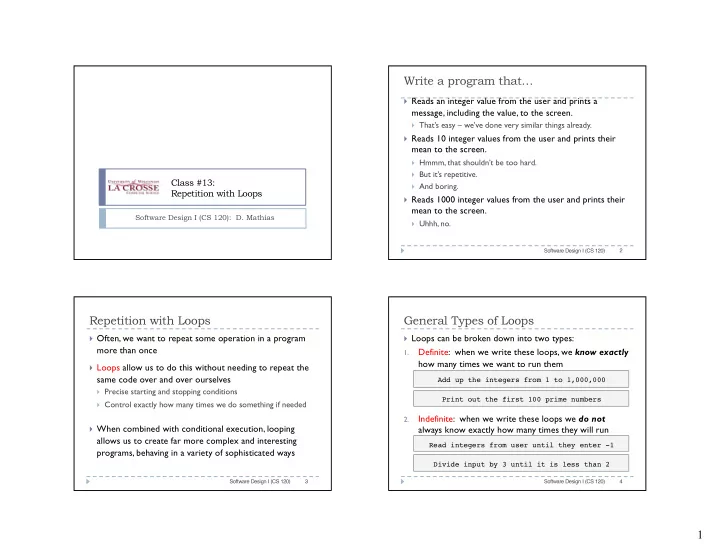
Write a program that } Reads an integer value from the user and prints a message, including the value, to the screen. } Thats easy weve done very similar things already. } Reads 10 integer values from the user and prints their mean to


slide-1
SLIDE 1

1

Class #13: Repetition with Loops

Software Design I (CS 120): D. Mathias

Write a program that…

} Reads an integer value from the user and prints a

message, including the value, to the screen.

} That’s easy – we’ve done very similar things already.

} Reads 10 integer values from the user and prints their

mean to the screen.

} Hmmm, that shouldn’t be too hard. } But it’s repetitive. } And boring.

} Reads 1000 integer values from the user and prints their

mean to the screen.

} Uhhh, no.

Software Design I (CS 120) 2

Repetition with Loops

} Often, we want to repeat some operation in a program

more than once

} Loops allow us to do this without needing to repeat the

same code over and over ourselves

} Precise starting and stopping conditions } Control exactly how many times we do something if needed

} When combined with conditional execution, looping

allows us to create far more complex and interesting programs, behaving in a variety of sophisticated ways

Software Design I (CS 120) 3

General Types of Loops

} Loops can be broken down into two types: 1.

Definite: when we write these loops, we know exactly how many times we want to run them

2.

Indefinite: when we write these loops we do not always know exactly how many times they will run

Software Design I (CS 120) 4

Add up the integers from 1 to 1,000,000 Print out the first 100 prime numbers Read integers from user until they enter -1 Divide input by 3 until it is less than 2

slide-2
SLIDE 2

2 Looping with while

} The while loop can be used for either definite or

indefinite cases (most common kind for indefinite)

} Simple syntax:

Software Design I (CS 120) 5

while ( condition ) { instructions; }

boolean expression (exactly like an if-condition) Code to repeat (as long as condition holds)

} The if conditional has a simple structure: } A while loop has similar structure, but more complex behavior:

if ( condition ) { instructions; } // rest of program

Comparing if and while

Software Design I (CS 120) 6 (a) boolean expression is evaluated (b) if false, skip the instructions and move on to rest of program (c) if true, do the instructions, then move on to rest of program while ( condition ) { instructions; } // rest of program (a) boolean expression is evaluated (b) if false, skip the instructions and move on to rest of program (c) if true, do the instructions, then repeat the process all over again, starting again at step (a)

A Definite Example

} Every loop has four parts:

} Initialization: establish

the state before looping

} Condition: boolean to

control when loop stops

} Main work: code to be

repeatedly executed

} Make progress: code to

move the loop toward termination by eventually changing the condition

Software Design I (CS 120) 7

int sum = 0; int count = 1; while ( count < 6 ) { sum = sum + count; count++; }

A Definite Example

Software Design I (CS 120) 8

int sum = 0; int count = 1; while (count < 6 ) { sum = sum + count; System.out.println( count + ". " + sum ); count++; }

Runs exactly 5 times, every time. (Why?)

slide-3
SLIDE 3

3 An Indefinite Example

} Every loop has four parts: } Initialization: establish

the state before looping

} Condition: boolean to

control when loop stops

} Main work: code to be

repeatedly executed

} Update: code to move

the loop toward termination by eventually changing the condition

Software Design I (CS 120) 9 System.out.print("Enter a value: "); Scanner scan = new Scanner( System.in ); int i = scan.nextInt(); int log = 0; while ( i > 1 ) { log++; i = i / 2; } System.out.println( "log_2 = " + log );

An Indefinite Example

Software Design I (CS 120) 10 System.out.print("Enter a value: "); Scanner scan = new Scanner( System.in ); int i = scan.nextInt(); int log = 0; while ( i > 1 ) { log++; i = i / 2; } System.out.println( "log_2 = " + log );

Will run differently depending upon input given. If input i > 1, runs log2(i) times. If input i <= 1, then never runs at all.

Tracing Loop Operations

Software Design I (CS 120) 11 int sum = 0; int count = 1; while ( count < 6 ) { sum = sum + count; System.out.println( … ); count++; }

Iteration # count < 6? sum count initialize N/A 1 1 true 1 2 2 true 3 3 3 true 6 4 4 true 10 5 5 true 15 6 6 false N/A N/A

Controlling Repetition

} Original loop:

sum == 1+2+3+4+5

} Change it to generate:

} sum == 1+2+3+…+25 } sum == 3+4+5+…+25 } sum == 1+3+5+…+11

Software Design I (CS 120) 12

int sum = 0; int count = 1; while ( count < 6 ) { sum = sum + count; count++; } while ( count < 26 ) int count = 3; ... while ( count < 26 ) while ( count < 12 ) ... count = count + 2

slide-4
SLIDE 4

4 How Many Times will a Loop Run?

Software Design I (CS 120) 13 int sum = 0; int count = 1; while ( count <= 100 ) { sum = sum + count; count = count + 2; } int sum = 0; int count = 99; while ( count != 0 ) { sum = sum + count; count = count - 2; } Runs 50 times: 1, 3, 5, …, 99 Runs Many, Many Times! int sum = 0; int count = 99; while ( count > 0 ) { sum = sum + count; count = count - 2; } Runs 50 times: 99, 97, 95, …, 1 int sum = 0; int count = 0; while ( count > 0 ) { sum = sum + count; count = count - 2; } Never runs at all.

Using Loops

} Sam earns $100 per day with

a daily raise of $100.

} Sue earns $0.01 per day with

a salary that doubles every day.

} How many days pass before

Sue’s total income actually exceeds Sam’s?

Software Design I (CS 120) 14 double sam = 100.0; double sue = 0.01; // day counter int count = 0; // loop until sue earns more while ( sue < sam ) { // count one day at time count++; // increase salaries sam = sam + 100.0; sue = sue * 2; } // print out final results System.out.println( … );

initialize prior- state variables boolean condition work to do progress the loop variables Note: this code sample actually calculates the day

  • n which Sue’s

daily pay exceeds Sam’s. We need to keep track of running total as well (see demo code)