Do Now! 1. On card write grade level you teach (Elementary or - - PowerPoint PPT Presentation

do now
SMART_READER_LITE
LIVE PREVIEW

Do Now! 1. On card write grade level you teach (Elementary or - - PowerPoint PPT Presentation

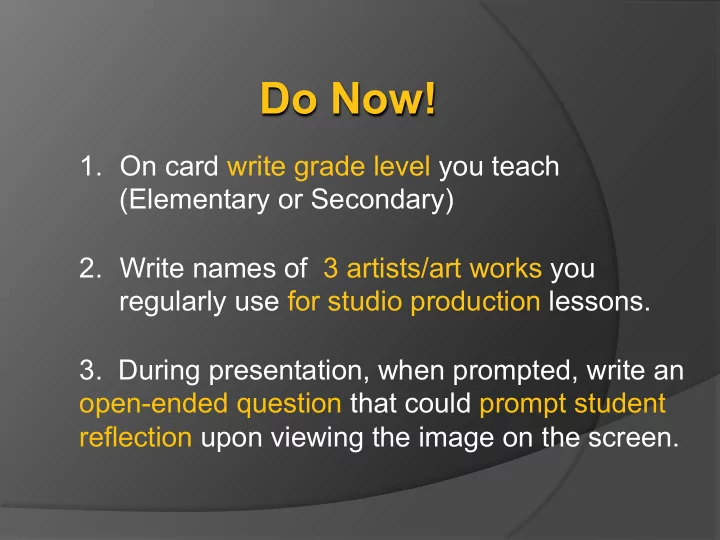
Do Now! 1. On card write grade level you teach (Elementary or Secondary) 2. Write names of 3 artists/art works you regularly use for studio production lessons. 3. During presentation, when prompted, write an open-ended question that could


slide-1
SLIDE 1
  • 1. On card write grade level you teach

(Elementary or Secondary)

  • 2. Write names of 3 artists/art works you

regularly use for studio production lessons.

  • 3. During presentation, when prompted, write an
  • pen-ended question that could prompt student

reflection upon viewing the image on the screen.

Do Now!

slide-2
SLIDE 2

Contemporary Art Engages Students to Think Reflectively, Critically, and Creatively

Barbara Suplee, The University of the Arts

¡

¡ ¡ ¡ ¡ ¡ ¡ ¡ ¡ ¡ ¡

Wild Swans, Su Blackwell (2008)

slide-3
SLIDE 3

It’s all about their stories!

¡

¡ ¡ ¡ ¡ ¡ ¡ ¡ ¡ ¡ ¡

slide-4
SLIDE 4

Small Acts, Isaac Cordal (2010) Magic Garden, Isaiah Zagar (2012) United Buddy Bears, Santiago, Chile (2015) Magic Clemson Clay Nest, Nils-Udo (2005)

slide-5
SLIDE 5
  • Contemporary art is being created NOW
  • Artists are generally living and working
  • Much of today’s contemporary art is

conceptual

  • It can be alienating, controversial…but
  • Not all of it is controversial

Contemporary Art…What is it?

slide-6
SLIDE 6

Carhenge, Jim Reinders (1987) Hand Art, Guido Daniele (2014) Knitting with Loaded Shotguns (Safety Off), Dave Cole (2008)

slide-7
SLIDE 7
  • YES, it promotes dialogue, divergent

thinking, and creativity

  • Many contemporary artists fit seamlessly

into art curricula (even at elementary level!)

  • Some teachers feel uncomfortable including

contemporary art in their curriculum

  • But…you can learn about it and use it

effectively in your classroom

Does it belong in YOUR Classroom?

slide-8
SLIDE 8

Focus of most art rooms

slide-9
SLIDE 9

Mastery Learning

Step-by-step, teacher-directed sketchbook assignment

slide-10
SLIDE 10

The results

Promotes CONVERGENT THINKING, following directions

slide-11
SLIDE 11

Divergent vs. Convergent Thinking

Promotes multiple solutions/ideas vs. a single solution/idea

slide-12
SLIDE 12

We need both!

21st Century Skills (www.p21.org) 2014 National Visual Arts Standards (NVAS)

slide-13
SLIDE 13

How can we promote Divergent thinking?

Self-Directed Learners, Goal Setting, Personal Reflection

slide-14
SLIDE 14

Ask open-ended, thought provoking questions

Questions that lead to Ideas and the construction of meaning

slide-15
SLIDE 15

Use the New (2014) Visual Arts Standards

slide-16
SLIDE 16

15 Big Ideas Identified: “Enduring Understandings”

slide-17
SLIDE 17

Focus on 4 Areas Pre-K-12

Aesthetic, Critical, and Creative Inquiry

slide-18
SLIDE 18

Creating Presenting Responding Connecting

Through concept-based inquiry and investigation of 15 Enduring Understandings (Big Ideas), the new “standards essentially ask students to step back and consider art and its connections to their world– to think about art, culture, and history, in general” (Stewart, 2014).

slide-19
SLIDE 19

CREATING

ENDURING UNDERSTANDING: Creativity and innovative thinking are essential life skills that can be developed. ESSENTIAL QUESTION(S): What conditions, attitudes, and behaviors support creativity and innovative thinking? What factors prevent or encourage people to take creative risks? How does collaboration expand the creative process?

PRESENTING

ENDURING UNDERSTANDING: Artists and other presenters consider various techniques, methods, venues, and criteria when analyzing, selecting, and curating

  • bjects, artifacts, and artworks for preservation and presentation.

ESSENTIAL QUESTION(S): How are artworks cared for and by whom? What criteria, methods, and processes are used to select work for preservation or presentation? Why do people value objects, artifacts, and artworks, and select them for presentation?

slide-20
SLIDE 20

RESPONDING

ENDURING UNDERSTANDING: Individual aesthetic and empathetic awareness developed through engagement with art can lead to understanding of self, others, the natural world, and constructed environments. ESSENTIAL QUESTION(S): How do life experiences influence the way you relate to art? How does learning about art impact how we perceive the world? What can we learn from our responses to art?

CONNECTING

ENDURING UNDERSTANDING: Through art-making, people make meaning by investigating and developing awareness of perceptions, knowledge, and experiences. ESSENTIAL QUESTION(S): How does engaging in creating art enrich people’s lives?

slide-21
SLIDE 21

Use Contemporary Art

Hope Hippo, Allora and Calzadilla (2005) Mud, Whistle, Daily Newspaper, Reader 16’x 6’x 5’

slide-22
SLIDE 22

I Am Become Death, Shatterer of Worlds , Damien Hirst (2006) Butterflies and household gloss on canvas, 7’ x 17.5’

slide-23
SLIDE 23

Wonder Space II, Toshiko Horiuchi MacAdam (2012) Hand crocheted nylon (used as an interactive play space for children)

slide-24
SLIDE 24

Puppy, Jeff Koons (1992) Stainless steel, soil and flowering plants, 40’ 8 3/16” x 27’ 2 3/4” x 29’ 10 1/4”

slide-25
SLIDE 25

Tar Beach, Faith Ringgold (1990)

slide-26
SLIDE 26

Minga, Bastardilla (2014)

slide-27
SLIDE 27

@ Large, Ai Weiwei on Alcatraz (2014) (Lego portraits of 76 “heroes of our time” who have been imprisoned or exiled)

slide-28
SLIDE 28

Plastic Bottles, Chris Jordan (2007) (2 Million discarded plastic bottles, the number used in the U.S. every 5 minutes)

slide-29
SLIDE 29

Anthony of Padua, Kehinde Wiley (2013) Oil on canvas, 72” x 60”

slide-30
SLIDE 30

Maria Lengauer

Philadelphia High School for Creative and Performing Arts (CAPA)

700+ Students (72% Minority Enrollment): Grades 9-12

slide-31
SLIDE 31
slide-32
SLIDE 32
slide-33
SLIDE 33

Strike Upon Mankind

slide-34
SLIDE 34
slide-35
SLIDE 35

Sisla (Child in Punjabi)

slide-36
SLIDE 36
slide-37
SLIDE 37

Primary Distribution

slide-38
SLIDE 38
slide-39
SLIDE 39

* Concept-based Inquiry* Student-centered Instruction Independent Problem-solving Self-directed Learning Journaling * List-making Free Association * Collaboration Self-reflection Self-assessment *Contemporary Art*

In Conclusion…to promote

divergent thinking, students’ deeper understanding of art, themselves,

  • thers, and their world, use:
slide-40
SLIDE 40

Thank You!

  • Questions?
  • Comments?