Workshop on anatomical models My Corporis Fabrica: Ontology for - - PowerPoint PPT Presentation

workshop on anatomical models
SMART_READER_LITE
LIVE PREVIEW

Workshop on anatomical models My Corporis Fabrica: Ontology for - - PowerPoint PPT Presentation

Workshop on anatomical models My Corporis Fabrica: Ontology for anatomical modeling Olivier Palombi (MD,PhD) Guillaume Bousquet Sahar Hassan David Jospin Benjamin Gilles Lionel Revret Franck Hetroy Franois Faure EVASION, INRIA, LJK


slide-1
SLIDE 1

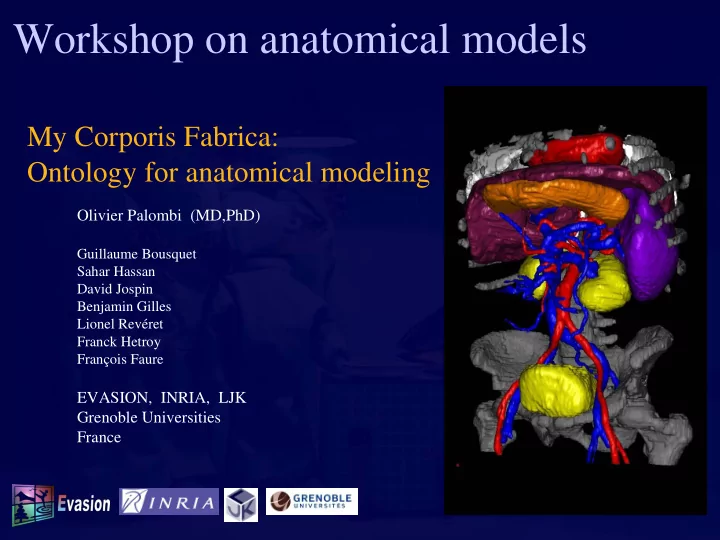
Workshop on anatomical models

My Corporis Fabrica: Ontology for anatomical modeling

Olivier Palombi (MD,PhD)

Guillaume Bousquet Sahar Hassan David Jospin Benjamin Gilles Lionel Revéret Franck Hetroy François Faure

EVASION, INRIA, LJK Grenoble Universities France

slide-2
SLIDE 2
slide-3
SLIDE 3

History of Anatomy Andreae Vesalii (1543) :

” De humani corporis fabrica libri septem ”

slide-4
SLIDE 4

Terminologia Anatomica (TA)

  • 1903: Internationnal Federation of Association of

Anatomists (IFAA) is created

  • 1961: ‘Nomina Anatomica’ (NA)
  • 1980: Federative Committee on Anatomical

Terminology (FCAT) is created

  • 1989: ‘Terminologia Anatomica’ (TA)
slide-5
SLIDE 5

ONTOLOGY

Definition: Is a "formal, explicit specification of a shared conceptualization". An ontology provides a computable representation of the underlying reality.

slide-6
SLIDE 6

ONTOLOGY COMPONENTS

Instances: The general purposes of an ontology is to provide a means of classifying

  • individuals. , even if those individuals are not explicitly part of the ontology.

Classes: Abstract objects. Attributes: Properties. Relations: ways in which classes can be related to one another. “The patella is a part of the knee and is a bone organ.”

slide-7
SLIDE 7

ONTOLOGY RELATIONS

The set of relations describes the semantics of the domain. “The patella is a part of the knee and is a bone organ.” The subsumption relation (is-a): This defines which objects are classified by which class. The meronymy relation ( part_of): Represents how objects combine together to form composite objects.

slide-8
SLIDE 8

A FORMAL ONTOLOGY

Definition: A Formal ontology is an ontology with a structure that is guided and defined through axioms. = Foundational Ontologies

  • indefinite expandability.
  • content and context independence.
  • accommodate different levels of granularity.

Basic formal Ontology (BFO) ( http://www.ifomis.org/bfo ). In biomedicine within the framework of the OBO Foundry

slide-9
SLIDE 9

The Open Biomedical Ontologies (OBO) ( http://www.obofoundry.org )

Purpose: ”Creating a suite of orthogonal interoperable reference

  • ntologies in the biomedical domain.”

Anatomy in OBO:

  • The Foundational Model of Anatomy ontology (FMA)
  • The Common Anatomy Reference Ontology (CARO)
slide-10
SLIDE 10

The Foundational Model of Anatomy ontology (FMA) ( http://sig.biostr.washington.edu/projects/fm )

FMA contains 75 000 classes and over 120 000 terms; over 2.1 million relationship instances from over 168 relationship types.

  • Unified context principle
  • Abstraction level principle
  • Species specificity principle
  • Definition principle
  • Organizational unit principle
  • Relationship contraint principle
  • Coherence principle
  • Representation principle
slide-11
SLIDE 11

The Foundational Model of Anatomy ontology (FMA) ( http://sig.biostr.washington.edu/projects/fm )

  • Protégé is an authoring and editing

environment for ontologies.

  • Querying Agent for the Foundational Model of Anatomy (OQAFMA): is a database

querying tool that provides access to FMA. Takes StruQL queries as input and returns XML- formatted results.

( http://sig.biostr.washington.edu/projects/oqafma/ )

slide-12
SLIDE 12

www.mycorporisfabrica.org

Anatomical ontology for mechanical modeling.

  • Based on FMA
  • Extensions:
  • mechanical parameters
  • geometric informations
  • functions and process
  • A new relational database
  • A specifc GUI
slide-13
SLIDE 13

MySQL implementation in MyCF

slide-14
SLIDE 14
slide-15
SLIDE 15

www.mycorporisfabrica.org