Anatomical Vocabulary with Dr. Ben Benjamin 1 Anatomical - - PDF document

anatomical vocabulary
SMART_READER_LITE
LIVE PREVIEW

Anatomical Vocabulary with Dr. Ben Benjamin 1 Anatomical - - PDF document

6/29/2020 presents Anatomical Vocabulary with Dr. Ben Benjamin 1 Anatomical Position 2 1 6/29/2020 The thumb is the most _________ finger? Posterior Anterior Lateral Medial 3 Lateral Anatomical Position Medial 4 2 6/29/2020


slide-1
SLIDE 1

6/29/2020 1

with Dr. Ben Benjamin

presents

Anatomical Vocabulary

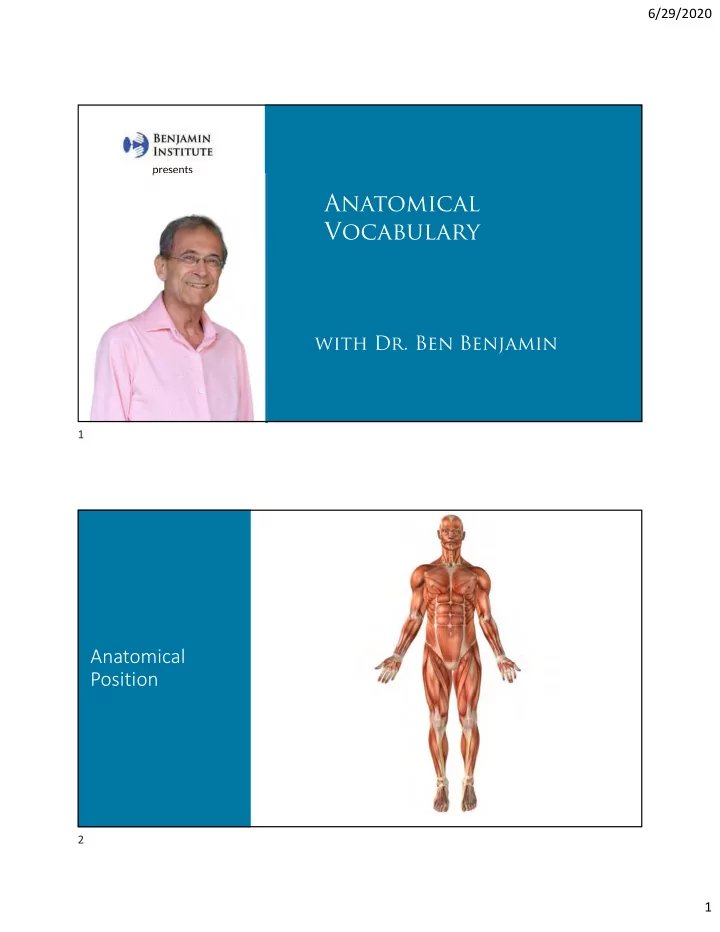
Anatomical Position

1 2
slide-2
SLIDE 2

6/29/2020 2

The thumb is the most _________ finger? Posterior Anterior Lateral Medial

Anatomical Position Medial Lateral

3 4

slide-3
SLIDE 3

6/29/2020 3

Anatomical Position

Medial Epicondyle Lateral Epicondyle

6

5 6

slide-4
SLIDE 4

6/29/2020 4

7 8

ANTERIOR POSTERIOR

7 8

slide-5
SLIDE 5

6/29/2020 5

9

Anterior Hip

10

SUPINE PRONE

9 10

slide-6
SLIDE 6

6/29/2020 6

11

SUPINATION PRONATION

12

11 12

slide-7
SLIDE 7

6/29/2020 7

13

PRONATED NEUTRAL SUPINATED

14

SUPINATION

13 14

slide-8
SLIDE 8

6/29/2020 8

15

DORSAL PLANTAR

16

DORSIFLEXION PLANTARFLEXION

15 16

slide-9
SLIDE 9

6/29/2020 9

Are you dorsiflexing or plantar flexing your foot? Plantarflexing

17 18

slide-10
SLIDE 10

6/29/2020 10

19

DISTAL PROXIMAL

20

Move the medial edge of your thumb pad on the medial anterior aspect of the distal tibia until you reach the tibialis anterior tendon, right at the joint line. Make sure the central portion of your thumb pad is touching the anterior medial malleolus.

19 20

slide-11
SLIDE 11

6/29/2020 11

21

DEEP TO

22

SUPERFICIAL TO

21 22

slide-12
SLIDE 12

6/29/2020 12

23

FLEXION EXTENSION FLEXION

  • f the shoulder

EXTENSION

  • f the shoulder

23 24

slide-13
SLIDE 13

6/29/2020 13

25

MEDIAL ROTATION LATERAL ROTATION

26

Medial Rotation Lateral Rotation

25 26

slide-14
SLIDE 14

6/29/2020 14

27

MEDIAL ROTATION

  • f the Shoulder

LATERAL ROTATION

  • f the Shoulder

28

EVERT INVERT

27 28

slide-15
SLIDE 15

6/29/2020 15

Supraspinatus Tendon

30

Superficial Distal End Deep Distal End

Supraspinatus Tendon

29 30

slide-16
SLIDE 16

6/29/2020 16

31

The head is ______ to the shoulder joint.

32

The head is superior to the shoulder joint.

31 32

slide-17
SLIDE 17

6/29/2020 17

33

The patella is ________ to the tibia.

34

The patella is superior to the tibia.

33 34

slide-18
SLIDE 18

6/29/2020 18

35

The elbow is ______ to the hand.

36

The elbow is superior to the hand.

35 36

slide-19
SLIDE 19

6/29/2020 19

37

The nose is on the ______ part of the head.

38

The nose is on the anterior part of the head.

37 38

slide-20
SLIDE 20

6/29/2020 20

39

The pinky is more ______ than the thumb.

40

The pinky is more medial than the thumb.

39 40

slide-21
SLIDE 21

6/29/2020 21

41

The L5 vertebra is ______ to the L4 vertebra.

42

The L5 vertebra is inferior to the L4 vertebra.

41 42

slide-22
SLIDE 22

6/29/2020 22

43

The soleus is ______ to the gastrocnemius.

Gastrocnemius Soleus

44

The soleus is deep to the gastrocnemius.

Gastrocnemius Soleus

43 44

slide-23
SLIDE 23

6/29/2020 23

45

The ear is both ________ and ________ to the nose.

46

The ear is both lateral and posterior to the nose.

45 46

slide-24
SLIDE 24

6/29/2020 24

47

The subscapularis muscle lies on the _______ surface of the scapula.

Subscapularis muscle

48

The subscapularis muscle lies on the anterior surface of the scapula.

Subscapularis muscle

47 48

slide-25
SLIDE 25

6/29/2020 25

49

The triceps tendon at the elbow is _______ to the triceps muscle.

Triceps tendon

50

The triceps tendon at the elbow is distal to the triceps muscle.

Triceps tendon

49 50

slide-26
SLIDE 26

6/29/2020 26

51

The infraspinatus tendon is ________ to the teres minor tendon.

52

The infraspinatus tendon is superior to the teres minor tendon.

51 52

slide-27
SLIDE 27

6/29/2020 27

53

The gluteus maximus is _________ to the gluteus minimus.

54

The gluteus maximus is superficial to the gluteus minimus.

53 54

slide-28
SLIDE 28

6/29/2020 28

55

The infraspinatus muscle is located on the ________, ________ aspect of the scapula bone.

56

The infraspinatus muscle is located on the posterior, inferior aspect of the scapula bone.

55 56

slide-29
SLIDE 29

6/29/2020 29

57

The Achilles tendon is attached _____ly to the _______ part of the calcaneus.

Achilles tendon

58

The Achilles tendon is attached distally to the posterior part of the calcaneus.

Achilles tendon

57 58

slide-30
SLIDE 30

6/29/2020 30

59

The lateral collateral ligament at the knee is at the ______, ______ aspect

  • f the thigh.

Lateral Collateral ligament

60

The lateral collateral ligament at the knee is at the lateral, inferior aspect

  • f the thigh.

Lateral Collateral ligament

59 60

slide-31
SLIDE 31

6/29/2020 31

61

When you step forward with the right leg in running or walking, the left hip is in _______.

62

When you step forward with the right leg in running or walking, the left hip is in extension.

61 62

slide-32
SLIDE 32

6/29/2020 32

63

If you are loosening a screw with your right hand, your forearm is ________.

64

If you are loosening a screw with your right hand, your forearm is pronating.

63 64

slide-33
SLIDE 33

6/29/2020 33

65

When you bring your toes towards your nose you are _______ing the foot.

66

When you bring your toes towards your nose you are dorsiflexing the foot.

65 66

slide-34
SLIDE 34

6/29/2020 34

67

When you rise up on to the balls of the feet while standing, you are _________ing the ankle.

68

When you rise up on to the balls of the feet while standing, you are plantar flexing the ankle.

67 68

slide-35
SLIDE 35

6/29/2020 35

69

When you place the right lateral malleolus on the left lower anterior thigh just proximal to the knee while sitting, you are bringing your right hip joint into ______ ______.

70

When you place the right lateral malleolus on the left lower anterior thigh just proximal to the knee while sitting, you are bringing your right hip joint into lateral rotation.

69 70

slide-36
SLIDE 36

6/29/2020 36

71

When a traffic cop says stop with their hand out in front of them, the wrist is in ________.

72

When a traffic cop says stop with their hand out in front of them, the wrist is in extension.

71 72

slide-37
SLIDE 37

6/29/2020 37

73

When you bring your knee to your chest you are ______ing the hip joint.

74

When you bring your knee to your chest you are flexing the hip joint.

73 74

slide-38
SLIDE 38

6/29/2020 38

75 76

True or False An acute injury refers to the severity

  • f the injury.

75 76

slide-39
SLIDE 39

6/29/2020 39

77

False An acute injury refers to the initial phase

  • f an injury.

78

True or False A chronic injury means that the injury is mild and not so severe.

77 78

slide-40
SLIDE 40

6/29/2020 40

79

False A chronic injury can be severely painful. The word chronic refers to the amount A chronic injury can be severely painful. The word chronic refers to the amount

  • f time the injury has been present not

the amount of pain the person is experiencing. A chronic injury is an injury that lasts beyond the acute phase. It may come and go or cause constant pain that may be mild or severe.

80

Yes or No Is a sprain less severe than a strain?

79 80

slide-41
SLIDE 41

6/29/2020 41

81

No A sprain and a strain can be equally severe. A sprain and a strain can be equally severe.

82

Yes or No Does a sprain differ from a strain?

81 82

slide-42
SLIDE 42

6/29/2020 42

83

Yes A sprain usually refers to ligaments and joints and a strain generally refers to tendons A sprain usually refers to ligaments and joints and a strain generally refers to tendons and muscles.

84

True or False Injured tendons and ligaments are often painless during strenuous activity after the person is fully warmed up.

83 84

slide-43
SLIDE 43

6/29/2020 43

85

True Injured tendons and ligaments are

  • ften painless

during strenuous activity after the person is fully warmed up.

Tendons and ligaments tend to be less painful when they are warmed up. When a person is warmed up and physically active, the movement stimulates the mechano-receptors which suppresses the experience of pain. By suppressing the pain signals your body doesn’t realize it’s being damaged further. The mechano-receptors also stimulate endorphin

  • production. Endorphins are natures morphine.

Endorphins suppress pain as well as giving the person a sense of well-being. Your body is sending you a message that this is damaging you but you don’t hear it.

In Conclusion

85 86

slide-44
SLIDE 44

6/29/2020 44

87