Woodhaven / Cross Bay Boulevard (Q52/53) Public Design Workshop | - - PowerPoint PPT Presentation

woodhaven cross bay boulevard q52 53
SMART_READER_LITE
LIVE PREVIEW

Woodhaven / Cross Bay Boulevard (Q52/53) Public Design Workshop | - - PowerPoint PPT Presentation

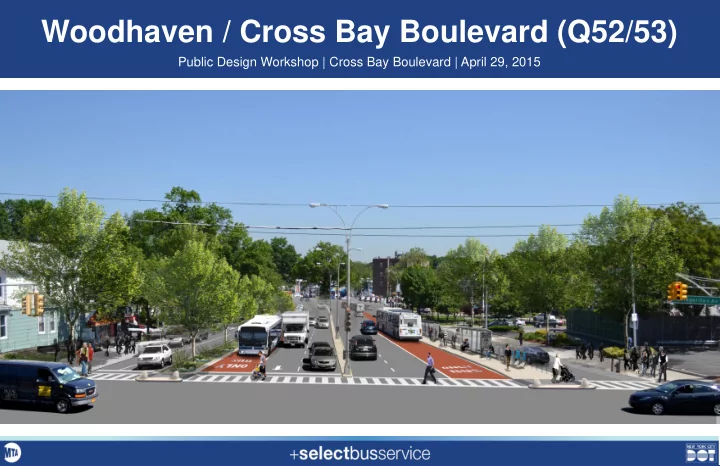
Woodhaven / Cross Bay Boulevard (Q52/53) Public Design Workshop | Cross Bay Boulevard | April 29, 2015 April 23, 2014 | JHS 210 Elizabeth Blackwell| 6:00 - 8:30 PM Meeting agenda Introductions Table presentation 1.Project background

slide-1
SLIDE 1

April 23, 2014 | JHS 210 Elizabeth Blackwell| 6:00 - 8:30 PM

Woodhaven / Cross Bay Boulevard (Q52/53)

Public Design Workshop | Cross Bay Boulevard | April 29, 2015

slide-2
SLIDE 2

Meeting agenda

Introductions Table presentation 1.Project background 2.Proposed SBS Route and Stations 3.Proposed Corridor Design 4.Focus Area Discussion Block-by-block street design review

2

slide-3
SLIDE 3

Woodhaven / Cross Bay SBS corridor

  • Based on the Q52/53 LTD bus route
  • 14 miles from Woodside to the

Rockaways

  • 30,000+ daily bus riders
  • Within a 15-min walk of the corridor:

− 400,000 residents − 43% of households do not own a car − 60% of residents commute by transit

  • Vision Zero Priority Corridor

Since 2009 on Woodhaven & Cross Bay Blvds: − Over 3,000 people were injured in a collision − 22 fatalities (17 of which were pedestrians)

Focus Area for tonight’s workshop

165 Av Rockaway Blvd / Liberty Av 3

slide-4
SLIDE 4

Community outreach process

2014 Meetings

  • CAC #1 – February 12
  • Queens Metropolitan HS – March 11
  • Public Workshop #1 – April 23
  • CB10 Presentation – June 5
  • Public Workshop #2 – June 25
  • Rockaways Public Workshop – Sept. 18
  • CAC #2 – October 22
  • Public Workshop #3 – Nov 5

2015 Meetings to date

  • CAC #3 – March 26
  • Public Design Workshops
  • April 16 – Woodhaven Blvd (South)
  • April 23 – Woodhaven Blvd (North)
  • April 29 – Cross Bay Blvd
  • April 30 – Broad Channel / Rockaways

Community Advisory Committee (CAC) Public Open Houses and Workshops Stakeholder Meetings Community Board Meetings

4

slide-5
SLIDE 5

Community feedback

  • 1. Bus service is unreliable and slow

during rush hour

  • 2. Transit improvements are needed to

better serve customers, especially in the Rockaways

  • 3. Pedestrian crossings are long and

dangerous

  • 4. Congestion leads to long and difficult

trips for buses and drivers

  • 5. Changing road widths and

configurations make the corridor difficult to navigate

5

slide-6
SLIDE 6

Project goal

Transform Woodhaven and Cross Bay Boulevards into a complete street where:

  • Buses operate quickly and reliably
  • Bus customers safely and easily

access bus stations

  • Pedestrians are comfortable

walking on and crossing the street

  • Drivers get where they need to go

at a reasonable and safe speed

6

slide-7
SLIDE 7

Project timeline

7

slide-8
SLIDE 8

Q52/Q53 SBS

Changes from Q52/Q53 LTD route:

  • The SBS will use the viaduct over Atlantic Av

(local bus will use service roads to access Atlantic Av)

  • Q52 extension is under consideration

Changes from Q52/Q53 LTD stops:

  • SBS stops at 91 Av instead of Atlantic Av

(local bus will still stop at Atlantic Av)

  • New stop at 101 Av
  • New stop at Pitkin Av
  • Broad Channel and Rockaway stops to be

discussed at upcoming workshop

8

slide-9
SLIDE 9

Focus Area - Bus Stops

9

slide-10
SLIDE 10

Fare collection

Q52/53 SBS

  • Off-board fare collection
  • Fare machines at every SBS stop
  • Pay with a Metrocard or with coins

(just like any NYC bus)

  • Customers can board at any door

Local / Express Buses

  • Pay on the bus (same as today)
  • Will have separate bus stop poles

from the Q52/53 SBS

10

slide-11
SLIDE 11

Design concept screening process

11

COMMUNITY INPUT

The concepts were presented at CAC Meeting #2 on October 22, 2014 and a Public Workshop on November 5, 2014

DEVELOP 3 DESIGN IDEAS TECHNICAL ANALYSIS

Transit Operations Safety & Pedestrian Amenities Traffic Mobility & Accessibility

CHOOSE A PREFERRED CORRIDOR DESIGN

Concept 1: Offset Bus Lanes Concept 2: Main Road Bus Lanes Concept 3: Median Bus Lanes

  • Substantial transit

improvement

  • Most potential for pedestrian

and safety improvements

  • Balances local vehicle access

and thru vehicle traffic

Concept 2 Main Road Bus Lanes

slide-12
SLIDE 12

Summary of chosen concept

12

1. Main road bus lanes improve bus speed and reliability; no conflicts with turning vehicles or parking 2. High-quality median bus stations for all buses (SBS, Local, and Express) 3. Medians shorten pedestrian crossing distances, provide refuges, and add greenery to the corridor 4. Calm service roads for parking, deliveries, and local access trips 5. Main roadway for thru vehicle trips 6. Consistent roadway design for the entire corridor improves navigability

4 2 3 1 5 6 1 2 3 4 5 6

slide-13
SLIDE 13

Corridor design summary

Roosevelt Av / Broadway Av

– No bus lanes – Improved curbside bus stops

Queens Blvd and Hoffman Dr

– Designated bus-only station areas – Improved bus stops / transfers

Woodhaven Blvd

– Main road bus lanes – All buses use median stations

Cross Bay Blvd (north of 165 Av)

– Offset bus lanes – SBS buses stop at bus bulbs – Local buses stop at the curb

Broad Channel / Rockaways

– No bus lanes / targeted transit priority treatments – Improved curbside bus stops

13

13

slide-14
SLIDE 14

Woodhaven Boulevard

  • All buses use main road bus lanes and median stations
  • Left-turn bays at selected locations
  • Slip lanes at select locations allow vehicles to move

between the service road and the main road

14 Existing Proposed

Typical 120’ right-of-way with station

Existing Proposed

Typical 120’ right-of-way

Example intersection: Woodhaven & 63rd Rd Example intersection: Woodhaven & Metropolitan Av

slide-15
SLIDE 15

Typical median station

15

2nd mid-block station access point (where feasible)

station access from intersection crosswalk

Local / Express Boarding Area

Maneuvering space

SBS Boarding area

fencing / screen

Avinguda Diagonal, Barcelona, Spain Pelham Parkway, Bronx White Plains Road, Bronx

slide-16
SLIDE 16

Cross Bay Boulevard

  • All buses use offset bus lanes
  • SBS buses stop at the bus bulbs;

Local / express buses stop at the curb

  • Maintains parking / deliveries at the curb

16 Existing Proposed Existing Proposed

Option 1

2 travel lanes each direction / left-turn bays

Option 2

3 travel lanes each direction / shared left-turn lanes

Based on feedback from the Community Advisory Committee, Option 2 is currently shown in the design plans; however, Option 1 will also be analyzed in terms of safety and traffic

slide-17
SLIDE 17

Typical bus bulb station

17

34th Street, Manhattan 1st Avenue, Manhattan Nostrand Avenue, Brooklyn

Local / Express buses stop at the curb

Maneuvering space

SBS buses stop at the bus bulb

The sidewalk is extended to meet the bus lane SBS buses can pass Local and Express buses

slide-18
SLIDE 18

Potential station amenities

18 real-time information shelters / fencing / windscreens

San Bernardino , CA – Bus rapid transit station (source: Architectural Record) Philadelphia, PA – 33rd & Dauphin Bus Loop (source: SEPTA)

public art benches and seating trees and greening

slide-19
SLIDE 19

Design details

19

Bus lanes

  • Over 6 miles of bus lanes
  • Opportunity to explore unique

treatments along Woodhaven Boulevard including:

– Physical separation

  • Hard barriers
  • Soft barriers (e.g. rumble strips)

– Bus lane materials

Brussels, Belgium (source: Flickr Greg Raisman) Eugene, Oregon (source: the Transport Politic)

Traffic analysis

Traffic analysis for the proposed design is underway; it will help inform:

  • Transit operations
  • Signal timing

– Longer pedestrian crossing times – More green time for Woodhaven / Cross Bay

  • Need for left / right turning bays

Screenshot of Woodhaven Blvd & Metropolitan Av

slide-20
SLIDE 20

Focus Area – Discussion

For discussion at table:

  • 1. Proposed bus stops
  • 2. Left-turns near Rockaway Blvd / Liberty Ave
  • 3. Options for Van Wicklen Road

After discussing the locations above, the facilitator will guide you to the block-by-block

street designs in the back of the room

20