
SLIDE 1
April 23, 2014 | JHS 210 Elizabeth Blackwell| 6:00 - 8:30 PM
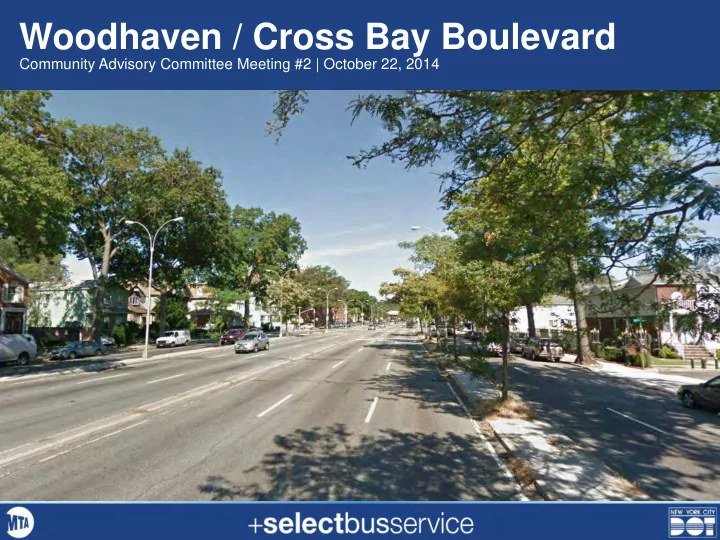
Woodhaven / Cross Bay Boulevard
Community Advisory Committee Meeting #2 | October 22, 2014
Woodhaven / Cross Bay Boulevard Community Advisory Committee Meeting - - PowerPoint PPT Presentation
Woodhaven / Cross Bay Boulevard Community Advisory Committee Meeting #2 | October 22, 2014 April 23, 2014 | JHS 210 Elizabeth Blackwell| 6:00 - 8:30 PM Agenda Introductions Presentation 1. Project background 2. Woodhaven / Cross Bay
April 23, 2014 | JHS 210 Elizabeth Blackwell| 6:00 - 8:30 PM
Community Advisory Committee Meeting #2 | October 22, 2014
Introductions Presentation
Group Discussion
2
comments and issues before the concepts are shown at the Public Open House in November
3
4
Congested Corridor Study
Woodhaven Blvd 2011-2013
Service and capital project Bus Rapid Transit (BRT) Phase II Plan
transit corridor at Public Meeting
(SBS) Corridor
5
Select Bus Service (SBS) is New York City’s brand name for a package
in faster and more reliable service on high-ridership bus routes. There are seven SBS routes currently
6
Improved fare collection Transit signal priority Passenger Information Stations & Amenities Bus lanes Branding
7
Faster Bus Service
Speeds have increased by 15-23%
Increased Ridership
Trips increased by 10%
Popular
Customer satisfaction of 95%+
Safer Roadways
Crashes reduced by over 20%
Proven Success
7 SBS routes in operation, carrying
8
9
Q52/53 LTD bus route
to the Rockaways
the corridor:
– 400,000 residents – 43% of households do not own a car – 60% of residents commute by transit
10
Community Advisory Committee Public Open Houses and Workshops Stakeholder Meetings Community Board Meetings
11
CAC #1 – February 12 Queens Metropolitan High School Meeting – March 11 Public Workshop #1 – April 23 CB10 Presentation – June 5 Public Workshop #2 – June 25 Rockaways Public Workshop – September 18 CAC #2 – October 22 Public Workshop #3 – will be held
designs
12
1. Bus service is unreliable and slow during rush hour 2. Improvements to the bus route are needed to better serve customers, especially in the Rockaways 3. Pedestrian crossings are long and dangerous 4. Congestion leads to long and difficult trips for buses and drivers 5. Changing road widths and configurations make the corridor difficult to navigate
13
14
The Project Team collected and analyzed a large amount data in order to:
Types of data collected:
15
almost half of the time
by up to 30 minutes (varies between 55 and 85 minutes)
midday and PM peaks
All Q53 Northbound Trips
In Motion 57% Red Lights 25% Bus Stops 18%
16
Q52/Q53 customers ride the bus route almost end- to-end
very important
used for local trips within the Rockaways
In Motion 57% Red Lights 25% Bus Stops 18%
Destinations
trips that start in the Rockaways
13% 13%
23%
19%
16% Stops along Broadway 7
Queens Center Mall MR Jamaica J Liberty / Rockaway A Within the Rockaways 16% other locations (not shown) 17
subway riders
– #1 intersection for pedestrian / bicycle crashes (32) – #2 intersection for crash-related injuries (170)
18
configurations
19
20
Long pedestrian crossing distance with no refuge 130’ All lanes are mixed traffic; lack
Wide roadway encourages speeding Bus stops lack amenities Left turns create congestion and safety issues
21
Wide roadway 160’ 4+ Lanes of traffic; changing road widths Wide service roads Complex roadway design, difficult to transition between local and main roads
22
Bus Service
enhancements (routes / stops)
amenities, including real-time bus arrival information
service
23
Street Design
each direction
where needed for traffic flow and safety
timings
enhancements
24
25
Offset bus lanes (one lane away from the curb) Local Bus Stop Median pedestrian refuge SBS Bus Bulb Station
26
Parking
Offset bus lanes in service road Local Bus Stops at curb Existing roadway configuration
27
Parking
Left-turn bay Offset bus lanes SBS Bus Bulb Stations Median pedestrian refuge Pedestrian Neckdowns Local Bus Stop Three travel lanes
28
Parking
Nostrand Avenue, Brooklyn First Avenue, Manhattan Webster Avenue, Bronx 29
Bus Service
bus bulbs
and turning vehicles Street Design / Safety
roadway geometry
medians at station locations Traffic
30
31
Curbside bus lanes in the mainline roadway Calmed service roads with parking SBS stations and Local bus stops on side median Shortened crossing distance with pedesrian refuges Separates local and thru traffic
32
Curbside bus lanes in the mainline roadway Calmed service roads with parking Separates thru and local traffic
33
Left-turn bays at non-station locations
Left-turn bay Right- turn lane SBS Stations and Local bus stops on expanded median Curbside bus lanes and thru traffic lanes in the main roadway Slip
Calmed service roads for local access and parking
34
Kings Hwy, Brooklyn Taipei, Taiwan K Street, Washington DC 35
Bus Service
median stations
vehicles or parking Street Design / Safety
traffic calming and shorten pedestrian crossings
Traffic
road and 2 lanes in main road)
36
37
Median Bus Station for SBS and Local buses Three lanes of traffic with parking Pedestrian refuge Median Busway with passing lane
38
Rush hour parking restrictions
Three lanes
parking Median Busway Planted center median at non- station locations
39
Requires left-turn only signal Rush hour parking restrictions SBS Stations and Local bus stops at median station Pedestrian neckdowns Three travel lanes and parking
40
Curitiba, Brazil Mexico City, Mexico Euclid Avenue, Cleveland, OH 41
Bus Service
Street Design / Safety
pedestrian refuge Traffic
Cross Bay Blvd /station locations
cross busway
42
43
Today: Discuss draft Design Concepts and gather initial feedback to refine concepts November 2014: Present draft Design Concepts at public open house and get community feedback Late 2014: Selection of Preferred Design 2015: Develop details for Preferred Design with community input; plan capital project
44
April 23, 2014 | JHS 210 Elizabeth Blackwell| 6:00 - 8:30 PM