Who are the Photographers? Thomas Babb (freelance) Jeff Harkey - - PDF document

who are the photographers
SMART_READER_LITE
LIVE PREVIEW

Who are the Photographers? Thomas Babb (freelance) Jeff Harkey - - PDF document

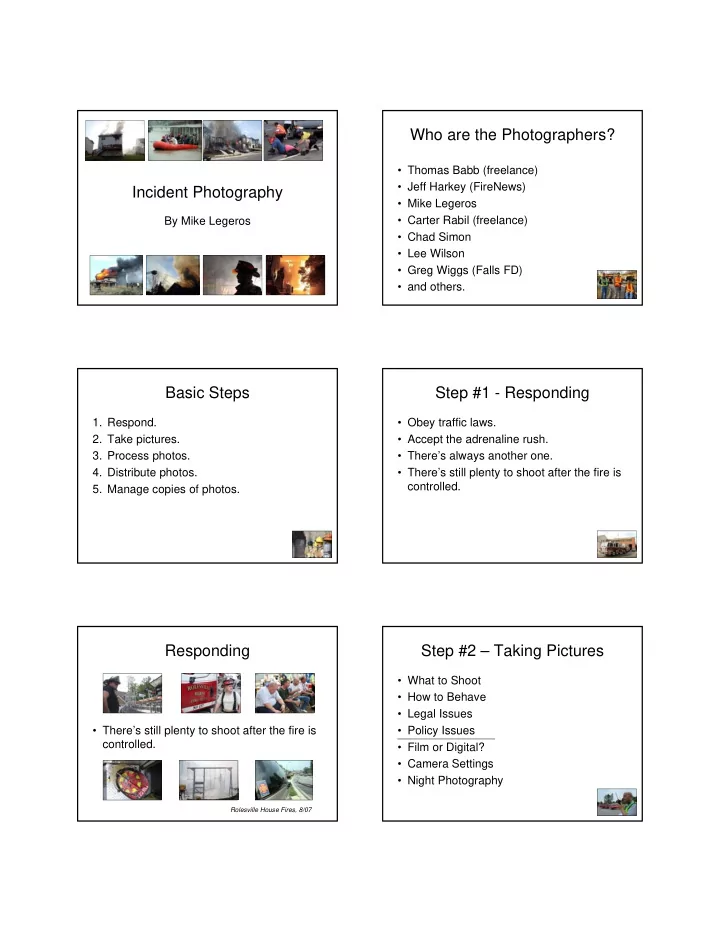
Who are the Photographers? Thomas Babb (freelance) Jeff Harkey (FireNews) Incident Photography Mike Legeros By Mike Legeros Carter Rabil (freelance) Chad Simon Lee Wilson Greg Wiggs (Falls FD) and others.


slide-1
SLIDE 1

Incident Photography

By Mike Legeros

Who are the Photographers?

  • Thomas Babb (freelance)
  • Jeff Harkey (FireNews)
  • Mike Legeros
  • Carter Rabil (freelance)
  • Chad Simon
  • Lee Wilson
  • Greg Wiggs (Falls FD)
  • and others.

Basic Steps

  • 1. Respond.
  • 2. Take pictures.
  • 3. Process photos.
  • 4. Distribute photos.
  • 5. Manage copies of photos.

Step #1 - Responding

  • Obey traffic laws.
  • Accept the adrenaline rush.
  • There’s always another one.
  • There’s still plenty to shoot after the fire is

controlled.

Responding

  • There’s still plenty to shoot after the fire is

controlled.

Rolesville House Fires, 8/07

Step #2 – Taking Pictures

  • What to Shoot
  • How to Behave
  • Legal Issues
  • Policy Issues
  • Film or Digital?
  • Camera Settings
  • Night Photography
slide-2
SLIDE 2

Priorities on Scene

  • 1. Stay safe.
  • 2. Perform your duties (if a responder).
  • 3. Do not hinder responders.
  • 4. Take pictures.

What to Shoot

  • Action.
  • People performing the actions.
  • Close ups of people, including responders

and spectators.

  • Scene from all sides, and different angles.

What Not to Shoot

  • Anything that induces negative reactions

from responders, spectators, or victims.

  • Such as:

– Standing over a victim and taking a picture. – Placing camera in the face of an exhausted, recuperating responder.

Your Behavior

  • The reaction of responders and authorities

to photographers at incidents varies based

  • n:

– Branding of photographer – Demeanor of photographer – Proximity to incident – Time on scene / number of pictures taken.

Legal Issues

  • Disclaimer: Presenter is not a lawyer, nor

plays one on television.

  • Public photography is not a crime.
  • Trespassing to take photographs is a

crime.

  • Using photographs can be a crime.

Policy Issues

Check your agency’s guidelines regarding:

  • Taking photos while on duty.
  • Distributing photos taken while on duty.
  • Using photos taken while on duty.
slide-3
SLIDE 3

Film or Digital?

  • Presenter shoots exclusively digital.
  • Faster, cheaper.
  • For his purposes, same quality.
  • Formerly used point-and-shoot digital

(Fuji).

  • Presently uses digital SLR (Canon).
  • Has UV filters on all lens.

Camera Settings

  • Picture quality
  • Picture mode
  • Aperture
  • Exposure
  • ISO speed
  • White balance
  • Focus mode
  • Metering mode

Camera Settings

  • Picture quality

Higher Quality Lower Quality Size of Picture Files Larger Smaller Number of Pictures Stored in Camera

  • r Memory Card

Less More Ease of Sending Files as E-Mail or Posting on Web Pages Harder Easier Quality of Printed Enlargements Better Worse

Camera Settings

  • Picture quality
  • Picture mode
  • Aperture
  • Exposure
  • ISO speed
  • White balance
  • Focus mode
  • Metering mode

Camera Settings

  • Picture mode
  • ISO speed

Camera Settings

  • Picture mode

Try Program Shift (P) instead of Auto

  • ISO speed

Increase for low light and night photography

slide-4
SLIDE 4

Using Your Flash

  • Flash during daylight will help brighten

shadows.

  • Flash during daylight may reflect on

reflective surfaces.

  • Flash at night will reflect on reflect surfaces.
  • Flash at night may illuminate smoke.
  • Flash at night will help freeze action.

Flash / No Flash

Wake Forest Live Burn, 08/06 Program Shift Mode – ISO Speed 100 (!)

Night Photography

  • Use higher or highest possible ISO setting.
  • Hold camera as steady as possible, against

face, or with tripod, or on surface and even with timer or remote release.

  • Use flash carefully, as it will expose reflect

surfaces, may also illuminate smoke.

  • Focus/meter on darker areas, so camera lets in

more light.

Metering

Problem: Camera captures fire and little else.

Metering

Problem: Camera captures fire and little else. Cause: Camera aimed at bright spot, and adjust to be less sensitive to light.

Metering

Problem: Camera captures fire and little else. Cause: Camera aimed at bright spot, and adjust to be less sensitive to light. Solution: Camera aimed at darker spot, and adjust to be more sensitive to light.

slide-5
SLIDE 5

Metering Metering

Raleigh Apartment Fire, 09/07 Program Shift Mode ISO Speed 1600

Step #3 - Processing

  • Brightness
  • Crop
  • Color
  • Contrast
  • Rotate
  • Sharpen
  • etc.

Cary Gas Leak, 10/07

Processing Programs

  • Adobe PhotoShop
  • Adobe PhotoShop Elements
  • Google Picsa
  • Macromedia Fireworks
  • Microsoft Photo Editor
  • Microsoft Picture Manager
  • etc.

Processing – Blurring Processing – Blurring

slide-6
SLIDE 6

Processing – Cropping

Raleigh Apartment Fire, 09/07 Program Shift Mode ISO Speed 1600

More Processing

  • Auto-leveling – Improve brightness and

contrast.

  • Sharpening – Reduce fuzziness.
  • Straightening – Slightly rotate to correct

camera tilt.

  • Create low-resolution versions for

distribution – Use software such as PhotoShop Elements to automate process.

Step #4 – Distributing Your Photos

  • Physical locations, e.g. firehouse bulletin board.
  • Private electronic communication, e.g. e-mail.
  • Private web sites, e.g. internal department web

pages.

  • Public web sites, including:

– Official department site. – Personal web site. – Photo sites, such as flickr.com.

What to Post

Good:

  • Anything that is not bad.

Bad:

  • Gore
  • Victim identities (faces without blurring, etc.)
  • Things embarrassing responders
  • Things misunderstood by the public.

Step #5 – Managing Your Photos

  • Store photos in a central location.
  • Create regular back-up copies.
  • Name folders and files wisely.
  • Prune photos as needed.
  • Record details as needed.

Naming Folders and Files

  • Include date and description:

Good: 2007 new year’s day house fire Better: 2007 Jan 01 house fire Best: 2007-01-01 house fire

  • Use software to rename multiple files and

folders, such as Flash Renamer.

slide-7
SLIDE 7

Creating Back Up Copies

  • Media choices:

– CD – DVD – Hard drive – Magnetic tape

  • Manual copying.
  • Automated copying.
  • Web site solutions.

Conclusion - Top Tips

  • Get there safely and quickly.
  • Be aware of surroundings.
  • Higher ISO for low or no light.
  • Hold steady for low or no light.
  • Avoid victim photos.
  • Don’t make responders look bad.
  • Manage photo files effectively.

The End www.legeros.com [ e-mail hidden ]