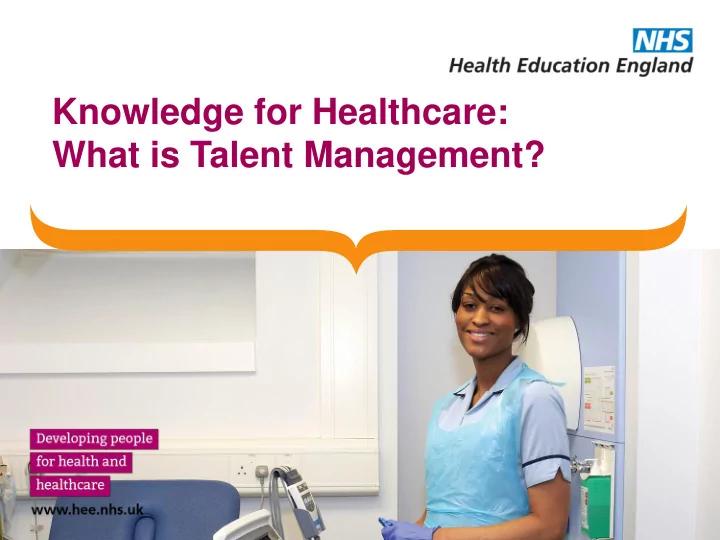
What is Talent Management? What do we mean by talent? NHS Leadership - - PowerPoint PPT Presentation
Knowledge for Healthcare: What is Talent Management? What do we mean by talent? NHS Leadership Academy Chartered Institute of Personnel Development (CIPD) Right people in the right roles with Systematic attraction, the right
What do we mean by ‘talent’?
@NHS_HealthEdEng #insertcampaignhashtag
NHS Leadership Academy Chartered Institute of Personnel Development (CIPD)
- Right people in the right roles with
the right values
- With access to the right
- pportunities, exposure, stretch
and development to reach their potential
- Whether this be in their current role
- r for a future role.
- Systematic attraction,
identification, development, engagement, retention and deployment of those individuals who are of particular value to an
- rganisation either in view of their
‘high potential’ for the future or because they are fulfilling business/operation critical roles.
So what is talent management?
‘Talent management’ is about ensuring
- rganisations maximise their talent, whether that
be through recruiting the right people into the right roles, developing existing employees to enable them to realise their potential or making sure individuals who are identified as having talent are motivated to stay with an
- rganisation, a sector or a profession in the
longer term.
Knowledge for Healthcare
‘For library and information professionals working in the NHS, talent management may extend beyond organisational boundaries into
- ur professional structures both within the
health sector and beyond’.
Nurturing individual talent and building a strategic approach
Talent management is crucial at both a strategic and at an individual level. According to the Ashridge Business School, ‘leading
- rganisations view talent management as a
strategic priority and an important long-term investment’.
Developing our talent
Talent management is about the value every individual brings to their organisation; it’s about understanding people’s unique contributions and ensuring they receive the development they need to have the maximum impact in their current or future roles.
Knowledge for Healthcare: Hosting a talent conversation
Holding the talent conversation
- A talent conversation will often take place between a
talented individual and their manager
- It may be that a professional lead may host for a
talent conversation which may be instigated by the individual themselves or by the senior librarian or knowledge specialist
Preparation for the conversation
- Give sufficient notice so both parties have
time to plan the meeting and reflect on performance
- Find venue that is private and without the
possibility of being interrupted
- Consider the time of day when you will have
the discussion
- Make sure you allow enough time
- Read through your documentation beforehand
Know your frameworks
- Bring competency and behavioural
frameworks helpful for the individual to consider e.g. – Talent grid (within this toolkit) – Healthcare Leadership Model – Healthcare Professional Skills and Knowledge Base – Knowledge and Skills Framework
Be clear about the process
- Ensure the librarian or knowledge specialist
knows what to expect from the conversation – no surprises
- Ensure you both have relevant documentation
- Be clear about the purpose of the
conversation
- What are each of your responsibilities?
Manager’s responsibilities
- Allow enough time and space for the conversation.
- Identify where the conversation fits - locally, regionally
and nationally
- Identify, develop and, where possible, retain talent
- Conduct personal development planning
- Facilitate the development of high-potential individuals
- Monitor development, achievement and progress
- Act as a coach and mentor
- Be a role model for your organisation’s/professional
body’s values and ethics.
Preparing for the conversation
Interviewee Interviewer
- Consider the venue and how you will get
there.
- Ensure you have allowed sufficient time
for a meaningful conversation.
- Be clear what you want to discuss.
- Research possible development
- pportunities.
- Read through documentation and
prepare for the discussion.
- Bring any additional competency or
behavioural frameworks.
- Act as a positive role-model.
- Give sufficient notice for both parties to
have enough time to plan the meeting and reflect on their performance.
- Find a mutually convenient venue that is
private and without the possibility of being interrupted.
- Consider the time of day when you will
have the discussion.
- Plan enough time for the discussion.
- Read through documentation and
prepare for the discussion.
- Bring any additional competency or
behavioural frameworks helpful for the individual.
A framework for the conversation
Questions to consider
- How is the employee performing against agreed
- bjectives?
- What evidence do you have to support your view of
their performance?
- What is your rationale for identifying their
performance as exceptional?
- What are the individual’s strengths and areas for
development?
Feedback and support
- What feedback do you plan to give at the meeting?
- What support will you be giving to help the individual
in the talent management process?
- Who else may be able to help?
Concluding the conversation
- Keep the momentum
- Agree next steps for both parties and make sure they
are recorded and shared
- Ensure actions follow the SMART principles found in
the toolkit
- Decide when you will meet again to review progress
- Thank the interviewee for their time
Knowledge for Healthcare: 60 Ways to Develop
Learning and development
- Be aware of your learning style. This can help you
understand which types of opportunity work best for you.
- You can explore your own learning style by using the
resources identified in the ‘development’ section of the Talent Management toolkit.
Where to find opportunities
- Tap into opportunities available through:
– Your employer – Your professional networks – The Chartered Institute of Library and Information Professionals (CILIP).
- Further information can be found in the Talent
Management Toolkit.
Training is not just courses
- Formal training events and workshops are
- nly one way to learn. There are many other
- pportunities to learn new skills and
knowledge…..
On-the-job learning
- Sit-by-Pat – the most traditional way to learn a new skill
- r task is to sit with a person who currently does it and
learn through doing it
- Delegation – undertake a task your manager may
- rdinarily do
- Mentoring – a mentor provides feedback and guidance,
acting as a trusted adviser
- Job enlargement – undertaking an extra activity in
addition to current duties. The additional activity generally involves a higher level of responsibility.
On-the-job learning (continued)
- Coaching – another member of staff acts as “coach”
encouraging the development of new skills or knowledge and providing constructive feedback
- Shadowing – attachment to another member of staff
- r department for a set period of time in order to learn
from them
- Observation – learning from watching others in action
Work experience
For example:
- Secondment
- Job
- Assistant to – an individual is seconded to work for a
senior manager for a set period of time.
- Job share
- A temporary job move e.g. to cover for absence
- Temporary promotion or “acting up”
- Work experience in another organisation
- Job transfer
Group or team activities
We gain knowledge and skills from others in group
- settings. While this is at the core of many training courses,
it can take a variety of different forms such as:
- Task forces and working parties
- Quality Circles
- Team building exercises and management games
- Problem solving
- Brainstorming and Action learning groups
- Workshops and discussion groups
- Simulation exercises
Self-development
Self-development activities can improve job satisfaction and long-term career prospects. Examples include:
- Adult education classes
- Co-coaching and buddy systems
- Study leave
- Special projects and research
- E-Learning and other skills packages
- Personal testing programmes
- Distance and open learning
- Reading lists
Face-to-face courses
- This form of training is likely to remain popular and is
an effective method of learning. Examples include:
- Short courses and modular courses
- Refresher
- Professional skills training
- Training programmes
- Part-time
- Taster or awareness courses
- Residential courses
- Seminars and conferences
60 ways to develop
- Learning can be undertaken in a large number of
different ways. Taking the time to identify opportunities which complement your learning style and fit with your ways of working, organisational and professional approaches and personal circumstances, will enable you to fully realise your potential
Conclusion
- Talent management is about the systematic attraction,
identification, development, engagement, retention and deployment of talented individuals who are of particular value to an organisation and professional practice
- It takes place at a strategic and individual level
- To be successful, planning is essential
- Talent management provides individuals with access