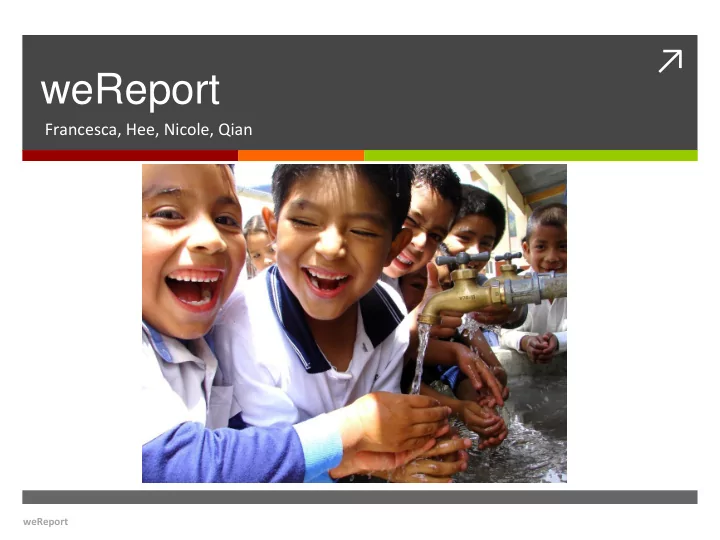
weReport Francesca, Hee, Nicole, Qian weReport Problem space - - PowerPoint PPT Presentation
wereport
SMART_READER_LITE
LIVE PREVIEW

weReport Francesca, Hee, Nicole, Qian weReport Problem space - - PowerPoint PPT Presentation

weReport Francesca, Hee, Nicole, Qian weReport Problem space 7,000 Peace Corps Volunteers at any given time $318.8 million is budgeted every year no current community feedback mechanism = ineffective monetary spending *


slide-1
SLIDE 1

weReport

Francesca, Hee, Nicole, Qian

weReport

slide-2
SLIDE 2

Problem space

  • 7,000 Peace Corps Volunteers at any given time
  • $318.8 million is budgeted every year
  • no current community feedback mechanism =

ineffective monetary spending

  • informal feedback

* weReport

slide-3
SLIDE 3

Problem space

Who will care about a solution?

  • US Government (USAID)
  • Peace Corps Organization and Volunteers
  • Community Members

Who will a solution effect?

  • All stakeholders
  • Selected Latin American Communities (short-term)
  • All communities with Peace Corps presence (long-

term)

* weReport

slide-4
SLIDE 4

Project description

weReport will be a user-friendly, intuitive platform that would allow NGO-affected community members to publically and anonymously report feedback on developmental projects using

SMS.

* weReport

slide-5
SLIDE 5

Project description

using weReport...

  • community members will be able to voice concerns
  • Peace Corps will be able to use the information collected to

more effectively allocate resources

The main elements

  • existing infrastructure in project communities (feature

phones, smart phones)

  • computers in the US for data aggregation

* weReport

slide-6
SLIDE 6

Design Challenge

  • restricting the design to use the existing technology infrastructure
  • each community has its own set of cultural factors (language barriers,

literacy, SMS plans, cellphone sharing, etc)

  • community members may be concerned about anonymity
  • across all countries with a Peace Corps presence (about 68, spanning

across the world), existing infrastructure and cultural factors vary dramatically

* weReport

slide-7
SLIDE 7

Related work

  • Many humanitarian crowdsourcing projects relate to weReport,

including...

  • Alive in Afghanistan (Todd Huffman)
  • Ushahidi
  • Our contacts include:
  • Jaron Reed (Peace Corps, volunteered in Guatemala)
  • Todd Huffman (Alive in Afghanistan)
  • Other Peace Corps volunteers
  • Developers of open-source tools like ODK and FrontLine SMS
  • What makes this project novel/interesting?
  • Huge scope
  • Many small projects, feedback not mapped based on location
  • How do we generate a consistent flow of feedback?

* weReport

slide-8
SLIDE 8

Findings so far

What did you do?

  • Surveyed PCVs
  • Talked to Jaron, Todd, Trevor

What did you learn from your fieldwork?

We need to narrow our scope to a few countries (Latin America)

What further fieldwork is needed?

  • Need to explore which specific existing technologies we'll

use (ie ODK, Frontline SMS)

  • Further research for future target countries, outside of Latin

* weReport

slide-9
SLIDE 9

Data Collected

  • *

weReport

slide-10
SLIDE 10

Data Collected

  • *

weReport

slide-11
SLIDE 11

Data Collected

  • Most areas spend less than 10$ a month on phone services

* weReport

slide-12
SLIDE 12

Basic scenario

* weReport

slide-13
SLIDE 13

Architecture

* weReport

slide-14
SLIDE 14

Design and evaluation

How will you iterate on your prototype and its UI?

  • Talk to PCVs in initial countries of deployment about what

works and what doesn't

Who will you ask to provide feedback?

  • PCVs

How will you evaluate your prototype and its UI?

  • Amount of feedback
  • Usefulness of feedback
  • General sentiment of PCV

* weReport

slide-15
SLIDE 15

Plan for next quarter

Week 1-2: ODK, ODK Aggregate, and SMS Frontline running on the devices. Week 3: Test out system locally and focus on security and reliability. Week 4: Redesign based on the findings on Week 3, have a fully functional prototype done. Week 5-6: Send out cellphones to Latin America and have PCVs test it out in the field. Gather data and feedback at the same time. Week 7-10: Analyze the feedback and redesign, re-evaluate, re- implement.

* weReport