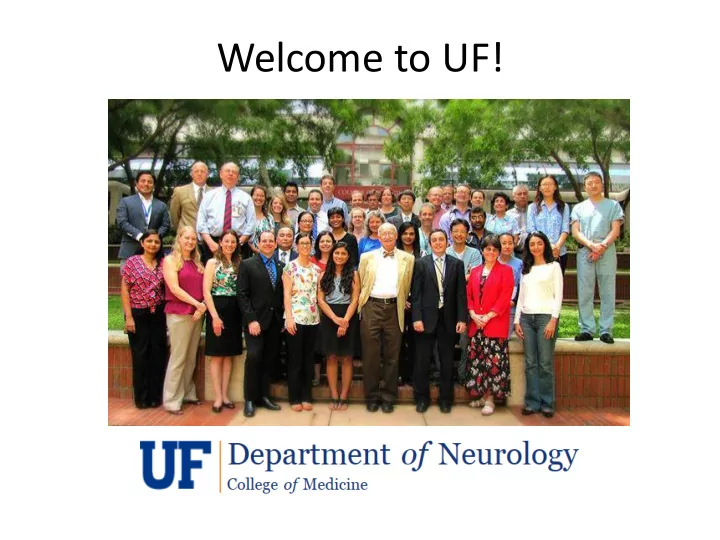
Welcome to UF! Introduction to UF Neurology Residency Christina - - PowerPoint PPT Presentation

welcome to uf introduction to uf neurology residency
SMART_READER_LITE
LIVE PREVIEW

Welcome to UF! Introduction to UF Neurology Residency Christina - - PowerPoint PPT Presentation

Welcome to UF! Introduction to UF Neurology Residency Christina Wilson, MD, PhD Assistant Professor, Vascular Neurology Division Residency Program Director Why University of Florida? Why Gainesville? Shands UF 850 beds Level-1 trauma


slide-1
SLIDE 1

Welcome to UF!

slide-2
SLIDE 2

Introduction to UF Neurology Residency

Christina Wilson, MD, PhD Assistant Professor, Vascular Neurology Division Residency Program Director

slide-3
SLIDE 3

Why University of Florida? Why Gainesville?

slide-4
SLIDE 4

Shands UF

  • 850 beds
  • Level-1 trauma center
  • 162 ICU beds

– 28 Neuro-ICU

  • Core neuro rotations

– Stroke service – General neurology service

slide-5
SLIDE 5

UF Comprehensive Stroke Center

  • Only Joint Commission-

certified comprehensive stroke center in northern FL

  • 13-county referral area
  • 600+ stroke admissions per

year

– Over 50 endovascular cases/yr

  • Multiple clinical trials
slide-6
SLIDE 6

Malcolm Randall VA Medical Center

  • Covers North FL/South GA
  • VA inpatient service
  • Continuity clinic/Neuro-1
  • Gait and balance clinic
  • Brain Rehabilitation Research Center (BRRC)
slide-7
SLIDE 7

Shands Medical Plaza

  • Outpatient neurology clinic

– Weekly continuity clinic – Lumbar puncture clinic – General neurology outpatient rotations – Outpatient subspecialty electives – Urgent care clinic

slide-8
SLIDE 8

UF Center for Movement Disorders and Neurorehabilitation

  • Movement disorders

selective

  • Research
  • pportunities
slide-9
SLIDE 9

Collaborative Neuromedicine at UF

  • McKnight Brain Institute

– Neuroscience, Neurology, Neurosurgery, Psychiatry

  • NeuromedicineInterdiciplinary

Clinical and Academic Program

  • Center for Translational Research

in Neurodegenerative Disease

  • Alzheimer’s Disease Research

Center

slide-10
SLIDE 10

Neuromedicine Tower - 2018

slide-11
SLIDE 11

UF in the future

  • New permanent chair
  • Resident complement increase
  • Faculty hires (10-20 new positions)

– General neurology, stroke, neuromuscular, neurocritical care, movement disorders, MS

  • Pre-eminence scholars in Neuromedicineand

across UF

  • UF Top-10 initiative
slide-12
SLIDE 12

Gainesville, Florida

  • Great athletics
  • University town

– Cultural events – Tolerance

  • Family-friendly

– Great schools/neighborhoods

  • Livable size
  • Often ranked among top

places to live in Florida, US

slide-13
SLIDE 13
slide-14
SLIDE 14

Residency Core Rotations

slide-15
SLIDE 15

Shands Stroke

  • One Senior resident (PGY3 or PGY4)
  • One Junior resident (PGY2)
  • 1 rotating residents (Neurosurgery, Pediatric

Neurology)

  • 1 – 4 medical students
  • 2 PAs
  • 1 stroke fellow
  • Covers all strokes in Shands

– Inpatient/ICU/ED consults/stroke alerts

slide-16
SLIDE 16

Shands General

  • One Senior Neurology (PGY3 or PGY4)
  • One Junior Neurology (PGY2)
  • 1 rotating residents (Neurosurgery, Pediatric

Neurology)

  • 1-4 medical students
  • 1 PA/ARNP
  • Covers all non-vascular neurology in Shands

– Inpatient/ICU/ED

  • Consults split 1:1 daytime neurohospitalist non-

teaching service

slide-17
SLIDE 17

VA Inpatient

  • One Senior Resident (PGY3 or PGY4)
  • One Junior Resident (PGY2)
  • 1 rotating resident (Psychiatry)
  • 1-4 medical students
  • Covers VA hospital (neurology ward, consults,

ED)

slide-18
SLIDE 18

Pediatric Neurology

  • 3 months total during

PGY3/PGY4 years

  • Covers pediatric neurology

– Wards, consults, clinics

  • 7 overnight calls/4 week

rotation

slide-19
SLIDE 19

Nightfloat

  • Two residents/night
  • Blocks

– Six days on – One day off (Saturday for seniors, Sunday for juniors)

  • 8 pm to 8 am

– Sign out at Morning Report

  • 2-3 blocks during PGY2
  • 2-3 blocks during PGY3
  • 1-2 blocks during PGY4
slide-20
SLIDE 20

Advantages of Nightfloat

  • Improves Continuity/Quality of Care
  • Avoids Fatigue:

– No resident over 80 hours any week – Longest continuous period working only 13 hours long – Residents off at least 1 day/week – Preserves Educational Experience – More attendance of weekday didactics when not on nightfloat – More time on non-core rotations – More time for reading

slide-21
SLIDE 21

Outpatient Longitudinal Clinics

  • Continuity Clinic

– ½ day per week – Alternate weeks between Shands and VA

– Patients from previous residents, inpatient experience, new patients

  • Neuro I

– ½ day per week on non-core rotations – VA – New patients

  • Gait and Balance clinic

– ½ day 4 times per year

  • LP clinic

– 4 times per year

slide-22
SLIDE 22

Early Selectives

  • Epilepsy I

– One month of EEG, EMU, and Epilepsy clinics

  • General Neurology Clinics

– One month, broad mix of patients

slide-23
SLIDE 23

Middle Selectives

Each one month long, taken throughout the three years, but majority completed before PGY4 year

  • Behavioral Neurology Clinic

– Includes TBI clinic at VA

  • Movement Disorders Clinic

– Includes DBS surgery

  • Neuromuscular Clinic

– Includes EMG/NCS training

  • Neuropathology

– Includes Brain Cutting

  • Psychiatry
slide-24
SLIDE 24

Senior Selective

  • Epilepsy II

– One month, taken during late PGY3/PGY4 year as a master course in Epilepsy

  • Neuroscience

– Several weeks of neuroscience lectures, labs,

  • pportunities to teach medical students
slide-25
SLIDE 25

Electives

  • 6 months electives in last 2 years

– Behavioral Neurology – Epilepsy – Movement Disorders – Neuromuscular – Research – Stroke – Neuro-oncology – Customized (with program director approval)

  • Mini-fellowships (3-4 concentrated months)
  • Individual track focuses (coming soon)

– Research, education

slide-26
SLIDE 26

Educational Opportunities

slide-27
SLIDE 27

Residency Education

Patient Care Research Didactic Lectures

slide-28
SLIDE 28

Research/Scholarly Activity

  • National meeting attendance
  • Local/regional/national presentations
  • Research project

– Up to 3-4 months of research rotations

  • Case reports
  • Quality projects
slide-29
SLIDE 29

Didactic lectures

  • Resident noon conferences (M/W/F)
  • Morning report
  • Grand rounds

– Clinical case presentation, CPC, M&M

  • Stroke neuroradiology conference
  • Bedside rounds with Dr. Heilman

– Tues afternoons biweekly

  • Subspecialty rotation conferences
slide-30
SLIDE 30

Optional Didactics

  • Tumor Board
  • Biomedical Engineering Seminar
  • Epilepsy Surgery Conference
  • Deep Brain Stimulator Conference
  • Movement disorder case Conference
  • Dementia Consensus Conference
  • Center for Neuropsychological Studies Conference
  • Neuroscience seminars
slide-31
SLIDE 31

Evaluation

  • Clinical rotation performance
  • Entrustable professional activities/OSCE
  • RITE (in-service examination)
  • Structured chart review
  • ABPN Clinical Skills Evaluation (5)
  • 360o assessment
  • Medical student assessment
  • Resident portfolio
slide-32
SLIDE 32

Vacation (four weeks per year)

  • Three weeks of vacation during

– Selectives – Electives

  • One week off during flex, either

– week of Christmas or – week of New Year’s Day

slide-33
SLIDE 33

Beyond Residency

slide-34
SLIDE 34

Fellowships

  • UF has fellowships in

– Stroke – Behavioral Neurology – Interventional Neuroradiology (with Neurosurgery and Radiology) – Movement Disorders – Neurophysiology (Epilepsy or Neuromuscular track) – Pain Medicine (with Anesthesia and Psychiatry) – Sleep (with Internal Medicine)

slide-35
SLIDE 35

Recent Graduates

  • 2015

– Neuroimmunology Fellowship at NIH – Movement Fellowship at University of Florida – Pain Fellowship at Mayo Jacksonville – Neuromuscular Fellowship at UCSF – Clinical Neurophysiology Fellowship at UT Houston

  • 2014

– Stroke Fellowship at University of Florida – Stroke Fellowship at University of Florida – Clinical Neurophysiology Fellowship at University of Florida – Clinical Neurophysiology Fellowship at University of Florida – Neuromuscular Fellowship at Cleveland Clinic

  • 2013

– Behavioral Neurology Fellowship, University of Florida – Behavioral Neurology Fellowship, Yale University – Sleep Disorders Fellowship, University of South Florida – Private practice

  • 2012

– Stroke at University of Florida – Stroke at University of Texas - Houston – Stroke/Interventional Neuroradiology in New Jersey – Epilepsy at Emory

slide-36
SLIDE 36

The PGY1 year

  • Five PGY1 positions at UF for Neurology
  • H visas not supported due to time needed to implement
  • Medicine Chiefs interview this afternoon

– Ranks yes/no

  • Ranking for neurology not directly impacted by medicine yes/no
slide-37
SLIDE 37

The Odds at UF

  • Nearly 400 applications per year
  • About 40 will be interviewed
  • Almost everyone interviewed is ranked
  • 5 positions
  • If we like you, we rank you (we usually like you)
  • If you’re ranked, you’ve got a chance
slide-38
SLIDE 38

Parting Thoughts

  • Our Faculty

– Love to teach – Approachable – Mentors – Great strengths and international repute in stroke, movement disorders, behavioral neurology, epilepsy, neuromuscular diseases, neurogenetics

  • Our Residents

– Small residency, true team approach

  • Once you join us, you’re family!
  • Go Gators!