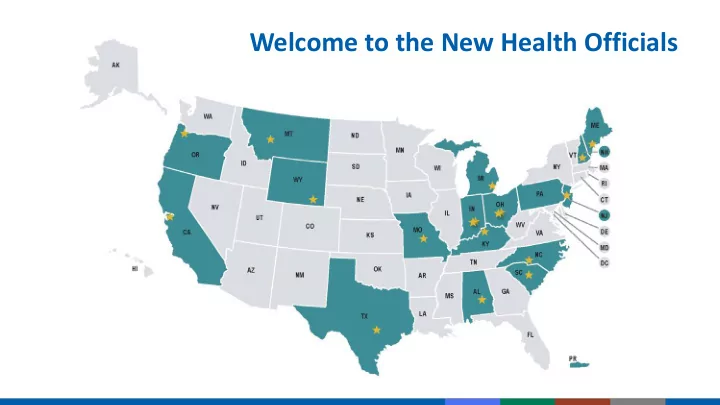
Welcome to the New Health Officials Welcome to the New State Health - - PowerPoint PPT Presentation
Welcome to the New Health Officials Welcome to the New State Health Officials Kristina Box, MD, FACOG Bruce Bates, DO Shereef Elnahal, MD, MBA Indiana State Maine Center for Disease New Jersey Department of Department of Health Control and
Welcome to the New State Health Officials
Kristina Box, MD, FACOG Indiana State Department of Health Lance Himes Ohio Department of Health Shereef Elnahal, MD, MBA New Jersey Department of Health Bruce Bates, DO Maine Center for Disease Control and Prevention Alexia Harrist, MD, PhD Wyoming Department of Health Scott Harris, MD, MPH Alabama Department
- f Public Health
Welcome to the New State Health Officials
Randall W. Williams, MD, FACOG Missouri Department of Health and Senior Services Jeffrey D. Howard, JR, MD Kentucky Department for Public Health Lilian Peake, MD, MPH South Carolina Department of Health and Environmental Control Lisa Morris, MSW New Hampshire Department of Health and Human Services Sheila Hogan Montana Department of Public Health and Human Services
Welcome to the New Local Health Officials
Muntu Davis, MD, MPH Alameda County Public Health Department Joneigh S. Khaldun, MD, MPH, FACEP Detroit Health Department Rachel Banks, MPA Multnomah County Health Department Virginia A. Caine, MD Marion County Public Health Department Gibbie Harris, MSPH, RN Mecklenburg County Health Department Mysheika W. Roberts, MD, MPH Columbus Public Health Philip Huang, MD, MPH Austin Public Health Department
Centers for Disease Control and Prevention
Centers for Disease Control and Prevention and Center for State, Tribal, Local and Territorial Support (proposed) Overview
José T. Montero, MD, MHCDS Director, Center for State, Tribal, Local and Territorial Support Centers for Disease Control and Prevention
CDC: Who We Are, What We Do, How We Support You
CDC: The Nation’s Health Protection Agency
- Founded in 1946
- Part of US Department of
Health and Human Services
- Headquartered in Atlanta
- 12,000+ full-time employees
– 60% with advanced degrees
Innovation
CDC Highlights
Improve health security at home and around the world Better prevent the leading causes of illness, injury, disability, and death Strengthen public health/ health care collaboration
CDC Strategic Directions
Strategic Direction #1: Improve Health Security at Home and Around the World
- CDC’s expertise in preparedness, rapid detection, and
response saves lives and safeguards communities from health threats.
- Employing faster, more advanced ways to find, stop,
and prevent infectious disease outbreaks here and abroad. – Increase access to high-quality laboratory testing, including the use of advanced molecular detection technologies – Enhance global health security by building and sustaining capacity to detect and respond to disease threats such as polio, influenza, Ebola, Middle East Respiratory Syndrome (MERS), and insect-borne threats, such as Zika – Enhance state and local abilities to prevent, detect, and respond to health threats
A Health Threat Anywhere Is a Health Threat Everywhere
Global
- bal av
aviat ation net etwork
Source: Kilpatrick & Randolph. Lancet 2012;380:1946–1955. Note: Air traffic to most places in Africa, regions of South America, and parts of central Asia is low. If travel increases in these regions, additional introductions of vector-borne pathogens are probable.
Rise In Opioid Deaths
Overlapping, Entangled but Distinct Epidemic
1 2 3 4 5
1999 2001 2003 2005 2007 2009 2011 2013 2015
Dea eaths per er 100, 100,000 000 pop
- pulation
- n
Met ethad adone Synthetic ic o
- pio
ioid ids Nat atural al an and s sem emi-synthetic ic opio ioid ids
Her eroin
Almost 310,00 people have died from an opioid
- verdose since 1999
3 Waves
SOURCE: National Vital Statistics System Mortality File.
CDC Public Health Responses
CDC Doctors, Nurses, and Disease Control Experts Work Around the World to Keep Americans Safe
CDC’s global presence Global Disease Detection Center Global Immunizations – Measles/Polio Influenza experts deployed Malaria experts deployed Field Epidemiology Training Program CDC epidemiologist in country Global HIV/AIDS Program GHSA phase one country Ebola-affected country
Staff of 2,000+ located in 60+ countries Global budget of >$3 Billion
As of April 2016
Strategic Direction #2: Better Prevent the Leading Causes of Illness, Injury, Disability, and Death
- Top 10 leading causes of death account for nearly 75% of all deaths in the United
States, cardiovascular disease, stroke, and cancer accounting for more than half of all deaths and more than $472 billion in healthcare costs – Provide timely, quality data on priority health and healthcare issues at the national, state, and local levels to better monitor and improve the health of Americans – Work with communities to prevent injury, disease, and disability – Support doctors, nurse practitioners, nurses, pharmacists, and other health professionals by increasing workforce capacity at the state and local levels.
Rates of Adults and Adolescents Living with Diagnosed HIV Infection, by Area of Residence, Year-end 2015 — United States and 6 Dependent Areas
N = 988,955 Total Rate: 364.3
Many People have HIV for Years Before they Know it
CDC Has Research, Detection, and Response Units Around the Country
CDC Laboratories Do Cutting Edge Science to Keep Americans Safe from Threats
Anchorage, AK
Threats to health in the Arctic
Atlanta, GA
Hundreds of pathogens and toxins
Morgantown, WV
Lung health and
- ther key worker
safety and health
Cincinnati, OH
Worker safety and health
Ft Collins, CO
Diseases spread by vectors such as ticks and mosquitoes
San Juan, PR
Diseases spread by vectors
Spokane, WA
Workplace safety engineering
Pittsburgh, PA
Mining safety
CDC Supports Real-time Response Throughout the United States
Strategic Direction #3: Strengthen Public Health and Health Care Collaboration
- We have a unique opportunity to increase the value of our nation’s health
investments by better aligning public health and health care. – Leverage partnerships with clinicians and healthcare organizations to decrease healthcare-associated and antibiotic-resistant infections and prevent prescription drug overdoses – Increase ability of public health and healthcare systems to reduce disease threats and improve health by increasing prevention through the use of community, clinical, and laboratory services – Use emerging data sources, existing surveys, and innovative information delivery to inform clinical care systems to improve population health
Technical Packages Facilitate Coordinated Action
February 2017 December 2016
Source: Unpublished NCHHSTP Surveillance Data, released at the Conference on Retroviruses and Opportunistic Infections, Feb 14, 2017, Seattle.
Advanced Molecular Detection Combines Cutting- Edge Approaches
Traditional epidemiology Genomic sequencing Bioinformatics Advanced molecular detection
+ + =
Nutrition, Physical Activity, Obesity, and Food Safety Healthcare- Associated Infections HIV Motor Vehicle Injuries Tobacco Teen Pregnancy
Progress on CDC Winnable Battles
Tips from Former Smokers
5 years of success in reducing smoking
- New campaign for 2017 now running
through end of May – TV, radio, and billboard ads in 5 languages (English, Spanish, Chinese, Vietnamese, Korean)
- More than 5 million smokers made quit
attempts because of the Tips campaigns, and at least 500,000 have quit for good
- Tips is cost-effective and a best buy for
public health – for every $2,000 we spend
- n ads, we prevent a death
Putting Pieces Together for Public Health Impact
Mar 7, 2017 November 2016
10
Examples of 6|18 Interventions
Bucket 1 Examples: In clinical setting Improve access to medications (e.g., via elimination of cost sharing) Expand access to comprehensive tobacco cessation treatment Remove barriers to use of long-acting reversible contraceptives Bucket 2 Examples: Outside of clinical setting Self-measured home blood pressure monitoring Diabetes Prevention Program Home visits for asthma care to reduce home triggers
CDC Program Level FY 2011-2019
(dollars in millions)
$0
$5,649 $5,666 $5,437 $5,791 $5,998 $6,271 $6,279 $7,445 $5,525 $352 $371 $375 $211 $136 $225 $30 $12 $15 $15 $15 $611 $809 $463 $831 $887 $892 $891 $801
$4,000 $4,500 $5,000 $5,500 $6,000 $6,500 $7,000 $7,500 $8,000 $8,500
FY 2011 FY 2012 FY 2013 FY 2014 FY 2015 FY 2016 FY 2017 Final FY 2018 Enacted FY 2019 PB
Budget Authority PHS Evaluation Transfer Prevention Fund Public Health and Social Services Emergency
$6,876 $6,837 $6,287 $6,833 $6,900 $7,178 $7,185 $8,246 $5,661
Advance US public health agency and system performance, capacity, agility, and resilience
CSTLTS Mission
Advance the US public health agency and system performance, capacity, agility and resilience
Technical Assistance to STLTs Internal CDC Coordination and Support Build/Develop Partnerships to Improve PH System Capacity Building Performance Improvement
CSTLTS — What We Do
CSTLTS Director Current Priorities
Implementation and Public Health Systems Science Rural Health Health Systems Integration Social Determinants
- f Health
Improved Technical Assistance Improved Internal CDC Coordination Improved Population Health Outcomes by Improving Public Health Agencies
External Input
Advisory Committee to the Director of CDC
Public Health Surveillance Think T ank Public Health Finance Think T ank Social Determinants of Health Think T ank State Local Tribal and T erritorial Subcommittee
Innovation
For more information, contact CDC 1-800-CDC-INFO (232-4636) TTY: 1-888-232-6348 www.cdc.gov The findings and conclusions in this report are those of the authors and do not necessarily represent the
- fficial position of the Centers for Disease Control and Prevention.