Welcome to London, Ontario Welcome to London, Ontario A Few Facts - - PDF document

welcome to london ontario welcome to london ontario
SMART_READER_LITE
LIVE PREVIEW

Welcome to London, Ontario Welcome to London, Ontario A Few Facts - - PDF document

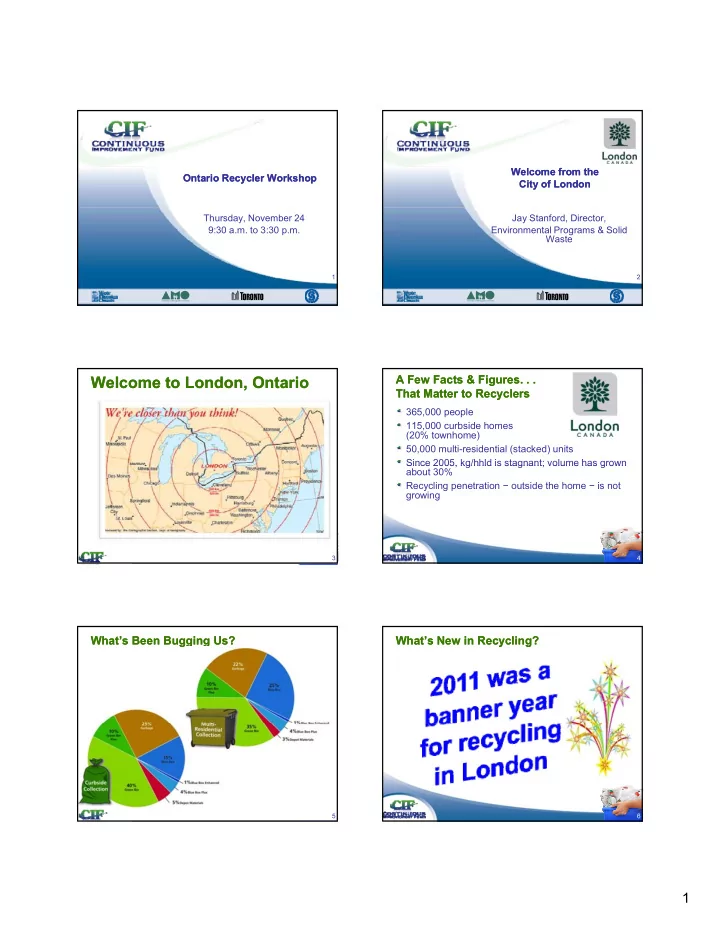
Welcome from the Welcome from the Ontario Recycler Workshop Ontario Recycler Workshop City of London City of London Thursday, November 24 Jay Stanford, Director, 9:30 a.m. to 3:30 p.m. Environmental Programs & Solid Waste 1 2


slide-1
SLIDE 1

1

Ontario Recycler Workshop Ontario Recycler Workshop

1

Thursday, November 24 9:30 a.m. to 3:30 p.m.

Welcome from the City of London Welcome from the City of London

2

Jay Stanford, Director, Environmental Programs & Solid Waste

Welcome to London, Ontario Welcome to London, Ontario

3

A Few Facts & Figures. . . That Matter to Recyclers A Few Facts & Figures. . . That Matter to Recyclers

365,000 people 115,000 curbside homes (20% townhome) 50,000 multi-residential (stacked) units Since 2005, kg/hhld is stagnant; volume has grown

4

Since 2005, kg/hhld is stagnant; volume has grown about 30% Recycling penetration − outside the home − is not growing

What’s Been Bugging Us? What’s Been Bugging Us?

5

What’s New in Recycling? What’s New in Recycling?

6

slide-2
SLIDE 2

2

New Materials with more MRF capability and capacity New Materials with more MRF capability and capacity

7

More Plastics (3, 6 & 7. . Plus clamshells)

Adding Curbside Capacity with 80 Litre Adding Curbside Capacity with 80 Litre

8

Litre (22 Gallon) Big Blue Litre (22 Gallon) Big Blue Adding Multi- residential Capacity Adding Multi- residential Capacity

9

Capacity – Carts Capacity – Carts Adding Multi-res ‘OCC’ Capacity Adding Multi-res ‘OCC’ Capacity

10

– OCC Bin Pilot – OCC Bin Pilot

Manning Drive MRF – Opened August 2011 Manning Drive MRF – Opened August 2011

11 11

What Are Some of the Biggest Challenges We Face? What Are Some of the Biggest Challenges We Face?

  • 1. Reducing contamination
  • 2. Managing challenging materials
  • 3. Improving curbside & multi-res (capture,

participation rates)

  • 4. Highlighting the value of recycling

12

  • 4. Highlighting the value of recycling
  • 5. Securing sustainable funding
slide-3
SLIDE 3

3

Our Focus for 2012 Our Focus for 2012

Optimization Projects. . . targeting:

  • 1. materials with low capture rates
  • 2. contamination and non-recyclables

3 neighbourhood recycling performance feedback

13

  • 3. neighbourhood recycling performance feedback
  • 4. litter reduction from Blue Boxes

A Few Perspectives from London Staff A Few Perspectives from London Staff

Partnerships/relationships are a key part of our foundation All aspects of an integrated waste management system must be maintained and optimized Local and regional benefits of resource t h t b ti i d

14

management have not been optimized

EPR in London. . . Some Different Meanings EPR in London. . . Some Different Meanings

Extended Partner Relationships Educated Partner Responsibilities E th i ti P l R i d

15

Enthusiastic People Required Ontario Recycler Workshop Ontario Recycler Workshop

16

Andy Campbell, Director, CIF

Today’s Audience Today’s Audience Approximately 60 people in London Expecting 40+ online Audience members include:

– municipal councillors, recycling & waste staff & other staff members

17

– industry association representatives – program representatives, consultants & other stakeholders

Today’s Program & Housekeeping Today’s Program & Housekeeping Full day session (to ~3:30 p.m.) with program & project updates For webcast viewers

 sound slider  webcast technical assistance

18

assistance  “Ask a Question”

  • no response

via console

  • check email

 link to slides & resources    

slide-4
SLIDE 4

4

Tour of Two MRFS Tour of Two MRFS

  • ~40 people
  • Preventive Maintenance

Program presentation by Bob Marshall, HMI Consulting Services Inc.

  • London MRF

presentation & id d t

19

guided tour

  • Bluewater MRF

presentation & guided tour

Special thanks to London & Bluewater MRF Staff & to Bob Marshall, HMI for a successful day!

Snapshot…Today’s Program Snapshot…Today’s Program

Program updates Morning break Meeting Best Practices (BP) for Planning & Procurement Lunch Automated Collection: The Wave of the Future

20

Afternoon break The Future of Blue Box Collection Reflections on Managing Printed Papers & Packaging

Today’s Speakers Today’s Speakers

Abby Barclay, Town of Arnprior Larry Freiburger, AET Cory Smith, Mississippi Mills Francis Veilleux, Bluewater Recycling Association Maria Kelleher, Kelleher Environmental Mary Little, 2cg Inc. Paul Shipway, McKellar Township Paul Speed, Rehrig Pacific Company

21 21 21

Glenda Gies Jay Stanford, City of London

  • Joe. C. Williams

Innovative Hydrogen Solutions Kevin Vibert, City of Toronto Rick Clow, MIPC Sherry Arcaro, Stewardship Ontario Shirley McLean, Halton Region

CIF Update CIF Update

22

Andy Campbell, P.Eng. Director, CIF

Overall CIF Project Status Overall CIF Project Status

Total Applications 612 Total Approved Projects 445 Total Approved Funding $30.5M Total Project Value $73M

23 23 23

Outstanding Applications 24 w/request for $19.6M Remaining Funds for 2011 $11M

2011 Project Highlights 2011 Project Highlights

Program Area Total 2011 Approvals RFP assistance $105,000 Large blue boxes $401,000 Multi-residential $456,000 Promotion & education $769,000 Public space recycling $782 000

24 24

Public space recycling $782,000 Recycling plans $440,000 Northern Ontario $308,000 Energy efficiency $109,000 MRF & transfer stations $256,000 Other $1,109,000

171 projects approved in 2011

slide-5
SLIDE 5

5

MIPC Decision Summer 2011 MIPC Decision Summer 2011

CIF to be extended for 2 years 2012 contribution ~$4.5M – up to 50% for rationalization 2013 contribution TBD in BP discussion before year end – will not exceed 10% of Base Steward Obligation less CNA/OCNA in-kind obligation

25 25 25

Up to $8M of existing uncommitted CIF funds for regionalization – no spending until Rationalization Study complete MIPC to develop new set of strategic directions for CIF – new mandate to direct funds to system rationalization, based on Provincial Optimization Study recommendations

New CIF Strategic Direction New CIF Strategic Direction Change funding emphasis from 2008 priorities to expenditures based on new project priorities set by MIPC & the CIF Committee Focus on provincial optimization Focus on materials management strategies

26

Focus on Blue Box BP knowledge & training What are Municipalities Asking For What are Municipalities Asking For How to create a sustainable waste management system in EPR world Outreach–practical examples on how to improve system How to do business cases to implement change Articulate CIF learnings

27

Training on how to operate facilities, write tenders/ RFPs Training on health & safety What are future BP & how to adopt them 2012 CIF Operations Plan 2012 CIF Operations Plan Reduced resources as a result of reduced budget Work with municipalities to complete nearly 400 outstanding projects $10M in proposed funding for provincial

  • ptimization projects

28

$0.75M for knowledge resource centre Continue to provide on-site assistance with municipalities to discuss operational improvements Knowledge Resource Centre Concept Knowledge Resource Centre Concept

Proposed 2012 Budget Business, Operations & BP training $300,000 BP development $150,000 RFP, tender & recycling plan development $100,000

29 29

RFP, tender & recycling plan development $100,000 Materials management studies $100,000 Sustainable waste management systems $100,000 Ontario Recycler Workshops Included in Admin budget Total $750,000

Study for Optimization of Blue Box Material Processing System in ON (1) Study for Optimization of Blue Box Material Processing System in ON (1) Purpose: to seek an optimal Blue Box system on a “waste shed basis”−not on municipal boundaries Use more transfer stations Use larger regional MRFs Minimize transportation logistics

30

Minimize transportation logistics Include municipal & private sector facilities Options to include analysis for 2012 & 2025 Sensitivity analysis to changing fuel costs & material volumes

slide-6
SLIDE 6

6

Study for Optimization of Blue Box Material Processing System in ON (2) Study for Optimization of Blue Box Material Processing System in ON (2) Retain a consultant in December Project to be completed in spring, 2012 CIF & MIPC will need to determine funding policies for $10M budget Develop application process for municipal

31

Develop application process for municipal submissions Blue Boxes & Carts Blue Boxes & Carts 2012 budget does not include funding for large Blue Boxes or carts Municipalities can still access CIF tenders for carts & 22-gallon Blue Boxes at substantial savings in 2012

32

RFP & Recycling Strategies Assistance RFP & Recycling Strategies Assistance CIF staff will approach municipalities who scored lowest on WDO Best Practice questions Municipalities who have immediate contract renewals should contact CIF

33

$100,000 total budget for 2011 CIF Staff CIF Staff Website - www.wdo/cif.ca

Andy Campbell−Director CIF andycampbell@wdo.ca 705.719.7913 Mike Birett−Manager CIF

34

Mbirett@wdo.ca 905.936.5661 Clayton Sampson−CIF Project Manager csampson@wdo.ca 519.539.0869

Incremental Change Today... Better System Tomorrow Incremental Change Today... Better System Tomorrow

35

Sherry Arcaro Director, Blue Box System Optimization Stewardship Ontario

The landscape is changing for the better The landscape is changing for the better

Partnerships that create positive change in the system

36 36 36

slide-7
SLIDE 7

7

Industry Initiatives Industry Initiatives 100% plant based bottle to be piloted in 2012

37

Partnership between Heinz & Coca-Cola on 30% plant based bottle On-going Communication & Collaboration On-going Communication & Collaboration

What is the purpose of PAC NEXT? VISION: A world without packaging waste MISSION: To unite leading organizations across the packaging value chain to collaboratively explore, evaluate & mobilize innovative packaging end-of-life solutions

38

SOLUTIONS: Economical recovery that leads to improved Reduction, Recycling, Reuse, Up-Cycling, Composting, Energy-from-Waste & other Emerging Solutions OBJECTIVE: To facilitate the convergence of ideas & identify sustainable solutions that lead to zero packaging waste

Lots of Work Still To Be Done! Lots of Work Still To Be Done!

39

Multi-municipal “Plastic Is In” Campaign Multi-municipal “Plastic Is In” Campaign

40

Creative Creative

41

Results: Results:

#1 other rigid pkg – clear 6.2% to 72.7% #1 other rigid pkg – clrd 5.4% to 60.4% #1 other rigid bottles 3.9% to 90.8%

42

slide-8
SLIDE 8

8

Upcoming Projects Upcoming Projects City of North Bay (in market) Region of York (working on agreement) City of Kingston (working on agreement) City of London (spring 2012) Region of Niagara (

i 2012) 43

Region of Niagara (spring 2012) Is your Plastic In? SO can help. Other materials… Other materials…

44

In some cases, market development to be done In other cases, effective MRF technology needed! Contact Info: Contact Info:

Sherry Arcaro Director Blue Box System Optimization – Stewardship Ontario Phone: 416-725-3156 sarcaro@stewardshipontario.ca Rick Denyes

45 45 45

Rick Denyes Director Blue Box Materials Management – Stewardship Ontario Phone: 416-303-0691 rdenyes@stewardshipontario.ca

Distribution of 2012 Funding Distribution of 2012 Funding

46

Rick Clow MIPC

2012 Steward Obligation 2012 Steward Obligation

  • sect. 25(5) Waste Diversion Act (2002)

Total amount paid to all municipalities under the program [shall be] equal to 50 per cent of the total net costs incurred by those municipalities 2005 Cost Containment Plan Requirement M i i l Bl B li ill

47

Municipal Blue Box recycling programs will, where possible, work to operate at best practices to minimize gross & net Blue Box program costs 2012 payment to all programs is $93.4 M

2011 Datacall Begets 2012 funding 2011 Datacall Begets 2012 funding

DATACALL RESULTS Total Gross Cost: $298.5 M Total Revenue: $95.2 M Total Net Cost: $203.1 M COMPARISON COSTS

48 48

BP Estimated Gross: $270.3 M 3 Year Average Revenue: $86.0 M FINAL NEGOTIATED Best Practices Net Cost: $187.7 M 2012 Steward Obligation: $93.4 M

slide-9
SLIDE 9

9

In-kind Funds & CIF In-kind Funds & CIF

Not Everything is Paid in Cash In November 2005 the Minister agreed that steward fees for newsprint producers who were members of the CNA or OCNA would be in the form of in-kind newspaper advertising 2012 CNA/OCNA deduction: $3.5 M 2012 CIF Contribution: $4.5 M

49 49

2012 CIF Contribution: $4.5 M CIF Investment Demonstrates Municipal Commitment to BP From 2008 to 2011 municipalities invested $53.4 M of steward’s

  • bligation to demonstrate their

commitment to continuous improvement & promotion of BP. In addition funds have been matched by municipalities

Final Breakdown of Our Share Final Breakdown of Our Share

Remaining Funds in 3 Buckets Funding Year 2010 2011 2012 Datacall Year 2008 2009 2010 Best Practice 5.0% 15.0% 25.0% Performance 30.0% 40.0% 45.0% Net cost 65.0% 45.0% 30.0% 2012 Funds for Distribution: $85 4M

50 50 50

2012 Funds for Distribution: $85.4M

What’s Left to Distribute? What’s Left to Distribute?

2012 Funds for Distribution: $85.4 M Not everyone gets 50% of what they spent recall: “total amount paid to all municipalities under the program [shall be] equal to 50 per cent of the total net costs 50% of our reported net costs = $101.5 M 50% of the negotiated net cost = $93.4 M 8 6% of this goes to CNA/OCNA & CIF

51 51

8.6% of this goes to CNA/OCNA & CIF 2005 Cost Containment Plan directs us to: reward municipalities that have implemented identified BP & provide incentives for municipalities to adopt BP Funding distributed in 3 sub-buckets to satisfy this direction

Net Cost Funding Net Cost Funding Represents 30% of total $85.4 M available funds Represents 12.6% of $203.1 M Reported Net Costs All programs receive 12.6% of their Reported Net Costs

52

Reported Net Costs Represents guaranteed minimum funding level Facts About Recovery Rates − 2012 Facts About Recovery Rates − 2012 Provincial Recovery Rate: 67.6%

– Stewardship Ontario develops annual estimate of generation by municipal program

  • “generation” is tonnes of Blue Box materials available for

collection from residential sources Reco er Rate = Marketed Tonnes ÷ Estimated Generation

53

Recovery Rate = Marketed Tonnes ÷ Estimated Generation

223 programs reported recovery rates from 3.3% to 286%

– recovery rates capped at 90% for performance calculations

Best Practices (BP) Funding Best Practices (BP) Funding

Represents 25% of total $ 85.4 M available funds Represents 10.5% of $203.1M Reported Net Costs BP Score from Section 3.4 of Datacall recall the Cost Containment Plan instruction to provide incentives for municipalities to adopt BP?

54 54

Step 1: Calculate each program’s “tonnage based share of net costs” Step 2: Multiply all programs tonnage based share of net costs by their BP score from Section 3.4 Step 3: Scale each program’s best practice score down equally so total funding adds up to $21.4M Basic Principle: All programs with the same BP score get same percentage of their tonnage based share of funding

slide-10
SLIDE 10

10

Performance Funding Performance Funding Represents 45% of total $85.4 M available funds

– represents 18.9% of $203.1 M Reported Net Costs – “performance” includes:

  • Efficiency = net cost per tonne

d

55

recovered

  • Effectiveness = tonnes recovered per

tonne generated

Facts About Net Costs−2012 Facts About Net Costs−2012 Average Net Cost per Tonne $228.86/T

– lowest cost 5% of tonnes $ 125.03/T – highest cost 5% of tonnes $ 517.53/T – 95% of programs cost less than $1416.92/T – 90% of programs cost less than $ 853 78/T

56

90% of programs cost less than $ 853.78/T – 80% of programs cost less than $ 589.93/T – 50% of programs cost less than $ 357.75/T

Performance Funding Performance Funding

Goals: Reward efficient programs Reward effective programs How it’s done:

– comparison with other like programs using 9 municipal groupings t d t 90%

57 57

– recovery rates capped at 90% – E&E factor = net cost per tonne ÷ recovery rate

Programs score based on performance within municipal grouping determines funding level Municipal group with more good performers than other groups will get additional funding

Program Funding Analysis Program Funding Analysis

Final funding should be consistent year to year & explainable 2012 will return relatively less for steady excellent BP programs because more programs are sharing BP bucket

Net Cost Allocation $25,628,135 Best Practices Allocation $21,356,779 E & E Allocation $38,442,203 Total Est. Funding $85,427,117 Large Urban $12,463,281 $11,002,570 $17,977,021 $41,442,872 Urban Regional $4,870,891 $5,971,652 $7,705,218 $18,547,761

58 58

g $ , , $ , , $ , , $ , , Medium Urban $1,285,739 $959,820 $1,923,214 $4,168,772 Rural Regional $3,424,977 $2,241,901 $5,186,452 $10,853,330 Small Urban $606,126 $377,127 $1,039,947 $2,023,200 Rural Collection - North $424,010 $99,786 $740,667 $1,264,463 Rural Collection - South $1,888,726 $585,768 $2,873,774 $5,348,269 Rural Depot - North $352,068 $26,394 $494,181 $872,643 Rural Depot - South $312,317 $91,763 $501,728 $905,808

2012 vs. 2011 Funding 2012 vs. 2011 Funding

Funding increased in all groups Total available funds increased from $81,121,037 to $85,427,117 for participating programs Tonnes increased from 870,214 to 887,242

Total Estimated Funding $85,427,117 2011 Total Funding $81,121,037 Large Urban $41,442,872 $38,704,666

59 59

Large Urban $41,442,872 $38,704,666 Urban Regional $18,547,761 $18,410,421 Medium Urban $4,168,772 $3,932,501 Rural Regional $10,853,330 $10,756,240 Small Urban $2,023,200 $1,755,655 Rural Collection - North $1,264,463 $1,091,775 Rural Collection - South $5,348,269 $4,984,757 Rural Depot - North $872,643 $798,307 Rural Depot - South $905,808 $686,714

Questions Questions

60
slide-11
SLIDE 11

11

Break Break

61

Welcome Back Welcome Back

62

Meeting Best Practices for Planning & Procurement Meeting Best Practices for Planning & Procurement

63

Clayton Sampson, CIF

Today’s Session Today’s Session Discussion about two important Blue Box program components:

– Blue Box program planning – procurement for recycling services

Both are BP for Blue Box recycling

64

y g Planning first, then procurement in this segment Background - Planning Background - Planning Development & implementation of up-to-date plan for recycling is BP #1 Accounts for 12.5% of BP funding Difficult to meet other BP without a recycling plan Plan enables programs to operate & improve Plan answers four questions:

65

Plan answers four questions:

  • 1. where do we want to be
  • 2. where are we now
  • 3. how do we get there
  • 4. how do we know when we get there

CIF Initiatives CIF Initiatives Recognized that planning was the first step for continuous improvement Decision to create a template for planning to help municipalities develop plans Waste Recycling Strategy guideline & template available for programs to utilize

htt // d / if/ / l i ht l

66

– http://www.wdo.ca/cif/resources/planning.html

Held workshops to explain template Provided funding to programs for plan development

slide-12
SLIDE 12

12

Results Results 2009 Datacall–75% of programs did not meet planning BP 2010 Datacall–45% of programs did not meet planning BP CIF has approved 93 planning projects–10% have b ti l i j t

67

been co-operative planning projects Based on approved projects & Datacall responses, estimate only 65 programs not meeting planning BP (29% of programs) Goal was 100% compliance Recycling Planning Session Recycling Planning Session Have different perspectives on Recycling Planning

– overview of planning & what are the main issues being encountered – how a large municipality handles ongoing task of keeping a plan current b fit f l i f ll & h it

68

– benefits of planning for a smaller program & how it assists with implementing improvements

Today’s Speakers Today’s Speakers Mary Little, Senior Consultant 2cg Inc. Shirley Mclean, Supervisor, Waste Planning Halton Region Paul Shipway, Administrative/Treasury Assistant To nship of McKellar

69

Township of McKellar Planning for the Future Through a Waste Recycling Strategy Planning for the Future Through a Waste Recycling Strategy

70

Mary Little Senior Consultant 2cg Inc.

Presentation Highlights Presentation Highlights Creating an Effective Waste Recycling Strategy For more information:

– mary@2cg.ca – www.2cg.ca

71

What is a Waste Recycling Strategy? What is a Waste Recycling Strategy? A Strategy is defined as:

– a plan, approach or tactic

A municipal Waste Recycling Strategy is a tool to help your program achieve Best Practices (BP) in the management of your Blue Box material

72

slide-13
SLIDE 13

13

Requirement Requirement The funding to municipalities in 2011 will be:

– 15% based on 2009 Datacall BP questions

The cash funding to municipalities in 2012 based

  • n responses to 2010 Datacall will be:

– 25% based on 2010 Datacall BP questions

73

q

Municipal Reaction Municipal Reaction “Limited staff resources & budget to devote to a Strategy” “No time to deal with a consultant/third party” “Where do I start?”

74

Getting Started Getting Started The CIF guidebook offers a format for your strategy & funding to complete it Use the Recycling Option Score table as a starting point for your program It’s a reference tool—adjusted to suit your own m nicipal needs

75

municipal needs Get’s you thinking What Works What Works Work through the Recycling Options Table as a group (environment committee, waste management staff) Add or remove options to suit your needs E ample

76

Example:

– if your program is depot based, replace option of collection frequency with option of increase depot hours

What Doesn’t Work What Doesn’t Work Working in isolation from your group Having your committee/waste management staff fill out the

  • ption score individually & not

as a team effort

77

as a team effort Strategy Suggestions: Strategy Suggestions: Start with comparing your Blue Box diversion rate & costs with your municipal group average

Average Blue Box Diversion Rate Y M i i lit 18 3%

78

If you are lower/higher than your group— is this a surprise?

Your Municipality 18.3% Municipal Grouping: Medium Urban 20.38%

slide-14
SLIDE 14

14

What We Found Effective What We Found Effective Focus on enhancing your existing program vs. re-vamping your entire program Choosing BP that are manageable for your program This is not a lengthy waste management master l k i h & h i

79

plan—keep it short & to the point How We Engaged Feedback? How We Engaged Feedback? Provided open communication with municipal staff

– back & forth emails, highlight areas in the strategy requiring comments, etc.

Provided summary tables highlighting easy to follow program initiatives

80

Provided BP examples of other municipal programs to assist with decision making Some Examples of Effective Strategies (1) Some Examples of Effective Strategies (1) Town of Meaford

– defined performance measures & diversion targets for their program – they have limited staff resources & are considering using volunteers & summer students to assist with re-launching their program

81

re launching their program

Town of West Nipissing

– identified areas needing additional promotion & education & applied to CIF for P&E funding

Some Examples of Effective Strategies (2) Some Examples of Effective Strategies (2) City of Kawartha Lakes

– identified need for staff training & have participated in several CIF, MWA core competencies workshops

County of Northumberland

– identified need to bolster their P&E for film plastic

82

sorting requirements – as result, has re-launched their ‘Bag your Bags’ campaign

Some Examples of Effective Strategies (3) Some Examples of Effective Strategies (3) Township of McKellar

– identified need for staff training & need to reduce

  • verall program costs

– as result, has participated in CIF, MWA core competencies workshops & applied for capital funding for depot site

83

funding for depot site

City of Stratford

– identified need to optimize collection & processing services for Blue Box program – as result, applied to CIF to prepare RFP & have recently secured a new processing contract

In Summary In Summary A Recycling Strategy essentially acts as an extension to your annual Datacall It tracks your Blue Box program & can be updated annually A Recycling Strategy is a document that demonstrates Bl e Bo program acco ntabilit

84

demonstrates Blue Box program accountability

slide-15
SLIDE 15

15

Halton Region Solid Waste Management Strategy Waste Recycling Plan Development: CIF Project #631.11 Halton Region Solid Waste Management Strategy Waste Recycling Plan Development: CIF Project #631.11

85

Shirley McLean Supervisor Solid Waste Planning Halton Region

Project Highlights Project Highlights Project goal: To reach a waste diversion rate of 65% Anticipated impacts:

– reduce garbage, increase Blue Box & GreenCart material i t di i

86 86 86

– increase access to diversion programs – increase landfill lifespan four years

For more information:

– shirley.mclean@halton.ca / www.halton.ca/waste – Twitter: @HaltonRecycles – Blog: www.haltonrecycles.ca

Why Develop a Solid Waste Management Strategy? Why Develop a Solid Waste Management Strategy? Halton landfill a valuable resource that should be conserved Conditions of Approval to form citizen advisory committee with goal of 3Rs Committee achieves this goal through development of strategy that is reviewed every five

87 87 87

years Continuous improvement of waste diversion to continue increasing landfill lifespan Avoid need to site new disposal capacity 2006-2010 Strategy has been implemented with diversion rate of 57.4% in 2010 2012-2016 Strategy Development 2012-2016 Strategy Development Met with citizen advisory committee to develop vision for updating strategy Staff retained consultant, Genivar Inc., through RFP process to undertake research & develop diversion options Genivar worked with staff to develop criteria

88 88 88

– resulted in short list of options to reach diversion target

Involved Finance Division to determine tax impacts

  • n residents

Draft Strategy approved by Council & public consultation conducted Finalizing Strategy Results Finalizing Strategy Results Draft strategy contained 11 initiatives to achieve 70% diversion ranked

– objective to achieve the greatest impact to diversion at the least cost

To reach 65%: $2.06/$100,000 CVA To reach 70%: $7.26/$100,000 CVA

89

Consultation results found greatest support for 65% due to tax impacts Final Strategy contains six initiatives to reach 65% at $2.47/$100,000 CVA Council Approved 2012-2016 Solid Waste Management Strategy Council Approved 2012-2016 Solid Waste Management Strategy

Initiative Diversion Cost /$100,000

Decrease bag limit with bag tags 3.0% $1.03 Expand Blue Box materials & capacity 1.6% $0.44 Enhance P&E 1.5% $0.29

90 90 90

Enhance Multi-res Diversion 1.0% $0.67 Enhance Textile P&E 0.30% $0.0 Expand Special Waste Drop-off Days 0.20% $0.04 Total 7.6% $2.47

slide-16
SLIDE 16

16

Best Practices Best Practices Sets targets that result in continuous improvement while remaining cost effective Introduces policies such as reduced bag limit that will support shift of recyclable material from garbage to Blue Box Pl h b d b C il

91

Plan has been approved by Council

– should ensure programs are supported when brought forward in budget process

Next Steps Next Steps

Developed booklet to communicate strategy to public Some initiatives added to 2012 Budget:

– partial P&E – multi-res FTE – $ for more recycling containers, drop-off days

92 92 92

p y

Staff will start R&D for details

  • f bag limit

Working with CIF & recycler on feasibility of adding materials to Blue Box Plan to phase in implementation of the six initiatives

  • ver next five years to smooth out impact to budget

Implementing A Plan Working Towards Sustainability, Efficiency & Effectiveness Waste Recycling Plan CIF 350 Implementing A Plan Working Towards Sustainability, Efficiency & Effectiveness Waste Recycling Plan CIF 350

93

(Solar Compactors-CIF 280) (Solar Compactors-CIF 280)

Paul Shipway Township of McKellar

Project Highlights Project Highlights

Project goal

– remove recycling program from just another item line on budget

Sustainable anticipated impacts:

– increase efficiency & effectiveness – improve performance/reduce costs

94

– increase public support/awareness – generate drastic quantifiable results

More information:

– admin@township.mckellar.on.ca – www.township.mckellar.on.ca – www.wdo.ca/cif/projects/projects.html

Priority Implementation Priority Implementation Why this project? It’s not good enough to just have a program! Maintain/increase funding (BP) Program was operating so poorly it was considered a statistical outlier

95 95

2010 Stats McKellar Group Average Group Rank $/Ton $2,028.65 $877.07 9/10 Capture Rate 17.2% 30.81% 9/10 Funding % 21.3% 27.1% 10/10 – 206/217

Project Description Project Description Integral Aspects of the plan Mindset – “Get the plan off the shelf” CIF-Guidebook for Waste Recycling Strategy CIF funding assistance Knowledgeable open minded consultants

96

Knowledgeable, open-minded consultants Staff eager to become “Recycling Experts” Public consultation Sound data/information

slide-17
SLIDE 17

17

Anticipated Results-Goals Anticipated Results-Goals Maintain/improve funding Reduce depot costs:

– target-2012 ($982/tonne)

Maximize capture rate

target 2015 capture rate of 65% (2012 35%)

97

– target-2015 capture rate of 65% (2012-35%)

Increase promotion & education

– use CIF tools – generate McKellar-specific communication methods

Program Improvement Timeline Program Improvement Timeline Plan improvement components prioritized based on immediate impact: April 2010 WRS Development Workshop

98 98 98

May 2010 Solar Compactors (CIF 280)

January 2011 Waste Recycling Strategy Progress To Date Progress To Date

“Generate drastic quantifiable results”

McKellar Stats 2010 2011 (YTD) +/- $/Ton $2,028.65 $278.45

  • $1,750.20

Capture Rate 17.2% 29% + 11.8% Tonnage 57.26 80.67 (90.67) + 23.41(+33.41)

99 99 99

Generation of a sustainable recycling program Improvement of integrated waste management program Awareness of weakness (positive/negative)

Tonnage 57.26 80.67 (90.67) 23.41( 33.41)

Conclusion Conclusion Benefits are not possible without support of Recycling Industry, SO, WDO & CIF Recycling Plans pave a trail towards efficient, sustainable waste management BP & Continuous Improvement transform from “b

  • rds” to dail acti ities

100

“buzzwords” to daily activities Development of adaptive, monitored recycling plan can produce tangible results! For more information Paul Shipway admin@township.mckellar.on.ca Questions Questions

101

Recycling Services Procurement Recycling Services Procurement

102

slide-18
SLIDE 18

18

Background Background BP is Effective Procurement & Contract Management Effective procurement makes for better contract management Majority of programs contract for recycling services

103

– collection &/or processing

This is where programs can make or break program operations Effective Procurement Effective Procurement Provides—quality, flexibility, effectiveness & efficiency Not difficult to do—need to include:

Clear Terms Detailed Background Information

104 104 104

Detailed Performance Specifications Ability to amend Incentives and Penalties, performance related Dispute Resolution Clear payment terms Explained evaluation & selection process

Procurement Initiatives Procurement Initiatives E&E Fund had Model Tender on Recyclers’ Knowledge Network CIF developed new model procurement documents

– annotated collection & processing RFP’s

105

– include best practices – provide options & examples – searchable & downloadable− http://contracts.wdo.ca

Provide support to programs for RFP development Today’s Speakers Today’s Speakers Cory Smith, Public Works Technologist, Town of Mississippi Mills Abby Barclay, Environmental Engineering

106

Abby Barclay, Environmental Engineering Technologist, Town of Arnprior Stratford Example Stratford Example Contracting for collection & processing Wanting to make changes in recycling program – new contract to reflect changes Separate procurement for processing & collection Processing RFP—received four submissions

107

Processing RFP received four submissions Successful bid included:

– expanded program—improved collection options – full revenue share—completive processing price

Evaluating Collection bids as we speak Best Practices – Joint Procurement Opportunity Best Practices – Joint Procurement Opportunity

108

Abby Barclay Environmental Eng. Tech. Town of Arnprior

slide-19
SLIDE 19

19

Project Highlights Project Highlights Goal:

– acquire services to collect, process & market recyclable materials from the towns of Renfrew & Arnprior using BP in the procurement process

Anticipated Impacts:

109

– improved contract & best practice compliance

For more information

– abarclay@arnprior.ca – www.arnprior.ca

State of Affairs State of Affairs Town of Arnprior had extended their contract since 2006

– had no monitor/measurement system

Town of Renfrew’s contract was expiring No joint processing services

110

j p g No coinciding end dates (between internal waste management contracts or neighbouring municipalities) Key Features Key Features Establish open dialogue between municipalities for all possible opportunities Incorporate all BP elements with support from CIF

– i.e. synchronizing expiry date of contracts

Collaborate on RFP for recycling services

111

y g Separate agreement between contractor & each municipality

112 112

Town of Anrprior Town of Anrprior

113 113

Town of Renfrew Town of Renfrew

114 114

slide-20
SLIDE 20

20

Benefits Benefits Cost savings in dividing work & sharing workload with different staff skills & expertise Creates better competitive bid process

– economies of scale

Promotes enhancement of both recycling

115

y g programs

– motivation for continuous improvement – expansion of materials – improved co-operation

Results Results Well drafted, detailed contract that encompasses all areas within BP & both Town’s individual recycling programs Eliminated negative impacts that were not included in each Town’s previous contracts C t i f $2 000/ / i i lit

116

Cost savings of $2,000/year/municipality Addressed importance of relationship management between the contractor & municipalities Next Steps Next Steps Monitor & measure the program to provide

  • pportunity for continuous improvement:

– promotion & education – set out rates – capture rates

117

– contractor operations You can’t manage what you don’t measure!

Multi-Municipal Procurement Of Recycling Services Multi-Municipal Procurement Of Recycling Services

118

Cory Smith The Town of Mississippi Mills

Project Highlights Project Highlights Project goal:

– to develop a tender & contract administration model for multi-municipal approach within our Municipal Waste Recycling Group that is mutually beneficial for all

Anticipated Impacts:

1. Add your logo here on this slide only 2. Complete the 4 bullet points on this slide

119

– lower costs & improved contract management for group

For more information:

– csmith@mississippimills.ca – http://www.mississippimills.ca

Background Background Mississippi Mills is part of a Municipal Recycling Waste Group (MRWG) with partners:

– Beckwith, Carleton Place, Montague, Drummond, North Elmsley (formerly also Perth & Smiths Falls)

MRWG used Multi-Municipal approach to procure waste collection & processing & recycling services (i l di Bl B )

120 120 120

(including Blue Box)

– both used SO Tendering Model

Very successful Blue Box Recycling Services Tender

– last tendered in 2005; contract extended through negotiation in 2009 (CIF Project #153)

slide-21
SLIDE 21

21

Advantages of Multi-Municipal Procurement Advantages of Multi-Municipal Procurement

Allows purchasing power/leverage – Mississippi Mills has 800 tonnes of Blue Box recyclables – with Waste Group, 3,700 tonnes of Blue Box recyclables Coordination of knowledge & staff resources Benefits MRF & collection contractors ll f i t t i

121 121 121

– allows for consistent service Using SO Tendering Model – well laid out to help with standardization; allows for easier contract co-ordination under admin. portion – important decisions made up front – contract able to be extended with additional services

Measuring Our Success Measuring Our Success

  • 1. New contract

negotiated in 2009

  • 2. Materials collected

increased

  • 3. Operational costs

decreased

122 122

  • 4. Mississippi Mills

Blue Box tonnes up 7.5% in 2010

– number corrected for growth

Coordination Coordination Coordination of the process

– who takes the lead?

Can be cause of delay Can limit effectiveness of program

not all municipalities have same ideas

123

– not all municipalities have same ideas

Can maximize staff effectiveness

– many hands make light work

Where Do We Go From Here? Where Do We Go From Here? Preparation for next Tender/RFP Gather appropriate information for making up front system decisions

– the industry is changing

Allow appropriate time for review

124

pp p

– many hands = many decision makers

Conclusions Conclusions Is Multi Municipal Procurement of Recycling Services BP?

– for Mississippi Mills−yes

Does Multi Municipal Procurement of Recycling Services allow for continuous improvement?

125

– for Mississippi Mills−yes

Are there Challenges with Multi Municipal Procurement of Recycling Services?

– for Mississippi Mills−yes, but worth the effort

Questions Questions

126

slide-22
SLIDE 22

22

Morning Wrap-up Morning Wrap-up

127

Enjoy Your Lunch Enjoy Your Lunch

128

We’re about to resume… We’re about to resume…

129

Welcome Back Welcome Back

130

This Afternoon… This Afternoon… Automated Collection: The Wave of the Future The Future Of Blue Box Collection Break Reflections on Managing Printed Papers & Packaging

131

Packaging Auto Collection The Wave of the Future? Auto Collection The Wave of the Future?

132

Mike Birett CIF

slide-23
SLIDE 23

23

Background Background Auto cart collection has been an established practice in North America for decades Long standing debates about boxes, bags & carts Lingering questions about user friendliness, capital costs, functionality in different conditions

133

CIF Funding CIF Funding CIF has funded several cart based projects:

– CIF 248 Guelph – CIF 548.11 Toronto – CIF135 Bluewater – numerous multi-res applications

134

numerous multi res applications

Objective is to better understand their benefits & potential limitations Today’s Speakers Today’s Speakers Our speakers will provide updates on:

– current CIF projects

  • Francis Veilleux, Bluewater Recycling Association
  • Kevin Vibert, City of Toronto

– related technologies

135

related technologies

  • Paul Speed, Rehrig Pacific Company

– vehicular innovations

  • Joe. C. Williams, Innovative Hydrogen Solutions

BRA Automated Collection Large Curbside Containers Project #559.3 BRA Automated Collection Large Curbside Containers Project #559.3

136

Francis Veilleux Bluewater Recycling Association

Project Highlights Project Highlights Project goal:

– convert collection system to fully automated

Anticipated impacts:

– decrease system cost – increase diversion

137

– increase diversion

More information:

– bluebox@bra.org – www.bra.org

Blue Box Program Blue Box Program Launched in 1981 Introduced Recycling UN Environment Award Undeniable Success

138

slide-24
SLIDE 24

24

Blue Box Recyclables Blue Box Recyclables

Then Now

139

Problems With Success Problems With Success Overflowing Boxes Create Litter Issues Lack of Capacity to Increase Further Recovery Poor Ergonomics Leading to Injuries Subject to Extreme Weather Conditions Scavenging is Easy & Costly

140

Scavenging is Easy & Costly

141 142 143 144

slide-25
SLIDE 25

25

145 146

Automated Collection Automated Collection

147

Why Automate? Why Automate? Higher Productivity Increased Efficiency Increased Workers’ & Users’ Safety Reduce Litter & Unsightly Setouts Easy to Handle by Residents

148

Easy to Handle by Residents Discourages Scavenging Improves Neighbourhood Esthetics Recycling Container Option Recycling Container Option 65 Gallon 95 Gallon

149 149

Option 4 Blue Boxes Ideal for Individuals Standard 6 Blue Boxes Built for Families

Convenience Depot Convenience Depot

150

slide-26
SLIDE 26

26

151

City of Toronto Automated Cart Collection Project #548.11 City of Toronto Automated Cart Collection Project #548.11

152

Kevin Vibert City of Toronto

Project Background Project Background 2008: Toronto rolled out recycling & garbage carts

– 454,000 residents with curbside collection

Spring 2010: CIF issued REOI identifying priority projects with BP grants including:

– automated collection

153 153

– large curbside containers

For more information:

– kvibert@toronto.ca

Project Scope Project Scope Purchase 10,000 recycling bins for new residents. Purchase 46 automated collection trucks

– 1st tender, 21 automated side loading trucks

  • delivery 2010 (20 diesel, 1 NG)

– 2nd tender 25 automated side loading trucks

154

2nd tender, 25 automated side loading trucks

  • delivery 2011 (23 diesel, 2 NG)

Total Cost $11.7M; CIF Contribution 1.4M Automated Collection Automated Collection

155 155

Solid Waste Collection Districts Solid Waste Collection Districts

156 156

slide-27
SLIDE 27

27

Automated Collection Trucks Automated Collection Trucks

157

1st tender Labrie 2nd tender McNeilus Automated Collection Findings Automated Collection Findings 21 semi-automated side loading trucks replaced with fully-automated side loading Automated side loading trucks cost approximately 70K more than semi– automated trucks

158 158

automated trucks Staffing

– 2010 District 4 collection staff compliment 135 – 2011 District 4 collection staff compliment 118

  • reduction of 17 staff or 13%

Natural Gas Truck Findings Natural Gas Truck Findings NG trucks now cost approximately $11,000 more than diesel Natural gas costs

– in 2011, NG cost $0.49/cubic meter – average cost = $1.33/km yearly cost based on 13 000 km = $17 290

159 159 159

– yearly cost based on 13,000 km = $17,290

Diesel costs

– in 2010, diesel fuel cost $1.01/litre – average cost = $1.73/km – yearly cost based on 13,000 km = $22,490

Difference $5,200 Natural Gas Stations Natural Gas Stations

160 160

Natural Gas Truck Findings (2) Natural Gas Truck Findings (2) Approximately 1 hour/day to fill truck

– 20 minutes fueling time + travel time

NG trucks have less power & operate slower

– 10% slower (*estimate from crew)

Enbridge fuel rental stations

161

Enbridge fuel rental stations

– connect to existing gas line

  • slow-fill overnight
  • cost approximately $4,000/yr

Best Practice Analysis & Next Steps Best Practice Analysis & Next Steps

Carts−Yes

– reduce WSIB claims, reduce blowing litter & increase capacity; residence prefer over BB

Automated Collection–Yes for Toronto

– reduce staffing & operational costs

CNG Truck–uncertain–further analysis required N t St

162 162 162

Next Steps: Time motion studies comparing automated versus semi-automated collection More detailed CNG truck monitoring

– examine maintenance/repair costs compared to diesel; detailed fuel analysis

Final report to CIF fall 2012

slide-28
SLIDE 28

28

RFID Technology in Blue Box Recycling RFID Technology in Blue Box Recycling

163

Paul Speed Rehrig Pacific Company

Rehrig Pacific Rehrig Pacific

Asset Tracking

  • C.A.R.T.S. – container

inventory and work order tracking RFID Tracking Services

  • Service Verification

Tracking, Participation, Lost Containers “Every Day Audits”

Family-owned company founded in 1913 Leading manufacturer of curbside containers for recycling, organics & refuse programs

32M Bl B & 25M 164 164

  • 2.8 million RFID enabled

containers on the street in over 75 customer locations On Street Services

  • In‐House A&D, RFID

Retrofitting, Route Auditing, and Container Management

– 32M Blue Boxes & 25M carts on the street. 60% of all RFID systems in N.A – Timmins, BRA & Toronto

Developed Environmental Services Group in 2007 to support Toronto roll out. We provide the following services to our industry:

Agenda/Goal for Today Agenda/Goal for Today

165 165

Illustrate How Technology Can:

  • Automate the asset (carts/bins) tracking process
  • Minimize the loss of containers
  • Eliminate the possibilities of servicing non paying accounts
  • Re-Coup Lost Collection Revenue
  • Increase Revenues from Recycling Programs

What have we learned? What have we learned? Improved cart management can save money!

A&D/Retrofit Audit Programs

– Rehrig Pacific conducted a review of 32 programs (over 600,000 addresses) that used C.A.R.T.S. to distribute new carts or retrofit existing carts with RFID tags – found that approx 3% of customers serviced were not on the original customer account list

Route Audit Program Findings findings savings

166 166

Route Audit Program Findings – findings savings

– Rehrig found several cases in mature programs where 10% or more

  • f homes were only paying for one trash container, but had two or

more

Customer Case Study

– a long term customer with 30,000 billable accounts, purchased 38,000 carts over 10 years = 2.6% container loss per year. Estimated at roughly $400,000 in excess container purchases!

Cost of Servicing Misplaced Carts Cost of Servicing Misplaced Carts

Description Inputs # of Carts Misplaced 1 Tipping Fees Per Ton $45.00 Average Pounds of Trash Per Cart Per Week 40 Collection Frequency Per Week 1 Cost Per Cart $45.00 Pounds Collected Per Cart Per Year 2,080 Operational Cost for Misplaced Refuse Carts

167 167

Annual Collection Cost for Every Misplaced Cart $46.80 Work Order Cost to Replace Misplaced Cart $10.00 Capital Loss Associated with Every Misplaced Cart $45.00 Total Annual Operational Cost for Every Misplaced Cart $101.80 Existing Cart Float 50,000 Average % of carts that are misplaced per year 2% Total Annual Operational Cost Related to Misplaced Carts $101,800

Create an Accurate Billing Database

168 168

slide-29
SLIDE 29

29

Accurate Billing Database Accurate Billing Database

169 169

C.A.R.T.S. ROI C.A.R.T.S. ROI

Description Inputs Number of Homes in Address List Provided 50,000 % of Customers Not on Billing List as Identified in the Field with C.A.R.T.S. 2.00% Estimated Cost of Collection Service Per Month $15.00 Term of Collection Contract in Months 60 A&D Cost Per Cart $5.00 Recouped Monthly Revenue $15,000.00

C.A.R.T.S. Customer Audit ROI

Use C.A.R.T.S for A&D, Retrofits or a Route Audit and Identify Non Paying Customers

170 170

Let Rehrig Pacific help you recoup your lost revenue!

Recouped Monthly Revenue $15,000.00

Customer ROI $650,000.00

171 172 172 172

RFID Features (1) RFID Features (1)

Eliminates cost of printing work orders – on a program with 3500 work orders per month, this could result in a $350-$1,000 monthly cost savings Minimizes Administrative & IT Support – eliminate three hours of admin work per day and save $900. per month Reduces lost containers/capital loss – program with 30K carts that experiences 2% container l 1 lt i $30 000 l f it l

Benefits of C.A.R.T.S.

173 173

p g p loss over 1-year, can result in $30,000 loss of capital Minimizes purchases of excess containers Inventory, Work Order & Warranty Tracking – provides Online Visibility of Inventory, work orders & streamlines the warranty process Provides accurate billing data & maintains your billing database – avoid servicing non paying accounts – pro-actively track lost or stolen assets

RFID Technology

RFID Features (2) RFID Features (2)

Asset Management Programs – proactively track lost & stolen containers “every day audit” Collection Data Tracking Programs – service verification – recycling participation pay-as-you-throw programs

174 174

– typically volume based incentive based recycling programs – rewarding people for their recycling efforts Improving Collection Efficiencies – visibility of your operations – route optimization & balancing – collection time studies

slide-30
SLIDE 30

30

Service Verification/Participation Service Verification/Participation

175 175

Non Participants Non Participants

176 176

Recycling Participation Increase ROI Recycling Participation Increase ROI

Today Tomorrow

Homes 72,000 72,000 Annual Residential Recycling Tonnage 17,486 26,609 Participation rate 46% 70% Average Pound Per House Per Pickup 40.61 40.61 Collection Frequency/Pickups Per Year 26 26 Total Number of Homes Participanting 33,120 50,400 177 177 Annual Recycling Tons from Increased Particpation 9,123 Revenue from Recycling MRF $35.00 $319,312.30 Disposal Cost Avoidance $45.00 $410,544.39 Total Annual Revenue/Cost shift from Participation Increase $729,856.70

Hydrogen Enhanced Combustion for Recycling Trucks Innovative Hydrogen Solutions Inc. Hydrogen Enhanced Combustion for Recycling Trucks Innovative Hydrogen Solutions Inc.

178

Joe C. Williams, President, Innovative Hydrogen Solutions Inc.

Project Highlights Project Highlights

Project goal:

– demonstrate effectiveness of IHS i-phi system in curbside recycle truck application

Anticipated impacts:

– increased mileage – cleaner engine d d i i

179

– reduced emissions – reduced carbon footprint

More information:

– jcw@ihstruck.com – www.ihstruck.com

The i-phi The i-phi No maintenance—just add distilled after once a week Only connections are to the battery, alternator & air intake Uses only about 25 amps

180

Safe & reliable

slide-31
SLIDE 31

31

Reduces Particulate Matter

How the i-phi works How the i-phi works

181 181 181

Faster more complete burn = less fuel used Cooler burn produces less NOx

Expected Benefits Expected Benefits Cleaner burn means cleaner engine & exhaust Reduce frequency of oil changes Fewer if any EGR replacement Fewer Regen cycles on DPF filter

182

Fewer Regen cycles on DPF filter Cleaner exhaust & cleaner vehicle Continuous Improvement Fund Field Trials Continuous Improvement Fund Field Trials From April 3, 2011 to October 2, 2011 Tested on five recycling trucks—urban & rural curbside pickup runs

– Plein Disposal in Waterloo Region – Turtle Island in York Region

Tests conducted by Global MRV—independent

183 183 183

y p testing company that manufactures Portable Emission Measuring equipment Results

– fuel savings averaged 7.27% – particulate matter reduced by an average of 38.26% – NOx reduced by average of 29.89%

CIF Test Results CIF Test Results Fuel savings averaged 7.27% Particulate matter reduced by average of 38.26% NOx reduced by average of 29.89% One of five test trucks had non-related maintenance during the trial & excluded from final

184

maintenance during the trial & excluded from final results Turtle Island Results Turtle Island Results

185

Customer ROI Model Customer ROI Model

Sample ROI Monthly Annual Km / Month 4,000 48,000 Litres / Km 0.6 Litres / Month 2,400 28,800 Cost / Litre 1.20 Cost / Month 2,880 34,560 Average Fuel Savings 7.27% Fuel Savings / Month $209 2,513 Oil Change Frequency (Kms) 15 000

Unit cost: $9,995 Typical installation: $1,000 Total cost: $10,995 Typical monthly lease: $375 186 186

Oil Change Frequency (Kms) 15,000 Cost 300 Km / Yr 48,000 Oil Changes / Yr 3.2 Cost of Oil Changes 960 Reduction in Oil Changes 50% Oil Change Savings $40 $480 Total Savings $249.38 $2,993

Payback period: 3.6 years *Rental program available

slide-32
SLIDE 32

32

Other Uses Other Uses

187 187 187

I-phi works on all diesel engines Better results & payback on highway runs Help Clean-up the Environment Help Clean-up the Environment Reduce your carbon footprint Reduce particulate matter & NOx emissions While cleaning the environment you also:

– reduce your maintenance keep trucks on the road longer

188

– keep trucks on the road longer – SAVE MONEY

www.ihstruck.com Let’s Clear the Air! Questions Questions

189

Enjoy Your Break Enjoy Your Break

190

Welcome Back Welcome Back

191

The Future of Blue Box Collection The Future of Blue Box Collection

192

Mike Birett CIF

slide-33
SLIDE 33

33

Background Background Blue Box composition is an evolving thing

– addition of new products – evolution of existing products

Potentially significant implications to collection & processing

193

p g Today’s speakers will give us a glimpse at what:

– we’re seeing at curb – we might expect in future

The Changing Evolution of Blue Box Composition The Changing Evolution of Blue Box Composition

194

Larry Freiburger AET Consultants

Highlights Highlights Purpose:

– to discuss changing evolution of Blue Box recycling composition & identify key trends including common themes

For more information:

195

– lfreiburger@aet-consultants.com www.aet- consultants.com

Considerations Considerations Is the changing evolution based on weight or volume or both? How has Blue Box composition evolved? What has caused the evolution of Blue Box composition?

196

What are some key indicators driving changing composition? What are the composition studies telling us? 3 Main Themes 3 Main Themes

  • 1. Volume vs. weight
  • 2. Municipal Blue Box recycling programs
  • 3. Changes in types of packaging used

197

  • 1. Is it a matter of weight or volume?
  • 1. Is it a matter of weight or volume?

198 198

Source: WellHome.com

slide-34
SLIDE 34

34

  • 1. Is it a matter of weight or volume?
  • 1. Is it a matter of weight or volume?

199 199

2006 Study: 1 blue box eq. + overflow = 1.69kg 2011 Study: 2.5 blue box eq. = 2.34kg or 0.94kg/blue box

  • 2. More Blue Box Materials Accepted
  • 2. More Blue Box Materials Accepted

2006 2011

200 200

2006 2006 2011

  • 3. Changes in type of packaging
  • 3. Changes in type of packaging
  • Shift to more recyclable packaging

(e.g. PET packaging)

201 201

2006 2011

  • 3. Changes in type of packaging
  • 3. Changes in type of packaging
  • More plastic overwrap & mixed resins

202 202

Conclusions Conclusions Blue Box composition has & is evolving Volume density needs to be considered—

  • ptimized, greener packaging means less weight

by volume but not always less material composition by volume

203

Expanded municipal recycling programs directly affect Blue Box material composition Packaging industry directly impacts Blue Box composition Markets for Ontario Blue Box Paper Fibres (Printed Paper & Paper Packaging) Markets for Ontario Blue Box Paper Fibres (Printed Paper & Paper Packaging)

204

Maria Kelleher Kelleher Environmental

slide-35
SLIDE 35

35

Presentation Outline Presentation Outline Amount of printed paper & paper packaging and how this will change Markets and how these will change Considerations for future planning

205

For more information

– Maria Kelleher, Kelleher Environmental – maria@kellenv.com

Ontario Blue Box Paper Fibre Quantity Estimates – 2009 – Big Numbers! Ontario Blue Box Paper Fibre Quantity Estimates – 2009 – Big Numbers!

Generated Diverted Disposed Total Printed Paper and Packaging 913,267 674,843 238,425 Printed Paper 555,369 439,341 116,029 Paper Packaging 357,898 235,502 122,396 206 207 207 207 208 208 208

ONP Numbers Dropping Significantly 2006 to 2009 ONP Numbers Dropping Significantly 2006 to 2009

209 209 209

The Death of Newspapers The Death of Newspapers

210 210

slide-36
SLIDE 36

36

Trends That Impact on Fibres in Blue Box Trends That Impact on Fibres in Blue Box

  • 1. Decline in newspaper generation and recovery

– because of electronic media

  • 2. Reduction in telephone directory distribution

– reduction of 3,300 tonnes in Toronto

  • 3. Printers in every home, more home offices

& working at home

211

g

– more residential writing papers – shredded paper an issue

  • 4. Increased internet sales

– more corrugated containers and/or boxboard

Impacts of Lifestyle & Packaging Changes

  • n Future Blue Box

Impacts of Lifestyle & Packaging Changes

  • n Future Blue Box

Conclusions of Toronto Future Blue Bin Study:

– fibres: 18% decrease (46kg/sf hh) in 10 years – containers: weight stays the same (-2kg/hh) but composition changes significantly – +17% plastic

212

– -50% glass – no change to metal

Significant implications for collection, processing, revenues of Ontario (ON) Blue Box System 85% of ON Fibres (675,000 tonnes) Collected From “Top 21” Programs 85% of ON Fibres (675,000 tonnes) Collected From “Top 21” Programs

213 213

Top 21 Single Stream vs. Two-Stream Collection Programs Top 21 Single Stream vs. Two-Stream Collection Programs

Single Stream Single St Paper Fibre Tonnes Two Stream Two Stream Paper Fibre Tonnes Two Stream Below 10k/y Two Stream Paper Fibre Tonnes Toronto 112,981 Ottawa 49,928 Quinte 8,486 Peel 71,081 Durham 34,918 Barrie 8,457 York 60,173 Hamilton 28,318 Peterb 6,949 Halton 34 168 Waterloo 26 464 Kingston 6 711

214 214 214

Halton 34,168 Waterloo 26,464 Kingston 6,711 Bluewater 8,626 Niagara 26,351 Thunder B 5,669 Guelph 5,088 London 20,679 Oxford 4,988 Sudbury 10,670 Essex W 18,626 Sault 4,905 Simcoe 16,353 TOTAL 303,000 222,000 46,000

Single Stream & Two Stream Collection in ON Single Stream & Two Stream Collection in ON

Single stream recycling decisions by municipalities driven more by efficiency of organics collection than Blue Box interests In theory, single stream results in higher capture of materials BUT… Concerns with single stream collection at MRF:

– higher MRF residue rates h ll ith lit ti l l f

215

– challenges with paper quality – concern particularly for domestic mills – Is it a zero sum game?

Two-stream programs still commonplace & belief has been that they are “more efficient” in terms of recovering “clean, more marketable fibre materials”

– Ottawa; new London MRF; Durham; Hamilton ; Niagara

Single Stream vs. Two-Stream Single Stream vs. Two-Stream

No-one goes back from single stream Original belief that it was cheaper & achieved higher recovery rates

– not proven using 2009 ON data

Variables that impact on pure analysis:

– % of MF households makes a difference to stats on

216

% of MF households makes a difference to stats on kg/hh & $/tonne – curbside garbage collection frequency (weekly or bi- weekly) impacts on recycling system participation – bag limit & user pay policies impact on participation

slide-37
SLIDE 37

37

Processing at Blue Box Programs >10k Tonnes/Year Fibres Processing at Blue Box Programs >10k Tonnes/Year Fibres

Single Stream MRF Operators Two Stream Two Stream Paper Fibre Tonnes (> 10k t/y)

Toronto Canada Fibres – Dufferin Canada Fibres – New Merch MRF Cascades - Scarborough Merch MRF Ottawa Cascades Peel Canada Fibres Durham Cascades York Miller Hamilton Canada Fibres

217 217

Halton Emterra (2014) Waterloo Waterloo Bluewater BRA Niagara Niagara Guelph London Miller Essex W EWSWA Simcoe Misc Sudbury Canada Fibres TOTAL 303,000 222,000

Fibre Revenues Fibre Revenues

Paper fibre revenues are backbone of Blue Box program Toronto:

– 71% to 75% of revenues from paper – 10% of revenues from aluminum – 10% to 12% of revenues from HDPE and PET

Fibres traded as global commodity P i b l /d d b l

218

Prices vary by economy, supply/demand balance, price of virgin pulp, etc. Mills will substitute one fibre for another depending on price & demand

– less picky about quality when economy good – very picky about quality in weak economy

  • i.e. will work with high contamination levels in buoyant

economy, but not in weak economy

Ontario Fibre Prices ($/t) 1994-2011 Ontario Fibre Prices ($/t) 1994-2011

100 150 200 250 219 219 50 Newspaper (ONP8) Corrugated (OCC) Hardpack (OBB/OCC) Boxboard (OBB) Polycoat Containers

Typical Fibre Bale Prices (Aug 2011) Typical Fibre Bale Prices (Aug 2011)

Significant drop in prices by October, 2011 Very volatile market conditions with slowdown in China August 2011 prices:

– OCC (Old Corrugated Containers) - $180/t – ONP (#8) – Newsprint mills − no one makes anymore (except BRA) – ONP #6 – not a newsprint bale

220

ONP #6 not a newsprint bale

  • combo of OCC, ONP, OBB – used in packaging mills

– Mixed Paper - $125/t (July, 2011) – Fine Paper (Sorted Office Paper SOP) - $204/t – Polycoat - $114/t – Hardpack (OCC & OBB) - $93/t – Boxboard (in US called Paperboard) - $77/t

Where Do Paper Fibres Grades Go? Where Do Paper Fibres Grades Go?

ONP

– mostly to recycled newsprint mills – used to make boxboard (e.g. Strathcona) – some to building applications if newsprint market not available

OCC, boxboard, mixed paper

– containerboard mills (linerboard or medium board) if fine paper in mixed bale to containerboard to improve

221

– if fine paper in mixed bale, to containerboard to improve quality

Fine paper (not a residential grade) and polycoat

– tissue mills – pulp suppliers to tissue mills

All of these fibres can go to lower grade applications, depending on market prices & conditions

ONP Markets – ON MRFs ONP Markets – ON MRFs

Newsprint mills – Abitibi Thorold (only newsprint mill remaining in Ontario) – Kruger, Montreal – White Birch, Quebec City (formerly Diashowa) – Atlantic, Whitby (now closed) Other markets

222

Other markets – Sonoco (Trent Valley and Brantford both take recycled fibres) – Strathcona (Quinte – makes clay coated spiralwound) – overseas (Peterborough, BRA) – ONP going to boxboard more than OCC

slide-38
SLIDE 38

38

OCC Markets – Ontario MRFs OCC Markets – Ontario MRFs

Atlantic (two sites in Scarborough, Progress Avenue) New Forest Scarborough (only new mill in Canada completely new mill four years old – owned by Atlantic) Cascades Norampac (owned by Cascades – six locations: Cabano, Jonquiere, Kinsey Falls, East Angus, QC; Mississauga & Trenton ON )

223

Sonoco (Trent Valley) Strathcona, Napanee Smurfit US (Peterborough) Kruger Montreal Various mills in ON, QC, US

Boxboard & Mixed Paper Markets – ON MRFs Boxboard & Mixed Paper Markets – ON MRFs

Most MRFs report they do not produce “hardpack”:

– mainly to medium board mills as filler – price discounted to % of OCC in bale

Mills in ON, QC & Michigan

– Brokered through Canada Fibres & Cascades Recovery Inc.

Norampac Niagara Falls NY (Niagara) – existing 100%

224

p g ( g ) g recycled mill

– new mill to be constructed on property next door – 100% light weight containerboard, 540,000 t/y

Sonoco (Quinte produces source separated Blue Box)

Mixed Paper & Polycoat Markets – ON MRFs Mixed Paper & Polycoat Markets – ON MRFs

Fine Paper

– not a residential grade – all residential writing papers go in mixed paper bale – fine paper from offices to tissue mills ON, QC, US

Mixed Paper

– includes residential printing and writing paper – mostly overseas (China)

225

mostly overseas (China) – Cascades (Durham)

Polycoat

– South Korea (through brokers); some US – Cascades, QC

China Factor China Factor More of ON fibres going to China China provided market when NA markets collapsed in 2008 Split opinion on long term sustainability of China market Significant concern re: depending on China market & they “pull the plug”

226

& they pull the plug Caution not to let domestic industry close down & then be dependent on China China–Projected Paper Industry Growth to 2015 China–Projected Paper Industry Growth to 2015

227 227

Chinese Demand Increasing Chinese Domestic Recovery Also Increasing Chinese Demand Increasing Chinese Domestic Recovery Also Increasing

Domestic RP RP imports TOTAL collection 2010 39.3 24.5 63.8 2009 34.1 28 62.1 2008 31 3 24 5 55 8

(Million tonnes; rounded figures.)

228 2008 31.3 24.5 55.8 2007 28 23 50.7

Source: RISI, China Paper Assn, US Dept of Commerce, Bureau of Census.

slide-39
SLIDE 39

39

Blue Box Fibre Markets (2006) Blue Box Fibre Markets (2006) Lowest prices in 10 years Mills are closing – Sonoco, Abitibi, Domtar, Cascades, Tembec, Weyerhaeuser; Abitibi still running two ONP lines; #8 news $50 less than today’s price OCC prices lowest in 10 years; 50%<than today OBB bl & t t k t j t d l i

229

OBB, gable & tetra markets just developing 62% ($62.5M) of Blue Box revenue is fibres Imports exceed exports by 1M tonnes Asian investments in fibre processing booming Blue Box System Today (2011) Blue Box System Today (2011) Big SS programs: York, Peel & Halton (plus Bluewater and Sudbury) on line 300,000 tonnes ss fibre; > two-stream for first time Co-collection, bag limits, user pay, every other week garbage collection all increase fibres collected

230 230 230

Over a dozen optical sorters installed; fibre trials not successful Amounts of fibre available and recycled beginning to drop Costs of Blue Box system costs have increased to $327/t gross; $257/t net Available Paper Dropping 2006 to 2009 Available Paper Dropping 2006 to 2009

231 231

Blue Box System Today (2011) Blue Box System Today (2011) Changing Blue Box fibre composition will have significant impact on collection, processing and revenues

– 8-10% decrease in overall paper available in ON Blue Box

Pulp and paper companies continue to build & expand where market is buoyant

closing ne sprint mills

232

– closing newsprint mills – expanding & building containerboard capacity

Price tag $450 million for 1 new US mill Cascades building new $450 million containerboard mill in Niagara Falls, NY

2 3

Blue Box System in Five Years (2016) Blue Box System in Five Years (2016) ONP sorting costs rise Shredded paper as % of residue grows Depending on price differentials, more mixed paper bales may be sold More Blue Box fibres co-processed with IC&I materials

233

More multi-family co-processed with single family Blue Box costs will continue to rise as fibre revenues drop (because of lower fibre tonnages) Bottom Line Re: Blue Box Fibres Bottom Line Re: Blue Box Fibres

Fibre recovery good, could be much better

– still losing 238,000 tonnes per year

Single Stream here to stay

– need to live with it & make it better

Multi family housing here to stay –

– need to start keeping better records, tracking data for MF & SF separately in Datacall 234 234 – need to figure out effective way to increase fibre recovery – mixed waste processing may be an option

Fibre composition changing

– need to address impacts on collection, processing, costs

Export markets are here to stay (at some level)

– adapt & understand what this means long term – recognize sustainability of local markets in long term planning

slide-40
SLIDE 40

40

Questions Questions

235

EPR Insights EPR Insights

236

Andy Campbell, CIF

Reflections on Managing Printed Papers & Packaging Reflections on Managing Printed Papers & Packaging

237

Glenda Gies

Glenda Gies & Associates

Presentation Overview Presentation Overview BC Initiatives

– full producer responsibility for printed papers & packaging

Ontario’s Blue Box System

– where we started

238

– where we’ve been – where we are – where (I think) we’re headed

BC Initiatives (1) BC Initiatives (1) October 2004 – Recycling Regulation (RR)

– obligates producers to submit stewardship program plan for approval by director – or comply with specified stewardship program requirements – if producer fails to comply, producer may no longer sell, offer for sale, distribute or use product in BC – obligates 75% recovery rate – no timeline specified

239

– obligates 75% recovery rate – no timeline specified

May 2011 – RR amended to include Schedule 5

– defines packaging & printed paper (PPP)

BC Initiatives (2) BC Initiatives (2) Packaging

– excludes beverage containers, which are managed under deposit-return program – milk containers not under deposit, included in definition of packaging under Recycling Regulation

Printed Paper

240

– includes paper that is printed, or is intended to be printed, with text or graphics – includes telephone directories – excludes other types of bound books

slide-41
SLIDE 41

41

BC Initiatives (3) BC Initiatives (3) Key differences between BC & Ontario (ON)

– producer choice

  • BC producers must choose to associate with a

producer responsibility organization

  • ON producers obligated to pay fees to Stewardship

Ontario unless exempted via ISP

municipal choice

241

– municipal choice

  • in BC, no mandatory municipal role through

regulation

  • not all BC municipalities provide PPP services

– full producer responsibility

  • no ‘shared responsibility’ or cost sharing formula

BC Initiatives (4) BC Initiatives (4) Multi-Material BC retained consulting team

– Glenda Gies, Maria Kelleher, Geoff Love, Liz Parry, Usman Valiante, Maura Walker – to undertake current state analysis

  • who, what, how much, at what cost

– to develop & assess program design options

242

  • options for MMBC to interface with marketplace
  • evaluation with pros, cons, risks, opportunities

Many are watching BC as a possible template for implementing full EPR in other jurisdictions Ontario’s System – Where We Started Ontario’s System – Where We Started Local initiatives

– volunteers operating drop-off depots – small community enterprises, often for training, employment for minorities, other social objectives

Evolved into municipal services

– driven by waste management planning

243

y g p g requirements – residents demanded diversion before disposal – provincial/industry grants for start-up capital, P&E – expected that material revenue would offset costs

Ontario’s System – Where We’ve Been Ontario’s System – Where We’ve Been Provincial/industry grants ended after roll-out Market revenue fell in early ‘90s during recession Municipalities looked for financial assistance RCO/MOE/AMO/CSR sponsored ‘Who Pays’ study

– settled on ‘shared responsibility’ as middle ground

Shared responsibility expected to deliver

244

Shared responsibility expected to deliver

– co-operative partnership between producers & municipalities – motivation for both parties to contain costs

Ontario’s System – Where We Are (1) Ontario’s System – Where We Are (1) Municipalities

– frustrated with changing product mix & end-of-pipe responsibility – frustrated with cost containment & BP – would like more producer financial responsibility but reluctant to relinquish system design/delivery

245

Producers

– increasingly accepting their responsibility for EOL – now defining their role as responsible producers – looking to establish provincially optimized system

Ontario’s System – Where We Are (2) Ontario’s System – Where We Are (2) Service levels

– reasonable for single-family households – multi-family households still lag behind

Inconsistent materials accepted

– limits broad P&E frustrates stewards of products excluded

246

– frustrates stewards of products excluded – constrains market development − SO’s initiatives viable only if new products accepted for collection – decision required by each municipality which slows market development process

slide-42
SLIDE 42

42

Ontario’s System – Where We Are (3) Ontario’s System – Where We Are (3) Difficult annual negotiation to establish BP net system cost & producers 50% share

– frustration on both sides with calculation of net cost & methodology to distribute available funding

Continued pressure from producers to find system design & cost efficiencies

used to continuous improvement within their own

247

– used to continuous improvement within their own businesses, expect same in Blue Box system delivery

Leads to tension & conflict between producers & municipalities Where (I think) We’re Headed (1) Where (I think) We’re Headed (1) Need a different basis for the relationship between municipalities & producers

– to support transition to full EPR

  • producers responsible to achieve program

performance objectives & associated program costs

– to redefine shared responsibility

  • originally ‘responsibility’ was defined as financial

248

  • under full EPR, producers responsible for program

costs, no longer ‘shared’ responsibility

  • going forward, ‘shared responsibility’ could be

redefined to build on strengths of municipalities & producers

– build more collaborative, less rancorous relationship

Where (I think) We’re Headed (2) Where (I think) We’re Headed (2)

Looking to strengths of each party

– Municipalities − resident interface, collection – producers − processing, marketing, market development

  • activities linked to remanufacturing

Developing more collaborative relationship

– negotiate roles & responsibilities linked to strengths allows each to deliver their role within context of defined

249

– allows each to deliver their role within context of defined & (hopefully) more productive partnership

All to achieve larger objectives

– more diversion, more market demand, lower net cost – sustainable consumption by moving externalized EOL costs into product price

Questions Questions

250

Thank You All! Thank You All!

Abby Barclay, Town of Arnprior Larry Freiburger, AET Cory Smith, Mississippi Mills Francis Veilleux, Bluewater Recycling Association Maria Kelleher, Kelleher Environmental Mary Little, 2cg Inc. Paul Shipway, McKellar Township Paul Speed, Rehrig Pacific Company

251 251 251

Glenda Gies Jay Stanford, City of London

  • Joe. C. Williams

Innovative Hydrogen Solutions Kevin Vibert, City of Toronto Rick Clow, MIPC Sherry Arcaro, Stewardship Ontario Shirley McLean, Halton Region

Wrap-up Wrap-up

252

slide-43
SLIDE 43

43

See You In the Spring! See You In the Spring!

253