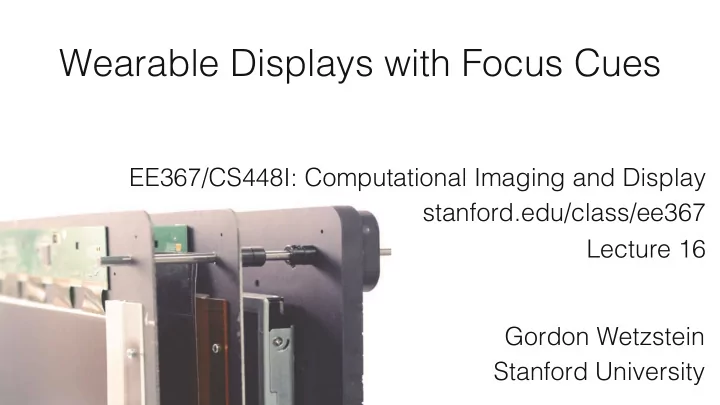
SLIDE 1
Wearable Displays with Focus Cues!
Gordon Wetzstein! Stanford University! EE367/CS448I: Computational Imaging and Display! stanford.edu/class/ee367! Lecture 16!
SLIDE 2
SLIDE 3 remote control of vehicles, e.g. drones! architecture walkthroughs! virtual travel! education! robotic surgery! gaming! simulation & training! visualization & entertainment! a trip down the rabbit hole!
SLIDE 4 VR at Stanford’s Medical School!
!
Lucile Packard Children’s Hospital: used to alleviate pain, anxiety for pediatric patients! ! !
VR Technology Clinic: applications in psychotherapy, mental health, for people with phantom pain, …!
help train residents, assist surgeons planning
photo from Stanford Medicine News!
SLIDE 5 Exciting Engineering Aspects of VR/AR!
sensors & imaging!
computer vision!
scene understanding!
photonics / waveguides!
human perception !
displays: visual, auditory, vestibular, haptic, …!
VR cameras!
cloud computing!
shared experiences!
HCI!
applications!
compression, streaming!
CPU, GPU!
IPU, DPU?!
images by microsoft, facebook!
SLIDE 6 Exciting Engineering Aspects of VR/AR!
CPU, GPU!
IPU, DPU?!
sensors & imaging!
computer vision!
scene understanding!
VR cameras!
cloud computing!
shared experiences!
compression, streaming!
photonics / waveguides!
human perception !
displays: visual, auditory, vestibular, haptic, …!
HCI!
applications!
images by microsoft, facebook!
SLIDE 7 Where We Want It To Be!
image by ray ban!
SLIDE 8 Personal Computer!
e.g. Commodore PET 1983!
Laptop!
e.g. Apple MacBook!
Smartphone!
e.g. Google Pixel!
AR/VR!
e.g. Microsoft Hololens!
???!
SLIDE 9 A Brief History of Virtual Reality!
1838! 1968! 2012-2017!
Stereoscopes!
Wheatstone, Brewster, …!
VR & AR !
Ivan Sutherland!
VR explosion!
Oculus, Sony, HTC, MS, …!
Nintendo! Virtual Boy!
1995!
???!
SLIDE 10 Ivan Sutherland’s HMD!
- !
- ptical see-through AR, including:!
- !
displays (2x 1” CRTs)!
rendering!
head tracking!
interaction!
model generation!
computer graphics!
human-computer interaction!
- I. Sutherland “A head-mounted three-dimensional display”, Fall Joint Computer Conference 1968!
SLIDE 11 Nintendo Virtual Boy!
computer graphics & GPUs were not ready yet!! ! Game: Red Alarm! !
SLIDE 12 Where we are now
IFIXIT teardown
SLIDE 13
SLIDE 14 Virtual Image!
1 d + 1 d' = 1 f
d! d’! f!
Problems: ! !
fixed focal plane!
no focus cues !
cannot drive accommodation with rendering!
SLIDE 15
Focus Cues – An Important Depth Cue!
SLIDE 16 Duane, 1912!
Nearest focus distance! Age (years)!
8! 16! 24! 32! 40! 48! 56! 64! 72! 4D (25cm)! 8D (12.5cm)! 12D (8cm)!
Importance of Focus Cues Decreases with Age - Presbyopia!
0D ("cm)! 16D (6cm)!
SLIDE 17 Relative Importance of Depth Cues!
Cutting & Vishton, 1995!
SLIDE 18
SLIDE 19
SLIDE 20
SLIDE 21
SLIDE 22
SLIDE 23
SLIDE 24
SLIDE 25
Blur Gradient Driven Accommodation
SLIDE 26
Blur Gradient Driven Accommodation
SLIDE 27
Blur Gradient Driven Accommodation
SLIDE 28
Blur Gradient Driven Accommodation
SLIDE 29
Blur Gradient Driven Accommodation
SLIDE 30
Blur Gradient Driven Accommodation
SLIDE 31
Blur Gradient Driven Accommodation
SLIDE 32
The Vergence-Accommodation Conflict (VAC)
SLIDE 33
Real World:! Vergence &! Accommodation! Match!
SLIDE 34
Current VR Displays:! Vergence & ! Accommodation! Mismatch! !
SLIDE 35
- Visual discomfort (eye tiredness & eyestrain) after ~20 minutes of
stereoscopic depth judgments (Hoffman et al. 2008; Shibata et al. 2011)
- Degrades visual performance in terms of reaction times and acuity
for stereoscopic vision (Hoffman et al. 2008; Konrad et al. 2016; Johnson et al. 2016)
- also: double vision (diplopia), reduced visual clarity, possibly
nausea
Consequences of Vergence-Accommodation Conflict
SLIDE 36
- Q1: How to address the vergence-accommodation
conflict for users of different ages?
- Q2: Can computational displays effectively replace
glasses in VR/AR?
- Q3: What are (in)effective near-eye display technologies?
possible solutions: gaze-contingent focus, light fields, …
SLIDE 37
- 1. Gaze-contingent Focus
- 1. Gaze-contingent Focus
SLIDE 38 Magnified Display! Display! Lens!
Fixed Focus!
1 d + 1 d' = 1 f
d! d’! f!
SLIDE 39 Adaptive Focus!
Magnified Display! Display! Lens!
1 d + 1 d' = 1 f
actuator " vary d’!
SLIDE 40 Adaptive Focus!
Magnified Display! Display! Lens!
focus-tunable! lens " vary f!
1 d + 1 d' = 1 f
SLIDE 41 Adaptive Focus - History!
- !
- M. Heilig “Sensorama”, 1962 (US Patent #3,050,870)!
- !
- P. Mills, H. Fuchs, S. Pizer “High-Speed Interaction On A Vibrating-Mirror 3D Display”, SPIE 0507 1984!
- !
- S. Shiwa, K. Omura, F. Kishino “Proposal for a 3-D display with accommodative compensation: 3DDAC”, JSID 1996!
- !
- S. McQuaide, E. Seibel, J. Kelly, B. Schowengerdt, T. Furness “A retinal scanning display system that produces multiple focal planes
with a deformable membrane mirror”, Displays 2003!
- !
- S. Liu, D. Cheng, H. Hua “An optical see-through head mounted display with addressable focal planes”, Proc. ISMAR 2008!
manual focus adjustment! Heilig 1962! automatic focus adjustment! Mills 1984! deformabe mirrors & lenses! McQuaide 2003, Liu 2008!
SLIDE 42 Padmanaban et al., PNAS 2017
SLIDE 43 Padmanaban et al., PNAS 2017
SLIDE 44 Padmanaban et al., PNAS 2017
SLIDE 45 Padmanaban et al., PNAS 2017
SLIDE 46 Padmanaban et al., PNAS 2017
SLIDE 47 Padmanaban et al., PNAS 2017
SLIDE 48 Padmanaban et al., PNAS 2017
SLIDE 49 Conventional
stereoscopic distance virtual image distance stereoscopic distance
vergence accommodation
Conventional Stereo / VR Display
SLIDE 50 With Focus Cues
virtual image distance stereoscopic distance stereoscopic distance
vergence accommodation
Removing VAC with Adaptive Focus
SLIDE 51 Follow the target with your eyes!
4D ! (0.25m)! 0.5D! (2m)!
Task!
SLIDE 52 Conventional
stereoscopic distance virtual image distance stereoscopic distance
Stimulus!
Padmanaban et al., PNAS 2017!
Accommodative Response!
Relative Distance [D]! Time [s]!
SLIDE 53 Stimulus! Accommodation! n = 59, mean gain = 0.29!
Padmanaban et al., PNAS 2017!
Accommodative Response!
Conventional
stereoscopic distance virtual image distance stereoscopic distance
Relative Distance [D]! Time [s]!
SLIDE 54 With Focus Cues
virtual image distance stereoscopic distance stereoscopic distance
Stimulus!
Padmanaban et al., PNAS 2017!
Accommodative Response!
Relative Distance [D]! Time [s]!
SLIDE 55 Stimulus! Accommodation!
Padmanaban et al., PNAS 2017!
Accommodative Response!
With Focus Cues
virtual image distance stereoscopic distance stereoscopic distance
Relative Distance [D]! Time [s]! n = 24, mean gain = 0.77!
SLIDE 56 Padmanaban et al., PNAS 2017
Do Presbyopes Benefit from Dynamic Focus?
Gain Age
SLIDE 57 Padmanaban et al., PNAS 2017
Do Presbyopes Benefit from Dynamic Focus?
Gain Age
conventional
SLIDE 58 Padmanaban et al., PNAS 2017
Do Presbyopes Benefit from Dynamic Focus?
Gain Age
conventional dynamic
SLIDE 59 Padmanaban et al., PNAS 2017!
Do Presbyopes Benefit from Dynamic Focus?!
Gain! Age!
conventional! dynamic!
Response for Physical Stimulus! Heron & Charman 2004!
SLIDE 60 Gaze-contingent Focus!
non-presbyopes: adaptive focus is like real world, but needs eye tracking!
HMD! lens! micro display! virtual image! eye tracking!
Padmanaban et al., PNAS 2017!
SLIDE 61 Gaze-contingent Focus!
Padmanaban et al., PNAS 2017!
SLIDE 62 Gaze-contingent Focus!
Padmanaban et al., PNAS 2017!
SLIDE 63 Gaze-contingent Focus!
Padmanaban et al., PNAS 2017!
SLIDE 64
at ACM SIGGRAPH 2016!
SLIDE 65
Oculus announces gaze-contingent varifocal display at F8, 05/2018 !
SLIDE 66 Oculus Half Dome Prototype!
Video courtesy of Facebook/Oculus!
SLIDE 67 Summary
- adaptive focus drives accommodation and can correct for refractive errors
(myopia, hyperopia)
- gaze-contingent focus gives natural focus cues for non-presbyopes, but
require eyes tracking
- presbyopes require fixed focal plane with correction
SLIDE 68
- 2. Light Field Displays
- 2. Light Field Displays
SLIDE 69
Near-eye Light Field Displays
Idea: project multiple different perspectives into different parts of the pupil!
SLIDE 70 Light Field Cameras! Light Field Stereoscope!
Huang et al., SIGGRAPH 2015!
SLIDE 71 Backlight! Thin Spacer & 2nd panel (6mm)! Magnifying Lenses! LCD Panel!
Light Field Stereoscope!
Huang et al., SIGGRAPH 2015!
SLIDE 72 Target Light Field!
Input: 4D light field for each eye!
SLIDE 73 Multiplicative Two-layer Modulation! Input: 4D light field for each eye!
SLIDE 74 Multiplicative Two-layer Modulation! Input: 4D light field for each eye!
SLIDE 75 Multiplicative Two-layer Modulation! Input: 4D light field for each eye!
SLIDE 76 Multiplicative Two-layer Modulation! Reconstruction:! for layer t1!
Tensor Displays, ! Wetzstein et al. 2012!
Input: 4D light field for each eye!
SLIDE 77 Traditional HMDs!
The Light Field HMD! Stereoscope!
Light Field Stereoscope!
Huang et al., SIGGRAPH 2015!
SLIDE 78 Traditional HMDs!
The Light Field HMD! Stereoscope!
Light Field Stereoscope!
Huang et al., SIGGRAPH 2015!
SLIDE 79 Traditional HMDs!
The Light Field HMD! Stereoscope!
Light Field Stereoscope!
Huang et al., SIGGRAPH 2015!
SLIDE 80 Traditional HMDs!
The Light Field HMD! Stereoscope!
Light Field Stereoscope!
Huang et al., SIGGRAPH 2015!
SLIDE 81 Tensor Displays!
Wetzstein et al., SIGGRAPH 2012!
SLIDE 82 Vision-correcting Display
iPod Touch prototype printed transparency
Huang et al., SIGGRAPH 2014
SLIDE 83 prototype! 300 dpi or higher!
Huang et al., SIGGRAPH 2014!
SLIDE 84 Diffraction in Multilayer Light Field Displays!
Wetzstein et al., SIGGRAPH 2011! Lanman et al., SIGGRAPH Asia 2011! Wetzstein et al., SIGGRAPH 2012! Maimone et all., Trans. Graph. 2013! …! Hirsch et al, SIGGRAPH 2014!
Less diffraction artifacts with LCoS !
blur!!
SLIDE 85
- 3. Accommodation-invariant Near-eye Displays
- 3. Accommodation-invariant Near-eye Displays
SLIDE 86
Blur Gradient Driven Accommodation
SLIDE 87
PSF Engineering
SLIDE 88
Q: can we drive accommodation with stereoscopic cues by optically removing the retinal blur cue?
SLIDE 89
SLIDE 90
SLIDE 91
SLIDE 92
SLIDE 93
How do we remove the blur cue?
SLIDE 94 Aperture Controls Depth of Field!
Image courtesy of Concept One Studios!
SLIDE 95 Aperture Controls Depth of Field!
Image courtesy of Concept One Studios!
SLIDE 96 Aperture Controls Depth of Field!
Image courtesy of Concept One Studios!
SLIDE 97 Maxwellian-type (pinhole) Near-eye Displays!
Point Light! Source!
SLIDE 98 Maxwellian-type (pinhole) Near-eye Displays
Severely reduces eyebox; requires dynamic steering of exit pupil
Spatial Light Modulator Point Light Source
SLIDE 99 Focal Sweep!
EDOF Cameras:!
Dowski & Cathey, App. Opt. 1995! Nagahara et al., ECCV 2008! Cossairt et al., SIGGRAPH 2010!
60Hz
SLIDE 100
SLIDE 101
SLIDE 102
Convolution!
SLIDE 103
Convolution!
SLIDE 104
Deconvolution!
SLIDE 105 Target Image
Target
SLIDE 106 Target Image! Conventional Display @ 1D!
Target! Conventional!
SLIDE 107 Target Image! Conventional Display @ 3D!
Target! Conventional!
SLIDE 108 Target! Conventional! AI!
AI @ 3D! Conventional Display @ 3D!
SLIDE 109 Stimulus
Distance (D)
3 2 1
Dynamic
5 10
Time Gain: 0.85
5 10 15 20
Time (s)
SLIDE 110 Measured User Response
Distance (D)
3 2 1
Dynamic
5 10
Time Gain: 0.85 Conventional
5 10 15 20
Time (s) Gain: 0.35
Stimulus Average
SLIDE 111 Measured User Response
Distance (D)
3 2 1
Dynamic
5 10
Time Gain: 0.85 Conventional
5 10 15 20
Time (s) Gain: 0.35
Stimulus Average
SLIDE 112
Future: multifocal lenses! Now: benchtop!
SLIDE 113
Photonics Challenges for Getting Here!
SLIDE 114
Thin Beam Combiner?!
SLIDE 115
Thin Beam Combiner!
SLIDE 116
Pepper’s Ghost 1862!
SLIDE 117
Case Studies Case Studies
SLIDE 118
Google Glass!
SLIDE 119
Google Glass!
SLIDE 120 Meta 2!
- ! larger field of view (90 deg) than Glass!
- ! also larger device form factor !
SLIDE 121
Microsoft HoloLens!
SLIDE 122 Microsoft HoloLens!
- ! diffraction grating-based
waveguide!
!
diagonally, 16:9 aspect, 47 pixels per visual degree!
SLIDE 123 Microsoft HoloLens 2!
Wall et al. US 10,025,093 2018
laser-scanned waveguide display!
claimed 2K resolution per eye (2560x1440), probably via “interlaced” scanning!
field of view: 52° diagonally (3:2 aspect, 47 pixels per visual degree) !
https://www.kguttag.com/2019/02/27/ hololens-2-first-impressions-good- ergonomics-but-the-lbs-resolution- math-fails/
SLIDE 124 Zeiss Smart Optics!
- ! great device form factor!
- ! polycarbonate light guide – easy to manufacture and robust!
- ! smaller field of view (17 deg)!
SLIDE 125
Challenges: Eye Box vs Field of View!
SLIDE 126 Challenges: Eye Box vs Field of View!
eye box / exit pupil! entrance pupil!
need small entrance pupil (small device) and large exit pupil (large eye box) - pupil needs to be magnified!
SLIDE 127 Challenges: Eye Box vs Field of View!
eye box / exit pupil! entrance pupil!
need small display (small device) but large field of view – image needs to be magnified!
field of view!
SLIDE 128 Challenges: Eye Box vs Field of View!
eye box / exit pupil! entrance pupil!
pupil needs to be magnified!
image needs to be magnified!
field of view!
can’t get both at the same time – etendue!
SLIDE 129 Challenges: Eye Box vs Field of View!
eye box / exit pupil! entrance pupil!
possible solutions: exit pupil replication (loss of light), live with small FOV (not great), dynamically steer eye box (mechanically difficult), ..!
field of view!
SLIDE 130 Challenges: Chromatic Aberrations!
thin grating couplers create chromatic aberrations!
SLIDE 131 Challenges: Chromatic Aberrations!
all solutions have their own problems: ease of manufacturing, yield, robustness, cost, …!
volume holographic couplers, e.g. TruLife Optics! stacked waveguides!
SLIDE 132 Occlusions!
Case 1: ! virtual in front of real! Case 2: ! real in front of virtual! virtual!
real!
" difficult: need to block real light!! " easy: don’t render virtual object everywhere!
SLIDE 133
Next quarter: EE 267!
SLIDE 134
The End