Wave Picture Reflection and Transmission @ dielectric interface - - PowerPoint PPT Presentation

wave picture reflection and transmission dielectric
SMART_READER_LITE
LIVE PREVIEW

Wave Picture Reflection and Transmission @ dielectric interface - - PowerPoint PPT Presentation

Wave Picture Reflection and Transmission @ dielectric interface Snells Law 1. Fermat's principle, which states that the light travels the path which takes the least time. By taking the derivative of the optical path length, the stationary


slide-1
SLIDE 1

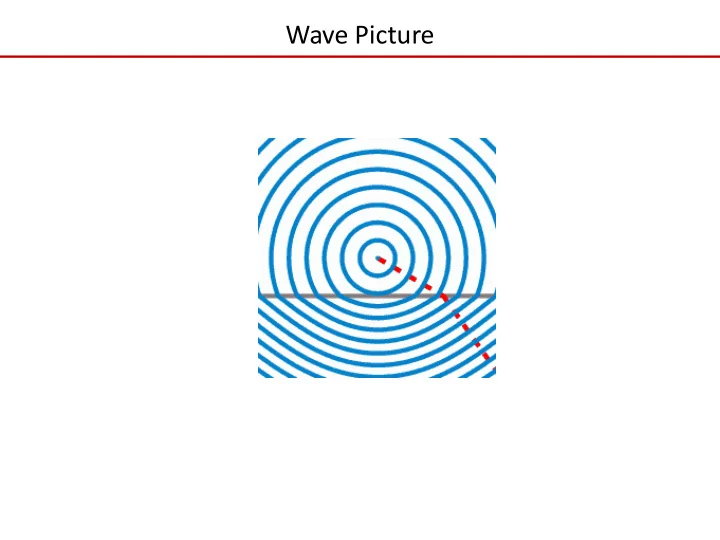
Wave Picture

slide-2
SLIDE 2

Reflection and Transmission @ dielectric interface

slide-3
SLIDE 3

Snell’s Law

1. Fermat's principle, which states that the light travels the path which takes the least time. By taking the derivative of the optical path length, the stationary point is found giving the path taken by the light (though it should be noted that the result does not show light taking the least time path, but rather one that is stationary with respect to small variations as there are cases where light actually takes the greatest time path, as in a spherical mirror).

  • In a classic analogy, the area of lower refractive index is replaced by a beach, the area of higher

refractive index by the sea, and the fastest way for a rescuer on the beach to get to a drowning person in the sea is to run along a path that follows Snell's law.

  • 2. Snell's law can be derived using interference of all possible paths of light wave from source to
  • bserver—it results in destructive interference everywhere except extrema of phase (where interference is

constructive)—which become actual paths.

  • 3. Application of the general boundary conditions of Maxwell equations for electromagnetic radiation.
  • 4. . Conservation of momentum based on translation symmetry considerations
slide-4
SLIDE 4

Derive Snell’s Law by Translation Symmetry

A homogeneous surface perpendicular to say the z direction can not change the transverse momentum. Since the propagation vector is proportional to the photon's momentum, the transverse propagation direction (kx,ky,0) must remain the same in both regions. Assuming without loss of generality a plane of incidence in the z,x plane kxRegion1 = kxRregion2. Using the well known dependence of the wave number on the refractive index of the medium, we derive Snell's law immediately.

kxRegion1 = kxRregion2 n1k0sinθ1 = n2k0sinθ2 n1sinθ1 = n2sinθ2

where is the wavenumber in vacuum. Note that no surface is truly homogeneous, in the least at the atomic scale. Yet full translational symmetry is an excellent approximation whenever the region is homogeneous on the scale of the light wavelength.

slide-5
SLIDE 5

Total Internal Reflectation

When light travels from a medium with a higher refractive index to one with a lower refractive index, Snell's law seems to require in some cases (whenever the angle of incidence is large enough) that the sine of the angle of refraction be greater than one. This of course is impossible, and the light in such cases is completely reflected by the boundary, a phenomenon known as total internal reflection. The largest possible angle of incidence which still results in a refracted ray is called the critical angle; in this case the refracted ray travels along the boundary between the two media. For example, consider a ray of light moving from water to air with an angle of incidence of 50°. The refractive indices of water and air are approximately 1.333 and 1, respectively, so Snell's law gives us the relation which is impossible to satisfy. The critical angle θcrit is the value of θ1 for which θ2 equals 90°: