Water is Life: Mapping Water Access in Peri-urban Malawi Student - - PowerPoint PPT Presentation

water is life mapping water access in peri urban malawi
SMART_READER_LITE
LIVE PREVIEW

Water is Life: Mapping Water Access in Peri-urban Malawi Student - - PowerPoint PPT Presentation

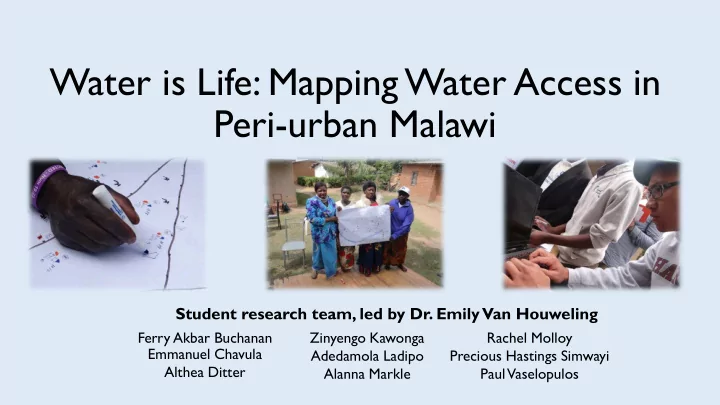
Water is Life: Mapping Water Access in Peri-urban Malawi Student research team, led by Dr. Emily Van Houweling Ferry Akbar Buchanan Zinyengo Kawonga Rachel Molloy Emmanuel Chavula Adedamola Ladipo Precious Hastings Simwayi Althea Ditter


slide-1
SLIDE 1

Water is Life: Mapping Water Access in Peri-urban Malawi

Ferry Akbar Buchanan Emmanuel Chavula Althea Ditter Zinyengo Kawonga Adedamola Ladipo Alanna Markle Rachel Molloy Precious Hastings Simwayi Paul Vaselopulos

Student research team, led by Dr. Emily Van Houweling

slide-2
SLIDE 2

10 20 30 40 50 60 70 80 90 100 1990 1995 2000 2005 2010 2015

PERCENT OF POPULATION YEAR Malawi Sub-Saharan Africa SADC

Safe Water Access, 1990-2015

90.2 67.6 64.4

slide-3
SLIDE 3

WASH-Related Indicators for Children Under 5

  • Underweight prevalence – 17%
  • Stunting prevalence – 42%
  • Diarrohea (last 2 weeks) – 24%
  • Mortality rate – 9%
slide-4
SLIDE 4

Evidence-based Decision Making

Data Analysis

Research question Desk research Data collection

Share Findings

slide-5
SLIDE 5

Research Objectives

Research question What is the reality of water access in peri-urban Malawi? Hypothesis Qualitative indicators may provide a more accurate depiction of water access in communities than coverage-based indicators

slide-6
SLIDE 6

Methodology

Data Collection

  • Participatory mapping
  • Focus groups
  • GIS mapping of

community

  • Semi-structured

interviews

  • Households & water

points

  • Decision makers
slide-7
SLIDE 7

Site Description

  • Peri-urban area north of Mzuzu

City located at Area 1B-Block 23 in Luwinga

  • Area is 11.56 hectares
  • Originally founded in 1981 by 8

families

  • Approximately 193 households
  • House density is one household

per .06 hectares

slide-8
SLIDE 8

Development Challenges

Safe water access Pit latrine stability and quality No summer or after school activities Food contamination in the market Hunger and undernutrition Distance from health facility and secondary schools

slide-9
SLIDE 9

Quotes

“Many children do not receive education beyond secondary school because they need to find jobs because

  • f lack of finances to pay for water.”

“There are many challenges in the community. Because of disease, malnutrition and distance from health facilities, there is a lot of death in the area. ”

slide-10
SLIDE 10

Income in Area 1B

Area 1B appears to have mixed levels of income, which was indicated by the following household attributes:

  • Roofing materials
  • Thatched Roofs 14%
  • Iron Sheets 79%
  • No Roof 8%
  • Electrical access
  • Electricity 42%
  • Without Electricity

59%

slide-11
SLIDE 11

Income Con’t

  • Sharing of sanitation

facilities

  • Shared Latrines 50%
  • Private Latrines or

Flush Toilets 39%

  • Ownership
  • Owned 42%
  • Rented 43%
slide-12
SLIDE 12

Types of Water Sources on Site

“Improved” Sources “Unimproved” Sources

Community Tap: 10% of surveyed households use Private Tap: 61% of surveyed households use Partially Covered Well: 43% of surveyed households use Unprotected Source: 0.6% of surveyed households use

slide-13
SLIDE 13

Types of Sanitation Facilities on Site

“Improved” Facilities “Unimproved” Facilities

Shared Pit Latrines: 56% of surveyed households share pit latrines Flush Toilets with Septic Tank: 8% of surveyed households use Latrine slabs for sale in local market

slide-14
SLIDE 14

Women’s Map

  • 31 hand dug wells, 4

non-operational

  • 3 operational

communal taps, 1 non-

  • perational communal

tap

  • Drew the church,

mosque, and the mill

  • Indicated more dug

wells

slide-15
SLIDE 15

Men’s Map

  • 22 hand dug wells, 2

non-operational

  • 3 operational

communal taps

  • Men drew a church

and a mosque

  • Indicated fewer wells

to upper side of the map

slide-16
SLIDE 16
  • Cost
  • Reliability
  • Seasonality
  • Functionality
  • Management
  • Trust in committees
  • Poor financial management
  • Importance of social

relations

  • Use of multiple sources
  • Poorly constructed

infrastructure

  • Wells
  • Latrines

Main Takeaways

slide-17
SLIDE 17

Data Analysis & Findings

Data Analysis:

  • Spatial
  • Quantitative
  • Qualitative
slide-18
SLIDE 18

Spatial Data Analysis

GPS

  • Collect &

Input Information collected from Area 1B Block 26

BaseCamp

  • Import &

Organize Data

Excel

  • Clean

Imported Data & Convert Necessary Tracking Coordinates

ArcMap

  • Develop

Map and Perform Spatial Analyses

slide-19
SLIDE 19

Map Features

  • Community Map:
  • Community Taps
  • Septic Tank
  • Standing Water
  • Public Latrines
  • Wells
  • Shops & Community Conveniences
  • Mosque
  • Roads and Paths
  • Stream/River
  • Interactive Map:
  • Community Map Features
  • Satellite Image of Area 1B Block 26
  • Spatial Analysis Layers of Attributes
slide-20
SLIDE 20

Households

  • Features In Map:
  • Households
  • Roads and labels
  • River/Stream
  • Water Points
slide-21
SLIDE 21

Households cont.

slide-22
SLIDE 22

Public Water Points

  • Features in Map
  • Water Points
  • Households
  • Roads
  • River/Stream
  • Findings
  • All households are within 500

meters of public water points

500m

slide-23
SLIDE 23

Public Water Points cont.

slide-24
SLIDE 24

Community Taps

  • Features in Map
  • Community Tap
  • Households
  • Roads
  • Rivers/Streams
  • Findings
  • All community taps are within 250

meters of households

250m

slide-25
SLIDE 25

Community Taps cont.

slide-26
SLIDE 26

Public Pit Latrines

  • Features in Map
  • Public Pit Latrines
  • Public Water Points
  • Findings
  • Only 1 out of 4 pit latrines are outside
  • f the required 30 meter radius of

public water pointsd

slide-27
SLIDE 27

Public Pit Latrines cont.

slide-28
SLIDE 28

Main Takeaways

  • Community is 100% covered
  • Community receptive and engaged
  • Accuracy of participatory maps
  • Contamination from latrines

threatens safe water sources

  • Population density
slide-29
SLIDE 29

Primary Finding: Water Access in Block 1B

JMP improved access 100% Piped water access 69% Piped water sole source 46%

slide-30
SLIDE 30

No Electricity Electricity Shar Priva

Matrix of Water Sources by Wealth Indicators

Community Tap Piped S tream Well

slide-31
SLIDE 31

Distance + Technology Economic Social Environmental

Reality of Water Access in Peri-urban Malawi

slide-32
SLIDE 32

Sharing Findings with the Community

Presenting findings to community for discussion and feedback Reviewing map accuracy Discussing future use of map and possible research projects

slide-33
SLIDE 33

Quotes

“We want the gap between the community and Water Board breached. We want a mediator between the community and the government. The community wants water quality testing. There is a lack of funds to cover the cost for testing. We need the technology and expertise to use the water quality testing equipment .” “We want to pre-pay for our water to prevent it from being stolen. The Water Board is profiting from privatizing the community taps and infringing on our access and use of water. We want better training on how to use the meters for the water from the community taps. There is a lack of trust in the community towards the Water Board. Being able to better keep track of our own meters will allow the community to advocate for more accurate rates of water use and charges. ”

slide-34
SLIDE 34

Summary of Findings

  • Definition of access impacts results
  • Affordability main barrier
  • Importance of community

participation in evidence-based decision making

  • Qualitative research complements

GIS data

slide-35
SLIDE 35

Recommendations

  • Affordability assessment
  • Explore misunderstandings between

water users and Water Board

  • Water quality testing of unimproved

sources

  • Expand mapping scale
  • Integrate with existing data collection

efforts

slide-36
SLIDE 36

Thank you | Zikomo kwambiri | Tawonga chomene