W through a poster, a performance, or a display Cite sources to - - PDF document

w
SMART_READER_LITE
LIVE PREVIEW

W through a poster, a performance, or a display Cite sources to - - PDF document

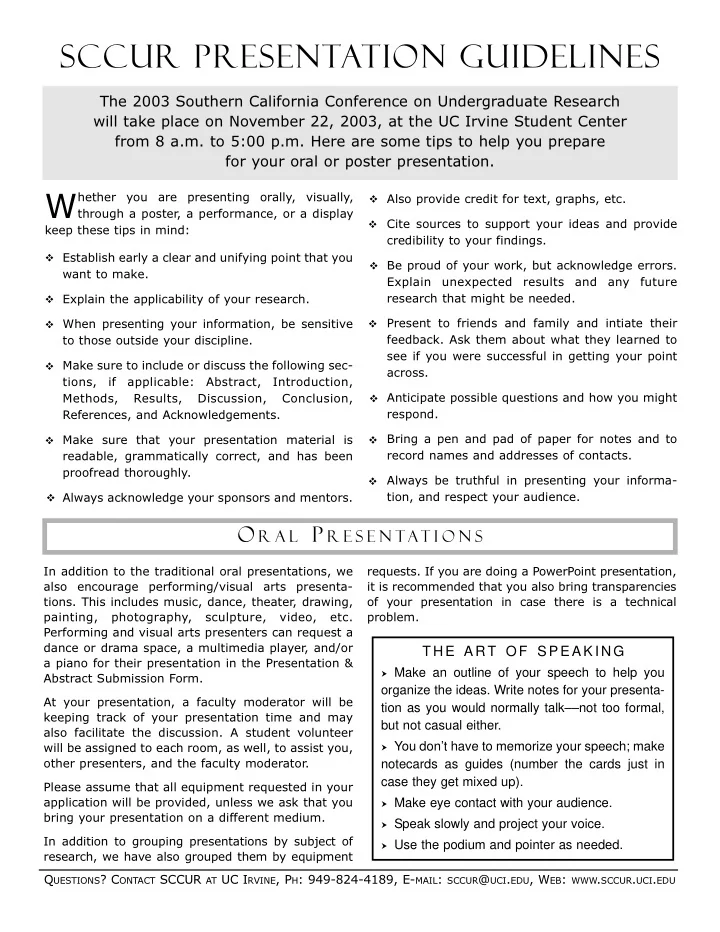
SCCUR Presentation Guidelines The 2003 Southern California Conference on Undergraduate Research will take place on November 22, 2003, at the UC Irvine Student Center from 8 a.m. to 5:00 p.m. Here are some tips to help you prepare for your oral


slide-1
SLIDE 1

SCCUR Presentation Guidelines

The 2003 Southern California Conference on Undergraduate Research will take place on November 22, 2003, at the UC Irvine Student Center from 8 a.m. to 5:00 p.m. Here are some tips to help you prepare for your oral or poster presentation.

W

hether you are presenting orally, visually, through a poster, a performance, or a display keep these tips in mind:

O R A L P R E S E N T AT I O N S

In addition to the traditional oral presentations, we also encourage performing/visual arts presenta-

  • tions. This includes music, dance, theater, drawing,

painting, photography, sculpture, video, etc. Performing and visual arts presenters can request a dance or drama space, a multimedia player, and/or a piano for their presentation in the Presentation & Abstract Submission Form. At your presentation, a faculty moderator will be keeping track of your presentation time and may also facilitate the discussion. A student volunteer will be assigned to each room, as well, to assist you,

  • ther presenters, and the faculty moderator.

Please assume that all equipment requested in your application will be provided, unless we ask that you bring your presentation on a different medium. In addition to grouping presentations by subject of research, we have also grouped them by equipment

  • requests. If you are doing a PowerPoint presentation,

it is recommended that you also bring transparencies

  • f your presentation in case there is a technical

problem.

THE ART OF SPEAKING

Make an outline of your speech to help you

  • rganize the ideas. Write notes for your presenta-

tion as you would normally talk––not too formal, but not casual either. You don’t have to memorize your speech; make notecards as guides (number the cards just in case they get mixed up). Make eye contact with your audience. Speak slowly and project your voice. Use the podium and pointer as needed.

QUESTIONS? CONTACT SCCUR AT UC IRVINE, PH: 949-824-4189, E-MAIL: SCCUR@UCI.EDU, WEB: WWW.SCCUR.UCI.EDU Establish early a clear and unifying point that you want to make. Explain the applicability of your research. When presenting your information, be sensitive to those outside your discipline. Make sure to include or discuss the following sec- tions, if applicable: Abstract, Introduction, Methods, Results, Discussion, Conclusion, References, and Acknowledgements. Make sure that your presentation material is readable, grammatically correct, and has been proofread thoroughly. Always acknowledge your sponsors and mentors. Also provide credit for text, graphs, etc. Cite sources to support your ideas and provide credibility to your findings. Be proud of your work, but acknowledge errors. Explain unexpected results and any future research that might be needed. Present to friends and family and intiate their

  • feedback. Ask them about what they learned to

see if you were successful in getting your point across. Anticipate possible questions and how you might respond. Bring a pen and pad of paper for notes and to record names and addresses of contacts. Always be truthful in presenting your informa- tion, and respect your audience.

slide-2
SLIDE 2

Prepare your visual aids well in advance and make sure they are clear . Use visual aids where appropriate in oral presentations because many people learn bet- ter visually, especially if they are not familiar with the

  • subject. Also, people remember more of what they

read than what they hear . Keep words to a minimum on slides, transparencies and other visual aids; make sure they are readable from the back of the room. Words should be large enough to read from several feet away, but don’t use all caps. Avoid using light colors for words, such as yellow or orange. The size of the typeface should be at least 12 point. Number your visual aids so you always know the

  • rder in case they get dropped or misplaced.

If you are using PowerPoint, slides, or transparencies in your presentation, don’t linger on one image for more than five minutes. After presenting the image, eliminate or block the projection source so that the audience will focus back on your talk. If you are using a 35mm slide projector for your pres- entation, come to the room in which you are to pres- ent a few minutes before the start of your session to load your slides into the carousel. Consider your purpose in distributing handouts because they might distract your audience. Give handouts prior to or during your presentation only if they are necessary for clarity during your talk. Otherwise, provide handouts at the end. When presenting statistical data, make the signifi- cance of it clear . In presenting equations, always define your constants and independent and depend- ent variables. Your discussion should focus on the relationship between the variables. Face the audience––don’t talk to your screen or note-

  • cards. Reiterate major points at the end to conclude.

P O S T E R P R E S E N T AT I O N S

If you are displaying a poster, you will find out dur- ing registration the specific location in the UC Irvine Student Center where you may exhibit your poster. Your poster will be displayed on an easel that will be set up against the walls on the bottom and second floors of the Student Center (you can request a table instead if that better suits your presentation materi- al). The posters will be shown throughout the day. Please do not remove your poster until the end of the day’s

  • activities. You will need to be present next to your

poster during your assigned poster session to explain and answer questions about your research. Poster presentations must be on 3’ or 4’ (height) by 4’ (width) poster board. Presentations should be pre- pared on poster board in advance. If this is not pos- sible because of difficulty transporting your poster board, poster board can be requested for the day of the conference. Please note that we are providing

  • nly 3’ (height) by 4’ (width) sized poster board.

Pushpins, glue, and other materials needed to assemble the poster board will be provided (a room for poster assembly will also be available). Space on a poster is limited, so pick wisely what to

  • present. Your display should be self-explanatory and

have a logical flow––others should be able to follow the order even if you are not present. Start with a rough draft of your design on paper, using graph paper or even post-it notes to simulate sections. T Y P E S O F V I S U A L A I D S

35mm slides

  • verhead transparencies

computer projections videos enlarged charts or figures and posters actual objects for display

QUESTIONS? CONTACT SCCUR AT UC IRVINE, PH: 949-824-4189, E-MAIL: SCCUR@UCI.EDU, WEB: WWW.SCCUR.UCI.EDU

ELEMENTS OF STYLE

Don’t use more than two fonts. Instead use bold, italic and font size to set type differently. Times New Roman, Arial, and Garamond are suggested type- faces. Stick to a color scheme (try a couple that com- plement or contrast with each other such as black

  • r navy on white). Try mounting text and figures on

colored paper, or using some colored font. Be consistent with your white space between sections of text, figures and headings; white space should be ample so the poster doesn’t look crammed.

slide-3
SLIDE 3

Posters should be readable from at least 3 feet away. The title of your text should be least 2 inches in

  • height. Include your name, major and school; the

name of your faculty mentor(s), his/her department, and school; and the names of other co-authors, majors and schools (these should be about 1 inch in height). Incorporate appropriate graphics in your

  • poster. Label or describe any charts, tables, figures,

graphs, or photos used. Make sure all edges line up

  • evenly. Edit, review, and spell check all the elements
  • f your poster display. Be sure to firmly attach all

materials to your poster board (spray adhesive, found in art supply stores, works best). During the poster session, stand to the side of your display so that you don’t block it. Prepare and prac- tice a five-minute summary speech about your proj-

  • ect. This time is an excellent networking possibility

so it is important to speak and interact professional-

  • ly. You will also receive lots of feedback and exposure

as well. P O S T E R T Y P E F A C E S I Z E S

Titles should be at least 2 inches high. The body type for the main sections should be at least 18 point if possible. Words should be large enough to read from several feet away, but don’t use all caps.

QUESTIONS? CONTACT SCCUR AT UC IRVINE, PH: 949-824-4189, E-MAIL: SCCUR@UCI.EDU, WEB: WWW.SCCUR.UCI.EDU

WHAT TO EXPECT ON NOVEMBER 22

  • Please arrive between 8-9 AM to pick up nametags and

the Conference Program.

  • Poster presenters will be taken to their easel or table

by a student volunteer.

  • Oral presenters should familiarize themselves with the

room and any equipment that will be used in their presen- tation.

CONFERENCE ETIQUETTE: The Southern California Conference on Undergraduate Research is created as a forum not only to present your achievements as an undergraduate researcher but also as a celebration of bringing together a community committed to excel- lence and knowledge expansion. Be a part of this community and support your peers, who have also experienced the trials and suc- cesses of the research process, by attending their presentations and learning about the research that they have completed. When you are participating as a presenter or as an audience member for the oral presentations, please demonstrate respect and courtesy for your fellow researchers throughout the entire session. If you must leave at anytime during the sessions, please inform the stu- dent room monitors that you will need to leave early, and they will assist you in leaving the session at the end of a presentation and before the next presentation begins.

SCHEDULE OF THE DAY

Registration 8:00 - 4:00 p.m. Breakfast 8:00 - 10:00 a.m. Opening Remarks 8:40 - 8:50 a.m. Oral Presentations, Session I 9:00 - 10:50 a.m. Keynote Speaker 11:00 - 11:50 p.m. Lunch & Roundtable Discussions 12:00 - 12:50 p.m. Poster Presentations, Session I 1:00 - 1:50 p.m. Oral Presentations, Session II 2:00 - 3:50 p.m. Poster Presentations, Session II 4:00 - 5:00 p.m. Reception 4:00 - 5:00 p.m.

UC IRVINE ADDRESS FOR SCCUR 2003: SCCUR 2003 Undergraduate Research Opportunities Program Student Services II, Suite 2300 University of California, Irvine Irvine, CA 92607 For driving directions to UC Irvine, visit our Web site at www.sccur.uci.edu under Contact Information.

slide-4
SLIDE 4

Title of Project Name of student(s), Major, School Faculty mentor(s), Department, School Title of Project Name of student(s), Major, School Faculty mentor(s), Department, School Title of Project Name of student(s), Major, School Faculty mentor(s), Department, School Abstract Abstract Background Information Results Methods Results Figure Acknowledge- ments Figure Discussion Introduction Figures

Conclusion References Acknowledgments Contact Info.

References Conclusion References

Acknowledgements

Results Abstract Introduction Methods Figure Figure

Graphics Graphics

SAMPLE DESIGNS FOR POSTER PRESENTATIONS

Figure QUESTIONS? CONTACT SCCUR AT UC IRVINE, PH: 949-824-4189, E-MAIL: SCCUR@UCI.EDU, WEB: WWW.SCCUR.UCI.EDU