
SLIDE 1
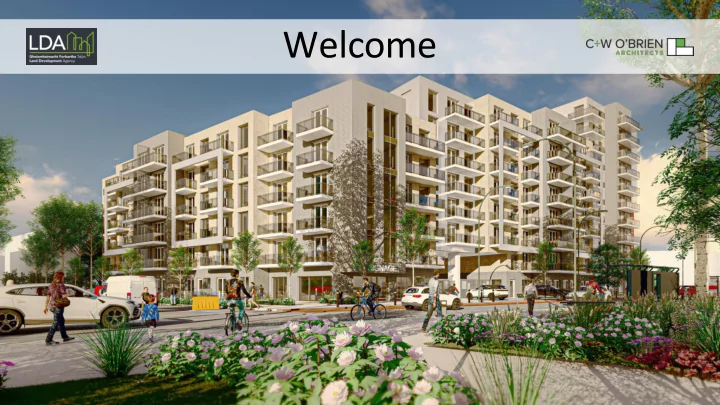
Welcome Agenda Who are C+W OBrien Architects Why are we here? - - PowerPoint PPT Presentation
Welcome Agenda Who are C+W OBrien Architects Why are we here? What is Modular Construction? What is all the Hype about? Whats happening next? Agenda Who are C+W OBrien Architects Why are we here?
2015 - DublinPort
2017 – Sandyford StudentResidences
2017 – Sandyford StudentResidences
2018 – Cookstown Phase1
2019 – CookstownRegeneration Concept Design Technical Design
Research & Development
Testing & Certification
PANELISED SYSTEMS 2 DIMENSIONAL
Also regarded as “non-volumetric pre-assembly”. These are either classified as ‘open’ or ‘closed’ with open panels normally being non-insulated and closed panels being insulated. Enhanced panels are also referred to and these panelised systems have been enhanced beyond the closed state to include windows and doors, services (electrical or plumbing) or other finishes such as external cladding or internal lining..
MODULAR OR VOLUMETRIC SYSTEMS – 3 DIMENSIONAL
This term is used to describe units prefabricated in a factory that enclose usable space that are typically fully finished internally, such as toilet/bathroom pods and plant rooms, whichare then installed within or onto a building or
buildings” where the completed useable space forms part of the completed building or structure finished internally (lined) and externally (clad). These are up to 80–95 per cent complete when they leave the factory
SUB-ASSEMBLIES AND COMPONENTS – 2D OR 3D
This covers manufactured components that fall short of being fully offsite manufacturedsystems. Typically, the term refers to simplified components like stairs, doors and windows that are manufactured in factories. They require more joints and connections, and require more careful alignments and infiltration checks.
HYBRID SYSTEM – 2D + 3D
A hybrid system is a combination of more than
combination of both volumetric and panelised systems.
HYBRID SYSTEM – 2D + 3D
Whole buildings are standardised building units prefabricated to the highest degree of finish as compared to components, panels, modules, and
factory environment (with larger building structures), providing the opportunity for the manufacturer to take control of the quality and speed of completion of the final product. However, sometimes their bulk size and weight presents difficulties in transportation from the factory to the building site.
1.Structure from first floor slab is Panelised Precast Concrete for Walls and Floors 2.Pods are used for Bathrooms, manufactured
plate with the structure is rising and manoeuvred into place when partitions are being constructed 3.Unitised façade panels; manufactured off site with windows, fibre cement cladding, insulation and fire stopping in place.
C + W O’Brien Architects have been working with
developed has developed through the various changes to industry standards and the implementation of the SHD process to go from 102 units in it’s first planning application, to an second application to increase to 126 apartments following updates to the apartment standards and currently an application is due for 196 units following the recent changes to the height guidelines. Over the past few months the development has changed hands. This led to a desire to build the project using 3D Modular Construction. C+W O’Brien Architects along with the design team have spent the past 2 months reviewing the design and have developed a modular design that works economically as well as avoiding the need for another planning application on the site. The project is currently in technical design phase and is due to start on site in September.
Cost of Construction Life Cycle Cost Higher Volume
Time Saving of 20%- 50% Faster return / income
Design Durability lifecycle Life cycle cost Factory produced quality control
Delivery certainty Logistics Contracting entity
Architects are arranging a series of 6 morning events in DCC offices to move the discussion on
event on February 4th 2020
BAM will be on site in the new year
Manufacturers