Vital Status on Emergency Visits and Hospital Admissions: A Remote - - PowerPoint PPT Presentation

vital status on emergency visits and
SMART_READER_LITE
LIVE PREVIEW

Vital Status on Emergency Visits and Hospital Admissions: A Remote - - PowerPoint PPT Presentation

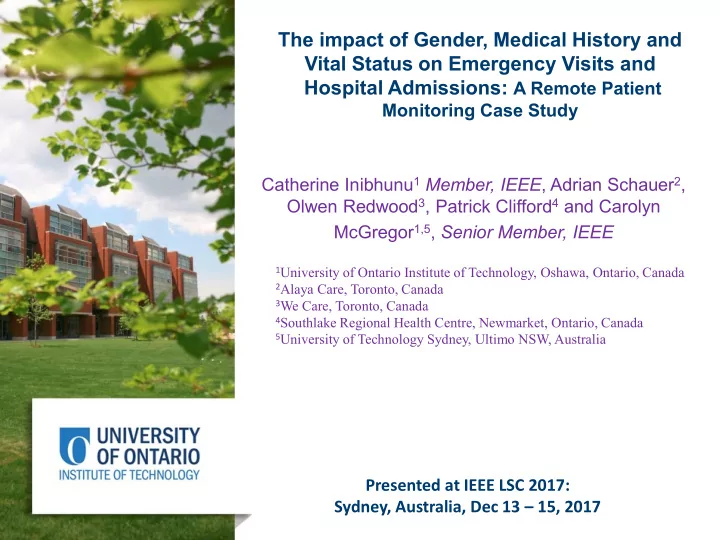
The impact of Gender, Medical History and Vital Status on Emergency Visits and Hospital Admissions: A Remote Patient Monitoring Case Study Catherine Inibhunu 1 Member, IEEE , Adrian Schauer 2 , Olwen Redwood 3 , Patrick Clifford 4 and Carolyn


slide-1
SLIDE 1

The impact of Gender, Medical History and Vital Status on Emergency Visits and Hospital Admissions: A Remote Patient

Monitoring Case Study Catherine Inibhunu1 Member, IEEE, Adrian Schauer2, Olwen Redwood3, Patrick Clifford4 and Carolyn McGregor1,5, Senior Member, IEEE

1University of Ontario Institute of Technology, Oshawa, Ontario, Canada 2Alaya Care, Toronto, Canada 3We Care, Toronto, Canada 4Southlake Regional Health Centre, Newmarket, Ontario, Canada 5University of Technology Sydney, Ultimo NSW, Australia

Presented at IEEE LSC 2017: Sydney, Australia, Dec 13 – 15, 2017

slide-2
SLIDE 2

Agenda

  • Research Problem
  • Research Objective
  • Overview of RPM Program
  • Methods
  • Results
  • Key Findings
  • Conclusion

2

slide-3
SLIDE 3

Research Problem

 In 2012/13, Canadians over 65 accounted for 78% of the most expensive type of hospital stays: COPD, pneumonia and HF (CIHI).  Patients with COPD: Highest rates of Hospital Readmissions, return within 7 days to ER Visit. Key

  • Aging Population & Associated HealthCare Costs

Key Questions?  What are the contributing factors to lengthy hospitalizations and multiple Emergency Visits on patients with COPD and HF?  Can identification of such facts lead to reduction on healthcare costs as well as improved outcomes for the patients.

3

slide-4
SLIDE 4

Research Objective

 Utilize Remote Patient Monitoring (RPM) Program  Demonstrate that Predictive analytics applied on patient data captured remotely can help identify risk factors to lengthy hospitalization and multiple ER Visits.  Key Metrics Evaluated: Impact

  • f gender and medical history
  • n ER visits and hospital

admissions  Partners

4

slide-5
SLIDE 5

Overview of RPM Program

Program Goal: Reducing Hospital Admissions and Emergency Department Visits for Chronically ill patients using Remote Patient Monitoring and Telehealth Tools Facilitated by:

Patient Monitoring Data Collection Analysis Action

5

slide-6
SLIDE 6

Methods

  • Data Details

 A subset of de-identified dataset collected from patients participating in the RPM programs in 2016-17.  Data elements included chronic disease, age, sex, hospitalization details, emergency room visit details and clients vital status.  Data Preparation: To facilitate the analysis: Cleaning, Linking and Standardization

  • Summary Statistics

 69, STD: 17.6, Min 20, Max 97, (N=84)  14% more Female Clients than Males

  • Predictive Analytics

 Probabilistic Analysis  Correlation Analysis on patient attributes to hospital admissions

6

slide-7
SLIDE 7

Results

 Variation on Client Medical History

 The probability of having past medical records based on age is statistically significant  The older the patient the higher the presence of more than one comorbidities (p=0.0175)

7

slide-8
SLIDE 8

Distribution of Current Medical by Age

 Statistically significant number of seniors adults with current medical history (p=0.0354).  A drill down on senior adults indicates a statistically significant number on clients aged 85 and over, (p=0.00331).  No indication that past and current medical history varies by gender

8

slide-9
SLIDE 9

Hospital Admissions

 20 hospital admissions, length of stay 2 to 11 days.  10 unique patients, 60%, 2 or more hospital admissions  Exasperation of COPD was the most common reason for of the hospitalization (64%). Correlation of Hospital Admissions by Gender  Statistical significant correlation for male clients on hospital admissions and past medical history (p=0.0001), allergies (p=0.0054).  For female participants, no such correlation is found  However, there was statistically significant correlation between allergies and past medical history at (p<0.0001)

  • n females

9

slide-10
SLIDE 10

Correlation Analysis by Age, Gender

Age 75 to 84, no hospitalizations  On males, strong correlation

  • n past and current medical

history that was statistically significant.  On Females presence of allergies was associated with Past medical history Age 85+ with Hospitalizations  Strong correlation between past and current medical history on males, similar findings not found on females

 Strong indication of differing features by Age and Gender  Need careful evaluation/factorization of variables used in predictive modelling

10

slide-11
SLIDE 11

Correlation on Client vital Status

 Statistical significant correlation between min, max blood pressure and weight (P<0.001).  There is also significant correlation between SPo2 and pulse rate.

Next research questions:  What does this correlation indicate on cohort of patients with/without hospitalizations?  Is there any temporal relationships in vital status leading up to an adverse event?

11

slide-12
SLIDE 12

Key Findings

Participation in RPM  Larger volume of female clients who participated in the program at 57% compared to 43% male. Variation on Commodities  Analysis indicates variations by age and gender on the existence

  • f multiple medical conditions.

Probability of Having Medical Conditions  A statistically significant indication that Senior adults age 65+ have a past medication condition (p=0.0175).  A statistically significant indication on presence on current medical conditions on seniors aged 85+ (p=0.0331). Correlation Analysis  On female clients, a strong correlation on presence of allergies, current and past medical history, however these factors were not correlated to hospital admissions.  On male clients, past medical history (p=0.0001) and presence of allergies (p=0.0054) all strongly correlation to hospitalization.  Vital status, statistically significant correlation on average: weight vs blood pressure, pulse vs weight, pulse and SPo2 (p<0.0001)

12

slide-13
SLIDE 13

Conclusion

 There is need to understand the cohort of patients participating in telehealth programs using Analytics  Potential to drive the necessary care needed leading to improved patient experience, reduction of cost of care and better outcome.  Analytics facilitated by statistical quantification of patient attributes thus provide evidence on variation across many data points collected on those patients. This paper provides  Several dimensions of analysis that shows variations among patients age and gender on; presence of past and current medical history, hospitalization and distribution on clients vital status.  In future works, we will perform further analysis to understand if hospitalization can be explained by the correlation seen in the client vital status prior to admission event as opposed to analysis on the whole timeframe when clients participates in the study.

13

slide-14
SLIDE 14

References

[1]

  • S. L. Gorst , C. J. Armitage, S. Brownsell and M. S. Hawley, "Home Telehealth Uptake and Continued

Use Among Heart Failure and Chronic Obstructive Pulmonary Disease Patients: A Systemic Review," Annals of Behaviour Medicine, vol. 43, no. 3, pp. 323-336, doi: 10.1007/s12160-014-9607-x, 2014. [2]

  • B. W. Ward, J. S. Schiller and R. A. Goodman, "Multiple Chronic Conditions among US Adults: A 2012

Update," Preventing Chronic Disease. DOI: http://dx.doi.org/10.5888/pcd11.130389, vol. 11, 2014. [3] We Care and Alaya Care, "Better Technology Better Outcomes: The Effects of Machine Learning Powered Remote Patient Monitoring on Home Care," 2013. [Online]. Available: http://www.alayacare.com/wp- content/uploads/2015/01/Machine-Learning-White-Paper-1.pdf. [Accessed August 2017]. [4] CIHI, "Health Care in Canada, 2011. A focus on Seniors and Aging," 2011. [Online]. Available: https://secure.cihi.ca/free_products/HCIC_2011_seniors_report_en.pdf.

14