Visualizing Probabilities A ^ B Sample space of all possible - - PDF document

visualizing probabilities
SMART_READER_LITE
LIVE PREVIEW

Visualizing Probabilities A ^ B Sample space of all possible - - PDF document

Machine Learning 10-701 Tom M. Mitchell Machine Learning Department Carnegie Mellon University January 18, 2011 Today: Readings: Bayes Rule Estimating parameters Probability review maximum likelihood Bishop Ch. 1 thru 1.2.3


slide-1
SLIDE 1

1

Machine Learning 10-701

Tom M. Mitchell Machine Learning Department Carnegie Mellon University January 18, 2011

Today:

  • Bayes Rule
  • Estimating parameters
  • maximum likelihood
  • max a posteriori

Readings: Probability review

  • Bishop Ch. 1 thru 1.2.3
  • Bishop, Ch. 2 thru 2.2
  • Andrew Moore’s online

tutorial

many of these slides are derived from William Cohen, Andrew Moore, Aarti Singh, Eric Xing, Carlos Guestrin. - Thanks!

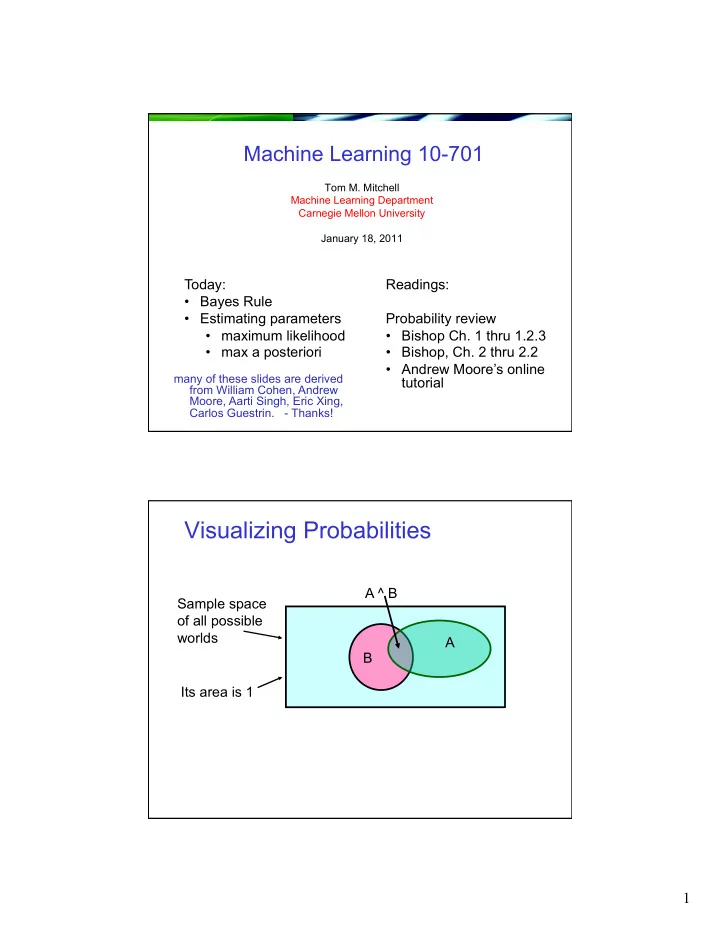
Visualizing Probabilities

Sample space

  • f all possible

worlds Its area is 1 B A A ^ B

slide-2
SLIDE 2

2

Definition of Conditional Probability

P(A ^ B)

P(A|B) = ----------- P(B)

B A

Definition of Conditional Probability

P(A ^ B)

P(A|B) = ----------- P(B)

Corollary: The Chain Rule

P(A ^ B) = P(A|B) P(B) P(C ^ A ^ B) = P(C|A ^ B) P(A|B) P(B)

slide-3
SLIDE 3

3

Independent Events

  • Definition: two events A and B are

independent if P(A ^ B)=P(A)*P(B)

  • Intuition: knowing A tells us nothing

about the value of B (and vice versa)

Bayes Rule

  • let’s write 2 expressions for P(A ^ B)

B A A ^ B

slide-4
SLIDE 4

4

P(B|A) * P(A) P(B) P(A|B) =

Bayes, Thomas (1763) An essay towards solving a problem in the doctrine

  • f chances. Philosophical Transactions of

the Royal Society of London, 53:370-418

…by no means merely a curious speculation in the doctrine of chances, but necessary to be solved in order to a sure foundation for all our reasonings concerning past facts, and what is likely to be hereafter…. necessary to be considered by any that would give a clear account of the strength of analogical or inductive reasoning…

Bayes’ rule we call P(A) the “prior” and P(A|B) the “posterior”

Other Forms of Bayes Rule

slide-5
SLIDE 5

5

Applying Bayes Rule

A = you have the flu, B = you just coughed Assume: P(A) = 0.05 P(B|A) = 0.80 P(B| ~A) = 0.2 what is P(flu | cough) = P(A|B)?

what does all this have to do with function approximation?

slide-6
SLIDE 6

6

The Joint Distribution

Recipe for making a joint distribution of M variables: Example: Boolean variables A, B, C

A B C Prob

0.30 1 0.05 1 0.10 1 1 0.05 1 0.05 1 1 0.10 1 1 0.25 1 1 1 0.10

A B C

0.05 0.25 0.10 0.05 0.05 0.10 0.10 0.30

[A. Moore]

The Joint Distribution

Recipe for making a joint distribution of M variables:

  • 1. Make a truth table listing all

combinations of values of your variables (if there are M Boolean variables then the table will have 2M rows). Example: Boolean variables A, B, C

A B C Prob

0.30 1 0.05 1 0.10 1 1 0.05 1 0.05 1 1 0.10 1 1 0.25 1 1 1 0.10

A B C

0.05 0.25 0.10 0.05 0.05 0.10 0.10 0.30

[A. Moore]

slide-7
SLIDE 7

7

The Joint Distribution

Recipe for making a joint distribution of M variables:

  • 1. Make a truth table listing all

combinations of values of your variables (if there are M Boolean variables then the table will have 2M rows).

  • 2. For each combination of

values, say how probable it is. Example: Boolean variables A, B, C

A B C Prob

0.30 1 0.05 1 0.10 1 1 0.05 1 0.05 1 1 0.10 1 1 0.25 1 1 1 0.10

A B C

0.05 0.25 0.10 0.05 0.05 0.10 0.10 0.30

[A. Moore]

The Joint Distribution

Recipe for making a joint distribution of M variables:

  • 1. Make a truth table listing all

combinations of values of your variables (if there are M Boolean variables then the table will have 2M rows).

  • 2. For each combination of

values, say how probable it is.

  • 3. If you subscribe to the

axioms of probability, those numbers must sum to 1. Example: Boolean variables A, B, C

A B C Prob

0.30 1 0.05 1 0.10 1 1 0.05 1 0.05 1 1 0.10 1 1 0.25 1 1 1 0.10

A B C

0.05 0.25 0.10 0.05 0.05 0.10 0.10 0.30

[A. Moore]

slide-8
SLIDE 8

8

Using the Joint

One you have the JD you can ask for the probability of any logical expression involving your attribute

[A. Moore]

Using the Joint

P(Poor Male) = 0.4654

[A. Moore]

slide-9
SLIDE 9

9

Using the Joint

P(Poor) = 0.7604

[A. Moore]

Inference with the Joint

P(Male | Poor) = 0.4654 / 0.7604 = 0.612

[A. Moore]

slide-10
SLIDE 10

10

Learning and the Joint Distribution

Suppose we want to learn the function f: <G, H>  W Equivalently, P(W | G, H) Solution: learn joint distribution from data, calculate P(W | G, H) e.g., P(W=rich | G = female, H = 40.5- ) =

[A. Moore]

sounds like the solution to learning F: X Y,

  • r P(Y | X).

Are we done?

slide-11
SLIDE 11

11

[C. Guestrin] [C. Guestrin]

slide-12
SLIDE 12

12

[C. Guestrin]

Maximum Likelihood Estimate for Θ

[C. Guestrin]

slide-13
SLIDE 13

13

[C. Guestrin] [C. Guestrin]

slide-14
SLIDE 14

14

[C. Guestrin]

Beta prior distribution – P(θ)

[C. Guestrin]

slide-15
SLIDE 15

15

Beta prior distribution – P(θ)

[C. Guestrin] [C. Guestrin]

slide-16
SLIDE 16

16

[C. Guestrin]

Conjugate priors

[A. Singh]

slide-17
SLIDE 17

17

Conjugate priors

[A. Singh]

Estimating Parameters

  • Maximum Likelihood Estimate (MLE): choose

θ that maximizes probability of observed data

  • Maximum a Posteriori (MAP) estimate:

choose θ that is most probable given prior probability and the data

slide-18
SLIDE 18

18

Dirichlet distribution

  • number of heads in N flips of a two-sided coin

– follows a binomial distribution – Beta is a good prior (conjugate prior for binomial)

  • what it’s not two-sided, but k-sided?

– follows a multinomial distribution – Dirichlet distribution is the conjugate prior

You should know

  • Probability basics

– random variables, events, sample space, conditional probs, … – independence of random variables – Bayes rule – Joint probability distributions – calculating probabilities from the joint distribution

  • Estimating parameters from data

– maximum likelihood estimates – maximum a posteriori estimates – distributions – binomial, Beta, Dirichlet, … – conjugate priors

slide-19
SLIDE 19

19

Extra slides Expected values

Given discrete random variable X, the expected value of X, written E[X] is We also can talk about the expected value of functions

  • f X
slide-20
SLIDE 20

20

Covariance

Given two discrete r.v.’s X and Y, we define the covariance of X and Y as e.g., X=gender, Y=playsFootball

  • r X=gender, Y=leftHanded

Remember: