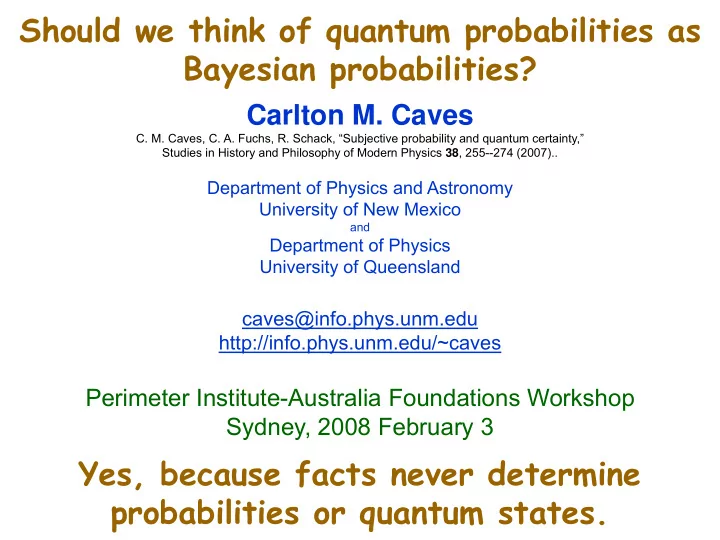
SLIDE 1 Should we think of quantum probabilities as Bayesian probabilities?
Carlton M. Caves
- C. M. Caves, C. A. Fuchs, R. Schack, “Subjective probability and quantum certainty,”
Studies in History and Philosophy of Modern Physics 38, 255--274 (2007)..
Department of Physics and Astronomy University of New Mexico
and
Department of Physics University of Queensland
caves@info.phys.unm.edu http://info.phys.unm.edu/~caves
Perimeter Institute-Australia Foundations Workshop Sydney, 2008 February 3
Yes, because facts never determine probabilities or quantum states.
SLIDE 2
Subjective Bayesian probabilities
Facts Outcomes of events Truth values of propositions Objective Probabilities Agent’s degree of belief in outcome of an event or truth of a proposition Subjective Facts never imply probabilities. Two agents in possession of the same facts can assign different probabilities. Category distinction
SLIDE 3 Subjective Bayesian probabilities
Probabilities Agent’s degree of belief in outcome of an event or truth of a proposition. Consequence of ignorance Agent’s betting odds Subjective Rules for manipulating probabilities are
- bjective consequences of consistent
betting behavior (Dutch book).
SLIDE 4
Subjective Bayesian probabilities
Facts in the form of observed data d are used to update probabilities via Bayes’s rule:
posterior prior conditional (model, likelihood)
The posterior always depends on the prior, except when d logically implies h0:
Facts never determine (nontrivial) probabilities. The posterior depends on the model even in this case. This is irrelevant to the quantum-mechanical discussion.
SLIDE 5 QM: Derivation of quantum probability rule from infinite frequencies?
Objective probabilities
- Logical probabilities (objective Bayesian): symmetry implies
probability
- Probabilities as frequencies: probability as verifiable fact
- Objective chance (propensity): probability as specified fact
■ Symmetries are applied to judgments, not to facts. ■ Bigger sample space; exchangeability. ■ Frequencies are facts, not probabilities. ■ Some probabilities are ignorance probabilities, but others are specified by the facts of a “chance situation.” ■ Specification of “chance situation”: same, but different.
chance
QM: Probabilities from physical law. Salvation of objective chance?
- C. M. Caves, R. Schack, ``Properties of the frequency
- perator do not imply the quantum probability
postulate,'' Annals of Physics 315, 123-146 (2005) [Corrigendum: 321, 504--505 (2006)].
SLIDE 6 Classical (realistic, deterministic) world Quantum world
State space Simplex of probabilities for microstates Convex set of density operators State Extreme point Microstate Ensemble Extreme point Pure state State vector Ensemble Mixed state Density operator Objective Subjective Objective Subjective
Scorecard:
- 1. Predictions for fine-grained measurements
2. Verification (state determination) 3. State change on measurement 4. Uniqueness of ensembles 5. Nonlocal state change (steering) 6. Specification (state preparation)
SLIDE 7
Certainty: Classical (realistic, deterministic) world Quantum world
State space Simplex of probabilities for microstates Convex set of density operators State Extreme point Microstate Ensemble Extreme point Pure state State vector Ensemble Mixed state Density operator Fine-grained measurement Certainty Probabilities Certainty or Probabilities Probabilities Objective Subjective Objective Subjective
SLIDE 8
Whom do you ask for the system state? The system or an agent? Classical (realistic, deterministic) world Quantum world
State space Simplex of probabilities for microstates Convex set of density operators State Extreme point Microstate Ensemble Extreme point Pure state State vector Ensemble Mixed state Density operator Verification: state determination Yes No No No Objective Subjective Ubjective Subjective
SLIDE 9 Classical (realistic, deterministic) world Quantum world
State space Simplex of probabilities for microstates Convex set of density operators State Extreme point Microstate Ensemble Extreme point Pure state State vector Ensemble Mixed state Density operator State change on measurement No Yes Yes Yes
State-vector reduction
Real physical disturbance?
Objective Subjective Ubjective Subjective
SLIDE 10
Classical (realistic, deterministic) world Quantum world
State space Simplex of probabilities for microstates Convex set of density operators State Extreme point Microstate Ensemble Extreme point Pure state State vector Ensemble Mixed state Density operator Uniqueness of ensembles Yes No No No Objective Subjective Ubjective Subjective
SLIDE 11
Classical (realistic, deterministic) world Quantum world
State space Simplex of probabilities for microstates Convex set of density operators State Extreme point Microstate Ensemble Extreme point Pure state State vector Ensemble Mixed state Density operator Nonlocal state change (steering) No Yes Yes Yes Objective Subjective Subjective Subjective
Real nonlocal physical disturbance?
SLIDE 12
Classical (realistic, deterministic) world Quantum world
State space Simplex of probabilities for microstates Convex set of density operators State Extreme point Microstate Ensemble Extreme point Pure state State vector Ensemble Mixed state Density operator Specification: state preparation Yes No Copenhagen: Yes Copenhagen: Yes
Copenhagen interpretation: Classical facts specifying the properties of the preparation device determine a pure state.
Objective Subjective Objective Objective
Copenhagen (objective preparations view) becomes the home of objective chance, with nonlocal physical disturbances
SLIDE 13
Copenhagen
Classical (realistic, deterministic) world Quantum world
State space Simplex of probabilities for microstates Convex set of density operators State Extreme point Microstate Ensemble Extreme point Pure state State vector Ensemble Mixed state Density operator Fine-grained measurement Certainty Probabilities Certainty or Probabilities Probabilities Verification: state determination Yes No No No State change on measurement No Yes Yes Yes Uniqueness of ensembles Yes No No No Nonlocal state change (steering) No Yes Yes Yes Specification: state preparation Yes No Yes Yes Objective Subjective Objective Objective
SLIDE 14 Classical and quantum updating
Facts in the form of observed data d are used to update probabilities via Bayes’s rule:
posterior prior conditional (model, likelihood)
The posterior always depends
- n the prior, except when d
logically implies h0: The posterior state always depends on prior beliefs, even for quantum state preparation, because there is a judgment involved in choosing the quantum operation. Facts in the form of observed data d are used to update quantum states:
posterior prior quantum operation (model)
Quantum state preparation:
Facts never determine probabilities
SLIDE 15
Where does Copenhagen go wrong?
The Copenhagen interpretation forgets that the preparation device is quantum mechanical. A detailed description of the operation of a preparation device (provably) involves prior judgments in the form of quantum state assignments.
SLIDE 16
Subjective Bayesian
Classical (realistic, deterministic) world Quantum world
State space Simplex of probabilities for microstates Convex set of density operators State Extreme point Microstate Ensemble Extreme point Pure state State vector Ensemble Mixed state Density operator Fine-grained measurement Certainty Probabilities Certainty or Probabilities Probabilities Verification: state determination Yes No No No State change on measurement No Yes Yes Yes Uniqueness of ensembles Yes No No No Nonlocal state change (steering) No Yes Yes Yes Specification: state preparation Yes No No No Objective Subjective Subjective Subjective
SLIDE 17 Is a quantum coin toss more random than a classical one? Why trust a quantum random generator over a classical one?
quantum coin toss Classical (realistic, deterministic) world Quantum world
State space Simplex of probabilities for microstates Convex set of density operators State Extreme point Microstate Ensemble Extreme point Pure state State vector Ensemble Mixed state Density operator Fine-grained measurement Certainty Probabilities Certainty or Probabilities Probabilities
- C. M. Caves, R. Schack, “Quantum randomness,” in preparation.
Measure spin along z axis: Measure spin along x axis:
SLIDE 18
quantum coin toss
Measure spin along z axis: Measure spin along x axis: Standard answer: The quantum coin toss is objective, with probabilities guaranteed by physical law. Subjective Bayesian answer? No inside information. Is a quantum coin toss more random than a classical one? Why trust a quantum random generator over a classical one?
SLIDE 19 Pure states and inside information
Party B has inside information about event E, relative to party A, if A is willing to agree to a bet on E that B believes to be a sure
- win. B has one-way inside information if B has inside
information relative to A, but A does not have any inside information relative to A. The unique situation in which no other party can have one-way inside information relative to a party Z is when Z assigns a pure
- state. Z is said to have a maximal belief structure.
Subjective Bayesian answer We trust quantum over classical coin tossing because an insider attack on classical coin tossing can never be ruled out, whereas the beliefs that lead to a pure-state assignment are inconsistent with any
- ther party’s being able to launch an insider attack.
SLIDE 20 Taking a stab at ontology
CMC only
Quantum systems are defined by attributes, such as position, momentum, angular momentum, and energy or
- Hamiltonian. These attributes—and thus the numerical
particulars of their eigenvalues and eigenfunctions and their inner products—are objective properties of the system. The value assumed by an attribute is not an
- bjective property, and the quantum state that we
use to describe the system is purely subjective.
SLIDE 21 Taking a stab at ontology
1. The attributes orient and give structure to a system’s Hilbert
- space. Without them we are clueless as to how to manipulate
and interact with a system. 2. The attributes are unchanging properties of a system, which can be determined from facts. The attributes determine the structure of the world. 3. The Hamiltonian orients a system’s Hilbert space now with the same space later. 4. Convex combinations of Hamiltonian evolutions are essentially unique (up to degeneracies). Why should you care? If you do care, how can this be made convincing? Status of quantum operations? Effective attributes and effective Hamiltonians? “Effective reality”?