Modeling the probability of occurrence of events with the new stpreg - - PDF document

modeling the probability of occurrence of events with the
SMART_READER_LITE
LIVE PREVIEW

Modeling the probability of occurrence of events with the new stpreg - - PDF document

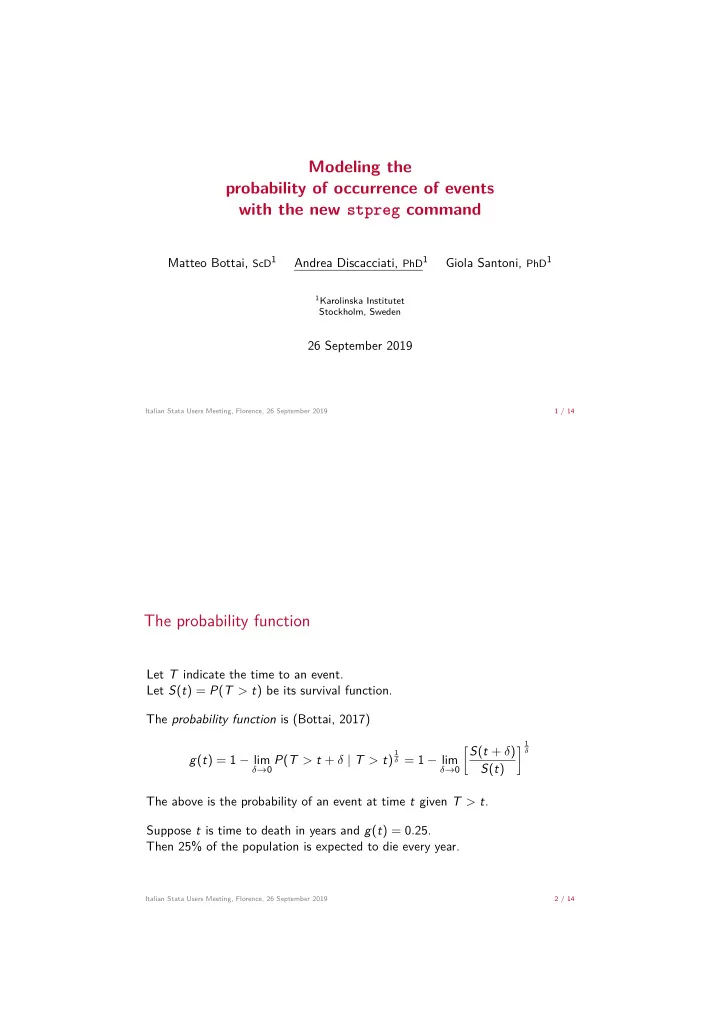
Modeling the probability of occurrence of events with the new stpreg command Matteo Bottai, ScD 1 Andrea Discacciati, PhD 1 Giola Santoni, PhD 1 1 Karolinska Institutet Stockholm, Sweden 26 September 2019 Italian Stata Users Meeting, Florence,


slide-1
SLIDE 1

Modeling the probability of occurrence of events with the new stpreg command

Matteo Bottai, ScD1 Andrea Discacciati, PhD1 Giola Santoni, PhD1

1Karolinska Institutet

Stockholm, Sweden

26 September 2019

Italian Stata Users Meeting, Florence, 26 September 2019 1 / 14

The probability function

Let T indicate the time to an event. Let S(t) = P(T > t) be its survival function. The probability function is (Bottai, 2017) g(t) = 1 − lim

δ→0 P(T > t + δ | T > t)

1 δ = 1 − lim

δ→0

5S(t + δ)

S(t)

6 1

δ

The above is the probability of an event at time t given T > t. Suppose t is time to death in years and g(t) = 0.25. Then 25% of the population is expected to die every year.

Italian Stata Users Meeting, Florence, 26 September 2019 2 / 14

slide-2
SLIDE 2

Log-normal time to event

0.0 0.5 1.0 2 4

Density

0.0 0.5 1.0 2 4

Survival

0.0 1.0 2.0 2 4

Hazard

0.0 0.5 1.0 2 4

Probability

Italian Stata Users Meeting, Florence, 26 September 2019 3 / 14

A two-population example

The annual risk in two populations is g0(t) = 0.5 and g1(t) = 0.9 The risk ratio, odds ratio, and hazard ratio are RR(t) = 1.8 OR(t) = 9.0 HR(t) = 3.3 The hazard ratio is not a risk ratio.

Italian Stata Users Meeting, Florence, 26 September 2019 4 / 14

slide-3
SLIDE 3

The new stpreg command

I Estimates virtually any probability function model I Allows time-dependent effects I Has postestimation commands (predict, test, lincom, estat, . . . ) I Stems from stgenreg by Crowther and Lambert (2013) Download it with . net from http://www.imm.ki.se/biostatistics/stata . net install stpreg

Italian Stata Users Meeting, Florence, 26 September 2019 5 / 14

Proportional-odds models

Let x denote a covariate. We consider the proportional-odds model g(t|x) 1 − g(t|x) = g0(t) 1 − g0(t) exp(β1x) The above can be written as logit g(t|x) = logit g0(t) + β1x The baseline function can be anything, e.g. logit g0(t) = θ0 + θ1t logit g0(t) = θ0 + θ1spline1(t) + θ2spline2(t) The quantity exp(β1) is the odds ratio per unit-increase in x.

Italian Stata Users Meeting, Florence, 26 September 2019 6 / 14

slide-4
SLIDE 4

Flexible proportional-odds model

We estimate a flexible proportional-odds model

. qui webuse brcancer, clear . qui stset rectime, failure(censrec = 1) scale(3652.4) . stpreg x4a, df(2) nolog Event-probability regression Number of obs = 686 Log likelihood = -667.42897 Odds Ratio

  • Std. Err.

z P>|z| [95% Conf. Interval] x4a 5.082306 1.795635 4.60 0.000 2.542856 10.1578 _eq1_cp2_rcs1 1.415463 .1732414 2.84 0.005 1.113572 1.799197 _eq1_cp2_rcs2 2.369021 .3778431 5.41 0.000 1.733037 3.238395 _cons .7311249 .2436484

  • 0.94

0.347 .3804761 1.404933 Note: _cons estimates baseline odds.

The odds are 5.1 times greater in the larger tumor grade group.

Italian Stata Users Meeting, Florence, 26 September 2019 7 / 14

Predicted event probabilities

. predict predicted, probability . gen years = rectime/365.24 . tw line predict years if x4a==0, sort || line predict years if x4a==1, sort

0.0 0.5 1.0 Probability 3 6 Follow-up time (years)

Italian Stata Users Meeting, Florence, 26 September 2019 8 / 14

slide-5
SLIDE 5

Probability-power models

Let x denote a covariate. We consider the probability-power model ¯ g(t|x) = ¯ g0(t)exp(β1x) where ¯ g(t) = 1 − g(t). The above can be written as log{− log[¯ g(t|x)]} = log{− log[¯ g0(t)]} + β1x The baseline probability function ¯ g0(t) can be anything. The power parameter exp(β1) is a measure of association. It corresponds to the hazard ratio per unit-increase in x.

Italian Stata Users Meeting, Florence, 26 September 2019 9 / 14

Flexible probability-power model

We estimate a flexible probability-power model

. stpreg x4a, power df(2) nolog Event-probability regression Number of obs = 686 Log likelihood = -668.30844 Power param.

  • Std. Err.

z P>|z| [95% Conf. Interval] x4a 2.584105 .6285316 3.90 0.000 1.604252 4.162439 _eq1_cp2_rcs1 1.207611 .0890262 2.56 0.011 1.045143 1.395335 _eq1_cp2_rcs2 1.692367 .1611357 5.53 0.000 1.404264 2.039577 _cons .5631365 .1349343

  • 2.40

0.017 .3520915 .9006827

The power parameter (hazard ratio) is 2.6.

Italian Stata Users Meeting, Florence, 26 September 2019 10 / 14

slide-6
SLIDE 6

Semi-parametric probability-power model

We estimate a semi-parametric probability-power model

. stcox x4a, nolog noshow Cox regression -- Breslow method for ties

  • No. of subjects =

686 Number of obs = 686

  • No. of failures =

299 Time at risk = 211.2035922 LR chi2(1) = 19.92 Log likelihood =

  • 1778.2134

Prob > chi2 = 0.0000 _t

  • Haz. Ratio
  • Std. Err.

z P>|z| [95% Conf. Interval] x4a 2.566048 .6241802 3.87 0.000 1.592993 4.133481

The power parameter (hazard ratio) is 2.6.

Italian Stata Users Meeting, Florence, 26 September 2019 11 / 14

The probability and the hazard function

The probability and the hazard functions are (Bottai, 2017) g(t) = 1 − lim

δ→0 P(T > t + δ | T > t)

1 δ = 1 − lim

δ→0

5S(t + δ)

S(t)

6 1

δ

h(t) = lim

δ→0 P(T ≤ t + δ | T > t)1

δ = lim

δ→0

5

1 − S(t + δ) S(t)

6 1

δ It can be shown that (Bottai, 2017) g(t) = 1 − exp[−h(t)] The probability is always smaller than the hazard g(t) < h(t)

Italian Stata Users Meeting, Florence, 26 September 2019 12 / 14

slide-7
SLIDE 7

Conclusions

I Hazards are often mistaken for probabilities. I For example, “the risk increases by 68% (HR = 1.68)”. I This problem is consequential (Sutradhar & Austin, 2018). I stpreg makes modeling probability functions simple.

Italian Stata Users Meeting, Florence, 26 September 2019 13 / 14

References

Bottai, M. (2017). A regression method for modelling geometric rates. Statistical Methods in Medical Research 26, 2700-2707. Bottai, M., Discacciati, A. and Santoni, G. (submitted). Modeling the probability of

  • ccurrence of events.

Crowther, M. and Lambert, P. (2013). stgenreg: A stata package for general parametric survival analysis. Journal of Statistical Software 53, 1-17. Discacciati, A. and Bottai, M. (2017). Instantaneous geometric rates via generalized linear models. Stata Journal 17, 358-371. Sutradhar, R. and Austin, P. C. (2018). Relative rates not relative risks: addressing a widespread misinterpretation of hazard ratios. Annals of Epidemiology 28, 54-57.

Italian Stata Users Meeting, Florence, 26 September 2019 14 / 14