CSCE 970 Lecture 4: Introduction to Bayesian Networks E.g. each - - PDF document

csce 970 lecture 4 introduction to bayesian networks
SMART_READER_LITE
LIVE PREVIEW

CSCE 970 Lecture 4: Introduction to Bayesian Networks E.g. each - - PDF document

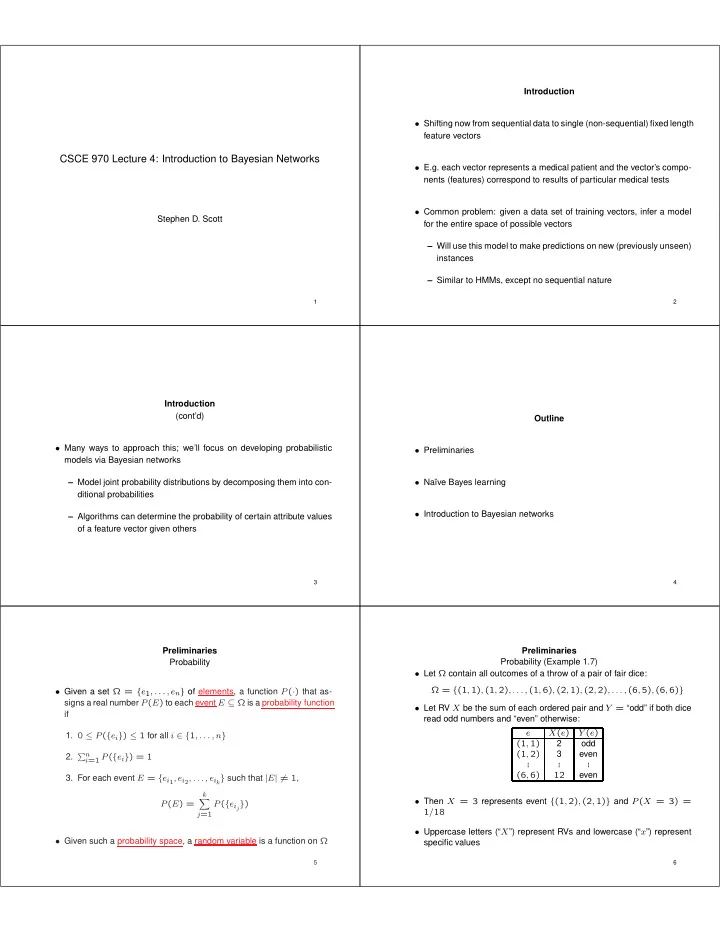
Introduction Shifting now from sequential data to single (non-sequential) fixed length feature vectors CSCE 970 Lecture 4: Introduction to Bayesian Networks E.g. each vector represents a medical patient and the vectors compo- nents


slide-1
SLIDE 1

CSCE 970 Lecture 4: Introduction to Bayesian Networks

Stephen D. Scott

1

Introduction

  • Shifting now from sequential data to single (non-sequential) fixed length

feature vectors

  • E.g. each vector represents a medical patient and the vector’s compo-

nents (features) correspond to results of particular medical tests

  • Common problem: given a data set of training vectors, infer a model

for the entire space of possible vectors – Will use this model to make predictions on new (previously unseen) instances – Similar to HMMs, except no sequential nature

2

Introduction (cont’d)

  • Many ways to approach this; we’ll focus on developing probabilistic

models via Bayesian networks – Model joint probability distributions by decomposing them into con- ditional probabilities – Algorithms can determine the probability of certain attribute values

  • f a feature vector given others

3

Outline

  • Preliminaries
  • Na¨

ıve Bayes learning

  • Introduction to Bayesian networks

4

Preliminaries Probability

  • Given a set Ω = {e1, . . . , en} of elements, a function P(·) that as-

signs a real number P(E) to each event E ⊆ Ω is a probability function if

  • 1. 0 ≤ P({ei}) ≤ 1 for all i ∈ {1, . . . , n}
  • 2. n

i=1 P({ei}) = 1

  • 3. For each event E = {ei1, ei2, . . . , eik} such that |E| = 1,

P(E) =

k

  • j=1

P({eij})

  • Given such a probability space, a random variable is a function on Ω

5

Preliminaries Probability (Example 1.7)

  • Let Ω contain all outcomes of a throw of a pair of fair dice:

Ω = {(1, 1), (1, 2), . . . , (1, 6), (2, 1), (2, 2), . . . , (6, 5), (6, 6)}

  • Let RV X be the sum of each ordered pair and Y = “odd” if both dice

read odd numbers and “even” otherwise: e X(e) Y (e) (1, 1) 2

  • dd

(1, 2) 3 even . . . . . . . . . (6, 6) 12 even

  • Then X = 3 represents event {(1, 2), (2, 1)} and P(X = 3) =

1/18

  • Uppercase letters (“X”) represent RVs and lowercase (“x”) represent

specific values

6

slide-2
SLIDE 2

Preliminaries Joint Distributions

  • In previous example, X ranged over the integers 2–12 and Y ranged
  • ver {odd,even}

– Each value in each range had its own probability

  • If we consider joint events (one from X’s range, one from Y ’s) we get

a joint probability distribution P(x, y) = P(X = x, Y = y)

  • E.g. x = 4 and y = odd represents the event {(1, 3), (3, 1)} and

P(x, y) = 1/18

7

Preliminaries Marginal Probability

  • If we have a handle on a joint distribution, we can sum across values
  • f an RV to get the marginal probability distribution of another RV
  • For two RVs X and Y ,

P(X = x) =

  • y

P(X = x, Y = y)

  • E.g.

P(X = 4) =

  • y

P(X = 4, Y = y) = P(X = 4, Y = odd) + P(X = 4, Y = even) = 1/18 + 1/36 = 1/12

  • Also see Example 1.15

8

Preliminaries Conditional Probability

  • Let E and F be events with P(F) > 0
  • The conditional probability of E given F is

P(E | F) = P(E ∩ F) P(F)

  • E.g. if x = 6 and y = even then

P(X = x) = P(X = x, Y = y) = P(X = x | Y = y) =

9

Preliminaries Bayes’ Theorem

  • An identity for conditional probabilities
  • Given two events E and F with P(E), P(F) > 0

P(E | F) = P(F | E)P(E) P(F) (Way to remember: the event named after the line goes in the denom- inator)

  • E.g. When x = 6 and y = even,

P(x | y) = P(y | x)P(x) P(y) = (2/5)(5/36) 27/36 = 2/27

10

Preliminaries Independence of Events

  • Two events E and F are independent if one of the following holds:
  • 1. P(E | F) = P(E) and P(E), P(F) = 0

(can switch roles of E and F for same result)

  • 2. P(E) = 0 or P(F) = 0
  • E and F are independent iff P(E ∩ F) = P(E)P(F)
  • E.g. is the event X = 6 independent of Y = even?
  • Is the event X = 10 ∪ X = 12 independent of Y = odd?

11

Preliminaries Conditional Independence of Events

  • Can also have independence conditioned on other variables
  • Events E and F are conditionally independent given G if P(G) > 0

and one of the following holds

  • 1. P(E | F ∩ G) = P(E | G) and P(E | G), P(F | G) > 0
  • 2. P(E | G) = 0 or P(F | G) = 0

12

slide-3
SLIDE 3

Preliminaries Conditional Independence of Events Example

  • Define third RV Z, defined as the product of the two dice results

P(X = 5 | Y = even) = 4/36 27/36 = 4/27 = 4/36 = P(X = 5) P(X = 5 | Y = even∩Z = 4) = 2/36 3/36 = 2/3 = P(X = 5 | Z = 4)

  • Thus the event X = 5 is not independent of Y = even, but is condi-

tionally independent of it given Z = 4

13

Preliminaries Independence of Random Variables

  • Given probability space (Ω, P), two RVs A and B are independent

(written IP(A, B)) if, for all values a of A and b of B, the events A = a and B = b are independent

  • I.e. for all values a and b, either P(a) = 0 or P(b) = 0 or

P(a | b) = P(a)

  • Generalizes to sets of RVs

14

Preliminaries Independence of Random Variables Example 1.16 Ω = set of all cards in a deck, P uniform Variable Values Outcomes R {r1, r2} royal/nonroyal cards T {t1, t2} tens & jacks/not t & j S {s1, s2} spades/nonspades s r t P(r, t | s) P(r, t) s1 r1 t1 1/13 4/52 = 1/13 s1 r1 t2 2/13 8/52 = 2/13 s1 r2 t1 1/13 4/52 = 1/13 s1 r2 t2 9/13 36/52 = 9/13 s2 r1 t1 3/39 = 1/13 4/52 = 1/13 s2 r1 t2 6/39 = 2/13 8/52 = 2/13 s2 r2 t1 3/39 = 1/13 4/52 = 1/13 s2 r2 t2 27/39 = 9/13 36/52 = 9/13 Thus P(r, t | s) = P(r, t) ⇒ IP({R, T}, {S})

15

Preliminaries Conditional Independence of Random Variables

  • Given probability space (Ω, P), two RVs A and B are

conditionally independent given C (written IP(A, B | C)) if, for all values a of A, b of B, and c of C, the events A = a and B = b are conditionally independent given event C = c

  • I.e. for all values a and b and c, either P(a | c) = 0 or P(b | c) = 0 or

P(a | b, c) = P(a | c)

  • Generalizes to sets of RVs

16

Preliminaries Conditional Independence of Random Variables, Example 1.17 P is uniform Var Values Outcomes V {v1, v2}

  • bj with “1”/“2”

S {s1, s2} square/round C {c1, c2} black/white c s v P(v | s, c) P(v | c) c1 s1 v1 1/3 3/9 = 1/3 c1 s1 v2 2/3 6/9 = 2/3 c1 s2 v1 1/3 3/9 = 1/3 c1 s2 v2 2/3 6/9 = 2/3 c2 s1 v1 1/2 2/4 = 1/2 c2 s1 v2 1/2 2/4 = 1/2 c2 s2 v1 1/2 2/4 = 1/2 c2 s2 v2 1/2 2/4 = 1/2 Thus P(v | s, c) = P(v | c) ⇒ IP ({V }, {S} | {C})

17

Basic Formulas for Probabilities

  • Product Rule: probability P(A ∩ B) of conjunction of events A and B:

P(A ∩ B) = P(A | B)P(B) = P(B | A)P(A)

  • Sum Rule: probability of a disjunction of two events A and B:

P(A ∪ B) = P(A) + P(B) − P(A ∩ B)

  • Theorem of total probability: if events A1, . . . , An are mutually exclu-

sive with n

i=1 P(Ai) = 1, then

P(B) =

n

  • i=1

P(B | Ai)P(Ai)

  • If X takes on real values, then its expected value is

E(X) =

  • x

xP(x)

18

slide-4
SLIDE 4

Na¨ ıve Bayes Classification

  • Na¨

ıve Bayes classifiers are like Bayesian networks taken to the ex- treme in their conditional independence assumption

  • Generally, the assumption is so unrealistic that NB is ineffective in pre-

dicting probabilities

  • Still good at classification, however
  • Successfully applied to text classification, diagnosis

19

Na¨ ıve Bayes Classification (cont’d)

  • Assume target function f : X → V , where each instance x described

by attributes a1, a2, . . . , an

  • Most probable value of f(x) is:

vMAP = argmax

vj∈V

P(vj | a1, a2, . . . , an) = argmax

vj∈V

P(a1, a2, . . . , an | vj) P(vj) P(a1, a2, . . . , an) = argmax

vj∈V

P(a1, a2, . . . , an | vj) P(vj) (Second equality comes from where?)

  • Thus all we have to do is model the joint distribution over the attributes

conditioned on the labels

  • Can we just frequency count our way out of this?

20

Na¨ ıve Bayes Classification (cont’d)

  • Problem with estimating probs from training data: estimating P(vj) eas-

ily done by counting, but there are exponentially (in n) many combs. of values of a1, . . . , an, so can’t get estimates for most combs

  • Na¨

ıve Bayes assumption: P(a1, a2, . . . , an | vj) =

  • i

P(ai | vj) so na¨ ıve Bayes classifier: vNB = argmax

vj∈V

P(vj)

  • i

P(ai | vj)

  • Now have only polynomial number of probs to estimate

21

Na¨ ıve Bayes Algorithm Na¨ ıve Bayes Learn

  • 1. For each target value vj

(a) ˆ P(vj) ← estimate P(vj) = fraction of exs with vj (b) For each attribute value ai of each attrib a

  • i. ˆ

P(ai | vj) ← estimate P(ai | vj) = fraction of vj-labeled exs with ai Classify New Instance(x) vNB = argmax

vj∈V

ˆ P(vj)

  • ai∈x

ˆ P(ai | vj)

22

Na¨ ıve Bayes Example

Day Outlook Temperature Humidity Wind PlayTennis D1 Sunny Hot High Weak No D2 Sunny Hot High Strong No D3 Overcast Hot High Weak Yes D4 Rain Mild High Weak Yes D5 Rain Cool Normal Weak Yes D6 Rain Cool Normal Strong No D7 Overcast Cool Normal Strong Yes D8 Sunny Mild High Weak No D9 Sunny Cool Normal Weak Yes D10 Rain Mild Normal Weak Yes D11 Sunny Mild Normal Strong Yes D12 Overcast Mild High Strong Yes D13 Overcast Hot Normal Weak Yes D14 Rain Mild High Strong No

Example to classify: Outlk = sun, Temp = cool, Humid = high, Wind = strong

Assign label vNB = argmaxvj∈V P(vj)

i P(ai | vj)

P(y) · P(sun | y) · P(cool | y) · P(high | y) · P(strong | y) = (9/14) · (2/9) · (3/9) · (3/9) · (3/9) = 0.0053 P(n) P(sun | n) P(cool | n) P(high | n) P(strong | n) = (5/14) · (3/5) · (1/5) · (4/5) · (3/5) = 0.0206 So vNB = n

23

Na¨ ıve Bayes Subtleties

  • Conditional independence assumption is often violated, i.e.

P(a1, a2, . . . , an | vj) =

  • i

P(ai | vj) . . . but it works surprisingly well anyway. Note don’t need estimated posteriors ˆ P(vj | x) to be correct; need only that

argmax

vj∈V

ˆ P(vj)

  • i

ˆ P(ai | vj) = argmax

vj∈V

P(vj)P(a1, . . . , an | vj)

  • Sufficient conditions given in [Domingos & Pazzani, 1996]
  • But not really trustworthy for probability estimates!

24

slide-5
SLIDE 5

Bayesian Belief Networks

  • Sometimes na¨

ıve Bayes assumption of conditional independence too restrictive

  • But inferring probabilities is intractable without some such assump-

tions

  • Bayesian belief networks (also called Bayes Nets) describe conditional

independence among subsets of variables

  • Allows combining prior knowledge about dependencies among vari-

ables with observed training data

25

Bayesian Belief Networks Directed Acyclic Graphs

  • A graph G = (V, E) consists of a set of vertices V , which are con-

nected to each other with edges from a set E

  • A directed graph is a graph in which each edge (x, y) is an ordered

pair, with direction from its head x to its tail y – x is y’s parent

  • A directed acyclic graph (DAG) G is a directed graph where there is no

path from a node to itself – If there’s a path from x to y, then y is a descendent of x and x is an ancestor of y

26

Bayesian Belief Networks The Markov Property

  • Consider a joint probability distribution P and a DAG G = (V, E).

(G, P) satisfies the Markov condition if for each RV X ∈ V , the set {X} is conditionally independent of the set of its nondescendents given the set of its parents, i.e. if PAX is the set of parents and NDX nondescendents, then IP ({X}, NDX | PAX)

  • If (G, P) satisifes the Markov condition, then (G, P) is a Bayesian network

27

Bayesian Belief Networks Each node in the DAG corresponds to a RV, and has a probability distribu- tion on that RV conditioned on its parents

28

Bayesian Belief Networks Example 1.29 P is uniform Var Values Outcomes V {v1, v2}

  • bj with “1”/“2”

S {s1, s2} square/round C {c1, c2} black/white We already showed that IP({V }, {S} | {C}). Which of the following DAGs make a Bayes net with P?

29

Bayesian Belief Networks Example 1.29 (cont’d)

30

slide-6
SLIDE 6

Bayesian Belief Networks Example 1.29 (cont’d) (a) V ’s conditional probability distribution depends on only C. When C is known, then V ’s distribution depends on no other variables (similarly for S) (b) V ’s distribution depends on nothing; S depends on only C. When C is fixed, then S depends on nothing. (c) Same as (b).

31

Bayesian Belief Networks Example 1.29 (cont’d) (d) When C is unknown, then V and S are independent, and C’s distri- bution depends on V and S. But say that e.g. V ∈ {0, 1} indicates whether a car’s battery is dead or alive, S ∈ {0, 1} indicates if a car’s tank is empty or full, and C ∈ {0, 1} indicates whether a gas guage reads empty or full. – V and S are independent if C unknown – Knowing C suddenly relates V and S since e.g. V = 0 influences the probability that S = 0 – We’ll discuss this more later

32

Bayesian Belief Networks Team Exercise What are the conditional independencies in a distribution P if (G, P) is a Bayes net with the following graph G?

33

Bayesian Belief Networks Factorization of a Joint Distribution

  • We already discussed the problems with directly estimating a joint dis-

tribution – Exponential number of combinations of attribute values makes it impossible to get enough training data to estimate the distribution – Also, the need to sum over all combinations of values makes marginal- izing intractable

  • Markov condition simplifies this problem by allowing factorization of the

joint distribution

34

Bayesian Belief Networks Factorization of a Joint Distribution

  • Theorem 1.4: If (G, P) satisfies the Markov condition, then P equals

the product of its conditional distributions of allnodes given values of their parents (when they exist)

  • E.g. P(f, c, b, ℓ, h) = P(f | b, ℓ)P(c | ℓ)P(b | h)P(ℓ | h)P(h)

Can estimate each conditional probability separately

35

Bayesian Belief Networks Factorization of a Joint Distribution (example) P(v, s, c) = P(v | c)P(s | c)P(c) Earlier we showed P(v1, s1, c1) = 2/13. Factorization yields P(v1 | c1)P(s1 | c1)P(c1) = (1/3)(2/3)(9/13) = 2/13 Also works for DAGs (b) and (c)

36

slide-7
SLIDE 7

Bayesian Belief Networks Generalization of Na¨ ıve Bayes Now it’s obvious how Bayes nets generalize na¨ ıve Bayes. How?

37

Bayesian Belief Networks Starting with the DAG

  • The process also works in reverse

– Start with a DAG G = (V, E) where each node in V is a RV with a discrete conditional distribution – Then the joint distribution P that comes from multiplying the condi- tional distributions satisfies the Markov condition with G

  • This is how we’ll typically work: define local conditional distributions

with a DAG and then analyze the resultant joint distribution

  • Also works with some continuous distributions, e.g. Gaussian

38

Bayesian Belief Networks Starting with the DAG (example)

  • H = smoking history, B = bronchitis, L = lung cancer, F = fatigue,

C = chest X-ray result

  • Scientific studies and experts’ opinions define conditional distribs

39