Language models Chapter 3 in Martin/Jurafsky Probabilistic Language - - PDF document

language models
SMART_READER_LITE
LIVE PREVIEW

Language models Chapter 3 in Martin/Jurafsky Probabilistic Language - - PDF document

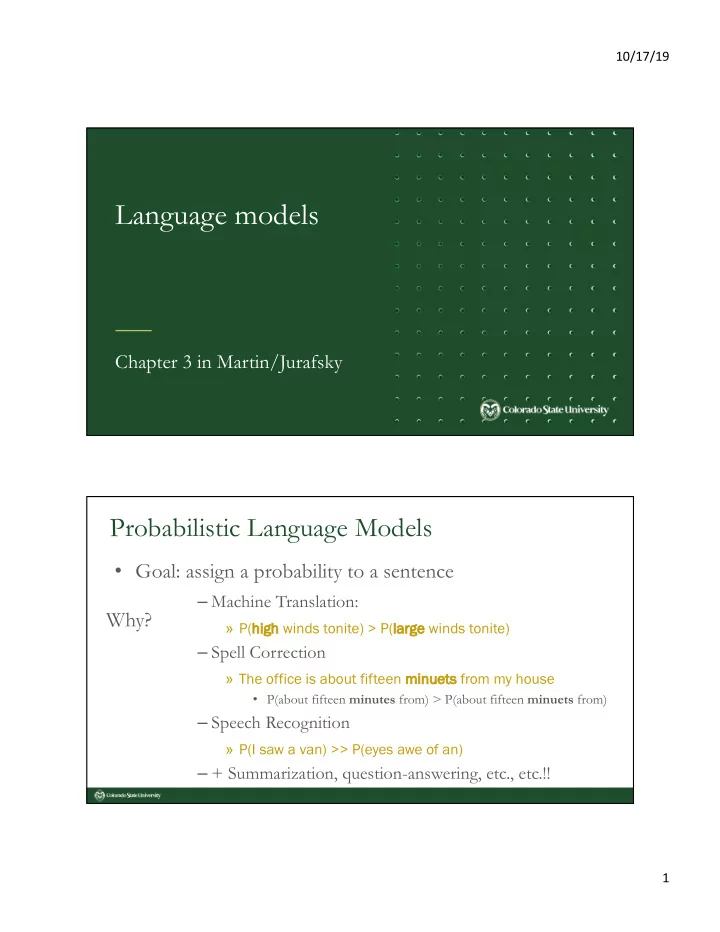
10/17/19 Language models Chapter 3 in Martin/Jurafsky Probabilistic Language Models Goal: assign a probability to a sentence Machine Translation: Why? P(hi high h winds tonite) > P(la large winds tonite) Spell Correction


slide-1
SLIDE 1

10/17/19 1

Language models

Chapter 3 in Martin/Jurafsky

Probabilistic Language Models

  • Goal: assign a probability to a sentence

– Machine Translation:

» P(hi high h winds tonite) > P(la large winds tonite)

– Spell Correction

» The office is about fifteen mi minu nuets from my house

  • P(about fifteen minutes from) > P(about fifteen minuets from)

– Speech Recognition

» P(I saw a van) >> P(eyes awe of an)

– + Summarization, question-answering, etc., etc.!!

Why?

slide-2
SLIDE 2

10/17/19 2

Probabilistic Language Modeling

  • Goal: compute the probability of a sentence or sequence
  • f words:

P(W) = P(w1,w2,w3,... ,wn)

  • Related task: probability of an upcoming word:

P(w5|w1,w2,w3,w4)

  • A model that computes either of these:

P(W) or P(wn|w1,w2…wn-1) is called a language model.

Probability theory

Random variable: a variable whose possible values are the possible outcomes of a random phenomenon. Examples: A person’s height, the outcome of a coin toss Distinguish between discrete and continuous variables. The distribution of a discrete random variable: The probabilities of each value it can take. Notation: P(X = xi). These numbers satisfy:

X

i

P(X = xi) = 1

slide-3
SLIDE 3

10/17/19 3

Joint probability distribution

A joint probability distribution for two variables is a table. If the two variables are binary, how many entries does it have? Let’s consider now the joint probability of d variables P(X1,…,Xd). How many entries does it have if each variable is binary?

pij

P(X = xi, Y = yj)

Example

  • Consider the roll of a fair die and let X be the variable that denotes

if the number is even (i.e. 2, 4, or 6) and let Y denote if the number is prime (i.e. 2, 3, or 5).

X/Y prime non-prime even 1/6 2/6

  • dd

2/6 1/6

slide-4
SLIDE 4

10/17/19 4

Example

  • Given P(X, Y) compute the probability that we picked an even

number: P(X=even) = P(X=even,Y=prime)+P(X=even,Y=non-prime) = 3/6

X/Y prime non-prime even 1/6 2/6

  • dd

2/6 1/6

Marginal probability

Marginal probability Joint probability

pij

P(X = xi, Y = yj) P(X = xi) = X

j

P(X = xi, Y = yj)

slide-5
SLIDE 5

10/17/19 5

Conditional probability

  • Compute the probability P(X=even | Y=non-prime)

P(X=even | Y=non-prime) = P(X=even , Y=non-prime) / P(Y=non-prime) = 2/6 / 1/2 = 2/3 X/Y prime non-prime even 1/6 2/6

  • dd

2/6 1/6

Marginal probability

Marginal probability Joint probability

pij

P(X = xi, Y = yj) P(X = xi) = X

j

P(X = xi, Y = yj)

Conditional probability

P(X = xi|Y = yj) = P(X = xi, Y = yj) P(Y = yj)

slide-6
SLIDE 6

10/17/19 6

The rules of probability

Marginalization Product Rule

Independence: X and Y are independent if P(Y=y|X=x) = P(Y=y) This implies P(x,y) = P(x) P(y)

P(x, y) = P(x)P(y|x)

P(x) = X

y

P(x, y)

Bayes’ rule

From the product rule: P(x, y) = P(y | x) P(x) and: P(x, y) = P(x | y) P(y) Therefore: This is known as Bayes’ rule P(y|x) = P(x|y)P(y) P(x)

slide-7
SLIDE 7

10/17/19 7

How to compute P(W)

  • We would like to compute this joint probability:

P(its, water, is, so, transparent, that)

  • Let's use the chain rule!

Reminder: The Chain Rule

  • For two variables we have:

P(A,B) = P(A)P(B|A)

  • More variables:

P(A,B,C,D) = P(A)P(B|A)P(C|A,B)P(D|A,B,C)

  • The chain rule:

P(x1,x2,x3,…,xn) = P(x1)P(x2|x1)P(x3|x1,x2)…P(xn|x1,…,xn-1)

slide-8
SLIDE 8

10/17/19 8

The chain rule applied for computing the joint probability of words in a sentence

P(“its water is so transparent”) =

P(its) × P(water|its) × P(is|its water)

× P(so|its water is) × P(transparent|its water is so)

P(w1w2…wn) = P(wi | w1w2…wi−1)

i

How not to estimate these probabilities

  • Naive approach:
  • Won't work: we’ll never see enough data for esbmabng these

P(the |its water is so transparent that) = Count(its water is so transparent that the) Count(its water is so transparent that)

slide-9
SLIDE 9

10/17/19 9

Markov Assumption

  • Simplifying assumption:
  • Or maybe

P(the |its water is so transparent that) ≈ P(the |that)

P(the |its water is so transparent that) ≈ P(the |transparent that)

Andrei Markov

Markov Assumption

  • In other words, we approximate each component in the

product as

P(w1w2…wn) ≈ P(wi | wi−k…wi−1)

i

P(wi | w1w2…wi−1) ≈ P(wi | wi−k…wi−1)

slide-10
SLIDE 10

10/17/19 10

Simplest case: the unigram model

fifth, an, of, futures, the, an, incorporated, a, a, the, inflation, most, dollars, quarter, in, is, mass thrift, did, eighty, said, hard, 'm, july, bullish that, or, limited, the

Some automabcally generated sentences from a unigram model

P(w1w2…wn) ≈ P(wi)

i

Condibon on the previous word:

Bigram model

texaco, rose, one, in, this, issue, is, pursuing, growth, in, a, boiler, house, said, mr., gurria, mexico, 's, motion, control, proposal, without, permission, from, five, hundred, fifty, five, yen

  • utside, new, car, parking, lot, of, the, agreement, reached

this, would, be, a, record, november

P(wi | w1w2…wi−1) ≈ P(wi | wi−1)

slide-11
SLIDE 11

10/17/19 11

N-gram models

  • We can extend to trigrams, 4-grams, 5-grams
  • In general this is an insufficient model of language

– because language has long-distance dependencies: “The computer(s) which I had just put into the machine room on the fifth floor is (are) crashing.”

  • But these models are still very useful!