Introduction CSCE CSCE 471/871 471/871 Lecture 6: Lecture 6: - - PDF document

introduction
SMART_READER_LITE
LIVE PREVIEW

Introduction CSCE CSCE 471/871 471/871 Lecture 6: Lecture 6: - - PDF document

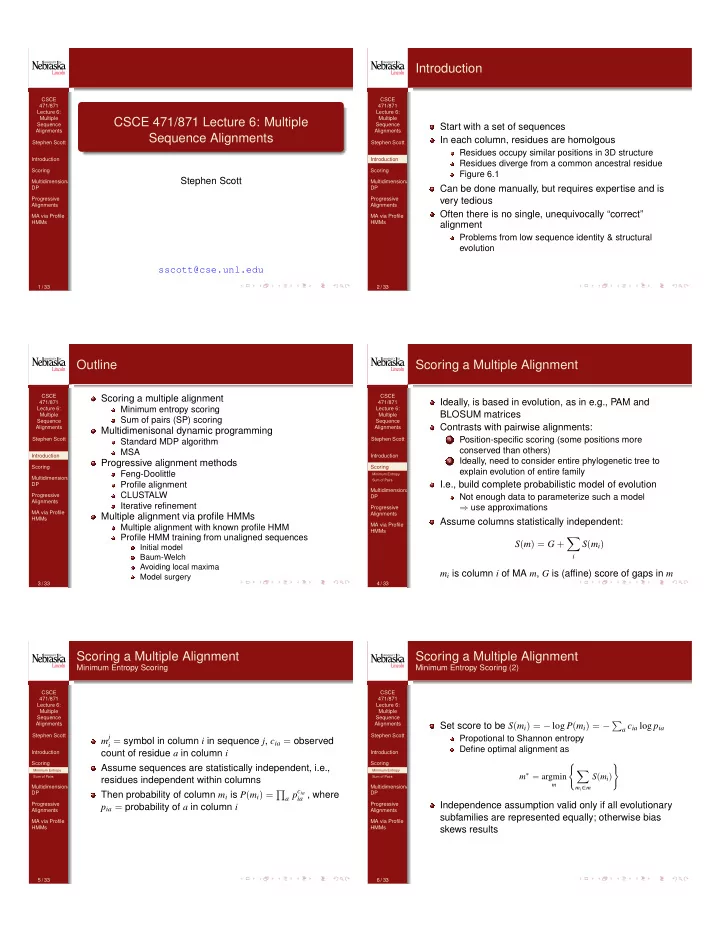
Introduction CSCE CSCE 471/871 471/871 Lecture 6: Lecture 6: Multiple Multiple CSCE 471/871 Lecture 6: Multiple Sequence Sequence Start with a set of sequences Alignments Alignments Sequence Alignments In each column, residues are


slide-1
SLIDE 1

CSCE 471/871 Lecture 6: Multiple Sequence Alignments Stephen Scott Introduction Scoring Multidimensional DP Progressive Alignments MA via Profile HMMs

CSCE 471/871 Lecture 6: Multiple Sequence Alignments

Stephen Scott sscott@cse.unl.edu

1 / 33 CSCE 471/871 Lecture 6: Multiple Sequence Alignments Stephen Scott Introduction Scoring Multidimensional DP Progressive Alignments MA via Profile HMMs

Introduction

Start with a set of sequences In each column, residues are homolgous

Residues occupy similar positions in 3D structure Residues diverge from a common ancestral residue Figure 6.1

Can be done manually, but requires expertise and is very tedious Often there is no single, unequivocally “correct” alignment

Problems from low sequence identity & structural evolution

2 / 33 CSCE 471/871 Lecture 6: Multiple Sequence Alignments Stephen Scott Introduction Scoring Multidimensional DP Progressive Alignments MA via Profile HMMs

Outline

Scoring a multiple alignment

Minimum entropy scoring Sum of pairs (SP) scoring

Multidimenisonal dynamic programming

Standard MDP algorithm MSA

Progressive alignment methods

Feng-Doolittle Profile alignment CLUSTALW Iterative refinement

Multiple alignment via profile HMMs

Multiple alignment with known profile HMM Profile HMM training from unaligned sequences

Initial model Baum-Welch Avoiding local maxima Model surgery

3 / 33 CSCE 471/871 Lecture 6: Multiple Sequence Alignments Stephen Scott Introduction Scoring

Minimum Entropy Sum of Pairs

Multidimensional DP Progressive Alignments MA via Profile HMMs

Scoring a Multiple Alignment

Ideally, is based in evolution, as in e.g., PAM and BLOSUM matrices Contrasts with pairwise alignments:

1

Position-specific scoring (some positions more conserved than others)

2

Ideally, need to consider entire phylogenetic tree to explain evolution of entire family

I.e., build complete probabilistic model of evolution

Not enough data to parameterize such a model ⇒ use approximations

Assume columns statistically independent: S(m) = G + X

i

S(mi) mi is column i of MA m, G is (affine) score of gaps in m

4 / 33 CSCE 471/871 Lecture 6: Multiple Sequence Alignments Stephen Scott Introduction Scoring

Minimum Entropy Sum of Pairs

Multidimensional DP Progressive Alignments MA via Profile HMMs

Scoring a Multiple Alignment

Minimum Entropy Scoring

mj

i = symbol in column i in sequence j, cia = observed

count of residue a in column i Assume sequences are statistically independent, i.e., residues independent within columns Then probability of column mi is P(mi) = Q

a pcia ia , where

pia = probability of a in column i

5 / 33 CSCE 471/871 Lecture 6: Multiple Sequence Alignments Stephen Scott Introduction Scoring

Minimum Entropy Sum of Pairs

Multidimensional DP Progressive Alignments MA via Profile HMMs

Scoring a Multiple Alignment

Minimum Entropy Scoring (2)

Set score to be S(mi) = − log P(mi) = − P

a cia log pia

Propotional to Shannon entropy Define optimal alignment as m⇤ = argmin

m

(X

mi2m

S(mi) )

Independence assumption valid only if all evolutionary subfamilies are represented equally; otherwise bias skews results

6 / 33

slide-2
SLIDE 2

CSCE 471/871 Lecture 6: Multiple Sequence Alignments Stephen Scott Introduction Scoring

Minimum Entropy Sum of Pairs

Multidimensional DP Progressive Alignments MA via Profile HMMs

Scoring a Multiple Alignment

Sum of Pairs (SP) Scores

Treat multiple alignment as N

2

  • pairwise alignments

If s(a, b) = substitution score from e.g., PAM or BLOSUM: S(mi) = X

k<`

s(mk

i , m` i )

Caveat: s(a, b) was derived for pairwise comparisons, not N-way comparisons correct z }| { log pabc qaqbqc vs. SP z }| { log pab qaqb + log pbc qbqc + log pac qaqc = log pabpbcpac q2

aq2 bq2 c

7 / 33 CSCE 471/871 Lecture 6: Multiple Sequence Alignments Stephen Scott Introduction Scoring

Minimum Entropy Sum of Pairs

Multidimensional DP Progressive Alignments MA via Profile HMMs

Scoring a Multiple Alignment

SP Problem

Given an alignment with only “L ” in column i, using BLOSUM50 yields an SP score of S1 = 5 N

2

  • = 5N(N − 1)/2

If one “L ” is replaced with “G”, then SP score is S2 = S1 − 9(N − 1) Problem: S2 S1 = 1 − 9(N − 1) 5N(N − 1)/2 = 1 − 18 5N , i.e., as N increases, S2/S1 → 1

But large N should give more support for “L ” in mi relative to S2, not less (i.e., should have S2/S1 decreasing)

8 / 33 CSCE 471/871 Lecture 6: Multiple Sequence Alignments Stephen Scott Introduction Scoring Multidimensional DP

Algorithm MSA

Progressive Alignments MA via Profile HMMs

Multidimensional Dynamic Programming

Generalization of DP for pairwise alignments Assume statistical independence of columns and linear gap penalty (can also handle affine gap penalties) S(m) = P

i S(mi), and ↵i1,i2,...,iN = max score of

alignment of subsequences x1

1...i1, x2 1...i2, . . ., xN 1...iN

↵i1,i2,...,iN = max 8 > > > > > > > > > > < > > > > > > > > > > : ↵i11,i21,i31,...,iN1 + S

  • x1

i1, x2 i2, x3 i3, . . . , xN iN

  • ,

↵i1,i21,i31,...,iN1 + S

  • −, x2

i2, x3 i3, . . . , xN iN

  • ,

↵i11,i2,i31,...,iN1 + S

  • x1

i1, −, x3 i3, . . . , xN iN

  • ,

. . . ↵i11,i21,i31,...,iN + S

  • x1

i1, x2 i2, x3 i3, . . . , −

  • ,

↵i1,i2,i31,...,iN1 + S

  • −, −, x3

i3, . . . , xN iN

  • ,

. . .

In each column, take all gap-residue combinations except 100% gaps

9 / 33 CSCE 471/871 Lecture 6: Multiple Sequence Alignments Stephen Scott Introduction Scoring Multidimensional DP

Algorithm MSA

Progressive Alignments MA via Profile HMMs

Multidimensional Dynamic Programming (2)

Assume all N sequences are of length L Space complexity = Θ( ) Time complexity = Θ( ) Is it practical?

10 / 33 CSCE 471/871 Lecture 6: Multiple Sequence Alignments Stephen Scott Introduction Scoring Multidimensional DP

Algorithm MSA

Progressive Alignments MA via Profile HMMs

MSA [Carrillo & Lipman 88; Lipman et al. 89]

Uses MDP , but eliminates many entries from consideration to save time Can optimally solve problems with L = 300 and N = 7 (old numbers), L = 150 and N = 50, L = 500 and N = 25, and L = 1000 and N = 10 (newer numbers) Uses SP scoring: S(a) = P

k<` S(ak`), where a is any

MA and ak` is PA between xk and x` induced by a If ˆ ak` is optimal PA between xk and x` (easily computed), then S(ak`) ≤ S(ˆ ak`) for all k and `

11 / 33 CSCE 471/871 Lecture 6: Multiple Sequence Alignments Stephen Scott Introduction Scoring Multidimensional DP

Algorithm MSA

Progressive Alignments MA via Profile HMMs

MSA (2)

Assume we have lower bound (a⇤) on score of optimal alignment a⇤:

(a⇤) ≤ S(a⇤) = X

k<`

S(a⇤ k`) = S(a⇤ k`) + X k0 < `0

(k0,`0)6=(k,`)

S(a⇤ k0`0) ≤ S(a⇤ k`) + X k0 < `0

(k0,`0)6=(k,`)

S(ˆ ak0`0)

Thus S(a⇤ k`) ≥ k` = (a⇤) − P

k0<`0

(k0,`0)6=(k,`)

S(ˆ ak0`0) When filling in matrix, only need to consider PAs that score at least k` (Figure 6.3) Can get (a⇤) from other (heuristic) alignment methods

12 / 33

slide-3
SLIDE 3

CSCE 471/871 Lecture 6: Multiple Sequence Alignments Stephen Scott Introduction Scoring Multidimensional DP Progressive Alignments

Feng-Doolittle Profile Alignment CLUSTALW Iterative Refinement

MA via Profile HMMs

Progressive Alignment Methods

Repeatedly perform pairwise alignments until all sequences are aligned Start by aligning the most similar pairs of sequences (most reliable)

Often start with a “guide tree”

Heuristic method (suboptimal), though generally pretty good Differences in the methods:

1

Choosing the order to do the alignments

2

Are sequences aligned to alignments or are sequences aligned to sequences and then alignments aligned to alignments?

3

Methods used to score and build alignments

13 / 33 CSCE 471/871 Lecture 6: Multiple Sequence Alignments Stephen Scott Introduction Scoring Multidimensional DP Progressive Alignments

Feng-Doolittle Profile Alignment CLUSTALW Iterative Refinement

MA via Profile HMMs

Progressive Alignment Methods

Feng-Doolittle

1

Compute a distance matrix by aligning all pairs of sequences

Convert each pairwise alignment score to distance: D = − log Sobs − Srand Smax − Srand Sobs = observed alignment score between the two sequences, Smax = average score of aligning each of the two sequences to itself, Srand = expected score of aligning two random sequences of same composition and length

2

Use a hierarchical clustering algorithm [Fitch & Margoliash 67] to build guide tree based on distance matrix

14 / 33 CSCE 471/871 Lecture 6: Multiple Sequence Alignments Stephen Scott Introduction Scoring Multidimensional DP Progressive Alignments

Feng-Doolittle Profile Alignment CLUSTALW Iterative Refinement

MA via Profile HMMs

Progressive Alignment Methods

Feng-Doolittle (2)

3

Build multiple alignment in the order that nodes were added to the guide tree in Step 2

Goes from most similar to least similar pairs Aligning two sequences is done with DP Aligning sequence x with existing alignment a done by pairwise aligning x to each sequence in a

Highest-scoring PA determines how to align x with a

Aligning existing alignment a with existing alignment a0 is done by pairwise aligning each sequence in a to each sequence in a0

Highest-scoring PA determines how to align a with a0

After each alignment formed, replace gaps with “X” character that scores 0 with other symbols and gaps

“Once a gap, always a gap” Ensures consistency between PAs and corresponding MAs

15 / 33 CSCE 471/871 Lecture 6: Multiple Sequence Alignments Stephen Scott Introduction Scoring Multidimensional DP Progressive Alignments

Feng-Doolittle Profile Alignment CLUSTALW Iterative Refinement

MA via Profile HMMs

Progressive Alignment Methods

Profile Alignment

Allows for position-specific scoring, e.g.:

Penalize gaps more in a non-gap column than in a gap-heavy column Penalize mismatches more in a highly-conserved column than a heterogeneous column

If gap penalty is linear, can use SP score with s(−, a) = s(a, −) = −g and s(−, −) = 0 Given two MAs (profiles) a1 (over x1, . . . , xn) and a2 (over xn+1, . . . , xN), align a1 with a2 by not altering the fundamental structure of either

Insert gaps into entire columns of a1 and a2 s(−, −) = 0 implies that this doesn’t affect score of a1 or a2

16 / 33 CSCE 471/871 Lecture 6: Multiple Sequence Alignments Stephen Scott Introduction Scoring Multidimensional DP Progressive Alignments

Feng-Doolittle Profile Alignment CLUSTALW Iterative Refinement

MA via Profile HMMs

Progressive Alignment Methods

Profile Alignment (2)

Score:

X

i

S(mi) = X

i

X

k,`:1k<`N

s(mk

i , m` i )

= X

i

X

k1,`12a1

s(mk1

i , m`1 i )+

X

i

X

k2,`22a2

s(mk2

i , m`2 i )+

z }| { X

i

X

k2a1,`2a2

s(mk

i , m` i )

Only the last term is affected by the alignment procedure, so it’s the only one that needs to be

  • ptimized

Thus alignment of profiles is similar to pairwise alignment, solved optimally via DP One profile can be single sequence

17 / 33 CSCE 471/871 Lecture 6: Multiple Sequence Alignments Stephen Scott Introduction Scoring Multidimensional DP Progressive Alignments

Feng-Doolittle Profile Alignment CLUSTALW Iterative Refinement

MA via Profile HMMs

Progressive Alignment Methods

CLUSTALW

Similar to Feng-Doolittle, but tuned to use profile alignment methods

1

Compute distance matrix via pairwise DP and convert to distances via Kimura [83]

Score with substitution matrix based on expected similarity of final alignment

2

Use hierarchical clustering algorithm [Saitou & Nei 87] to build guide tree

18 / 33

slide-4
SLIDE 4

CSCE 471/871 Lecture 6: Multiple Sequence Alignments Stephen Scott Introduction Scoring Multidimensional DP Progressive Alignments

Feng-Doolittle Profile Alignment CLUSTALW Iterative Refinement

MA via Profile HMMs

Progressive Alignment Methods

CLUSTALW (2)

3

Build multiple alignment in the order that nodes were added to the guide tree in Step 2

Use sequence-sequence, sequence-profile, or profile-profile as necessary Weight sequences to compensate for bias in SP scoring Use position-specific gap-open profile penalties; e.g., more likely to allow new gap in hydrophilic regions Adjusts gap penalties to concentrate gaps in a few regions Dynamically adjusts guide tree to defer low-scoring alignments until later

19 / 33 CSCE 471/871 Lecture 6: Multiple Sequence Alignments Stephen Scott Introduction Scoring Multidimensional DP Progressive Alignments

Feng-Doolittle Profile Alignment CLUSTALW Iterative Refinement

MA via Profile HMMs

Progressive Alignment Methods

Iterative Refinement Methods [Barton & Sternberg 87]

Start with MA, then iteratively remove one sequence (or subset) x at a time and realign to profile of remaining sequences ⇒ will increase score or not change it Repeat with other sequences until alignment remains unchanged Guaranteed to reach local max if all sequences tried

20 / 33 CSCE 471/871 Lecture 6: Multiple Sequence Alignments Stephen Scott Introduction Scoring Multidimensional DP Progressive Alignments

Feng-Doolittle Profile Alignment CLUSTALW Iterative Refinement

MA via Profile HMMs

Progressive Alignment Methods

Iterative Refinement Methods (2)

1

Pairwise align the two most similar sequences

2

Sequence-profile align the profile of current MA to most similar sequence; repeat until all sequences aligned

3

Remove sequence x1 and sequence-profile realign it to profile of rest; repeat for x2, . . . , xN

4

Repeat above step until convergence

21 / 33 CSCE 471/871 Lecture 6: Multiple Sequence Alignments Stephen Scott Introduction Scoring Multidimensional DP Progressive Alignments MA via Profile HMMs

HMM Known HMM Unknown Local Maxima Simulated Annealing Model Surgery

MA via Profile HMMs

Replace SP scoring with more statistically valid HMM scheme

··

^ But don’t we need a multiple alignment to build the profile HMM?

Use heuristics to set architecture, Baum-Welch to find parameters

22 / 33 CSCE 471/871 Lecture 6: Multiple Sequence Alignments Stephen Scott Introduction Scoring Multidimensional DP Progressive Alignments MA via Profile HMMs

HMM Known HMM Unknown Local Maxima Simulated Annealing Model Surgery

Multiple Alignment with Known Profile HMM

Find most likely (Viterbi) path and line up residues from same match states Insert state emissions are not aligned (Figs. 6.4–6.6)

OK so long as residues are true insertions (not conserved or meaningfully alignable) Other MA algorithms align entire sequences

23 / 33 CSCE 471/871 Lecture 6: Multiple Sequence Alignments Stephen Scott Introduction Scoring Multidimensional DP Progressive Alignments MA via Profile HMMs

HMM Known HMM Unknown Local Maxima Simulated Annealing Model Surgery

Profile HMM Training from Unaligned Sequences

Used by SAM

1

Choose length of model (number of match states) and initialize parameters

2

Set parameters via Baum-Welch

Use heuristics to avoid local optima

3

Check length of model from Step 1 and update if necessary

Repeat Step 2 if model length changed

4

Align all sequences to final model using Viterbi algorithm and build MA

24 / 33

slide-5
SLIDE 5

CSCE 471/871 Lecture 6: Multiple Sequence Alignments Stephen Scott Introduction Scoring Multidimensional DP Progressive Alignments MA via Profile HMMs

HMM Known HMM Unknown Local Maxima Simulated Annealing Model Surgery

Profile HMM Training from Unaligned Sequences

Choosing Initial Model

Architecture completely set once we choose number match states M When we started with MA, we applied heuristics to set M But we don’t have MA!

Heuristic: Let M = average sequence length If prior information known, use that instead

For initial parameters, complexity of B-W search makes us want to start near good local optimum

Start with reasonable initial values of parameters (e.g., transitions into match states relatively large):

Sample from Dirichlet prior Start with guess of MA

25 / 33 CSCE 471/871 Lecture 6: Multiple Sequence Alignments Stephen Scott Introduction Scoring Multidimensional DP Progressive Alignments MA via Profile HMMs

HMM Known HMM Unknown Local Maxima Simulated Annealing Model Surgery

Profile HMM Training from Unaligned Sequences

Baum-Welch: Forward Equations

fM0(0) = 1 fMk(i) = eMk(xi) ⇥ fMk1(i − 1) aMk1Mk + fIk1(i − 1) aIk1Mk + fDk1(i − 1) aDk1Mk ⇤ fIk(i) = eIk(xi) [ fMk(i − 1) aMkIk + fIk(i − 1) aIkIk + fDk(i − 1) aDkIk] fDk(i) = fMk1(i) aMk1Dk + fIk1(i) aIk1Dk + fDk1(i) aDk1Dk fMM+1(L + 1) = fMM(L) aMMMM+1 + fIM(L) aIMMM+1 + fDM(L) aDMMM+1

26 / 33 CSCE 471/871 Lecture 6: Multiple Sequence Alignments Stephen Scott Introduction Scoring Multidimensional DP Progressive Alignments MA via Profile HMMs

HMM Known HMM Unknown Local Maxima Simulated Annealing Model Surgery

Profile HMM Training from Unaligned Sequences

Baum-Welch: Backward Equations

bMM+1(L + 1) = 1 ; bMM(L) = aMMMM+1 bIM(L) = aIMMM+1 ; bDM(L) = aDMMM+1 bMk(i) = bMk+1(i + 1) aMkMk+1 eMk+1(xi+1) + bIk(i + 1) aMkIk eIk(xi+1) +bDk+1(i) aMkDk+1 bIk(i) = bMk+1(i + 1) aIkMk+1 eMk+1(xi+1) + bIk(i + 1) aIkIk eIk(xi+1) +bDk+1(i) aIkDk+1 bDk(i) = bMk+1(i + 1) aDkMk+1 eMk+1(xi+1) + bIk(i + 1) aDkIk eIk(xi+1) +bDk+1(i) aDkDk+1

27 / 33 CSCE 471/871 Lecture 6: Multiple Sequence Alignments Stephen Scott Introduction Scoring Multidimensional DP Progressive Alignments MA via Profile HMMs

HMM Known HMM Unknown Local Maxima Simulated Annealing Model Surgery

Profile HMM Training from Unaligned Sequences

Baum-Welch: Re-estimation Equations

EMk(a) = 1 P(x) X

i:xi=a

fMk(i) bMk(i) EIk(a) = 1 P(x) X

i:xi=a

fIk(i) bIk(i) AXkMk+1 = 1 P(x) X

i

fXk(i) aXkMk+1 eMk+1(xi+1) bMk+1(i + 1) AXkIk = 1 P(x) X

i

fXk(i) aXkIk eIk(xi+1) bIk(i + 1) AXkDk+1 = 1 P(x) X

i

fXk(i) aXkDk+1 bDk+1(i)

28 / 33 CSCE 471/871 Lecture 6: Multiple Sequence Alignments Stephen Scott Introduction Scoring Multidimensional DP Progressive Alignments MA via Profile HMMs

HMM Known HMM Unknown Local Maxima Simulated Annealing Model Surgery

Profile HMM Training from Unaligned Sequences

Avoiding Local Maxima

B-W will converge to local maximum likelihood model, but how good is that globally? Long sequences ⇒ many parameters to optimize ⇒ increased risk of getting stuck in local minimum Methods to avoid this:

Multiple runs from random start points (sometimes done in training artificial neural networks) Use random pertubations of current solution to nudge it into different parts of the search space, e.g., simulated annealing

29 / 33 CSCE 471/871 Lecture 6: Multiple Sequence Alignments Stephen Scott Introduction Scoring Multidimensional DP Progressive Alignments MA via Profile HMMs

HMM Known HMM Unknown Local Maxima Simulated Annealing Model Surgery

Profile HMM Training from Unaligned Sequences

Simulated Annealing

Based on annealing process to crystallize compounds In optimization, this involves occasionally selecting worse solutions to allow movement to a region of the search space where a better local optimum exists Movement is done probabilistically (so optimization can be thought of as a Markov process), and probability of worse choice decreases as optimization progresses Probability of a particular solution x is P(x) = (1/Z) exp (−E(x)/T); Z = R exp (−E(x)/T) is normalizer, E(x) is energy (objective) function to be minimized, and T is temperature parameter that is reduced based on annealing schedule T → ∞ ⇒ P(x) → uniform, T → 0 ⇒ P(x) → peaks at minimum values of E(x)

30 / 33

slide-6
SLIDE 6

CSCE 471/871 Lecture 6: Multiple Sequence Alignments Stephen Scott Introduction Scoring Multidimensional DP Progressive Alignments MA via Profile HMMs

HMM Known HMM Unknown Local Maxima Simulated Annealing Model Surgery

Profile HMM Training from Unaligned Sequences

Simulated Annealing (2)

For HMM, use as E(x) the negative log of likelihood: − log P(X | ✓), so P(x) = exp

  • − 1

T (− log P(X | ✓))

  • Z

= P(X | ✓)1/T R P(X | ✓0)1/Td✓0 To sample from this distribution, can use noise injection

  • r Viterbi estimation

Noise injection: Add noise to counts estimated in forward-backward procedure, decreasing noise rate slowly

31 / 33 CSCE 471/871 Lecture 6: Multiple Sequence Alignments Stephen Scott Introduction Scoring Multidimensional DP Progressive Alignments MA via Profile HMMs

HMM Known HMM Unknown Local Maxima Simulated Annealing Model Surgery

Profile HMM Training from Unaligned Sequences

Simulated Annealing (3): Viterbi Estimation

Based on Viterbi alternative to B-W, in which emission and transition counts come from most likely paths rather than forward-backward expectation estimates

In SA approximation, rather than choosing most likely path, choose a path probabilistically: P(⇡) = P(⇡, x | ✓)1/T P

⇡0 P(⇡0, x | ✓)1/T

Denominator comes from modified forward algorithm with exponentiated parameters Use stochastic traceback to return ⇡: For i = L + 1 down to 1, P(⇡i1 | ⇡i) = fi1,⇡i1 ˆ a⇡i1,⇡i P

k fi1,k ˆ

ai,⇡i , ˆ aij = a1/T

ij

32 / 33 CSCE 471/871 Lecture 6: Multiple Sequence Alignments Stephen Scott Introduction Scoring Multidimensional DP Progressive Alignments MA via Profile HMMs

HMM Known HMM Unknown Local Maxima Simulated Annealing Model Surgery

Model Surgery

B-W should give reasonably good parameters to fit architecture to data But was the architecture accurate in the first place?

Too few match states ⇒ overuse of insertion states, incorrectly labeling some parts as non-matches Too many match states ⇒ overuse of deletion states

Model surgery (heuristically) identifies such problems and updates model

Use f-b or Viterbi to compute usage of all the model’s transitions If a match state Mi is used too infrequently, delete it and collapse the model If an insert state Ij is used too frequently, expand it to a sequence of match states (number = average length of insertions)

Have to recompute parameters via B-W after surgery!

33 / 33