
SLIDE 1
Visualizing covariates in proportional hazards model using R
Juha Karvanen International CVD Epidemiology Unit Department of Health Promotion and Chronic Disease Prevention National Public Health Institute Finland
Outline
- An illustrative example
- Elements of interpretation
- Rank-hazard plots
- Model comparison with rank-hazard plots
- Conclusion
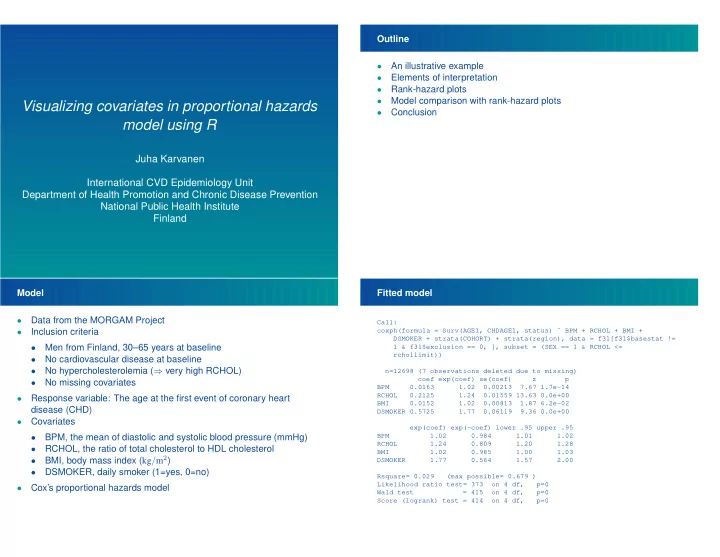
Model
- Data from the MORGAM Project
- Inclusion criteria
- Men from Finland, 30–65 years at baseline
- No cardiovascular disease at baseline
- No hypercholesterolemia (⇒ very high RCHOL)
- No missing covariates
- Response variable: The age at the first event of coronary heart
disease (CHD)
- Covariates
- BPM, the mean of diastolic and systolic blood pressure (mmHg)
- RCHOL, the ratio of total cholesterol to HDL cholesterol
- BMI, body mass index (kg/m2)
- DSMOKER, daily smoker (1=yes, 0=no)
- Cox’s proportional hazards model
Fitted model
Call: coxph(formula = Surv(AGE1, CHDAGE1, status) ˜ BPM + RCHOL + BMI + DSMOKER + strata(COHORT) + strata(region), data = f31[f31$basestat != 1 & f31$exclusion == 0, ], subset = (SEX == 1 & RCHOL <= rchollimit)) n=12698 (7 observations deleted due to missing) coef exp(coef) se(coef) z p BPM 0.0163 1.02 0.00213 7.67 1.7e-14 RCHOL 0.2125 1.24 0.01559 13.63 0.0e+00 BMI 0.0152 1.02 0.00813 1.87 6.2e-02 DSMOKER 0.5725 1.77 0.06119 9.36 0.0e+00 exp(coef) exp(-coef) lower .95 upper .95 BPM 1.02 0.984 1.01 1.02 RCHOL 1.24 0.809 1.20 1.28 BMI 1.02 0.985 1.00 1.03 DSMOKER 1.77 0.564 1.57 2.00 Rsquare= 0.029 (max possible= 0.679 ) Likelihood ratio test= 373
- n 4 df,
p=0 Wald test = 415
- n 4 df,
p=0 Score (logrank) test = 414
- n 4 df,
p=0