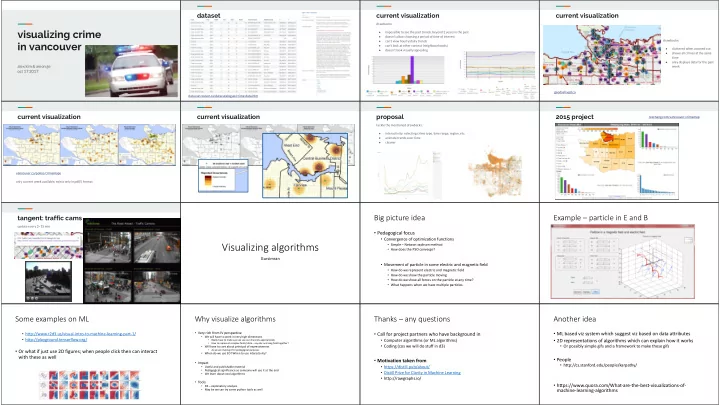

SLIDE 1
visualizing crime in vancouver
alex kim & amon ge
- ct 17 2017
dataset
data.vancouver.ca/datacatalogue/crime-data.htm
current visualization
drawbacks:
- impossible to see the past trends, beyond 2 years in the past
- doesn’t allow choosing a period of time of interest
- can’t view hourly/daily trends
- can’t look at other context (neighbourhoods)
- doesn’t look visually appealing
current visualization
geodash.vpd.ca drawbacks:
- cluttered when zoomed out
- shows all crimes at the same
time
- nly displays data for the past
week
current visualization
vancouver.ca/police/crimemaps
- nly current week available, exists only in pdf(!) format
current visualization proposal
tackle the mentioned drawbacks:
- interactivity: selecting crime type, time range, region, etc.
- animate trends over time
- cleaner
2015 project
rexchang.com/vancouver-crimemap
tangent: traffic cams
update every 2~15 min
Visualizing algorithms
Gursimran
Big picture idea
- Pedagogical focus
- Convergence of optimization functions
- Simple – Netwon raphson method
- How does the PSO converge?
- Movement of particle in some electric and magnetic field
- How do we represent electric and magnetic field
- How do we show the particle moving
- How do we show all forces on the particle at any time?
- What happens when we have multiple particles.
Example – particle in E and B Some examples on ML
- http://www.r2d3.us/visual-intro-to-machine-learning-part-1/
- http://playground.tensorflow.org/
- Or what if just use 2D figures; when people click then can interact
with these as well
Why visualize algorithms
- Very rich from IV perspective
- We will have to work in very high dimentions
- Really have to make sure we use our channels appropriately
- How to represent complex fields/ data – say elec and mag field together?
- Will have to care about principal of expressiveness
- As we are making it for pedagogical purposes
- When do we use 3D? When to use interactivity?
- Impact
- Useful and publishable material
- Pedagogical significance so someone will use it at the end
- We learn about cool algorithms
- Tools
- D3 – explanatory analysis
- May be we can try some python tools as well
Thanks – any questions
- Call for project partners who have background in
- Computer algorithms (or ML algorithms)
- Coding (cos we will do stuff in d3)
- Motivation taken from
- https://distill.pub/about/
- Distill Prize for Clarity in Machine Learning
- http://rawgraphs.io/
Another idea
- ML based viz system which suggest viz based on data attributes
- 2D representations of algorithms which can explain how it works
- Or possibly simple gifs and a framework to make these gifs
- People
- http://cs.stanford.edu/people/karpathy/
- https://www.quora.com/What-are-the-best-visualizations-of-
machine-learning-algorithms