Pre-Plant Vineyard Fertilization Not exact science Few if any - - PDF document

pre plant vineyard fertilization
SMART_READER_LITE
LIVE PREVIEW

Pre-Plant Vineyard Fertilization Not exact science Few if any - - PDF document

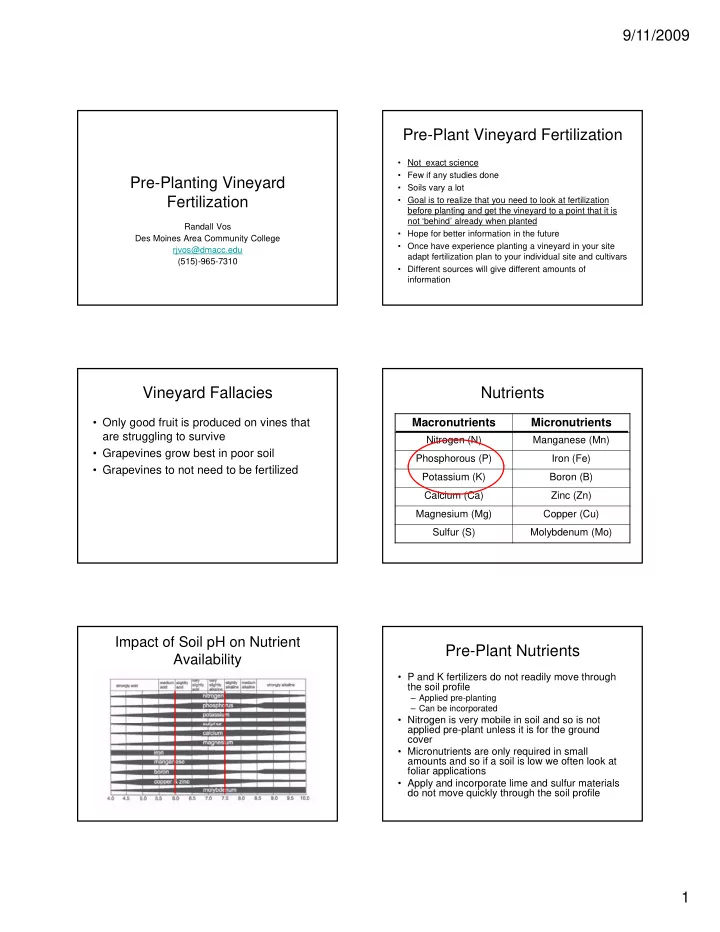
9/11/2009 Pre-Plant Vineyard Fertilization Not exact science Few if any studies done Pre-Planting Vineyard Soils vary a lot Fertilization Goal is to realize that you need to look at fertilization before planting and get the


slide-1
SLIDE 1

9/11/2009 1

Pre-Planting Vineyard Fertilization

Randall Vos Des Moines Area Community College rjvos@dmacc.edu (515)-965-7310

Pre-Plant Vineyard Fertilization

  • Not exact science
  • Few if any studies done
  • Soils vary a lot
  • Goal is to realize that you need to look at fertilization

b f l ti d t th i d t i t th t it i before planting and get the vineyard to a point that it is not ‘behind’ already when planted

  • Hope for better information in the future
  • Once have experience planting a vineyard in your site

adapt fertilization plan to your individual site and cultivars

  • Different sources will give different amounts of

information

Vineyard Fallacies

  • Only good fruit is produced on vines that

are struggling to survive

  • Grapevines grow best in poor soil

G i t t d t b f tili d

  • Grapevines to not need to be fertilized

Nutrients

Macronutrients Micronutrients

Nitrogen (N) Manganese (Mn) Phosphorous (P) Iron (Fe) Potassium (K) Boron (B) Calcium (Ca) Zinc (Zn) Magnesium (Mg) Copper (Cu) Sulfur (S) Molybdenum (Mo)

Impact of Soil pH on Nutrient Availability

Pre-Plant Nutrients

  • P and K fertilizers do not readily move through

the soil profile

– Applied pre-planting – Can be incorporated

  • Nitrogen is very mobile in soil and so is not

g y applied pre-plant unless it is for the ground cover

  • Micronutrients are only required in small

amounts and so if a soil is low we often look at foliar applications

  • Apply and incorporate lime and sulfur materials

do not move quickly through the soil profile

slide-2
SLIDE 2

9/11/2009 2

Fertilizer Labels

20 - 10 - 20 %N - % phosphate - % potash

Fertilization

  • P & K are in many different forms in the soil and not all

are plant available

  • Soil tests look at plant available forms
  • If you apply 20 lbs of K, will your soil test later show that

your soil increased the plant available K by 20 lbs? your soil increased the plant available K by 20 lbs?

  • No, it gets converted into different forms, the ratio that

remains plant available depends on the soil type and fertility

  • That’s why this is not exact science
  • Main point is that grapes need P & K in the soil

Midwest Grape Production Guide

Some regions in the Midwest have high soil magnesium levels and may require higher levels of potassium to compensate One method is if soil Mg levels are higher than 600 lbs per acre, to apply enough K to equal 50% of that, though not sure if the best approach Table 1. Preplant P recommendations for apples, pears, stone fruits, grapes, strawberries and raspberries. Soil test level (ppm P)1 Recommendation (lb P2O5/acre)

Fertilizing Fruit Crops

Eric Hanson, Michigan State University, MSUE Bulletin E-852

10 90 20 70 30 40 40 20 50

1To convert to lb/acre, 6.7 inch depth, multiply by 2.

http://www.canr.msu.edu/vanburen/e-852.htm

Soil Test Example: Macronutrients

Sample Water pH Buffer pH Phosphorus (P) Potassium (K) Calcium (Ca) Magnesium (Mg) % Organic Matter (OM)

1 6.1 6.7 30 80 2024 125 3.25 2 7.2 7.3 12 120 1845 350 4

Parts per Million (ppm) Lbs per acre= ppm X 2 Sample Water pH Buffer pH Phosphorus (P) Potassium (K) Calcium (Ca) Magnesium (Mg) % Organic Matter (OM)

1 6.1 6.7 60 160 4048 250 3.25 2 7.2 7.3 24 240 3690 700 4

Fertilizing Fruit Crops

Eric Hanson, Michigan State University, MSUE Bulletin E-852 Table 2. Pre-Plant K recommendations for various fruit crops. Recommendation (lb K2O/acre) Soil test (ppm K)1 Apples, Stone fruits, grapes, raspberries Strawberrie pp pears raspberries s 15 170 220 200 25 150 200 170 50 100 150 120 75 50 100 70 100 50 20 125

1To convert to lb/acre, 6.7 inch depth, multiply by 2.

http://www.canr.msu.edu/vanburen/e-852.htm

slide-3
SLIDE 3

9/11/2009 3

Lbs per acre= ppm X 2 Sample Water pH Buffer pH Phosphorus (P) Potassium (K) Calcium (Ca) Magnesium (Mg) % Organic Matter (OM)

1 6.1 6.7 60 160 4048 250 3.25

Soil pH is good P is good K is low

SOIL 1

K is low All else looks pretty good So we need to apply K, if the ideal is 250-300lbs/acre and we only have 160 lbs/acre

Fertilizing Fruit Crops

Eric Hanson, Michigan State University, MSUE Bulletin E-852 Table 2. Pre-Plant K recommendations for various fruit crops. Recommendation (lb K2O/acre) Soil test (ppm K)1 Apples Stone fruits, grapes, Strawberrie Apples, pears raspberries Strawberrie s 15 170 220 200 25 150 200 170 50 100 150 120 75 50 100 70 100 50 20 125

1To convert to lb/acre, 6.7 inch depth, multiply by 2.

http://www.canr.msu.edu/vanburen/e-852.htm

Two common K fertilizers are 0-0-50 and 0-0-60, the third number representing the potash. This means that these fertilizers are 50% and 60% potash, respectively. Since we want to apply 100 lbs of potash we need to do the following to determine fertilizer rates depending on the product we use: 100/0.5 =200 lbs of 0-0-50

  • r

100/0 6 = 170 lbs of 0 0 60

SOIL 1

100/0.6 =~170 lbs of 0-0-60 Note that this does not mean the soil test taken after applying the fertilizer will show that we have added that exact amount. Applied fertilizer takes many forms on the soil that are not available to plants. Keep in mind these are merely guidelines. That give merit to pre-plant K applications. Once we are producing fruit, petiole samples are the true indicator of plant nutrient needs.

Lbs per acre= ppm X 2 Sample Water pH Buffer pH Phosphorus (P) Potassium (K) Calcium (Ca) Magnesium (Mg) % Organic Matter (OM)

2 7.2 7.3 24 240 3690 700 4

Soil pH is high P is low K is low

SOIL 2

K is low Mg is high Table 1. Preplant P recommendations for apples, pears, stone fruits, grapes, strawberries and raspberries. Soil test level (ppm P)1 Recommendation (lb P2O5/acre)

Fertilizing Fruit Crops

Eric Hanson, Michigan State University, MSUE Bulletin E-852

10 90 20 70 30 40 40 20 50

1To convert to lb/acre, 6.7 inch depth, multiply by 2.

http://www.canr.msu.edu/vanburen/e-852.htm

Fertilizing Fruit Crops

Eric Hanson, Michigan State University, MSUE Bulletin E-852 Table 2. Pre-Plant K recommendations for various fruit crops. Recommendation (lb K2O/acre) Soil test (ppm K)1 Apples Stone fruits, grapes, Strawberrie Apples, pears raspberries Strawberrie s 15 170 220 200 25 150 200 170 50 100 150 120 75 50 100 70 100 50 20 125

1To convert to lb/acre, 6.7 inch depth, multiply by 2.

http://www.canr.msu.edu/vanburen/e-852.htm

slide-4
SLIDE 4

9/11/2009 4

Phosphorus fertilizer is measured as P2O5 (phosphate) and that is the second number in the label. If we have close to 10 ppm the MSU info indicates we should apply about 90 lbs of phosphate. Common P containing fertilizers are 0-46-0, 18-46-0, and 11-42-0, the later 2 containing nitrogen as well. To calculate the amount of fertilizer required to applied 60 lbs of phosphate go through the following calculations: 90/0.46 = ~195 lbs of 0-46-0 or 18-46-0 90/0 48 = 185 lbs of 11 48 0

SOIL 2

90/0.48 = ~185 lbs of 11-48-0 According the MSU info we should be applying around 50 lbs of potash. However our high Mg may indicate needing more than that. So I am going to double that to 100 lbs, so depending on our fertilizer we apply: 100/0.5 =200 lbs of 0-0-50

  • r

100/0.6 =~170 lbs of 0-0-60

Pre Plant Fertilization

  • Not exact science
  • If low in P and K it is advisable to add

some to aide in establishment I ti i t ti i i t t

  • Incorporation into rooting zone is important
  • Applications in mature vineyard based on

actual P & K uptake.

  • Adjusting pH has a large impact on

micronutrient availability