Visualizing Heart Data Visualizing Heart Data of a living entity by - - PDF document

visualizing heart data visualizing heart data
SMART_READER_LITE
LIVE PREVIEW

Visualizing Heart Data Visualizing Heart Data of a living entity by - - PDF document

What do researchers seek? What do researchers seek? To achieve a better understanding of the state To achieve a better understanding of the state Visualizing Heart Data Visualizing Heart Data of a living entity by analyzing time-


slide-1
SLIDE 1

1

Visualizing Heart Data Visualizing Heart Data from Pulse Intervals from Pulse Intervals

By By Juan Gabriel Estrada Alvarez Juan Gabriel Estrada Alvarez

What do researchers seek? What do researchers seek?

  • To achieve a better understanding of the state

To achieve a better understanding of the state

  • f a living entity by analyzing time
  • f a living entity by analyzing time-
  • series data

series data taken from blood pressure taken from blood pressure

  • Tools exist (e.g. Spectral analysis, Wavelet,

Tools exist (e.g. Spectral analysis, Wavelet, etc.) etc.)

  • These tools are nonetheless hard to interpret:

These tools are nonetheless hard to interpret:

– – The high irregularity in the data set causes The high irregularity in the data set causes “ “noise noise” ” to show up, possibly hiding the juicy stuff to show up, possibly hiding the juicy stuff

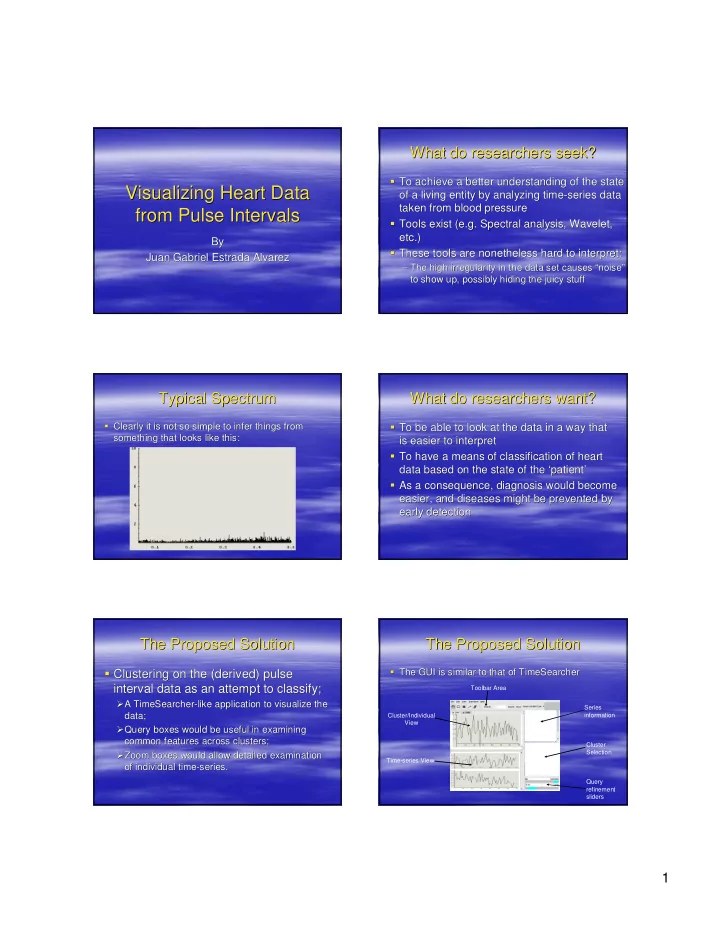
Typical Spectrum Typical Spectrum

  • Clearly it is not so simple to infer things from

Clearly it is not so simple to infer things from something that looks like this: something that looks like this:

What do researchers want? What do researchers want?

  • To be able to look at the data in a way that

To be able to look at the data in a way that is easier to interpret is easier to interpret

  • To have a means of classification of heart

To have a means of classification of heart data based on the state of the data based on the state of the ‘ ‘patient patient’ ’

  • As a consequence, diagnosis would become

As a consequence, diagnosis would become easier, and diseases might be prevented by easier, and diseases might be prevented by early detection early detection

The Proposed Solution The Proposed Solution

  • Clustering on the (derived) pulse

Clustering on the (derived) pulse interval data as an attempt to classify; interval data as an attempt to classify;

  • A

A TimeSearcher TimeSearcher-

  • like application to visualize the

like application to visualize the data; data;

  • Query boxes would be useful in examining

Query boxes would be useful in examining common features across clusters; common features across clusters;

  • Zoom boxes would allow detailed examination

Zoom boxes would allow detailed examination

  • f individual time
  • f individual time-
  • series.

series.

The Proposed Solution The Proposed Solution

  • The GUI is similar to that of

The GUI is similar to that of TimeSearcher TimeSearcher

Cluster/Individual View Time-series View Cluster Selection Query refinement sliders Toolbar Area Series information

slide-2
SLIDE 2

2

What has been done What has been done

  • Contacted the authors of

Contacted the authors of TimeSearcher TimeSearcher; ;

  • Established (tentatively) the clustering

Established (tentatively) the clustering algorithm to be used: Normalized algorithm to be used: Normalized version of the RMSD (average version of the RMSD (average geometric distance); geometric distance);

  • Partial GUI (based on Harry

Partial GUI (based on Harry Hochheiser Hochheiser’ ’s s source code) source code)

The issues that make it hard The issues that make it hard

1.

  • 1. A typical series is roughly about 7,000 data

A typical series is roughly about 7,000 data points points 2.

  • 2. Original data contains corrupted points due

Original data contains corrupted points due to monitoring machine calibration to monitoring machine calibration 3.

  • 3. Series do not all start at the same time!

Series do not all start at the same time! Expensive pre Expensive pre-

  • processing may be required.

processing may be required. 4.

  • 4. User feedback?

User feedback?

Possible solutions Possible solutions

1.

  • 1. Use neighbour averaging to represent

Use neighbour averaging to represent several data points in one single point several data points in one single point 2.

  • 2. Recover missing points by averaging the

Recover missing points by averaging the immediate neighbours. immediate neighbours. 3.

  • 3. Maybe there exists a representation that

Maybe there exists a representation that allows comparison independent of allows comparison independent of “ “starting starting” ” and and “ “ending ending” ” points. The

  • points. The

spectrum of each series is a candidate spectrum of each series is a candidate

Possible solutions Possible solutions

  • One can notice similarities at first sight on the spectra:

One can notice similarities at first sight on the spectra:

  • This is evidence that clustering is possible

This is evidence that clustering is possible

Possible solutions Possible solutions

4.

  • 4. User feedback is definitely desirable.

User feedback is definitely desirable. Will contact Bruce Van Will contact Bruce Van Vliet Vliet for this for this purpose purpose

What has changed What has changed

BEFORE BEFORE

  • Series and clusters would be

Series and clusters would be displayed with full detail displayed with full detail

  • Cluster view would allow

Cluster view would allow querying on clusters only querying on clusters only

  • Allow zooming in cluster and

Allow zooming in cluster and individual views individual views

NOW NOW

  • Averaging of data points will be

Averaging of data points will be done done

  • Cluster view allows switching to

Cluster view allows switching to viewing all series in the clusters viewing all series in the clusters selected and vice selected and vice-

  • versa

versa (querying on time series would (querying on time series would then be allowed) then be allowed)

  • An extra window will display

An extra window will display time series in full detail to allow time series in full detail to allow comparison with other series. comparison with other series. Only display where zoom will be Only display where zoom will be supported supported

slide-3
SLIDE 3

3

What Next? What Next?

  • Contact Bruce for user feedback

Contact Bruce for user feedback

  • Implement clustering (including pre

Implement clustering (including pre-

  • processing)

processing)

  • Implement the display areas

Implement the display areas

  • Integrate with the existing querying implementation of

Integrate with the existing querying implementation of TimeSearcher TimeSearcher

  • Implement detailed view in separate window with zoom

Implement detailed view in separate window with zoom capabilities capabilities

  • Tune up the GUI

Tune up the GUI

  • Acknowledgements:

Acknowledgements:

– – Harry Harry Hochheiser Hochheiser for kindly providing the source code of for kindly providing the source code of TimeSearcher TimeSearcher – – Bruce Van Bruce Van Vliet Vliet for kindly providing the data set for kindly providing the data set