Visibility isnt everything: Managing Meta and Auxiliary data in - - PowerPoint PPT Presentation

visibility isn t everything
SMART_READER_LITE
LIVE PREVIEW

Visibility isnt everything: Managing Meta and Auxiliary data in - - PowerPoint PPT Presentation

Visibility isnt everything: Managing Meta and Auxiliary data in ALMA Observations Nuria P. F. Lorente ALMA Computing, NRAO The Protagonists Michel Caillat (ALMA, Observatoire de Paris) Franois Viallefond (ALMA, Observatoire de


slide-1
SLIDE 1

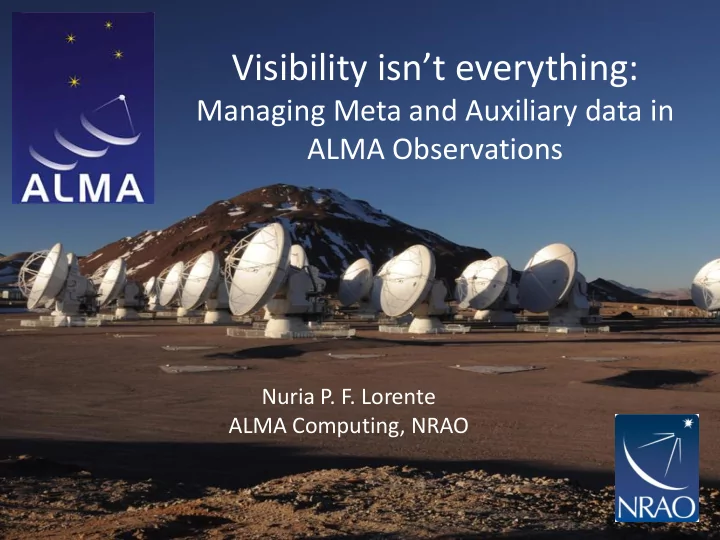
Visibility isn’t everything:

Managing Meta and Auxiliary data in ALMA Observations

Nuria P. F. Lorente ALMA Computing, NRAO

slide-2
SLIDE 2

The Protagonists

  • Michel Caillat (ALMA, Observatoire de Paris)
  • François Viallefond (ALMA, Observatoire de Paris)
  • Heiko Hafok (MPIfR)
  • Robert Lucas (ALMA, ESO)
  • Michael Rupen (EVLA, NRAO)
slide-3
SLIDE 3

The Atacama Large Millimeter/submillimeter Array

  • Started Early Science operations in September 2011

– 16 antennas – ν = 84-720 GHz – Data rates: < 15 MB/s

  • On completion:

– 66 antennas – Data rates: 6 MB/s (avg) – 60 MB/s (peak) – Majority of data consists of visibilities, but small fraction (0.1 MB/s) are Metadata and Auxiliary data.

slide-4
SLIDE 4

Metadata & Auxiliary Data

  • Metadata: describes the observation, visibilities, calibration

and auxiliary data – eg. project number, spectral setup, location of data in the archive

  • Auxiliary data: data required to process and analyse the

primary data – eg. pointing, square-law detector, water-vapour radiometer data.

  • Stored in the Archive, as ALMA Science Data Model (ASDM)
slide-5
SLIDE 5

ALMA Science Data Model (SDM)

  • Must contain all the information necessary for the

astronomical processing of raw data from the telescope.

  • Format in which raw science data will be archived and

provided to astronomical observers.

  • Supported by the Common Astronomy Software

Applications (CASA) post-processing software

  • Set of tables represented as XML documents (mostly)
  • Data from correlators, square-law detectors, radiometers,
  • etc. stored in binary blocks.
slide-6
SLIDE 6

Data Flow in the ALMA software system

slide-7
SLIDE 7

Capturing the Meta/Auxiliary Data

Interface to other subsystems State machine Marshals the data

slide-8
SLIDE 8

ASDM Table Dependencies

slide-9
SLIDE 9

ASDM Table Dependencies

slide-10
SLIDE 10

ASDM Table Dependencies

slide-11
SLIDE 11

Capturing the Meta/Auxiliary Data

Interface to other subsystems State machine Marshals the data

slide-12
SLIDE 12

What have we gained?

  • Maintainability: uses several specialised data or function-

based classes, rather than a very small number of classes to do everything.

  • Consolidation: have been able to remove much code

repetition (eg. for different observing modes).

  • Extensibility: for new ASDM tables, new observing modes
  • Better testing: specialisation of tasks results in a module

which is easier to test (at the unit and end-to-end levels)

slide-13
SLIDE 13

The Atacama Large Millimeter/submillimeter Array (ALMA), an international astronomy facility, is a partnership of Europe, North America and East Asia in cooperation with the Republic of Chile. ALMA is funded in Europe by the European Organization for Astronomical Research in the Southern Hemisphere (ESO), in North America by the U.S. National Science Foundation (NSF) in cooperation with the National Research Council of Canada (NRC) and the National Science Council of Taiwan (NSC) and in East Asia by the National Institutes of Natural Sciences (NINS) of Japan in cooperation with the Academia Sinica (AS) in Taiwan. ALMA construction and operations are led on behalf of Europe by ESO, on behalf of North America by the National Radio Astronomy Observatory (NRAO), which is managed by Associated Universities, Inc. (AUI) and

  • n behalf of East Asia by the National Astronomical Observatory of Japan (NAOJ). The Joint ALMA Observatory (JAO)

provides the unified leadership and management of the construction, commissioning and operation of ALMA.

slide-14
SLIDE 14