
SLIDE 1
Facilitation of the exchange trough advice on harmonized wine regulations in all Western Balkan Countries
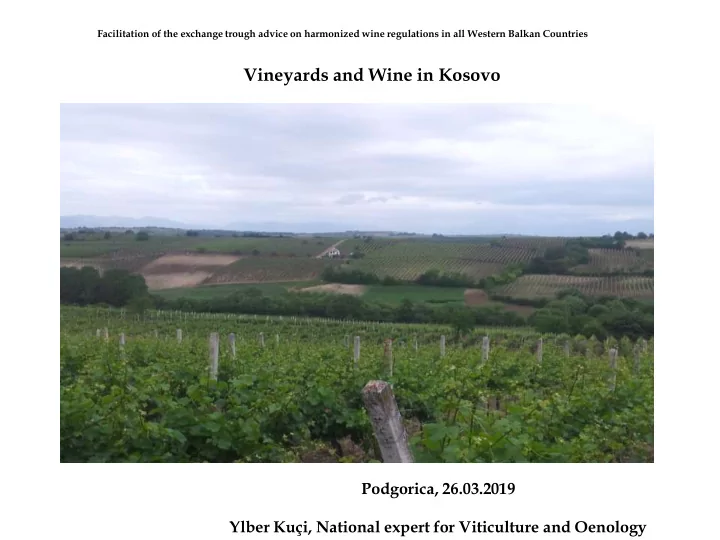
Vineyards and Wine in Kosovo
Podgorica, 26.03.2019 Ylber Kuçi, National expert for Viticulture and Oenology
Vineyards and Wine in Kosovo Podgorica, 26.03.2019 Ylber Kui, - - PowerPoint PPT Presentation
Facilitation of the exchange trough advice on harmonized wine regulations in all Western Balkan Countries Vineyards and Wine in Kosovo Podgorica, 26.03.2019 Ylber Kui, National expert for Viticulture and Oenology Facilitation of the exchange
Facilitation of the exchange trough advice on harmonized wine regulations in all Western Balkan Countries
Vineyards and Wine in Kosovo
Podgorica, 26.03.2019 Ylber Kuçi, National expert for Viticulture and Oenology
Facilitation of the exchange trough advice on harmonized wine regulations in all Western Balkan Countries
1. Analyses of sector of Viticulture and Wine production 2. Support in drafting the legislation on wine, wine products and aromatized wine product 3. Draft Strategy for Development of Viticulture and Wine Production 2020 - 2025
Republic of Kosovo currently has 3,320 hectares of vineyards according to the register of vineyards (last updates 22.03.2019). Currently in Kosovo grape vine is cultivated in 18 (eighteen) municipalities
Facilitation of the exchange trough advice on harmonized wine regulations in all Western Balkan Countries
Nr. Vineyard zone Sur./ha % of vineyard
vineyards
farmers 1 Deçan 1.23 0.03 4 4 2 Gjakovë 67.4 2.04 146 135 3 Graqanicë 1.11 0.03 3 2 4 Hani i Elezit 1.33 0.04 6 6 5 Istog 0.11 2 2 6 Kamenicë 0.42 0.01 1 1 7 Gjilan 0.31 3 1 8 Leposaviq 8.29 0.25 12 1 9 Klina 0.84 0.02 4 4 10 Lipjan 4.97 0.15 20 17 11 Malisheva 47.95 1.45 249 208 12 Mamusha 21.03 0.63 73 70 13 Peja 14.37 0.43 36 33 14 Prizren 186.77 5.66 884 681 15 Rahovec 2,426.39 73.55 5,389 2,643 16 Suhareka 514.53 15.59 1,416 1023 17 Skënderaj 0.63 0.01 2 2 18 Vushtrri 1.14 0.03 1 1 Total 3,298.82 99.92 8,251.00 4,834.00
Structure of Vineyards
The structure of the vineyards of Kosovo is made up of red varieties, white varieties and table grapes. Red grape varieties represented with 49%, White grape varieties represented with 26% and Table grape represented with 25%.
So from the chart we see that varieties for wine production dominate by 75%. The grape cultivars platform in Kosovo are mainly (about 66%) represented by Red grape varieties and 34% White grape varieties.
Structure of Vineyards
Red Wine varieties are represented by 1630.36 ha. Red Wine varieties are divided between foreign and domestic (Balkans) origin. The dominant variety from Balkan origin is Vranac, Prokupa, Zhameta. Besides Vranac and Prokupa other varieties are Game, Cabernet Sauvignon, Pino Noir, Merlot etc.
Red grape varieties
White varieties are represented by 838.83 ha. White grape vineyards also are divided between foreign and domestic Ballkan
Chardonnay
White grape varieties
Table grape varieties
Table varieties are represented by 829.25 ha. Based on the vineyards register, it is noted that the Muscat Hamburg, Muskat Italia, Afuzali, Kardinal and Victoria varieties dominate and all together constitute 77% of the table grapes.
Current situation in the Wine production
Currently, in the Republic of Kosovo there operate 27 companies licensed by the Ministry of Agriculture, dealing with grape processing and other grape and wine products.
Wine Export from 2015 - 2018,
Kosovo from 2013 to 2018 has exported wine to 31 countries. The countries in which Kosovo has exported more wine are: Croatia - 14,216,165, milion liters Serbia - 12,892,127, milion liters Albania - 5,934,046, milion liters Slovenia - 1,731,604, milion liters Switzerland - 1,120,394, milion liters Czech Republic - 1,126.46, milion liters
Wine Import from 2015-2018,
Kosovo from 2013 to 2018 has imported wine from 37 countries. The countries in which Kosovo has imported more wine are: Montenegro – 1,416,916, milion liters North Macedonia – 1,114,425, milion liters Italy – 563,142, liters France -239,761, liters
Actual status of Legal Framework Kosovo has adopted the Law on Wines in 2005, Law no.02/L-8, the Wine Law, while in 2011 has amended and supplemented Law for Wines from 2005. Law No. 04/L-019, on Amending and Supplementing the Law no. 02/L-8
The current legal framework for wines is partly harmonized with the legislation of the European Union Countries. The Wine Law is supplemented with administrative instructions currently 10 (ten). Wine Legislation
The first Wine Law (Law No.02/L-8) was more closely aligned with Regulation 1493/1999. Most of the chapters were adopted by this regulation. Over the years the requirements for amendments and supplements to this law were increased. In 2019, MAFRD, has started to create the concept paper that preceded the drafting of the new Wine Law. The drafting of the new Law on Wines is foreseen to be made during 2020, while the adoption will take place in 2021. MAFRD, has prepared draft law on Spirit drinks. This draft law has passed the procedures in the government and the Agriculture Commission and is now expected to be approved by the Kosovo Assembly. The draft law is fully harmonized with the regulation Regulation (EC) No 110/2008 of the European Parliament
Wine Legislation
Strategy for Development of Viticulture and Wine Production 2020 - 2025
1. Increasing profitability in grape and wine production; 2. Diversification of grape and wine products. Establishing new cultivation systems; and 3. Implementation of good practices in viticulture and wine and environmental protection
Main Objectives
The Strategic Plan for the Viticulture and Wine Production 2020 - 2025 is envisaged to have 3 objectives, 10 priorities and 40 implementing measures. (Annex I), Budget Framework 2020 -2025, Implementing Measures).
Planed cost over the years around 35,214,220 €
Achievement Vineyards Register
Achievement Wine Control Quality
CONCLUSIONS Main findings - Future steps
requirements of the global market. Profiling of the main grape varieties and accompanying varieties.
accordance with E.C. Regulations.
and harmonizing support measures with the objectives of the strategy.