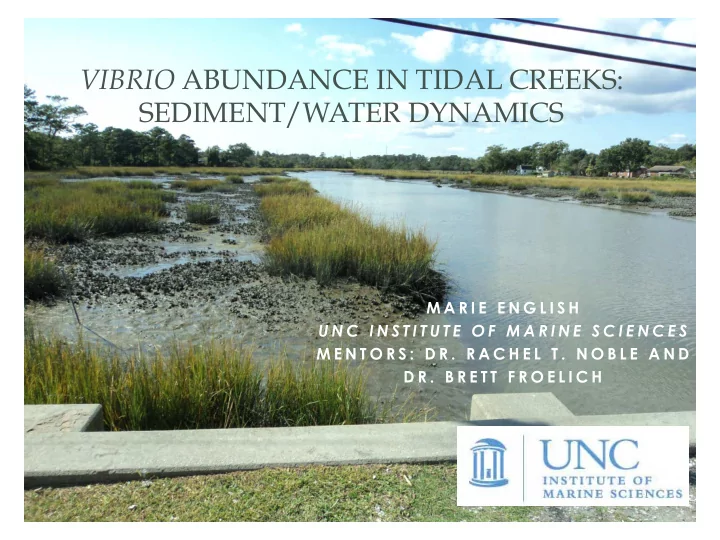
SLIDE 1 M A R I E E N G L I S H U N C I N S T I T U T E O F M A R I N E S C I E N C E S M E N T O R S : D R . R A C H E L T . N O B L E A N D D R . B R E T T F R O E L I C H
VIBRIO ABUNDANCE IN TIDAL CREEKS: SEDIMENT/WATER DYNAMICS
SLIDE 2 THE GENUS VIBRIO
- Native to estuaries (Nearly 35% of coastal bacterial pop.)
- Facultative anaerobes
- Pathogenic spp.
- Vibrio cholerae, Vibrio vulnificus, Vibrio parahaemolyticus
- V. vulnificus is most important seafood-borne pathogen in the USA
- Can cause wound infections, septicemia, gastroenteritis
- Recent research shows climate change is leading to an
increased # of vibrio cases (Oliver, DUML seminar)
- Ecology
- Influenced mainly by salinity and temperature
- Halophilic
- Predictive models for vibrio sp. concentrations based on salinity and
temp are 70-75% accurate (Hsieh et al., 2007)
SLIDE 3 SALINITY/TEMP RANGE FOR PATHOGENIC VIBRIO SP.
- Optimal salinity range
- 5-25 ppt
- Very low and very high salinities appear to be detrimental to
growth and persistence (Noble, 2008)
- Optimal water temp. range
- 20-30 ⁰C is where the highest concentrations are seen
- Below 20 ¡⁰C = low density of vibrio
- Below 10 ¡⁰C = no vibrio in water column
Parameter Range Mean and S.D. Salinity (ppt) 15.00 - 32.00 26.05 ± 5.875 Temperature (⁰C) 15.41 - 30.32 22.67 ± 4.316
SLIDE 4
“The Biology of Vibrios”
SLIDE 5
STUDY SITES
SLIDE 6
INDIVIDUAL SITES
9/27 Site 1 Site 2 Site 4 Site 3
SLIDE 7
PART OF THE LOCAL COMMUNITY
Locals fish for shrimp, flounder, and mullet
SLIDE 8
CALICO CREEK SAMPLING
SLIDE 9
CALICO CREEK SAMPLING
SLIDE 10
PROCESSING
SLIDE 11
TOTAL VIBRIO ENUMERATION
10/5 CFU= colony forming units
SLIDE 12
CHROM AGAR
9/27 10/5 Purple colonies= V. parahaemolyticus Blue colonies= V. vulnificus
SLIDE 13
WHAT CAUSES THE DECLINE IN VIBRIO ABUNDANCE IN THE WATER COLUMN?
SLIDE 14
WHAT CAUSES THE DECLINE IN VIBRIO ABUNDANCE IN THE WATER COLUMN?
SLIDE 15
BACTERIA IN THE WATER COLUMN DECREASE WHEN CONDITIONS ARE STRESSFUL
Low temperatures = Stressful for bacteria
SLIDE 16
POST-HURRICANE SANDY = COOLER WATER TEMPS
11/1
1 2 3 4
Sed. (1:10) Water (1:10) Water (1:1)
SLIDE 17
BACTERIA IN THE WATER COLUMN DECREASE WHEN CONDITIONS ARE STRESSFUL
High salinities = stressful for bacteria
SLIDE 18
VIBRIO SP. ABUNDANCE IS HIGHER IN SEDIMENTS
SLIDE 19
SEDIMENT > WATER
9/27
2S 1S 2W 1W 4S 3S 4W 3W
SLIDE 20
ARE SEDIMENT ABUNDANCES AFFECTED BY STRESSFUL CONDITIONS?
SLIDE 21
SEDIMENT PROTECTION
SLIDE 22
SEDIMENT PROTECTION
SLIDE 23
ARE SEDIMENT ABUNDANCES AFFECTED BY STRESSFUL CONDITIONS?
SLIDE 24
IS THIS UNIQUE TO VIBRIO, AN AUTOCHTHONOUS BACTERIA?
SLIDE 25
IS THIS UNIQUE TO VIBRIO, AN AUTOCHTHONOUS BACTERIA?
SLIDE 26 FUTURE STUDIES
- Continue study in colder months using qPCR to
compare with cultured methods for signs of
- verwintering (VBNC cells)
- Must use molecular methods below 15 ¡⁰C because the cells
enter a state where they are no longer culturable
- Organic matter content of sediments and
correlation with pathogenic Vibrio
- Grain size analysis of sediments and correlation with
pathogenic Vibrio
SLIDE 27 CONCLUSIONS
1. In harsh conditions, Vibrio decrease in the water column. 2. Bacteria are found in higher concentrations in the sediments
- 3. Vibrio in the sediments are somewhat protected from salinity
and temperature changes in water column 4. The sediments provide protection for endogenous bacteria, but the same pattern was not seen for exogenous (the control).
SLIDE 28
ACKNOWLEDGEMENTS
Rachel Noble Brett Froelich Sarah Rhodes Sydney Brothers Denene Blackwood Monica Greene Raul Gonzalez Mark Vergougstraete Rodney Guajardo Sara Posey
SLIDE 29 BIBLIOGRAPHY
- DUML Seminar with Dr. Jim Oliver: "Vibrio vulnificus:
Death on the Half-Shell” Wednesday, August 29, 201212:30pm, LSRC A328 & Marine Lab: Repass Center
- Thompson, Fabiano Lopes, Brian Austin, and J. G. Swings.
"12: Aquatic Environment." The Biology of Vibrios. Washington, D.C.: ASM, 2006. 176. Print.
- Hsieh, Jennifer L., J. Stephen Fries, and Rachel T. Noble.
"Dynamics and Predictive Modelling of Vibrio Spp. in the Neuse River Estuary, North Carolina, USA." Environmental Microbiology 0.0 (2007): 070907020408001-??? Print.