Epilithic abundance and composition: Influences on allochthonous - - PowerPoint PPT Presentation

epilithic abundance and
SMART_READER_LITE
LIVE PREVIEW

Epilithic abundance and composition: Influences on allochthonous - - PowerPoint PPT Presentation

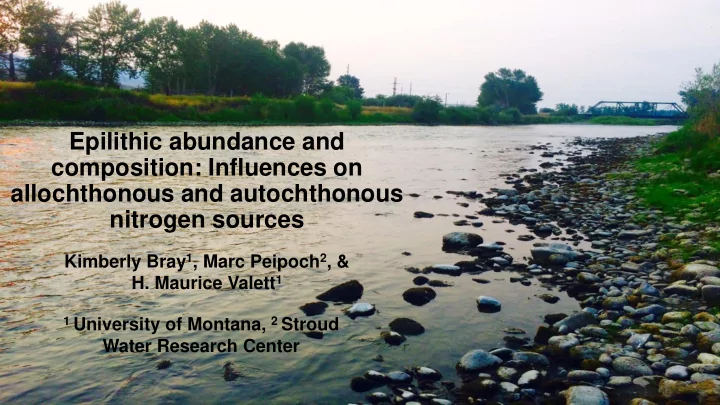
Epilithic abundance and composition: Influences on allochthonous and autochthonous nitrogen sources Kimberly Bray 1 , Marc Peipoch 2 , & H. Maurice Valett 1 1 University of Montana, 2 Stroud Water Research Center Peterson et al. 2001,


slide-1
SLIDE 1

Epilithic abundance and composition: Influences on allochthonous and autochthonous nitrogen sources

Kimberly Bray1, Marc Peipoch2, &

  • H. Maurice Valett1

1 University of Montana, 2 Stroud

Water Research Center

slide-2
SLIDE 2

Peterson et al. 2001, Science

slide-3
SLIDE 3

Biota

N2

N fixation

Norg

Autochthonous

NO3

  • NO3
  • nitrate uptake

Allochthonous

slide-4
SLIDE 4
slide-5
SLIDE 5

Clark Fork River

Source: Clark Fork Coalition

slide-6
SLIDE 6

Nutrient Concentrations

From Tri-State Water Quality Council 2009

Phosphate Nitrate Discharge

slide-7
SLIDE 7

Redfield Ratio

Alfred Redfield Source: NOAA

Ratio of C:N:P in oceanic phytoplankton = 106:16:1

slide-8
SLIDE 8

Nutrient Concentrations

SRP Nitrate Redfield Ratio

slide-9
SLIDE 9

Cladophora algae

Chl a AFDM

Epilithic OM and chlorophyll a

slide-10
SLIDE 10

Seasonal Cladophora bloom: A conceptual diagram

Cladophora discharge

slide-11
SLIDE 11

Nostoc cyanobacteria: a blue-green “algae”

NO3

  • NO3
slide-12
SLIDE 12

Facultative Nitrogen Fixation N  N + 8 H+ + 8 e- 2 NH3 + H2

stream conditions:

  • High levels of PAR
  • Slow moving water
  • High phosphate concentrations
  • Low nitrate concentrations
  • High temperatures

Nostoc cyanobacteria

nitrogenase

slide-13
SLIDE 13

Nostoc

Seasonal succession of periphyton: A conceptual diagram

Cladophora discharge

slide-14
SLIDE 14

Nostoc

Seasonal succession of periphyton: A conceptual diagram

discharge Autochthonous N Cladophora Allochthonous N

slide-15
SLIDE 15

Source: Clark Fork Coalition

Key questions:

  • What is the role of allochthonous and autochthonous

nitrogen sources in determining epilithic biomass over a summer growing season?

  • How do environmental conditions influence N fixation

rates?

slide-16
SLIDE 16

Drummond, MT

Diel Study Site Summer-long Study Site

University

  • f Montana

Missoula

Study Sites

slide-17
SLIDE 17

Sampling Timeline

July 31st Aug. 14th Aug. 28th Sept. 8th Aug. 9th Seasonal sampling: 9 replicates per round Metrics

  • N fixation rates
  • Instream nutrient concentrations (ammonium,

nitrate, phosphate)

  • Dissolved oxygen concentrations
  • Temperature
  • PAR
  • Epilithic composition and abundance
  • Chlorophyll a

Diel sampling: 3 replicates every 2.5 hours

slide-18
SLIDE 18

H  C  C  H + 2H+ + 2 e- H2  C = C  H2

nitrogenase

Acetylene Reduction Technique

slide-19
SLIDE 19

Cell Counts

Green algae Cyanobacteria

slide-20
SLIDE 20

Seasonal N fixation

slide-21
SLIDE 21

Highest [NO3

  • ]

& [NH4

+]

Phosphate Ammonium Nitrate

Seasonal N fixation and nutrient concentrations

Concentration (µg N or P/L)

Lowest [NO3

  • ]

& [NH4

+]

slide-22
SLIDE 22

Date AFDM (g / m2)

10 20 30 40

Date

Y Data

200 400 600 800 1000 1200 1400 1600 1800

Cell Abundance (# / field of view)

Nostoc Clado.

Epilithic OM (g AFDM / m2)

Seasonal trends in epilithic biomass and periphyton composition

slide-23
SLIDE 23

Night

Diel N fixation

0.19 ± 0.13 0.03 ± 0.006

slide-24
SLIDE 24

Environmental influences on diel N-fixation

Temperature (°C) N fixation (µg N/m2/hr) 0.2 0.4

R2 = 0.36 p = 0.027

200 400 600 PAR (mmol m-2S-1) 15 0.2 0.4 20 25 30

R2 = 0.36 p = 0.019

35 N fixation (µg N/m2/hr)

slide-25
SLIDE 25

Metabolic Demand: Temperature dependence of N fixation

Temperature (1/kT) Activation energy = 1.34 eV

From Welter et al. 2015

Arrhenius Relationship: ln N fixation = −Ea kT + ln A

slide-26
SLIDE 26

Conclusions

Environmental Constraints:

  • Temperature
  • PAR
  • Nutrient

concentrations

  • Epilithic

composition

from Grimm and Petrone 1997

slide-27
SLIDE 27

Source: NY State Department of Environmental Conservation

slide-28
SLIDE 28

Source: Clark Fork Coalition

slide-29
SLIDE 29

Acknowledgements

  • Maury Valett
  • Marc Peipoch
  • Amy Marcarelli
  • Erin Eberhard
  • Patrick Hurley
  • Carly Andlauer

"This material is based upon work supported in part by the National Science Foundation EPSCoR Cooperative Agreement OIA-1757351"