V0G 7/21/2016 IASE 2C: Handling Objections V0G 2016 IASE3 1 V0G - - PDF document

v0g 7 21 2016 iase 2c handling objections
SMART_READER_LITE
LIVE PREVIEW

V0G 7/21/2016 IASE 2C: Handling Objections V0G 2016 IASE3 1 V0G - - PDF document

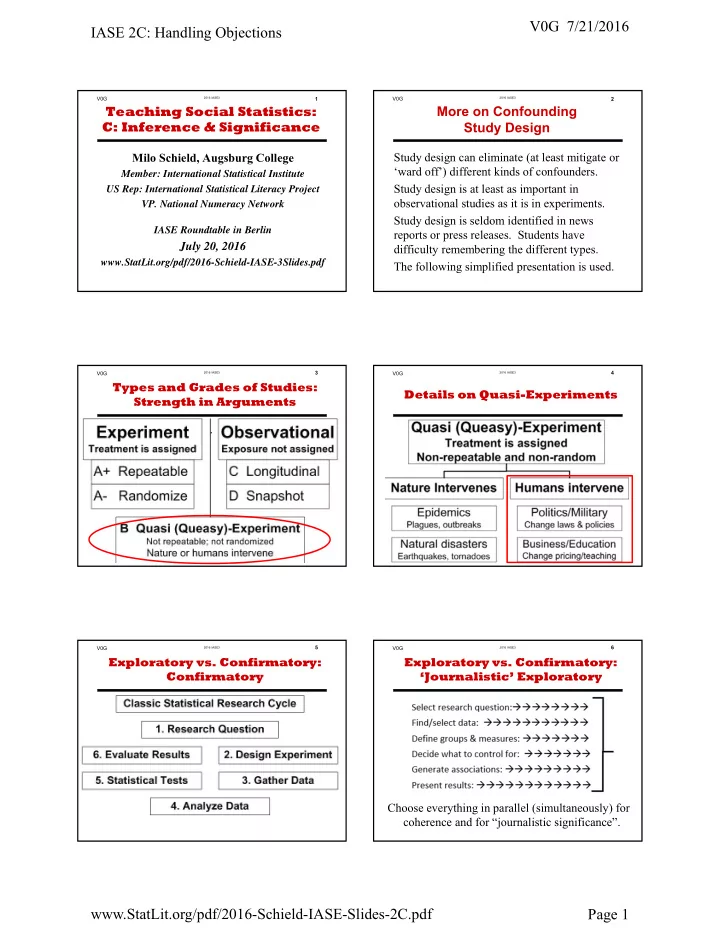
V0G 7/21/2016 IASE 2C: Handling Objections V0G 2016 IASE3 1 V0G 2016 IASE3 2 Teaching Social Statistics: More on Confounding C: Inference & Significance Study Design Milo Schield, Augsburg College Study design can eliminate (at


slide-1
SLIDE 1

IASE 2C: Handling Objections V0G 7/21/2016 www.StatLit.org/pdf/2016-Schield-IASE-Slides-2C.pdf Page 1

2016 IASE3

V0G 1

Milo Schield, Augsburg College

Member: International Statistical Institute US Rep: International Statistical Literacy Project

  • VP. National Numeracy Network

IASE Roundtable in Berlin

July 20, 2016

www.StatLit.org/pdf/2016-Schield-IASE-3Slides.pdf

Teaching Social Statistics: C: Inference & Significance

2016 IASE3

V0G

More on Confounding Study Design

Study design can eliminate (at least mitigate or ‘ward off’) different kinds of confounders. Study design is at least as important in

  • bservational studies as it is in experiments.

Study design is seldom identified in news reports or press releases. Students have difficulty remembering the different types. The following simplified presentation is used.

2

2016 IASE3

V0G 3

Types and Grades of Studies: Strength in Arguments .

2016 IASE3

V0G 4

Details on Quasi-Experiments .

2016 IASE3

V0G 5

Exploratory vs. Confirmatory: Confirmatory .

2016 IASE3

V0G 6

Exploratory vs. Confirmatory: ‘Journalistic’ Exploratory Choose everything in parallel (simultaneously) for coherence and for “journalistic significance”.

slide-2
SLIDE 2

IASE 2C: Handling Objections V0G 7/21/2016 www.StatLit.org/pdf/2016-Schield-IASE-Slides-2C.pdf Page 2

2016 IASE3

V0G

Status Update

More time for observational data, assembly, confounding and study design must mean that there is less time for statistical inference.

7

But some new topics involving chance and statistical inference should be added.

2016 IASE3

V0G

More Focus on Randomness

  • 1. More precision on statistical significance
  • 2. Frequentists need Bayes for decision rules.
  • 3. Coincidence  as data 
  • 4. Show how controlling for a confounder can

influence statistical significance.

8

Decision-makers seldom need any thing more than “statistical significance.”

2016 IASE3

V0G

1) Statistically Significant

What does ‘statistically significant’ mean? The outcome (or anything more extreme) is unlikely

  • 1. if due to chance
  • 2. to be due to chance
  • 3. due to chance

9

#1 is OK. For a frequentist, #2 is wrong. #3 is ambiguous. The differences are subtle!

2016 IASE3

V0G

2) Statistical Tests and Frequentist Decision Making

Teaching students to reject the null (accept the alternate) for a statistically-significant outcome is NOT justified by Frequentist theory.

10

As Frequentists, statistical educators should NEVER allow statistical significance to be used for decision-making. Decision-making should always be left to subject-matter experts.

2016 IASE3

V0G

Statistical Tests and Bayesian Decision Making

But focusing on p-values and avoiding decision- making violates the 2016 GAISE guidelines: “Statistics is a decision-making process.”

11

Statistical educators should embrace Bayes. If the alternate (Ha) is more likely to be true than the null (Ho), then a test statistic with a p-value of P gives at least a (1-P) confidence that Ho is False and Ha is true. Schield (1996)

2016 IASE3

V0G

Statistical Tests and Bayesian Decision Making

Some may think: “Schield has lost it. We’ve taught this decision-rule for decades.”

12

My reply: Where is it proven that this decision rule is justified regardless of the alternative? Remember Utts p-value for ESP: 10^-18. Should this extremely small p-value justify rejecting the Null (No ESP) and accepting the alternative (H1). Schield (1996)

slide-3
SLIDE 3

IASE 2C: Handling Objections V0G 7/21/2016 www.StatLit.org/pdf/2016-Schield-IASE-Slides-2C.pdf Page 3

2016 IASE3

V0G

3) Coincidence in Big Data

.

13

Coincidence?

2016 IASE3

V0G

Showing Coincidence Law of Very Large Numbers

The unlikely is almost certain given enough tries. Rare outcome is more likely than not given N tries where P(success) = 1/N. Selecting unlikely outcomes after-the-fact.

  • Unlikely sequences in flipping coins
  • Unlikely patterns in grains of rice
  • Seeing why the Birthday problem works

14

2016 IASE3

V0G

Why We Should Teach “Practical” Statistics

  • 1. Students value assembly and confounding.
  • 2. Increased focus on critical thinking
  • 3. They need it; they see value in it.

15

Can we teach statistical significance in less time? Can we show the criteria for statistical significance? Can we demonstrate the influence of confounding, assembly and bias on statistical significance? YES!

2016 IASE3

V0G

Teach Statistical Inference Differently

  • 1. Skip derivation of the sampling distribution.

See Utts (2014) and de Veaux (2011).

  • 2. Use 1-2-3 rule for Confidence levels.
  • 3. Focus on statistical significance (big idea).
  • 4. Use statistical-significance short-cuts
  • 5. Non-overlap of 95% confidence intervals

is sufficient for statistical significance

16

2016 IASE3

V0G

Statistically-Significant Short-Cut: Chi-Square

Statistically significant if chi-square > 2(DF+1)

17 2.5 7.5 12.5 17.5 22.5

1 3 5 7 9

Degrees of Freedom

Statistically‐Significant Chi‐Square Sortcut

Model: Chi‐squared > 2(DF+1)

Actual Cutoffs Schield

2016 IASE3

V0G

Statistically-Significant Short-Cut: Bivariate Correlation

Statistically significant if r > 2/Sqrt(n)

18

slide-4
SLIDE 4

IASE 2C: Handling Objections V0G 7/21/2016 www.StatLit.org/pdf/2016-Schield-IASE-Slides-2C.pdf Page 4

IASE 2016 - 3

19

  • 3. Correlation = 93.6%.

Isn’t this statistically significant?

Normal Statistical Significance Cutoffs Don’t Apply to Time-Based Correlations

www.tylervigen.com

2016 IASE3

V0G

Can we show Confounder Influence

  • n Statistical Significance?

Variation – random variation – is at the core of the introductory statistics course. We know that controlling for a confounder can negate or reverse an observed association. Can we show this with minimal assumptions?

20

Yes, using Wainer’s standardization diagram

2016 IASE3

V0G

Confounder Influence: Non-Overlap = Statistical Significance

.

21

2016 IASE3

V0G

Confounder Influence on Statistical Significance

.

22

2016 IASE3

V0G

Showing Influence on Statistical Significance

Variation – random variation – should be at the core of the introductory statistics course. Wainer’s Standardization technique allow us to show students how controlling for a confounder can influence statistical significance.

23

Showing confounder influence on statistical significance should be included in every introductory statistic course. Anything less is professional negligence.

2016 IASE3

V0G

Statistics for Decision Makers: Recommendations

To uphold statistics as numbers with a context, a new intro statistics course should be offered. This intro course needs more focus on big ideas:

  • Context (control), assembly (definitions) and

bias are big ideas for non-statisticians.

  • Randomness and statistical significance are

big ideas for statisticians.

  • Seeing how confounding, assembly and bias

can influence statistical significance should be central for a “statistics-in-context” course.

24

slide-5
SLIDE 5

IASE 2C: Handling Objections V0G 7/21/2016 www.StatLit.org/pdf/2016-Schield-IASE-Slides-2C.pdf Page 5

IASE 2016 - 3

25

Thesis

Adding context to introductory statistics will

  • uphold context as the essence of statistics (e.g.,

statistics are numbers in context),

  • give stronger support for statistics as a liberal art
  • separate applied statistics from mathematical

statistics,

  • improve student retention of key ideas, and
  • improve student attitudes on the value of statistics.
IASE 2016 - 3

26

Student Evaluations

Claim: Statistical literacy should be required for all students for graduation. Of the 57 students in my classes this past year, * 68% chose “Agree” or "Strongly agree " while * 21% chose "Strongly agree." This is a strong confirmation that a class focused on

  • bservational studies and using statistical associations as

evidence for causal connections is of value to future decision makers.

IASE 2016 - 3

27

Conclusion

Statistical educators should support three intro classes: Stat 100: Statistical Literacy (Statistics in the Media) Stat 101: Statistics for Researchers (Statistical Inference) Focus on derivations and statistical tests. Emphasis on random samples & inference Stat 102: Practical Statistics for Decision Makers. Focus on all sources of influence on statistics Emphasis on Assembly and Confounding. Show confounder influence on significance. Stat 102 is needed to meet the 2016 GAISE guidelines.

slide-6
SLIDE 6

IASE 2C: Handling Objections V0G 7/21/2016 www.StatLit.org/pdf/2016-Schield-IASE-Slides-2C.pdf Page 1

2016 IASE3

V0G 1

Milo Schield, Augsburg College

Member: International Statistical Institute US Rep: International Statistical Literacy Project

  • VP. National Numeracy Network

IASE Roundtable in Berlin

July 20, 2016

www.StatLit.org/pdf/2016-Schield-IASE-3Slides.pdf

Teaching Social Statistics: C: Inference & Significance

slide-7
SLIDE 7

IASE 2C: Handling Objections V0G 7/21/2016 www.StatLit.org/pdf/2016-Schield-IASE-Slides-2C.pdf Page 2

2016 IASE3

V0G

More on Confounding Study Design

Study design can eliminate (at least mitigate or ‘ward off’) different kinds of confounders. Study design is at least as important in

  • bservational studies as it is in experiments.

Study design is seldom identified in news reports or press releases. Students have difficulty remembering the different types. The following simplified presentation is used.

2

slide-8
SLIDE 8

IASE 2C: Handling Objections V0G 7/21/2016 www.StatLit.org/pdf/2016-Schield-IASE-Slides-2C.pdf Page 3

2016 IASE3

V0G 3

Types and Grades of Studies: Strength in Arguments .

slide-9
SLIDE 9

IASE 2C: Handling Objections V0G 7/21/2016 www.StatLit.org/pdf/2016-Schield-IASE-Slides-2C.pdf Page 4

2016 IASE3

V0G 4

Details on Quasi-Experiments .

slide-10
SLIDE 10

IASE 2C: Handling Objections V0G 7/21/2016 www.StatLit.org/pdf/2016-Schield-IASE-Slides-2C.pdf Page 5

2016 IASE3

V0G 5

Exploratory vs. Confirmatory: Confirmatory .

slide-11
SLIDE 11

IASE 2C: Handling Objections V0G 7/21/2016 www.StatLit.org/pdf/2016-Schield-IASE-Slides-2C.pdf Page 6

2016 IASE3

V0G 6

Exploratory vs. Confirmatory: ‘Journalistic’ Exploratory Choose everything in parallel (simultaneously) for coherence and for “journalistic significance”.

slide-12
SLIDE 12

IASE 2C: Handling Objections V0G 7/21/2016 www.StatLit.org/pdf/2016-Schield-IASE-Slides-2C.pdf Page 7

2016 IASE3

V0G

Status Update

More time for observational data, assembly, confounding and study design must mean that there is less time for statistical inference.

7

But some new topics involving chance and statistical inference should be added.

slide-13
SLIDE 13

IASE 2C: Handling Objections V0G 7/21/2016 www.StatLit.org/pdf/2016-Schield-IASE-Slides-2C.pdf Page 8

2016 IASE3

V0G

More Focus on Randomness

  • 1. More precision on statistical significance
  • 2. Frequentists need Bayes for decision rules.
  • 3. Coincidence  as data 
  • 4. Show how controlling for a confounder can

influence statistical significance.

8

Decision-makers seldom need any thing more than “statistical significance.”

slide-14
SLIDE 14

IASE 2C: Handling Objections V0G 7/21/2016 www.StatLit.org/pdf/2016-Schield-IASE-Slides-2C.pdf Page 9

2016 IASE3

V0G

1) Statistically Significant

What does ‘statistically significant’ mean? The outcome (or anything more extreme) is unlikely

  • 1. if due to chance
  • 2. to be due to chance
  • 3. due to chance

9

#1 is OK. For a frequentist, #2 is wrong. #3 is ambiguous. The differences are subtle!

slide-15
SLIDE 15

IASE 2C: Handling Objections V0G 7/21/2016 www.StatLit.org/pdf/2016-Schield-IASE-Slides-2C.pdf Page 10

2016 IASE3

V0G

2) Statistical Tests and Frequentist Decision Making

Teaching students to reject the null (accept the alternate) for a statistically-significant outcome is NOT justified by Frequentist theory.

10

As Frequentists, statistical educators should NEVER allow statistical significance to be used for decision-making. Decision-making should always be left to subject-matter experts.

slide-16
SLIDE 16

IASE 2C: Handling Objections V0G 7/21/2016 www.StatLit.org/pdf/2016-Schield-IASE-Slides-2C.pdf Page 11

2016 IASE3

V0G

Statistical Tests and Bayesian Decision Making

But focusing on p-values and avoiding decision- making violates the 2016 GAISE guidelines: “Statistics is a decision-making process.”

11

Statistical educators should embrace Bayes. If the alternate (Ha) is more likely to be true than the null (Ho), then a test statistic with a p-value of P gives at least a (1-P) confidence that Ho is False and Ha is true. Schield (1996)

slide-17
SLIDE 17

IASE 2C: Handling Objections V0G 7/21/2016 www.StatLit.org/pdf/2016-Schield-IASE-Slides-2C.pdf Page 12

2016 IASE3

V0G

Statistical Tests and Bayesian Decision Making

Some may think: “Schield has lost it. We’ve taught this decision-rule for decades.”

12

My reply: Where is it proven that this decision rule is justified regardless of the alternative? Remember Utts p-value for ESP: 10^-18. Should this extremely small p-value justify rejecting the Null (No ESP) and accepting the alternative (H1). Schield (1996)

slide-18
SLIDE 18

IASE 2C: Handling Objections V0G 7/21/2016 www.StatLit.org/pdf/2016-Schield-IASE-Slides-2C.pdf Page 13

2016 IASE3

V0G

3) Coincidence in Big Data

.

13

Coincidence?

slide-19
SLIDE 19

IASE 2C: Handling Objections V0G 7/21/2016 www.StatLit.org/pdf/2016-Schield-IASE-Slides-2C.pdf Page 14

2016 IASE3

V0G

Showing Coincidence Law of Very Large Numbers

The unlikely is almost certain given enough tries. Rare outcome is more likely than not given N tries where P(success) = 1/N. Selecting unlikely outcomes after-the-fact.

  • Unlikely sequences in flipping coins
  • Unlikely patterns in grains of rice
  • Seeing why the Birthday problem works

14

slide-20
SLIDE 20

IASE 2C: Handling Objections V0G 7/21/2016 www.StatLit.org/pdf/2016-Schield-IASE-Slides-2C.pdf Page 15

2016 IASE3

V0G

Why We Should Teach “Practical” Statistics

  • 1. Students value assembly and confounding.
  • 2. Increased focus on critical thinking
  • 3. They need it; they see value in it.

15

Can we teach statistical significance in less time? Can we show the criteria for statistical significance? Can we demonstrate the influence of confounding, assembly and bias on statistical significance? YES!

slide-21
SLIDE 21

IASE 2C: Handling Objections V0G 7/21/2016 www.StatLit.org/pdf/2016-Schield-IASE-Slides-2C.pdf Page 16

2016 IASE3

V0G

Teach Statistical Inference Differently

  • 1. Skip derivation of the sampling distribution.

See Utts (2014) and de Veaux (2011).

  • 2. Use 1-2-3 rule for Confidence levels.
  • 3. Focus on statistical significance (big idea).
  • 4. Use statistical-significance short-cuts
  • 5. Non-overlap of 95% confidence intervals

is sufficient for statistical significance

16

slide-22
SLIDE 22

IASE 2C: Handling Objections V0G 7/21/2016 www.StatLit.org/pdf/2016-Schield-IASE-Slides-2C.pdf Page 17

2016 IASE3

V0G

Statistically-Significant Short-Cut: Chi-Square

Statistically significant if chi-square > 2(DF+1)

17

2.5 7.5 12.5 17.5 22.5

1 3 5 7 9

Degrees of Freedom

Statistically‐Significant Chi‐Square Sortcut

Model: Chi‐squared > 2(DF+1)

Actual Cutoffs Schield

slide-23
SLIDE 23

IASE 2C: Handling Objections V0G 7/21/2016 www.StatLit.org/pdf/2016-Schield-IASE-Slides-2C.pdf Page 18

2016 IASE3

V0G

Statistically-Significant Short-Cut: Bivariate Correlation

Statistically significant if r > 2/Sqrt(n)

18

slide-24
SLIDE 24

IASE 2C: Handling Objections V0G 7/21/2016 www.StatLit.org/pdf/2016-Schield-IASE-Slides-2C.pdf Page 19

IASE 2016 - 3

19

  • 3. Correlation = 93.6%.

Isn’t this statistically significant?

Normal Statistical Significance Cutoffs Don’t Apply to Time-Based Correlations

www.tylervigen.com

slide-25
SLIDE 25

IASE 2C: Handling Objections V0G 7/21/2016 www.StatLit.org/pdf/2016-Schield-IASE-Slides-2C.pdf Page 20

2016 IASE3

V0G

Can we show Confounder Influence

  • n Statistical Significance?

Variation – random variation – is at the core of the introductory statistics course. We know that controlling for a confounder can negate or reverse an observed association. Can we show this with minimal assumptions?

20

Yes, using Wainer’s standardization diagram

slide-26
SLIDE 26

IASE 2C: Handling Objections V0G 7/21/2016 www.StatLit.org/pdf/2016-Schield-IASE-Slides-2C.pdf Page 21

2016 IASE3

V0G

Confounder Influence: Non-Overlap = Statistical Significance

.

21

slide-27
SLIDE 27

IASE 2C: Handling Objections V0G 7/21/2016 www.StatLit.org/pdf/2016-Schield-IASE-Slides-2C.pdf Page 22

2016 IASE3

V0G

Confounder Influence on Statistical Significance

.

22

slide-28
SLIDE 28

IASE 2C: Handling Objections V0G 7/21/2016 www.StatLit.org/pdf/2016-Schield-IASE-Slides-2C.pdf Page 23

2016 IASE3

V0G

Showing Influence on Statistical Significance

Variation – random variation – should be at the core of the introductory statistics course. Wainer’s Standardization technique allow us to show students how controlling for a confounder can influence statistical significance.

23

Showing confounder influence on statistical significance should be included in every introductory statistic course. Anything less is professional negligence.

slide-29
SLIDE 29

IASE 2C: Handling Objections V0G 7/21/2016 www.StatLit.org/pdf/2016-Schield-IASE-Slides-2C.pdf Page 24

2016 IASE3

V0G

Statistics for Decision Makers: Recommendations

To uphold statistics as numbers with a context, a new intro statistics course should be offered. This intro course needs more focus on big ideas:

  • Context (control), assembly (definitions) and

bias are big ideas for non-statisticians.

  • Randomness and statistical significance are

big ideas for statisticians.

  • Seeing how confounding, assembly and bias

can influence statistical significance should be central for a “statistics-in-context” course.

24

slide-30
SLIDE 30

IASE 2C: Handling Objections V0G 7/21/2016 www.StatLit.org/pdf/2016-Schield-IASE-Slides-2C.pdf Page 25

IASE 2016 - 3

25

Thesis

Adding context to introductory statistics will

  • uphold context as the essence of statistics (e.g.,

statistics are numbers in context),

  • give stronger support for statistics as a liberal art
  • separate applied statistics from mathematical

statistics,

  • improve student retention of key ideas, and
  • improve student attitudes on the value of statistics.
slide-31
SLIDE 31

IASE 2C: Handling Objections V0G 7/21/2016 www.StatLit.org/pdf/2016-Schield-IASE-Slides-2C.pdf Page 26

IASE 2016 - 3

26

Student Evaluations

Claim: Statistical literacy should be required for all students for graduation. Of the 57 students in my classes this past year, * 68% chose “Agree” or "Strongly agree " while * 21% chose "Strongly agree." This is a strong confirmation that a class focused on

  • bservational studies and using statistical associations as

evidence for causal connections is of value to future decision makers.

slide-32
SLIDE 32

IASE 2C: Handling Objections V0G 7/21/2016 www.StatLit.org/pdf/2016-Schield-IASE-Slides-2C.pdf Page 27

IASE 2016 - 3

27

Conclusion

Statistical educators should support three intro classes: Stat 100: Statistical Literacy (Statistics in the Media) Stat 101: Statistics for Researchers (Statistical Inference) Focus on derivations and statistical tests. Emphasis on random samples & inference Stat 102: Practical Statistics for Decision Makers. Focus on all sources of influence on statistics Emphasis on Assembly and Confounding. Show confounder influence on significance. Stat 102 is needed to meet the 2016 GAISE guidelines.