1. Understanding Social Statistics V0G 7/21/2016 V0G 2016 IASE-1 - - PDF document

1 understanding social statistics v0g 7 21 2016
SMART_READER_LITE
LIVE PREVIEW

1. Understanding Social Statistics V0G 7/21/2016 V0G 2016 IASE-1 - - PDF document

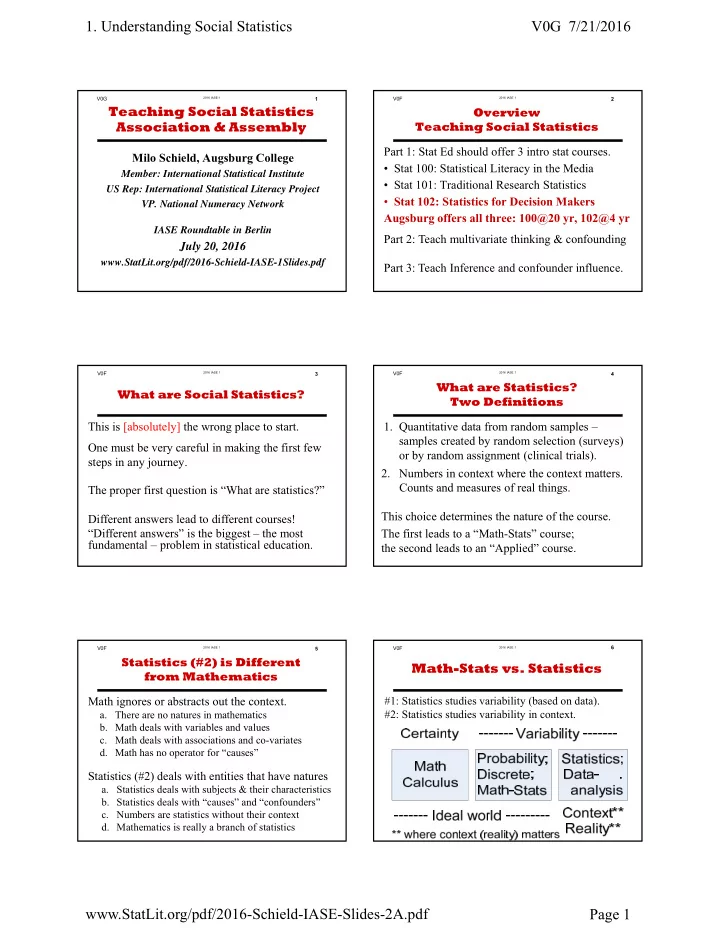
1. Understanding Social Statistics V0G 7/21/2016 V0G 2016 IASE-1 1 V0F 2016 IASE 1 2 Teaching Social Statistics Overview Association & Assembly Teaching Social Statistics Part 1: Stat Ed should offer 3 intro stat courses. Milo


slide-1
SLIDE 1
  • 1. Understanding Social Statistics

V0G 7/21/2016 www.StatLit.org/pdf/2016-Schield-IASE-Slides-2A.pdf Page 1

2016 IASE-1

V0G 1

Milo Schield, Augsburg College

Member: International Statistical Institute US Rep: International Statistical Literacy Project

  • VP. National Numeracy Network

IASE Roundtable in Berlin

July 20, 2016

www.StatLit.org/pdf/2016-Schield-IASE-1Slides.pdf

Teaching Social Statistics Association & Assembly

V0F

2016 IASE 1

2

Overview Teaching Social Statistics Part 1: Stat Ed should offer 3 intro stat courses.

  • Stat 100: Statistical Literacy in the Media
  • Stat 101: Traditional Research Statistics
  • Stat 102: Statistics for Decision Makers

Augsburg offers all three: 100@20 yr, 102@4 yr Part 2: Teach multivariate thinking & confounding Part 3: Teach Inference and confounder influence.

V0F

2016 IASE 1

3

What are Social Statistics? This is [absolutely] the wrong place to start. One must be very careful in making the first few steps in any journey. The proper first question is “What are statistics?” Different answers lead to different courses! “Different answers” is the biggest – the most fundamental – problem in statistical education.

V0F

2016 IASE 1

4

What are Statistics? Two Definitions

  • 1. Quantitative data from random samples –

samples created by random selection (surveys)

  • r by random assignment (clinical trials).
  • 2. Numbers in context where the context matters.

Counts and measures of real things. This choice determines the nature of the course. The first leads to a “Math-Stats” course; the second leads to an “Applied” course.

V0F

2016 IASE 1

5

Statistics (#2) is Different from Mathematics Math ignores or abstracts out the context.

  • a. There are no natures in mathematics
  • b. Math deals with variables and values
  • c. Math deals with associations and co-variates
  • d. Math has no operator for “causes”

Statistics (#2) deals with entities that have natures

  • a. Statistics deals with subjects & their characteristics
  • b. Statistics deals with “causes” and “confounders”
  • c. Numbers are statistics without their context
  • d. Mathematics is really a branch of statistics

V0F

2016 IASE 1

6

Math-Stats vs. Statistics

#1: Statistics studies variability (based on data). #2: Statistics studies variability in context.

slide-2
SLIDE 2
  • 1. Understanding Social Statistics

V0G 7/21/2016 www.StatLit.org/pdf/2016-Schield-IASE-Slides-2A.pdf Page 2

V0F

2016 IASE 1

7

What are Social Statistics? Two definitions

  • 1. Random-sample data involving social

conditions or activities. Typically surveys by government agencies. Focus on sampling, margin of error and bias.

  • 2. All data involving social conditions or activities.

Much – if not most -- of this data is:

  • population data (administrative systems)
  • longitudinal (time-series)
  • bservational (susceptible to confounding)
2016 IASE-1

V0G 8

“We teach the wrong stuff; We teach it the wrong way; We teach it in the wrong order.” de Veaux Consider teaching “Association is not causation”

  • 1973 Berkeley sex discrimination case
  • Ice cream sales and burglaries

Teaching Statistics

Solution: Chance-based associations.

  • Who gets longest run in 10 flips of a coin?
  • How can we distinguish luck from skill?

Problem: These involve confounding – not chance.

2016 IASE-1

V0G 9

.
  • a. Statistics involving people

What are Social Statistics?

  • b. Statistics obtained from
  • bservational studies.

V0F

2016 IASE 1

10

How Should We Teach a Social Statistics Course?

Wrong question! First answer these questions:

  • Who are the students in Introductory Statistics?
  • What are their goals and attitudes?
  • What aspects of statistics will help them in their major?

Then answer this:

  • What are the primary contributions of statistics

to human knowledge?

V0F

2016 IASE 1

11

Goals of the Students; Perspectives of the Teachers

Students’ majors. Teachers’ disciplinary home

V0F

2016 IASE 1

12

Stat 101 students: What are their Attitudes?

  • Many (most?) see less value in statistics after the course

than before.

  • “Least valuable course in the Business-Econ core.”

Augsburg Business-Economics majors.

  • Lost almost half of the course gain within 4 months

Tintle et al, (2012) SERJ.

  • Lost 33% of what they knew on their final within 12

month in an online course. Nadir (2004)

  • Less than 0.2% will major in statistics (US nationwide).

www.amstat.org/misc/StatsBachelors2003-2013.pdf 1,135 stat majors in 2013 at 32 colleges

slide-3
SLIDE 3
  • 1. Understanding Social Statistics

V0G 7/21/2016 www.StatLit.org/pdf/2016-Schield-IASE-Slides-2A.pdf Page 3

V0F

2016 IASE 1

13

Three Audiences: Three Courses

.

Derivation CLT, CL, ME, Surveys, Hyp tests, Clinical Trials Quasi- Experiments, Observational Studies

2016 IASE-1

V0G

We need to teach Statistics for Decision Makers

“One size fits all” doesn’t work any more. We should drop the idea of “the course” in intro stats.

14

We should support three algebra-intro statistics courses:

Stat 102: Statistics for Decision Makers. Some Algebra Stat 101: Traditional Research-Inference. Most Algebra Stat 100: Statistical Literacy. Media-base, little Algebra At least half of all intro sections should be Stat 102.

V0F

2016 IASE 1

15

Association vs. Causation Many (most?) students think that “association” is a collection of people with similar interests/goals,

  • r a group of teams in a given sport or league.

1) Compare values of variables: As X , Y . 2) Compare averages of groups:

Young adults with a bachelor's degree earned 62% more than high school completers. If you get a B.A., you can expect to earn 62% more than if you just complete high school.

V0F

2016 IASE 1

16

Social Statistics: Associations Baseball players whose names begin with the letter “D” are more likely to die young Asian-Americans are most susceptible to heart attacks on the fourth day of the month

Source: Standard Deviations: Flawed Assumptions, Tortured Data,

and Other Ways to Lie with Statistics by Gary Smith (2015).

Drinking a full pot of coffee every morning will add years to your life, but one cup a day increases the risk of pancreatic cancer.

V0F

2016 IASE 1

17

Association vs. Causation Using Ordinary English

How Climate Change is Fueling Rise in Shark Attacks

www.yahoo.com/news/climate-change-fueling-rise-shark-145333862.html V0F

2016 IASE 1

18

Association vs. Causation: Can be Tricky

.

slide-4
SLIDE 4
  • 1. Understanding Social Statistics

V0G 7/21/2016 www.StatLit.org/pdf/2016-Schield-IASE-Slides-2A.pdf Page 4

V0F

2016 IASE 1

19

Speculative [Spotty] Statistics Using Ordinary English Does a death certificate ever list air pollution as a cause of death? Does a coroner certify this? These are association-based statistics. These are speculative (spotty) statistics.

V0F

2016 IASE 1

20

Association vs. Causation Using Ordinary English

V0F

2016 IASE 1

21

Observational Statistics More Influences Randomization eliminates many types of influence. Inference models eliminate many others. Teaching random-sample statistics is simpler. Observational statistics have a host of influences. Teaching observational statistics is harder. Students need a structure that groups these influences into three or four categories.

V0F

2016 IASE 1

22

Observational Statistics are Influenced By: Confounding: [See Part 2]

  • what was – and was not – controlled for
  • what kind of study was involved.

Assembly: [See Part 1]

  • how the statistics were selected, collected, defined,

grouped, summarized, compared and presented.

Randomness [See Part 3] Error/bias Statistical admonition: “Take CARE”

V0F

2016 IASE 1

23

Stats as Premise(Crit. Thinking) Stats as Conclusion (Stat Literacy) .

V0F

2016 IASE 1

24

Assembly: Defining Groups # US children: Elevated levels of lead:

  • 27,000 in 2009
  • 259,000 in 2010 [Almost a factor of 10]

In 2010, the CDC reduced the minimum for elevated levels of lead from 10 to five*.

* micrograms per dl of blood

www.cdc.gov/nceh/lead/data/StateConfirmedByYear1997-2011.htm

slide-5
SLIDE 5
  • 1. Understanding Social Statistics

V0G 7/21/2016 www.StatLit.org/pdf/2016-Schield-IASE-Slides-2A.pdf Page 5

V0F

2016 IASE 1

25

Small Changes in Syntax; Big Changes in Semantics

.

V0F

2016 IASE 1

26

Assembly in Moore’s Concepts & Controversies

.

V0F

2016 IASE 1

27

Assembly in Presentation 7 nano grams/gram (7/Million)

.

V0F

2016 IASE 1

28

Why Teachers Don’t Want to Teach Assembly

  • 1. Ordinary English is too ambiguous.
  • 2. Leave this up to subject-matter experts.
  • 3. This is not really “statistics”
  • 4. Teaching it requires subject-matter expertise.
  • 1. Ordinary English is how statistics are communicated
  • 2. If we don’t teach it, students will never see it.
  • 3. We define what is really “statistics”.
  • 4. We can teach it without subject-matter expertise:

Which is bigger in a class: (1) # of students, (2) # of male students, or (3) # of students in or waiting?

V0F

2016 IASE 1

29

Contributions of Statistics to Human Knowledge .

29 V0F

2016 IASE 1

30

Most Important Topics/Ideas

Augsburg StatLit Students 1 Classify different kinds of influence (Take CARE) 2 Confounding 2 Hypothetical thinking: Plausible confounders, plausible definitions [Assembly]. 4 Statistics are more than numbers [Assembly] 5 Association-causation & Randomness (Luck vs. skill) 5 Bias: Placebo, single blind; double blind 5 Named Ratio grammar; Percent, Percentages, Rates

30

slide-6
SLIDE 6
  • 1. Understanding Social Statistics

V0G 7/21/2016 www.StatLit.org/pdf/2016-Schield-IASE-Slides-2A.pdf Page 1

2016 IASE-1

V0G 1

Milo Schield, Augsburg College

Member: International Statistical Institute US Rep: International Statistical Literacy Project

  • VP. National Numeracy Network

IASE Roundtable in Berlin

July 20, 2016

www.StatLit.org/pdf/2016-Schield-IASE-1Slides.pdf

Teaching Social Statistics Association & Assembly

slide-7
SLIDE 7
  • 1. Understanding Social Statistics

V0G 7/21/2016 www.StatLit.org/pdf/2016-Schield-IASE-Slides-2A.pdf Page 2

V0F

2016 IASE 1

2

Overview Teaching Social Statistics Part 1: Stat Ed should offer 3 intro stat courses.

  • Stat 100: Statistical Literacy in the Media
  • Stat 101: Traditional Research Statistics
  • Stat 102: Statistics for Decision Makers

Augsburg offers all three: 100@20 yr, 102@4 yr Part 2: Teach multivariate thinking & confounding Part 3: Teach Inference and confounder influence.

slide-8
SLIDE 8
  • 1. Understanding Social Statistics

V0G 7/21/2016 www.StatLit.org/pdf/2016-Schield-IASE-Slides-2A.pdf Page 3

V0F

2016 IASE 1

3

What are Social Statistics? This is [absolutely] the wrong place to start. One must be very careful in making the first few steps in any journey. The proper first question is “What are statistics?” Different answers lead to different courses! “Different answers” is the biggest – the most fundamental – problem in statistical education.

slide-9
SLIDE 9
  • 1. Understanding Social Statistics

V0G 7/21/2016 www.StatLit.org/pdf/2016-Schield-IASE-Slides-2A.pdf Page 4

V0F

2016 IASE 1

4

What are Statistics? Two Definitions

  • 1. Quantitative data from random samples –

samples created by random selection (surveys)

  • r by random assignment (clinical trials).
  • 2. Numbers in context where the context matters.

Counts and measures of real things. This choice determines the nature of the course. The first leads to a “Math-Stats” course; the second leads to an “Applied” course.

slide-10
SLIDE 10
  • 1. Understanding Social Statistics

V0G 7/21/2016 www.StatLit.org/pdf/2016-Schield-IASE-Slides-2A.pdf Page 5

V0F

2016 IASE 1

5

Statistics (#2) is Different from Mathematics Math ignores or abstracts out the context.

  • a. There are no natures in mathematics
  • b. Math deals with variables and values
  • c. Math deals with associations and co-variates
  • d. Math has no operator for “causes”

Statistics (#2) deals with entities that have natures

  • a. Statistics deals with subjects & their characteristics
  • b. Statistics deals with “causes” and “confounders”
  • c. Numbers are statistics without their context
  • d. Mathematics is really a branch of statistics
slide-11
SLIDE 11
  • 1. Understanding Social Statistics

V0G 7/21/2016 www.StatLit.org/pdf/2016-Schield-IASE-Slides-2A.pdf Page 6

V0F

2016 IASE 1

6

Math-Stats vs. Statistics

#1: Statistics studies variability (based on data). #2: Statistics studies variability in context.

slide-12
SLIDE 12
  • 1. Understanding Social Statistics

V0G 7/21/2016 www.StatLit.org/pdf/2016-Schield-IASE-Slides-2A.pdf Page 7

V0F

2016 IASE 1

7

What are Social Statistics? Two definitions

  • 1. Random-sample data involving social

conditions or activities. Typically surveys by government agencies. Focus on sampling, margin of error and bias.

  • 2. All data involving social conditions or activities.

Much – if not most -- of this data is:

  • population data (administrative systems)
  • longitudinal (time-series)
  • bservational (susceptible to confounding)
slide-13
SLIDE 13
  • 1. Understanding Social Statistics

V0G 7/21/2016 www.StatLit.org/pdf/2016-Schield-IASE-Slides-2A.pdf Page 8

2016 IASE-1

V0G 8

“We teach the wrong stuff; We teach it the wrong way; We teach it in the wrong order.” de Veaux Consider teaching “Association is not causation”

  • 1973 Berkeley sex discrimination case
  • Ice cream sales and burglaries

Teaching Statistics

Solution: Chance-based associations.

  • Who gets longest run in 10 flips of a coin?
  • How can we distinguish luck from skill?

Problem: These involve confounding – not chance.

slide-14
SLIDE 14
  • 1. Understanding Social Statistics

V0G 7/21/2016 www.StatLit.org/pdf/2016-Schield-IASE-Slides-2A.pdf Page 9

2016 IASE-1

V0G 9

.
  • a. Statistics involving people

What are Social Statistics?

  • b. Statistics obtained from
  • bservational studies.
slide-15
SLIDE 15
  • 1. Understanding Social Statistics

V0G 7/21/2016 www.StatLit.org/pdf/2016-Schield-IASE-Slides-2A.pdf Page 10

V0F

2016 IASE 1

10

How Should We Teach a Social Statistics Course?

Wrong question! First answer these questions:

  • Who are the students in Introductory Statistics?
  • What are their goals and attitudes?
  • What aspects of statistics will help them in their major?

Then answer this:

  • What are the primary contributions of statistics

to human knowledge?

slide-16
SLIDE 16
  • 1. Understanding Social Statistics

V0G 7/21/2016 www.StatLit.org/pdf/2016-Schield-IASE-Slides-2A.pdf Page 11

V0F

2016 IASE 1

11

Goals of the Students; Perspectives of the Teachers

Students’ majors. Teachers’ disciplinary home

slide-17
SLIDE 17
  • 1. Understanding Social Statistics

V0G 7/21/2016 www.StatLit.org/pdf/2016-Schield-IASE-Slides-2A.pdf Page 12

V0F

2016 IASE 1

12

Stat 101 students: What are their Attitudes?

  • Many (most?) see less value in statistics after the course

than before.

  • “Least valuable course in the Business-Econ core.”

Augsburg Business-Economics majors.

  • Lost almost half of the course gain within 4 months

Tintle et al, (2012) SERJ.

  • Lost 33% of what they knew on their final within 12

month in an online course. Nadir (2004)

  • Less than 0.2% will major in statistics (US nationwide).

www.amstat.org/misc/StatsBachelors2003-2013.pdf 1,135 stat majors in 2013 at 32 colleges

slide-18
SLIDE 18
  • 1. Understanding Social Statistics

V0G 7/21/2016 www.StatLit.org/pdf/2016-Schield-IASE-Slides-2A.pdf Page 13

V0F

2016 IASE 1

13

Three Audiences: Three Courses

.

Derivation CLT, CL, ME, Surveys, Hyp tests, Clinical Trials Quasi- Experiments, Observational Studies

slide-19
SLIDE 19
  • 1. Understanding Social Statistics

V0G 7/21/2016 www.StatLit.org/pdf/2016-Schield-IASE-Slides-2A.pdf Page 14

2016 IASE-1

V0G

We need to teach Statistics for Decision Makers

“One size fits all” doesn’t work any more. We should drop the idea of “the course” in intro stats.

14

We should support three algebra-intro statistics courses:

Stat 102: Statistics for Decision Makers. Some Algebra Stat 101: Traditional Research-Inference. Most Algebra Stat 100: Statistical Literacy. Media-base, little Algebra At least half of all intro sections should be Stat 102.

slide-20
SLIDE 20
  • 1. Understanding Social Statistics

V0G 7/21/2016 www.StatLit.org/pdf/2016-Schield-IASE-Slides-2A.pdf Page 15

V0F

2016 IASE 1

15

Association vs. Causation Many (most?) students think that “association” is a collection of people with similar interests/goals,

  • r a group of teams in a given sport or league.

1) Compare values of variables: As X , Y . 2) Compare averages of groups:

Young adults with a bachelor's degree earned 62% more than high school completers. If you get a B.A., you can expect to earn 62% more than if you just complete high school.

slide-21
SLIDE 21
  • 1. Understanding Social Statistics

V0G 7/21/2016 www.StatLit.org/pdf/2016-Schield-IASE-Slides-2A.pdf Page 16

V0F

2016 IASE 1

16

Social Statistics: Associations Baseball players whose names begin with the letter “D” are more likely to die young Asian-Americans are most susceptible to heart attacks on the fourth day of the month

Source: Standard Deviations: Flawed Assumptions, Tortured Data,

and Other Ways to Lie with Statistics by Gary Smith (2015).

Drinking a full pot of coffee every morning will add years to your life, but one cup a day increases the risk of pancreatic cancer.

slide-22
SLIDE 22
  • 1. Understanding Social Statistics

V0G 7/21/2016 www.StatLit.org/pdf/2016-Schield-IASE-Slides-2A.pdf Page 17

V0F

2016 IASE 1

17

Association vs. Causation Using Ordinary English

How Climate Change is Fueling Rise in Shark Attacks

www.yahoo.com/news/climate-change-fueling-rise-shark-145333862.html

slide-23
SLIDE 23
  • 1. Understanding Social Statistics

V0G 7/21/2016 www.StatLit.org/pdf/2016-Schield-IASE-Slides-2A.pdf Page 18

V0F

2016 IASE 1

18

Association vs. Causation: Can be Tricky

.

slide-24
SLIDE 24
  • 1. Understanding Social Statistics

V0G 7/21/2016 www.StatLit.org/pdf/2016-Schield-IASE-Slides-2A.pdf Page 19

V0F

2016 IASE 1

19

Speculative [Spotty] Statistics Using Ordinary English Does a death certificate ever list air pollution as a cause of death? Does a coroner certify this? These are association-based statistics. These are speculative (spotty) statistics.

slide-25
SLIDE 25
  • 1. Understanding Social Statistics

V0G 7/21/2016 www.StatLit.org/pdf/2016-Schield-IASE-Slides-2A.pdf Page 20

V0F

2016 IASE 1

20

Association vs. Causation Using Ordinary English

slide-26
SLIDE 26
  • 1. Understanding Social Statistics

V0G 7/21/2016 www.StatLit.org/pdf/2016-Schield-IASE-Slides-2A.pdf Page 21

V0F

2016 IASE 1

21

Observational Statistics More Influences Randomization eliminates many types of influence. Inference models eliminate many others. Teaching random-sample statistics is simpler. Observational statistics have a host of influences. Teaching observational statistics is harder. Students need a structure that groups these influences into three or four categories.

slide-27
SLIDE 27
  • 1. Understanding Social Statistics

V0G 7/21/2016 www.StatLit.org/pdf/2016-Schield-IASE-Slides-2A.pdf Page 22

V0F

2016 IASE 1

22

Observational Statistics are Influenced By: Confounding: [See Part 2]

  • what was – and was not – controlled for
  • what kind of study was involved.

Assembly: [See Part 1]

  • how the statistics were selected, collected, defined,

grouped, summarized, compared and presented.

Randomness [See Part 3] Error/bias Statistical admonition: “Take CARE”

slide-28
SLIDE 28
  • 1. Understanding Social Statistics

V0G 7/21/2016 www.StatLit.org/pdf/2016-Schield-IASE-Slides-2A.pdf Page 23

V0F

2016 IASE 1

23

Stats as Premise(Crit. Thinking) Stats as Conclusion (Stat Literacy) .

slide-29
SLIDE 29
  • 1. Understanding Social Statistics

V0G 7/21/2016 www.StatLit.org/pdf/2016-Schield-IASE-Slides-2A.pdf Page 24

V0F

2016 IASE 1

24

Assembly: Defining Groups # US children: Elevated levels of lead:

  • 27,000 in 2009
  • 259,000 in 2010 [Almost a factor of 10]

In 2010, the CDC reduced the minimum for elevated levels of lead from 10 to five*.

* micrograms per dl of blood

www.cdc.gov/nceh/lead/data/StateConfirmedByYear1997-2011.htm

slide-30
SLIDE 30
  • 1. Understanding Social Statistics

V0G 7/21/2016 www.StatLit.org/pdf/2016-Schield-IASE-Slides-2A.pdf Page 25

V0F

2016 IASE 1

25

Small Changes in Syntax; Big Changes in Semantics

.

slide-31
SLIDE 31
  • 1. Understanding Social Statistics

V0G 7/21/2016 www.StatLit.org/pdf/2016-Schield-IASE-Slides-2A.pdf Page 26

V0F

2016 IASE 1

26

Assembly in Moore’s Concepts & Controversies

.

slide-32
SLIDE 32
  • 1. Understanding Social Statistics

V0G 7/21/2016 www.StatLit.org/pdf/2016-Schield-IASE-Slides-2A.pdf Page 27

V0F

2016 IASE 1

27

Assembly in Presentation 7 nano grams/gram (7/Million)

.

slide-33
SLIDE 33
  • 1. Understanding Social Statistics

V0G 7/21/2016 www.StatLit.org/pdf/2016-Schield-IASE-Slides-2A.pdf Page 28

V0F

2016 IASE 1

28

Why Teachers Don’t Want to Teach Assembly

  • 1. Ordinary English is too ambiguous.
  • 2. Leave this up to subject-matter experts.
  • 3. This is not really “statistics”
  • 4. Teaching it requires subject-matter expertise.
  • 1. Ordinary English is how statistics are communicated
  • 2. If we don’t teach it, students will never see it.
  • 3. We define what is really “statistics”.
  • 4. We can teach it without subject-matter expertise:

Which is bigger in a class: (1) # of students, (2) # of male students, or (3) # of students in or waiting?

slide-34
SLIDE 34
  • 1. Understanding Social Statistics

V0G 7/21/2016 www.StatLit.org/pdf/2016-Schield-IASE-Slides-2A.pdf Page 29

V0F

2016 IASE 1

29

Contributions of Statistics to Human Knowledge .

29

slide-35
SLIDE 35
  • 1. Understanding Social Statistics

V0G 7/21/2016 www.StatLit.org/pdf/2016-Schield-IASE-Slides-2A.pdf Page 30

V0F

2016 IASE 1

30

Most Important Topics/Ideas

Augsburg StatLit Students 1 Classify different kinds of influence (Take CARE) 2 Confounding 2 Hypothetical thinking: Plausible confounders, plausible definitions [Assembly]. 4 Statistics are more than numbers [Assembly] 5 Association-causation & Randomness (Luck vs. skill) 5 Bias: Placebo, single blind; double blind 5 Named Ratio grammar; Percent, Percentages, Rates

30