Using the Tool Information Requirements To complete this tool, you - - PowerPoint PPT Presentation

using the tool
SMART_READER_LITE
LIVE PREVIEW

Using the Tool Information Requirements To complete this tool, you - - PowerPoint PPT Presentation

Using the Tool Information Requirements To complete this tool, you will need to have access to the following information: Your proposed output measure - the unit costing tool is available for 'hours' and 'places' measures. Refer to the


slide-1
SLIDE 1

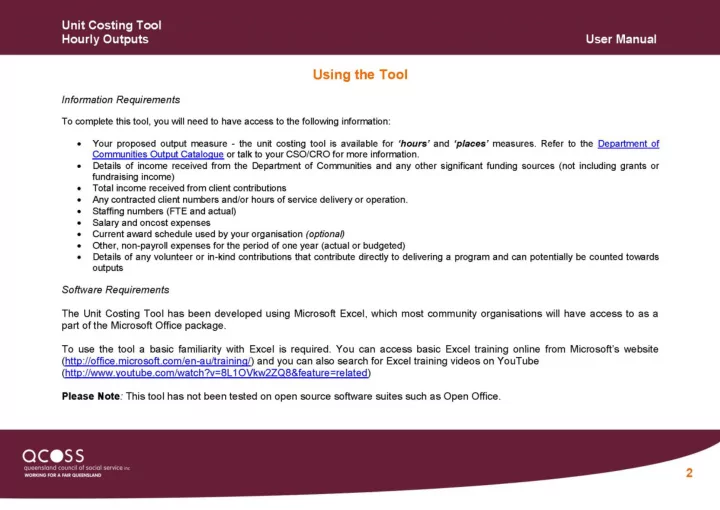
Using the Tool

Information Requirements To complete this tool, you will need to have access to the following information:

  • Your proposed output measure - the unit costing tool is available for 'hours' and 'places' measures. Refer to the Department of

Communities Output Catalogue or talk to your CSO/CRO for more information.

  • Details of income received from the Department of Communities and any other significant funding sources (not including grants or

fundraising income)

  • Total income received from client contributions
  • Any contracted client numbers and/or hours of service delivery or operation.
  • Staffing numbers (FTE and actual)
  • Salary and oncost expenses
  • Current award schedule used by your organisation (optionaO
  • ther, non-payroll expenses for the period of one year (actual or budgeted)
  • Details of any volunteer or in-kind contributions that contribute directly to delivering a program and can potentially be counted towards
  • utputs

Software Requirements The Unit Costing Tool has been developed using Microsoft Excel, which most community organisations will have access to as a part of the Microsoft Office package. To use the tool a basic familiarity with Excel is required. You can access basic Excel training online from Microsoft's website (httpJloffice.microsoft.com/en-au/training/) and you can also search for Excel training videos on YouTube (httpJlwww.youtube.com/watch?v=8L 1 OVkw2ZQ8&feature=related) Please Note: This tool has not been tested on open source software suites such as Open Office.

slide-2
SLIDE 2

Entering Data The tool has been colour coded according to this legend for ease of use:

~

Data input is generally required Data input is optional Calculation cells - DO NOT enter any data

Before Completing the Tool

Before completing the tool you will need to determine the following: a) whether you will detail your operating and occupancy expenses using a "freeform" schedule, or use the schedule in the Standard Chart of Accounts b) whether you will analyse and record your organisational costs (corporate overhead) by individual cost element or, use a pre- determined mark-up factor, such as 15%, 20% etc c) whether you will assign value to volunteer or in-kind support , and if any volunteer time will be counted towards your outputs d) whether penalty pay rates apply to all staff pay, including leave, or solely to time worked on the job It is unlikely that the information generated by this tool will be exact to the dollar. The tool has been designed to give you an estimate of the full cost of service delivery, and a starting point for negotiating your outputs based on current resources. The information will also only reflect the cost of service delivery at a given point in time. You will need to ensure that the costs you enter into the template relate directly to providing the contracted service. Costs relating to unfunded services or discretionary client activities should be excluded.

slide-3
SLIDE 3

If you have already negotiated your hourly

  • utputs with the

Department enter 'Y' here Enter your total income including any subsidies from the Department of Communities here You may also enter income received from other significant agencies or client contributions here. Do not include income from grants, donations and

  • fundraising. This forms part
  • f your organisational

contribution.

I'

~

Clients and Staff - Service Delivery Assumptions

acess

q.-Jond

(ounaJ 01 sociOl MNIc ....

  • -_._---

Unit Costing Tool for Hourly Outputs Clients and Staff

page 2

Service Name: Community Suppon Services

§

input cell - reqUired input cell - optional calculated cell

ervice agreements with funding agencies:

Old pepartment of Communities Other - (enter ntributions & allowances Total income {exel. fundraising}

Total outputs per year Service operating hours per year

Level and range of client suppon needs - I complex & diverse nee,

Service description

Community Access insert DoC output code _ sfaff se . $ mcom

e j~

NIce I client .

120 n e rv hours

seNlCo

"""

.....

§

  • ::J

C

3 ~

,-

],

5Ql!em

2

' 250 ~

If you have already negotiated your hourly

  • utputs, enter the total here

If you have already negotiated your outputs, a ratio of client to staff hours will be calculated once you complete the 'Clients and Staff' section of the tool. A ratio of '1' would reflect

  • ne-on-one work with
  • clients. A higher ratio could

reflect group work and a lower ration could reflect a two worker per one client model. This figure represents the number of hours per year your service is open Once you complete the 'Clients and Staff' section of the tool, the number of hours per year that your staff can provide service delivery will appear here. This information will support you to negotiate your outputs.

slide-4
SLIDE 4

Clients and Staff - Service Delivery Operating Assumptions

In this part of the tool you will enter the details your service operation details. Generally, services operate less than 52 weeks per year after taking into account public holidays and Christmas shutdown periods. Service delivery operating assumptions:

  • perating days per week
  • perating weeks per year
  • perating hours per day

days weeks

hours §B

.o

50.0 9.0

slide-5
SLIDE 5

Clients and Staff - Staff Operating Assumptions

In this part of the tool you will enter your staff operating assumptions, which are used to determine the number of hours you r direct service delivery staff are available to provide support to clients (either face-to-face or on behalf of - See the Department of Communities Outputs Catalogue for more details).

Staffing operating assumptions:

Standard hours per week per FTE staff member Siaff operating ~

'e ks

per year. Annual leave Public holidays Personal and sick leave Training Other non-service delivery

Service delivery weeks per FTE

  • ~
. . . ~
  • - --- . -,

_. --- ,...-

St.

, atlon factors (indlrecf time).

ravel lime

Personal Administration Other · Insert defalls (if needed Insert ade N/onal lmes): Team meelinqs Client service time Total

Contact hours per year per FTE staff member

hours

00

..

.,.. ~

wk.,year 2.0

wks..year 2.0 wks,.year 1 0

wk.,year 3.0 wk.,year l\. 43.0

.1\

~

hrsIW/(f)erFTE

% ........ 00 % 00 % 2% 08 I % 3% 1 1 %

./

00 %

....-

0.0

00 %

95% ... 36 1 % 100% ~ hours

I

1,5521 :>

1

The tool will then calculate the number of direct contact hours your staff can provide to clients per year, per FTE. Enter the standard Full Time Equivalent (FTE) hours per week that is the basis for annual salary in your award or certified agreement. Enter your staff's leave entitlements here. Assuming your staff will take their full leave entitlements each year will provide a more realistic base for calculating full cost of service. Enter proportions of time spent by service delivery staff performing 'indirect' activities. Refer to the DoC Outputs Catalogue for more information on what is considered 'indirect' time, e.g. travel time between clients or services, training, staff meetings, network meetings etc To calculate the % time in indirect activities, use the following formula: (No. hours per wk / Standard FTE hours per wk) x 100 REASONABLENESS CHECK - Does this percentage

  • f

staff time spent working with or on behalf

  • f

clients seem reasonable?

slide-6
SLIDE 6

Clients and Staff - Staff Operating Assumptions cont.

The next part of the tool is where your staffing levels and salaries are entered. You may choose to enter actual staffing costs or draw on the annual base salary rates from your award or certified agreement. Base salary rates are useful in determining full-cost as they will not fluctuate due to staffing vacancies etc. Enter the annual base salary for each level for your direct service delivery staff.

REASONABLENESS CHECK - does this percentage of non- contact delivery time seem reasonable? I.e. for every x hours spent in direct service delivery, x hours is spent in coordination or admin.

  • Actual direct staffing involved in delNenng S,fo

GO outPltN,:

S

45.000 ave,

"':

./. ",

(expand If additional rales ;;;; needed)

f\. ---

Service facilitation, CO<Ndination and management: Service facilitation & cO-<lrdination staff Service management FTEs FTEs FTEs FTEs FTEs FTEs FTEs base salary

S 52.000

  • Enter the number of FTEs

employed at each salary

..--..

~

ryb a nd

level.

/

1.2 '-

3.4

\

You may choose to record salary levels in the green

I

column for your reference.

"\.

1.2 /

  • hours per w

eek

25.00

Service administla"'t i:::,on'--________

  • +-___
  • +

___

  • --l "'---1

Olher:

II-----------+-----+------l

Enter the base salary and hours per week of any coordination and admin staff specific to this program.

I

Total hours per year As a % of seNice delivery staffing

1,300 42'10

Do not include snr management. Their wage is covered under

  • rganisational costs
slide-7
SLIDE 7

Clients and Staff - Optional Inputs

This part of the tool allows for the inclusion of a number of optional components that each contribute towards understanding your full cost of service delivery.

Optional inputs: Recognrtion of Volunleer.s: Ex gral,a and other slaff paymenls. Type of paymenl (enler descnpMn)

Estimated annual payment· S

Recognrbon of tn·klnd suppor/: Use of a benchmark marlc-up factor to calci Benchmark factor applied to servi InclusIOn of the cosl of capilal In -full cost": Risk-free rate of cost of capital Depreciated replacement cost of

S per hour

(a) notional benefit $

25.00

I

~$I

  • ~ I

S 1.000

I

If volunteer effort is to be included, enter an estimate of the hourly value in box (a), you may

volunteer hours per w eek

choose to use a relevant casual rate from your

(b) total (e) recognised not recognised ...... Award or Certified Agreement. Enter the total

as output as output

hours spent in a typical week, related to service

25 0 25.0 0.0

delivery in box (b) and any volunteer hours to be recognised as outputs should be entered in

I

I

Total

I

box (c).

: S 1.000 :

......... Enter any additional benefits received by staff,

Is '

'~

  • utside of their standard entitlements.

Enter an estimate of any benefit received

I

15%

I

relating specifically to service delivery, e.g. repair and maintenance, rent etc. If you have chosen to use a pre-determined mark-

..... up factor for organisational costs, enter it here. If

this is blank, you must include organisational expenses in your operating expenses.

..... If your organisation owns a property used for

service delivery, you can enter a cost of capital

  • here. Please refer to separate notes for more

details.

slide-8
SLIDE 8

Staffing Costs - Penalty and Oncost Rates

This part of the tool calculates the weighted average penalty rate for service delivery staff. If penalty rates apply, use the table to determine the weighted average penalty rate by first entering the total weekly hours of service operation followed by the number of hours per week subject to varying penalty rates (as shown in the example). The only input needed is (a) the penalty rates applicable to each period of work time (e.g. payment at time and a half = a 50% penalty rate) , and (b) the number of hours in the working week that correspond to each penalty rate .

Staffing salary costs and oncosts: Weighted average overtime penalty rate - applicable hours

based on seMce hours per week at ~5

' 0

Evening Mon-Fti

15%

applied to

7.0

Salurday

150%

applied to Sunday

200%

applied to public holIday

150%

applied to

PO'''' .......... ,""

Some providers apply an average penalty

~

8.1

  • loading to all non-working time (e.g. Leave,

public holidays, etc.) If your organisation does this, enter "Y' here.

  • If gross penalty tare Is

to

Gross penalty rate

I

23%1

v

  • apply. enrer "Y". otherwise

Net penalty rate (based on service delivery time)

I

22%1

leave O /ank &

the default will be tI1e net rate

You will then enter the relevant oncost rates.

Oncosl rales Workers' compensation insurance " of lolal pay 3 0% Superannuation " of lolal pay 9 0% Annual Leave Loading 1 0%

Long seNice leave % of staff elIgIble 1 100%

1

welghled rale 1 7% Oncost rate for co.ordination, management & admin activities 14.7% Service delivery oncost rate 17.3%1

slide-9
SLIDE 9

Staffing Costs - Calculation

Based on the information you have just entered, the tool will now calculate your staffing costs and give you a preliminary unit cost per hour of direct service delivery.

Calculalion of Staffing Costs: Direct service delivery Service facilitation & co-ordination staff Service management Service administration Volunteers Ex gratia and other staff payments: Total staffing and oncosts Total delivery outputs staff servioe hours

  • lient servioe hours

base salary

53,289 34.211

· ·

· · 31,250 1,000

__

119, 750.

Staffing cost per output

S per staff service hour S

38.78

len servIce OUf '-"

__

  • =-=-'-'

$

  • ncosts

9,242 5,018 14,259 1 4.62

Weighted average salary p.a. per paid FTE

[$

48,0431

[S 7,i4f]

s

total

62,531 39.228

· ·

· · 31,250 1,000 134,009 3,088 1 3,500 43.39 38.29 [ S-- 55,784 1

slide-10
SLIDE 10

Expenses - Freeform or Standard Chart of Accounts

You may choose to enter your expenses using either a freeform template, or the Standard Chart of Accounts (SCOA). If you choose to use the freeform template for entering your expenses, you must enter "Y" in the appropriate field on the Freeform template. PLEASE NOTE: If

you are not using a mark-up factor for organisational costs, you must include these expenses in the "Total Cost" column.

acess

queenslond council of SO<lOt service"", ~roa"'QUI"'"

Unit Costing Tool for Hourly Outputs Expenses· Freeform Input

Service Name: Community Support Services

This is the "freeform" version for expense entry - if you wish to use it, please enter "Y"

Page 4a

y Please use this schedule if you do not use the standard chart of accounts. Discretionary costs need fo be Identtfted and eliminated from the calculation of the hourly rate. Any component of cost that meets the "organisational" cost criteria (refer to separate notes) needs to be eliminated if you have opted to use the mark up factor on p2 that is applied to Occupancy and SelVice Delivery Costs. If you have not opted to use the marl< up factor. you will need to include organisaUonaJ costs as either occupancy or sefV;ce delivery as appropdate. Please use page 4b if you have adopted the Queensland Standard Chart of Accounts for your financiaJ s Direct service and occupancy costs Cost category

Total

):,cretiOnary or

Organisational

OCcupancy SeN;ce

n.applicable costs (replaced

DeliVery

cosV(creditj sts (excluded) by marl< up)

costs

(residual)

Base salaries 119,750

C'~I~_ . ~.~ 1.1 'len
slide-11
SLIDE 11

Expense Categories

The Unit Costing Tool is underpinned by three expense categories - Service Delivery, Occupancy and Organisational Costs. Most of your service delivery costs will be related to salaries and on costs, which are entered in the first part of the tool. In the expenses component, you will be prompted to enter your non-staffing service delivery costs, and your occupancy costs. Detailed definitions of these terms are provided in the tool's glossary. The following table will also help you determine which costs apply to a particular category. A good rule of thumb for determining your organisational costs is that they are generally the costs your organisation would incur even if you did not run a particular

  • program. For example, you would still require a Co-ordinator, payroll, phone systems, HR management, financial auditing etc.

Service Delivery

  • Salaries, oncosts and

allowances of service delivery, coordination, supervisory and advisory staff

(excluding snrmanagement)

  • Service operating expenses

(consumables. travel. phone)

  • Occupational health and safety
  • Quality management

Occupancy

  • Rental (or market equivalent

rental for owned premises)

  • Utilities
  • Cleaning
  • Furniture and Equipment
  • Insurance
  • Household orrelated

consumables

  • Depreciation
  • Building repair and

maintenance and cost of capital (if a market equivalent rent is not charged for owned premises)

Organisational

  • General management
  • Governance
  • Finance
  • Procurement

·IT

  • HR management
  • Payroll

Applied to direct service and

  • ccupancy

costs at an agreed benchmark rate.

slide-12
SLIDE 12

Your Unit Cost

Once you have entered your expenses the tool will calculate your unit cost. Based on the information you have entered, this will represent roughly the full-cost of delivering your service, and will indicate what proportion of this cost is met by your organisation. The tool also provides you with information and things to consider so you can interpret your unit cost. You can access this information by clicking "Interpreting Your Unit Cost" at the bottom of the page.

slide-13
SLIDE 13

Step 3. Calculating the components of "full cost" of service S/seNfce hour SeMce delivery sryear 145,009 $ 46.96 Occupancy s.year 6.000 $ 1.94 Organisational costs s.year 22.651

S 733

Risk free cost of capital

sryear $

  • Total cost

&year 113,660

S

56.23

+ consisting of:

SeMce delivery &year

166,760 $ 54.00

Occupancy &year

6,900 $ 2.23 Step 4. Calculating the "full cost" hourly rate per service hour and cost per output

Full cost per output

Slhour

Total revenues per output

Slhour

Net costfprice per output (attributable to seMce provider)

$/hour % of full cost consisting of:

Net cost/price per output (attributable to volunteers) $/hour

% of full cost

Net cost/price per output (cash outlay by service provider)

Slhour % of full cost

Full cost per service operating hour + S per hour of service availability funded by: Subsidies & contributions Volunteer effort Service provider

1 $ 56.231 1 $ 38,861 1

I

1 1 $ $ $ $ $17.38 30.9% $10.12 18.0% $7.26 12.9% 77.18 53.33 13.89 9.96 Step 5. Calculating OUlputs purchased by funding agencies and funded by provider

Full cost of total outputs less - client allowances & contributions

= net cost to funding agency Number of outputs:

sryear sryear S-Year Purchased by DoC

hours

Purchased by other funding agencies

hours

Funded by service provider

hours 173,660 173,660 1 $ 56.231 stair seNice hours 1 2.134 1 1 954

C

INTERPRETING YOUR UNIT COST -:::>

S/CIlent

  • utput hour

$ 41 43

S

6.47

S S

49.62

S

47.65

S

1 97 1 $ 49.621 1 $ 34.291 $15,33

  • 44,7%

This provides an indication of the proportion of tolal cost that IS met by volunteer effort This is the cost per hour of seNice availability and the funding conlnbutions 1 $ 49.621 d lenthours 69.1% 2,419 69%

0.0% 0%

30.9% 1.081 31%