Using evidence to improve access to finance for SMEs WWGS, - - PowerPoint PPT Presentation

using evidence to improve access to finance for smes
SMART_READER_LITE
LIVE PREVIEW

Using evidence to improve access to finance for SMEs WWGS, - - PowerPoint PPT Presentation

Using evidence to improve access to finance for SMEs WWGS, September 2016 Elizabeth Koshy Program Manager, SME program ,IPA ekoshy@poverty-action.org The role of SMEs Key source of job creation and social mobility Hire and


slide-1
SLIDE 1

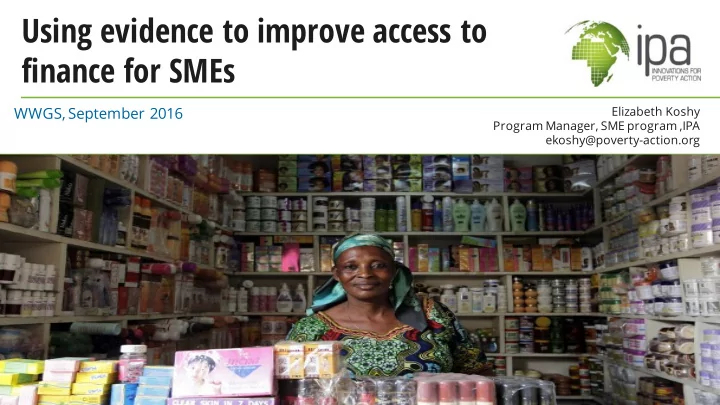
Using evidence to improve access to finance for SMEs

​Elizabeth Koshy ​Program Manager, SME program ,IPA ​ekoshy@poverty-action.org

WWGS, September 2016
slide-2
SLIDE 2

üKey source of job creation and social mobility üHire and train low-skilled workers üMarket aggregators üMultiplier effect üCrucial to the development of strong, dynamic economies

The role of SMEs

slide-3
SLIDE 3

Constraints to SME growth

Access to finance ​Human capital and skills ​Access to markets ​Regulatory constraints ​Lack of infrastructure

slide-4
SLIDE 4
  • Billions of dollars spent

annually to promote entrepreneurship

  • Yet, little evidence on most

effective ways to address those barriers. There is need for innovation, experimentation and learning in the SME development space.

But.. What works?

slide-5
SLIDE 5

IPA’s Solution The Problem

Innovations for Poverty Action

Discovering and promoting effective solutions to global poverty problems

slide-6
SLIDE 6

The SME program at IPA

Discovering and promoting effective solutions to barriers that restrict SME growth in developing countries

Over 100 studies across 33 countries

Bridge the gap between research and policy Build the body of evidence Promote evidence based decision making

slide-7
SLIDE 7

​Business training ​Mentoring ​Consulting services ​Business plan competitions Innovative financial products ​Better screening mechanisms ​Alternative collateral models ​Matching grants Export support Matching platforms Value chain development Government procurement

Human capital and skills Access to finance Access to markets and information

SME Program Research Agenda

slide-8
SLIDE 8
  • Approximately 45-55% of MSME’s

are unserved or underserved

  • Value of credit gap >2 trillion USD
  • SME’s are very dependent on

external financing

  • Bank’s are reluctant to lend to

SME’s because its expensive and risky

Access to finance

slide-9
SLIDE 9

SME’s face constraints along the entire lending cycle

Screening Collateral Investment Repayment

Featured study I: Computer generated credit scores in Colombia Featured study II: Flexible collateral in Colombia Featured study III: Financial literacy training in the DR Featured study IV: Relationship banking in India

slide-10
SLIDE 10

SME’s face constraints along the entire lending cycle

Screening

  • Limited historical

information

  • Incomplete financial

records

  • No credit bureaus

Collateral Investment Repayment

slide-11
SLIDE 11

Improving client screening

Featured study: The impact of computer generated credit scores on lending in Colombia

slide-12
SLIDE 12

Ø Reduce processing time and costs Ø Increase incentives of credit committee Ø But do you lose valuable “soft information”?

Using computer generated credit scores for client screening

Can a computer generated credit score reduce the bank’s cost and improve the quality of the bank’s loan review process

slide-13
SLIDE 13

Studying the impact of computer generated credit scores

  • Partnered with Bancamia, a bank in Colombia
  • Randomly assigned availability of score across loan applications in

8 branches

  • Experimental design:
  • Group A: Credit score given to committee prior to decision
  • Group B: Credit score given to committee after decision
  • Group C: Control Group, no credit score
slide-14
SLIDE 14
  • Fraction of non decisions

drops by more than 40 percent with a credit score

  • Committee spent more time
  • n harder to evaluate

applications

  • Effect mainly seen through

the incentive channel

  • Information technology can

play a role in decentralized decision making

Computer generated scores improve efficiency of loan process

slide-15
SLIDE 15

SME’s face constraints along the entire lending cycle

Screening Collateral

  • SME’S don’t

have the type

  • f collateral

required by banks Investment Repayment

slide-16
SLIDE 16
  • New secured transaction reform in Colombia in association with

IFC and Colombian government

  • Ability to use movable collateral such as vehicles, machinery,

accounts receivable etc.

  • Reform includes
  • Unified online registry
  • Increased enforcement in the case of default

What is the impact of the reform on lender’s and on SME business

  • utcomes?

Using movable assets as collateral

slide-17
SLIDE 17

SME’s face constraints along the entire lending cycle

Screening Collateral Investment

  • Many business
  • wners

unprepared to make business decisions Repayment

slide-18
SLIDE 18

Improving financial management of SMEs

Featured study: Keeping it simple – Financial literacy and rules of thumb for micro-entrepreneurs

slide-19
SLIDE 19

Strong association between improved understanding of financial concepts and outcomes Evidence on success of training programs is mixed

Training micro-entrepreneurs in financial literacy

Can training programs improve financial practices and outcomes? How can financial training be taught more effectively

slide-20
SLIDE 20

Studying the impact of “rules of thumb” training

  • Partnered with a microfinance institution (ADOPEM) in the

Dominican Republic

  • Randomly assigned training opportunity across 1,200 clients
  • Experimental design:
  • Group A: Traditional accounting training
  • Group B: Rules-of-thumb training
  • Group C: Control Group, no training
slide-21
SLIDE 21
  • “Rules of thumb” trainees were 6 to

12 percentage points more likely to separate business and personal cash

  • More effect on less sophisticated

clients

  • Better revenue particularly in bad

weeks Financial training programs can

  • work. One size does not fit all when

it comes to training

“Rules of thumb” training more effective than traditional training

slide-22
SLIDE 22

SME’s face constraints along the entire lending cycle

Screening Collateral Investment Repayment

  • Higher default

rates compared to larger borrowers

slide-23
SLIDE 23

Improving repayment rates

Featured study: The personal side of relationship banking

slide-24
SLIDE 24

Using relationship banking to reduce default rates

ü Creates more personal responsibility for client ü Gathers more “soft information” on the client Can a personal relationship between the lender and borrower lead to lower default rates without increasing lending cost?

slide-25
SLIDE 25

Studying the impact of relationship banking

  • Partnered with a ICICI Bank in India
  • Randomly assigned increased interaction across 1319 loans
  • Experimental design:

Group A: Personal touch treatment Group B: Medium touch treatment Group C: Reminder treatment Group D: Control Group

slide-26
SLIDE 26
  • Groups A and B had .1 fewer late

payments compared to D.

  • Reduction in the number of multiple

delinquencies

  • Improved customer satisfaction
  • Additional cost compensated by

reduced late payments

  • No difference between high and

medium touch groups. Personalized attention is sufficient

Personal interaction improves loan repayment

slide-27
SLIDE 27

Conclusion

  • Small tweaks can have material impact
  • But, many questions still remain
  • Rigorous evidence can point us to the most

effective ways to help SME’s improve their access to finance

  • Strong research partnerships are key to

ask the right questions and make sure results are implemented

slide-28
SLIDE 28

THANK YOU ekoshy@poverty-action.org www.poverty-action.org/sme