Use of Phytoremediation To Augment Standard Pump and Treat - - PowerPoint PPT Presentation

use of phytoremediation to augment standard pump and
SMART_READER_LITE
LIVE PREVIEW

Use of Phytoremediation To Augment Standard Pump and Treat - - PowerPoint PPT Presentation

Use of Phytoremediation To Augment Standard Pump and Treat Technologies at Superfund Sites A WSP Member Neil J. Brown, P.E. Regional Engineering Manager OCTOBER 26 -28, 2020 Th The Site 16-Acre Abandoned Electrical Equipment


slide-1
SLIDE 1

OCTOBER 26 -28, 2020

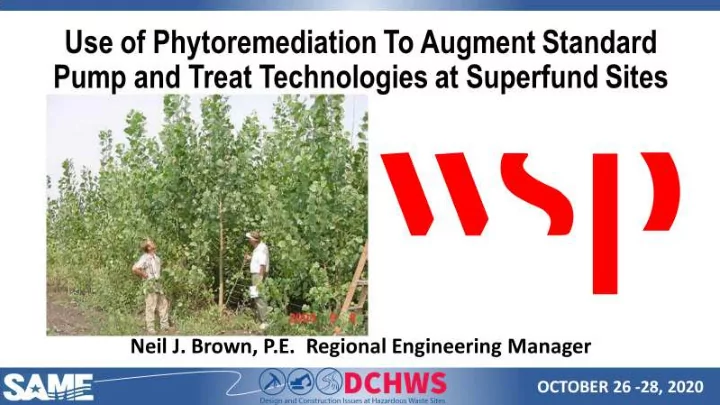
Use of Phytoremediation To Augment Standard Pump and Treat Technologies at Superfund Sites

Neil J. Brown, P.E. Regional Engineering Manager

A WSP Member
slide-2
SLIDE 2

OCTOBER 26 -28, 2020

Th The Site

  • 16-Acre Abandoned Electrical

Equipment Manufacturing Plant located in a residential community

  • PCB soil contamination
  • PCB and VOC groundwater

contamination

  • One of the largest incineration

projects in the country.

slide-3
SLIDE 3

OCTOBER 26 -28, 2020

“Pump” and Treat System

  • Groundwater collection: interconnected trenches that

gravity drained into a single collection manhole

  • Treatment:
  • pH adjustment
  • Air stripping (VOC removal)
  • GAC (PCB removal/VOC polishing)
  • POTW discharge
slide-4
SLIDE 4

OCTOBER 26 -28, 2020

slide-5
SLIDE 5

OCTOBER 26 -28, 2020

Couple of Kickers

  • The incinerator was permitted under TSCA.
  • New VOC source areas were identified.
  • Additional excavation would not be “publicly” acceptable.
  • Funding/Time running out.
slide-6
SLIDE 6

OCTOBER 26 -28, 2020

REMEDY

  • Identified 4 hot spot areas
  • Develop and implement series of Remedy Enhancements:
  • Two Dual Phase Extraction systems (Topic for another

presentation); and

  • Two Phyto remediation plots (Topic for today)
slide-7
SLIDE 7

OCTOBER 26 -28, 2020

WHY PHYTOREMEDIATION?

  • Shallow groundwater table, at least at one location
  • Relatively low operation and maintenance cost
  • Green technology
  • Would still be “working” after groundwater treatment system is

shut down

  • Remember, site located in a residential community
slide-8
SLIDE 8

OCTOBER 26 -28, 2020

The Design Team

  • Illinois EPA
  • University of Florida
  • Iowa State University
  • WSP, Formerly: Ecology and Environment, Inc.
slide-9
SLIDE 9

OCTOBER 26 -28, 2020

The SYSTEMS

  • North West Corner
  • PCE Contaminated Soil

and Groundwater

  • Plot Size: 95’ x 235’
  • Poplar, willow, and

limited bald cypress

  • 643 trees planted
  • No Specialize planting

required.

  • East Side of GTU
  • TCE Groundwater

contamination

  • Plot Size: 90’ x 300’
  • Poplar and willows
  • 418 trees planted
  • Not the case here
slide-10
SLIDE 10

OCTOBER 26 -28, 2020

Wha What’s s Going ng On On

slide-11
SLIDE 11

OCTOBER 26 -28, 2020

The Systems cont.

  • Randomized complete block split-plot design
  • For Northwest Corner: 18 different poplar clones, 24 willow distinct

clones and 1 type of bare root planted.

  • For GTU: 1 type of poplar and 21 different willow clones planted.
  • Pine bark added in 4-foot wide strips for weed prevention
slide-12
SLIDE 12

OCTOBER 26 -28, 2020

Si Site Sch Schema matic

GTU

  • ST. VINCENTS AVENUE

NORTHWEST Perc PHYTOREMEDIATION PLOT GRAVEL ROAD GTU PHYTOREMEDIATION PLOT FENCE NURSERY SVE TRAILER SVE TRAILER

24TH STREET Northwest PERC Plot

GTU Plot

slide-13
SLIDE 13

OCTOBER 26 -28, 2020

NW NW C Corn rner P r Plantings

slide-14
SLIDE 14

OCTOBER 26 -28, 2020

GTU TU Area

slide-15
SLIDE 15

OCTOBER 26 -28, 2020

OPERATIONS AND MONITORING

  • Weed Control
  • Fertilization
  • Irrigation
  • Pest/Disease Control
  • Growth Monitoring
  • Groundwater Monitoring (standard stuff)
  • Biomass sampling.
slide-16
SLIDE 16

OCTOBER 26 -28, 2020

BIOMASS SAMPLING

slide-17
SLIDE 17

OCTOBER 26 -28, 2020

BIG DON’T! T!!! (i (i.e .e., ., Ov Over Water)

slide-18
SLIDE 18

OCTOBER 26 -28, 2020

EN END RESULTS

  • Trees height ranged from 4 to 5 meters in height after 2 years.
  • Annual groundwater uptake was estimated to be 209,000 gallons.
  • 3 Years after the initial plantings: GTU and Dual Phase systems were shutdown
  • No significant increase in contaminant concentrations or areal extent of contaminant

plumes after 5-years of planting.

  • PHYTOREMEDIATION SYSTEMS CONINUTE TO OPERATE, AND ANALYTICAL RESULTS

SHOW THAT VOC CONTAMINANT EXTRACTION AND DEGRADATION IS STILL OCCURING.

slide-19
SLIDE 19

OCTOBER 26 -28, 2020

TH THANK Y ANK YOU

Neil J. Brown, P.E. Regional Engineering Manger WSP Solutions

Formerly: Ecology and Environment, Inc.

33 West Monroe, Suite 1410 Chicago, Illinois 60604 312-578-9243 neil.brown@wsp.com www.wsp.com

A WSP Member