CSE 311: Foundations of Computing announcements Fall 2013 Reading - - PowerPoint PPT Presentation

cse 311 foundations of computing announcements
SMART_READER_LITE
LIVE PREVIEW

CSE 311: Foundations of Computing announcements Fall 2013 Reading - - PowerPoint PPT Presentation

CSE 311: Foundations of Computing announcements Fall 2013 Reading assignment Lecture 10: Functions, Modular arithmetic Modular arithmetic 4.1-4.2, 7 th edition 3.4-3.5, 6 th edition Homework 3 due now Graded Homework 2 and Solutions


slide-1
SLIDE 1

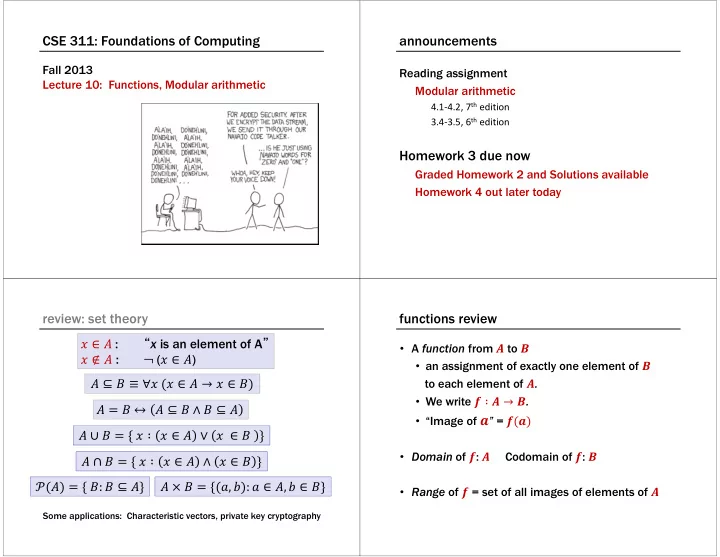
CSE 311: Foundations of Computing

Fall 2013 Lecture 10: Functions, Modular arithmetic

announcements

Reading assignment Modular arithmetic

4.1-4.2, 7th edition 3.4-3.5, 6th edition

Homework 3 due now

Graded Homework 2 and Solutions available Homework 4 out later today

review: set theory

∈ : “x is an element of A” ∉ : ¬ ( ∈ ) ⊆ ≡ ∀ ( ∈ → ∈ ) = ↔ ⊆ ∧ ⊆ ∪ = { ∶ ∈ ∨ ∈ } ∩ = { ∶ ∈ ∧ ∈ }

Some applications: Characteristic vectors, private key cryptography

() = { : ⊆ } × = {(, ): ∈ , ∈ }

functions review

  • A function from to
  • an assignment of exactly one element of

to each element of .

  • We write ∶ → .
  • “Image of ” = ()
  • Domain of :

Codomain of :

  • Range of = set of all images of elements of
slide-2
SLIDE 2

image, preimage

a b c d e 1 2 3 4

is this a function? one-to-one? onto?

a b c d e 1 2 3 4 5 6

number theory (and applications to computing)

  • Branch of Mathematics with direct relevance to

computing

  • Many significant applications

– Cryptography – Hashing – Security

  • Important tool set

modular arithmetic

  • Arithmetic over a finite domain
  • In computing, almost all computations are over a

finite domain

slide-3
SLIDE 3

what are the values computed?

public void Test1() { byte x = 250; byte y = 20; byte z = (byte) (x + y); Console.WriteLine(z); } public void Test2() { sbyte x = 120; sbyte y = 20; sbyte z = (sbyte) (x + y); Console.WriteLine(z); }

what are the values computed? divisibility

Integers a, b, with a ≠ 0, we say that a divides b if there is an integer k such that b = ka. The notation a | b denotes “a divides b.”

division theorem

Let a be an integer and d a positive integer. Then there are unique integers q and r, with 0 ≤ r < d, such that a = dq + r. q = a div d r = a mod d

Note: r ≥ 0 even if a < 0. Not quite the same as a%d

slide-4
SLIDE 4

arithmetic mod 7 a +7 b = (a + b) mod 7 a ×7 b = (a × b) mod 7

+ 1 2 3 4 5 6 1 2 3 4 5 6

X

1 2 3 4 5 6 1 2 3 4 5 6

modular arithmetic

Let a and b be integers, and m be a positive integer. We say a is congruent to b modulo m if m divides a – b. We use the notation a ≡ b (mod m) to indicate that a is congruent to b modulo m.

modular arithmetic

Let a and b be integers, and let m be a positive

  • integer. Then a ≡ b (mod m) if and only if

a mod m = b mod m.

modular arithmetic

Let m be a positive integer. If a ≡ b (mod m) and c ≡ d (mod m), then

  • a + c ≡ b + d (mod m) and
  • ac ≡ bd (mod m)
slide-5
SLIDE 5

example

Let n be an integer. Prove that n2 ≡ 0 (mod 4) or n2 ≡ 1 (mod 4)

n-bit unsigned integer representation

  • Represent integer x as sum of powers of 2:

If = ∑ !2!

#$% !&'

where each bi ∈ {0,1} then representation is bn-1...b2 b1 b0

99 = 64 + 32 + 2 + 1 18 = 16 + 2

  • For n = 8:

99: 0110 0011 18: 0001 0010

signed integer representation

n-bit signed integers Suppose −2#$% < < 2#$% First bit as the sign, n-1 bits for the value 99 = 64 + 32 + 2 + 1 18 = 16 + 2 For n = 8: 99: 0110 0011

  • 18: 1001 0010

Any problems with this representation?

two’s complement representation

n bit signed integers, first bit will still be the sign bit Suppose 0 ≤ < 2#$%, is represented by the binary representation of Suppose 0 ≤ ≤ 2#$%, − is represented by the binary representation of 2# −

99 = 64 + 32 + 2 + 1 18 = 16 + 2 For n = 8: 99: 0110 0011

  • 18: 1110 1110

Key property: Twos complement representation of any number y is equivalent to y mod 2n so arithmetic works mod 2n

slide-6
SLIDE 6

signed vs two’s complement

  • 7
  • 6
  • 5
  • 4
  • 3
  • 2
  • 1

1 2 3 4 5 6 7 1111 1110 1101 1100 1011 1010 1001 0000 0001 0010 0011 0100 0101 0110 0111

  • 8
  • 7
  • 6
  • 5
  • 4
  • 3
  • 2
  • 1

1 2 3 4 5 6 7 1000 1001 1010 1011 1100 1101 1110 1111 0000 0001 0010 0011 0100 0101 0110 0111

Signed Two’s complement

two’s complement representation

  • For 0 < ≤ 2#$%, − is represented by the

binary representation of 2# −

  • To compute this: Flip the bits of then add 1:

– All 1’s string is 2# − 1, so Flip the bits of ≡ replace by 2# − 1 −