announcements CSE 311: Foundations of Computing Fall 2013 Reading - - PowerPoint PPT Presentation

announcements cse 311 foundations of computing
SMART_READER_LITE
LIVE PREVIEW

announcements CSE 311: Foundations of Computing Fall 2013 Reading - - PowerPoint PPT Presentation

9/30/2013 announcements CSE 311: Foundations of Computing Fall 2013 Reading assignments Lecture 3: Logic and Boolean algebra Propositional Logic 1.1 -1.3 7 th Edition 1.1 -1.2 6 th Edition Boolean Algebra 12.1 12.3 7 th Edition


slide-1
SLIDE 1

9/30/2013 1 CSE 311: Foundations of Computing

Fall 2013 Lecture 3: Logic and Boolean algebra

announcements

Reading assignments – Propositional Logic

1.1 -1.3 7th Edition 1.1 -1.2 6th Edition

– Boolean Algebra

12.1 – 12.3 7th Edition 11.1 – 11.3 6th Edition

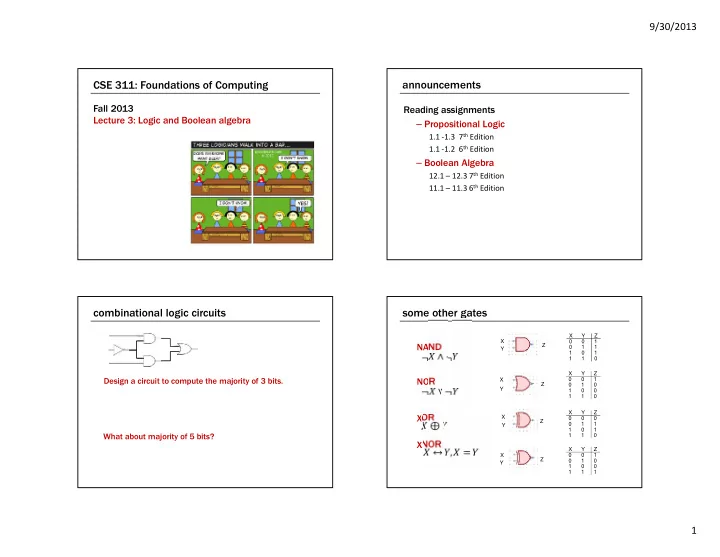
combinational logic circuits

Design a circuit to compute the majority of 3 bits. What about majority of 5 bits?

some other gates

NAND ¬ ∧ ¬ NOR ¬ ∨ ¬ XOR ⊕ XNOR ↔ , =

X Y Z X Y Z 1 1 1 1 1 1 1 X Y Z 1 1 1 1 1 Z X Y X Y Z X Y Z 1 1 1 1 1 1 X Y Z 1 1 1 1 1 1 Z X Y

slide-2
SLIDE 2

9/30/2013 2 review: logical equivalence

Terminology: A compound proposition is a Tautology if it is always true Contradiction if it is always false Contingency if it can be either true or false

p ∨ ¬ p p  p (p  q)  p (p  q)  (p   q)  ( p  q)  ( p   q)

review: logical equivalence

p and q are logically equivalent if and only if p  q is a tautology

i.e. p and q have the same truth table

The notation p  q denotes p and q are logically equivalent Example: p  ¬ ¬ p

p ¬ p ¬ ¬ p p ↔ ¬ ¬ p

review: De Morgan’s laws

  • (p  q)   p   q
  • (p  q)   p   q

What are the negations of:

The Yankees and the Phillies will play in the World Series. It will rain today or it will snow on New Year’s Day.

review: De Morgan’s laws

p q ¬ p ¬ q ¬ p ∨ ¬ q p ∧ q ¬ ( p ∧ q) ¬ ( p ∧ q) ↔ ( ¬ p ∨ ¬ q)

T T T F F T F F

Example:  (p ∧ q)  ( p   q)

slide-3
SLIDE 3

9/30/2013 3 review: Law of Implication

p q p → q ¬ p ¬ p ∨ q (p → q) ↔ (¬ p ∨ q)

T T T F F T F F

(p  q)  ( p  q) understanding connectives

  • Reflect basic rules of reasoning and logic
  • Allow manipulation of logical formulas

– Simplification – Testing for equivalence

  • Applications

– Query optimization – Search optimization and caching – Artificial Intelligence – Program verification

review: properties of logical connectives

  • Identity
  • Domination
  • Idempotent
  • Commutative
  • Associative
  • Distributive
  • Absorption
  • Negation
  • De Morgan’s Laws

Textbook: 1.3 7th Edition/1.2 6th Edition, Table 6

some equivalences related to implication

p  q 

  • p  q

p  q 

  • q   p

p  q 

  • p  q

p  q 

  • (p   q)

p  q  (p q)  (q  p) p  q 

  • p   q

p  q  (p  q)  ( p   q)

  • (p  q)

 p   q

slide-4
SLIDE 4

9/30/2013 4 some equivalences related to implication p  q 

  • q   p

logical proofs To show P is equivalent to Q

– Apply a series of logical equivalences to subexpressions to convert P to Q

To show P is a tautology

– Apply a series of logical equivalences to subexpressions to convert P to T

prove this is a tautology (p  q)  (p  q) prove this is a tautology (p  (p  q))  q

slide-5
SLIDE 5

9/30/2013 5 proving non-equivalence (p  q)  r p  (q  r) boolean logic

Combinational logic

– output = input

Sequential logic

– output =

  • utput

, input

  • output dependent on history
  • concept of a time step (clock)

An algebraic structure consists of

– a set of elements B = {0, 1} – binary operations { + , • } (OR, AND) – and a unary operation { ’ } (NOT )

a quick combinational logic example

Calendar subsystem: # of days in a month (to control watch display) – used in controlling the display of a wrist-watch LCD screen – inputs: month, leap year flag – outputs: number of days Example: (March, non-leap year) → 31

implementation in software

integer number_of_days (month, leap_year_flag){ switch (month) { case 1: return (31); case 2: if (leap_year_flag == 1) then return (29) else return (28); case 3: return (31); ... case 12: return (31); default: return (0); } }

20

slide-6
SLIDE 6

9/30/2013 6 implementation with combinatorial logic

Encoding:

  • how many bits for each input/output?
  • binary number for month
  • four wires for 28, 29, 30, and 31

leap month d28 d29 d30 d31 month leap d28 d29 d30 d31 0000 – – – – – 0001 – 1 0010 1 0010 1 1 0011 – 1 0100 – 1 0101 – 1 0110 – 1 0111 – 1 1000 – 1 1001 – 1 1010 – 1 1011 – 1 1100 – 1 1101 – – – – – 1110 – – – – – 1111 – – – – –

implementation with combinatorial logic

Truth-table to logic to switches to gates

d28 = “1 when month=0010 and leap=0” d28 = m8'•m4'•m2•m1'•leap‘ d31 = “1 when month=0001 or month=0011 or ... month=1100” d31 = (m8'•m4'•m2'•m1) + (m8'•m4'•m2•m1) + ... + (m8•m4•m2'•m1') d31 = can we simplify more?

month leap d28 d29 d30 d31 0000 – – – – – 0001 – 1 0010 1 0010 1 1 0011 – 1 0100 – 1 ... 1100 – 1 1101 – – – – – 111– – – – – –

implementation with combinatorial logic

d28 = m8'•m4'•m2•m1'•leap’ d29 = m8'•m4'•m2•m1'•leap d30 = (m8'•m4•m2'•m1') + (m8'•m4•m2•m1') + (m8•m4'•m2'•m1) + (m8•m4'•m2•m1) = (m8'•m4•m1') + (m8•m4'•m1) d31 = (m8'•m4'•m2'•m1) + (m8'•m4'•m2•m1) + (m8'•m4•m2'•m1) + (m8'•m4•m2•m1) + (m8•m4'•m2'•m1') + (m8•m4'•m2•m1') + (m8•m4•m2'•m1')

combinational logic

  • Switches
  • Basic logic and truth tables
  • Logic functions
  • Boolean algebra
  • Proofs by re-writing and by truth table