Announcements Reading assignments Today and Monday: CSE 311 - - PowerPoint PPT Presentation

announcements
SMART_READER_LITE
LIVE PREVIEW

Announcements Reading assignments Today and Monday: CSE 311 - - PowerPoint PPT Presentation

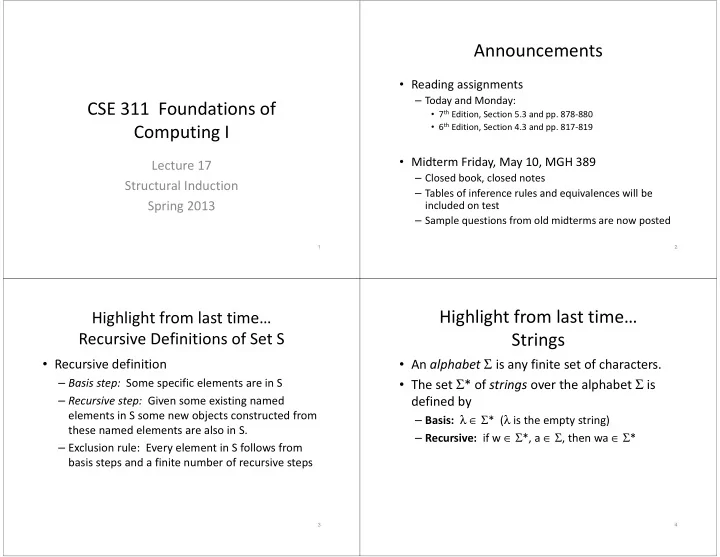
Announcements Reading assignments Today and Monday: CSE 311 Foundations of 7 th Edition, Section 5.3 and pp. 878-880 6 th Edition, Section 4.3 and pp. 817-819 Computing I Midterm Friday, May 10, MGH 389 Lecture 17 Closed


slide-1
SLIDE 1

CSE 311 Foundations of Computing I

Lecture 17 Structural Induction Spring 2013

1

Announcements

  • Reading assignments

– Today and Monday:

  • 7th Edition, Section 5.3 and pp. 878-880
  • 6th Edition, Section 4.3 and pp. 817-819
  • Midterm Friday, May 10, MGH 389

– Closed book, closed notes – Tables of inference rules and equivalences will be included on test – Sample questions from old midterms are now posted

2

Highlight from last time… Recursive Definitions of Set S

  • Recursive definition

– Basis step: Some specific elements are in S – Recursive step: Given some existing named elements in S some new objects constructed from these named elements are also in S. – Exclusion rule: Every element in S follows from basis steps and a finite number of recursive steps

3

Highlight from last time… Strings

  • An alphabet Σ is any finite set of characters.
  • The set Σ* of strings over the alphabet Σ is

defined by

– Basis: λ ∈ Σ* (λ is the empty string) – Recursive: if w ∈ Σ*, a ∈ Σ, then wa ∈ Σ*

4

slide-2
SLIDE 2

Highlight from last time… Functions on recursively defined sets

len (λ) = 0; len (wa) = 1 + len(w); for w ∈ Σ*, a ∈ Σ Reversal: λR = λ (wa)R = awR for w ∈ Σ*, a ∈ Σ Concatenation: x • λ = x for x ∈ Σ* x • wa = (x • w)a for x, w ∈ Σ*, a ∈ Σ

5

Highlight from last time… Rooted Binary trees

  • Basis: • is a rooted binary tree
  • Recursive Step: If and are rooted

binary trees then so is:

6

T1 T2 T1 T2

Highlight from last time… Functions defined on rooted binary trees

  • size(•)=1
  • size( ) = 1+size(T1)+size(T2)
  • height(•)=0
  • height( )=1+max{height(T1),height(T2)}

7

T1 T2 T1 T2

Structural Induction: Proving properties of recursively defined sets

How to prove ∀ ∀ ∀ ∀x∈S. P(x) is true:

  • 1. Let P(x) be “…”. We will prove P(x) for all x∈S
  • 2. Base Case: Show that P is true for all specific

elements of S mentioned in the Basis step

  • 3. Inductive Hypothesis: Assume that P is true for

some arbitrary values of each of the existing named elements mentioned in the Recursive step

  • 4. Inductive Step: Prove that P holds for each of

the new elements constructed in the Recursive step using the named elements mentioned in the Inductive Hypothesis

  • 5. Conclude that ∀

∀ ∀ ∀x∈S. P(x)

8

slide-3
SLIDE 3

Structural Induction versus Ordinary Induction

  • Ordinary induction is a special case of

structural induction:

– Recursive Definition of ℕ

  • Basis: 0 ∈
  • Recursive Step: If k ∈ then k+1 ∈
  • Structural induction follows from ordinary

induction

  • Let Q(n) be true iff for all x∈S that take n Recursive

steps to be constructed, P(x) is true.

9

Using Structural Induction

  • Let S be given by

– Basis: 6 ∈ S; 15 ∈ S; – Recursive: if x, y ∈ S, then x + y ∈ S.

  • Claim: Every element of S is divisible by 3

10

Using Structural Induction

  • Let S be a set of strings over {a,b} defined as

follows

– Basis: a ∈ S – Recursive:

  • If u ∈ S then au ∈ S and bau ∈ S
  • If u ∈ S and v ∈ S then uv ∈ S
  • Claim: if x ∈ S then x has more a’s than b’s

11

len(x•y)=len(x)+len(y) for all strings x and y

12

Let P(w) be “For all strings x, len(x•w)=len(x)+len(w)”

slide-4
SLIDE 4

For every rooted binary tree T size(T) ≤ 2height(T)+1-1

13

Languages: Sets of Strings

  • Sets of strings that satisfy special properties

are called languages. Examples:

– English sentences – Syntactically correct Java/C/C++ programs – All strings over alphabet Σ – Palindromes over Σ – Binary strings that don’t have a 0 after a 1 – Legal variable names. keywords in Java/C/C++ – Binary strings with an equal # of 0’s and 1’s

14

Regular Expressions over Σ

  • Each is a “pattern” that specifies a set of strings
  • Basis:

– ∅ ∅ ∅ ∅, λ λ λ λ are regular expressions – a is a regular expression for any a ∈ Σ

  • Recursive step:

– If A and B are regular expressions then so are:

  • (A ∪ B)
  • (AB)
  • A*

15

Each regular expression is a “pattern”

  • λ

λ λ λ matches the empty string

  • a matches the one character string a
  • (A ∪ B) matches all strings that either A

matches or B matches (or both)

  • (AB) matches all strings that have a first part

that A matches followed by a second part that B matches

  • A* matches all strings that have any number of

strings (even 0) that A matches, one after another

16

slide-5
SLIDE 5

Examples

  • 0*
  • 0*1*
  • (0 ∪ 1)*
  • (0*1*)*
  • (0 ∪ 1)* 0110 (0 ∪ 1)*
  • (0 ∪ 1)* (0110 ∪ 100)(0 ∪ 1)*

17

Regular expressions in practice

  • Used to define the “tokens”: e.g., legal variable names,

keywords in programming languages and compilers

  • Used in grep, a program that does pattern matching

searches in UNIX/LINUX

  • Pattern matching using regular expressions is an essential

feature of hypertext scripting language PHP used for web programming – Also in text processing programming language Perl

18

Regular Expressions in PHP

  • int preg_match ( string $pattern , string $subject,...)
  • $pattern syntax:

[01] a 0 or a 1 ^ start of string $ end of string [0-9] any single digit \. period \, comma \- minus . any single character ab a followed by b (AB) (a|b) a or b (A ∪ B) a? zero or one of a (A ∪ λ λ λ λ) a* zero or more of a A* a+

  • ne or more of a AA*
  • e.g. ^[\-+]?[0-9]*(\.|\,)?[0-9]+$

General form of decimal number e.g. 9.12 or -9,8 (Europe)

19

More examples

  • All binary strings that have an even # of 1’s
  • All binary strings that don’t contain 101

20

slide-6
SLIDE 6

Regular expressions can’t specify everything we might want

  • Fact: Not all sets of strings can be

specified by regular expressions

–One example is the set of binary strings with equal #’s of 0’s and 1’s

21