CSE 311: Foundations of Computing announcements Fall 2013 Reading - - PowerPoint PPT Presentation

cse 311 foundations of computing announcements
SMART_READER_LITE
LIVE PREVIEW

CSE 311: Foundations of Computing announcements Fall 2013 Reading - - PowerPoint PPT Presentation

CSE 311: Foundations of Computing announcements Fall 2013 Reading assignment Lecture 5: Canonical forms, predicate Logic Predicates and Quantifiers 1.4, 1.5 7 th Edition 1.3, 1.4 6 th Edition 2 review: boolean algebra review: mapping


slide-1
SLIDE 1

CSE 311: Foundations of Computing

Fall 2013 Lecture 5: Canonical forms, predicate Logic

announcements

  • Reading assignment

– Predicates and Quantifiers

1.4, 1.5 7th Edition 1.3, 1.4 6th Edition

2

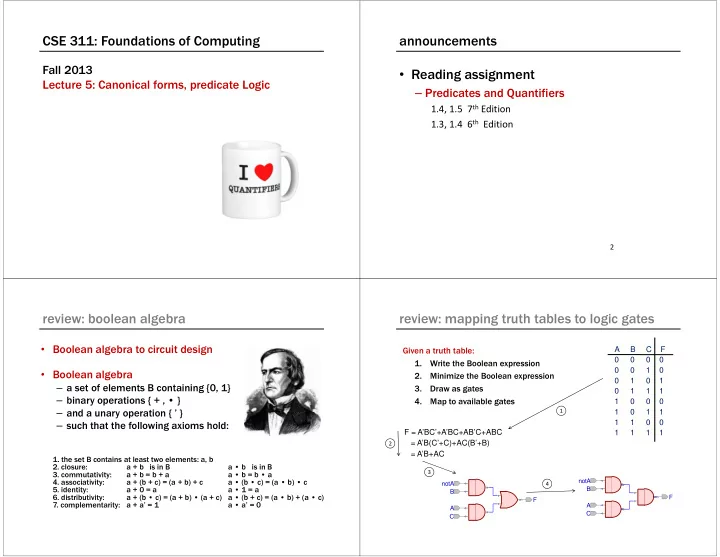
review: boolean algebra

  • Boolean algebra to circuit design
  • Boolean algebra

– a set of elements B containing {0, 1} – binary operations { + , • } – and a unary operation { ’ } – such that the following axioms hold:

  • 1. the set B contains at least two elements: a, b
  • 2. closure:

a + b is in B a • b is in B

  • 3. commutativity:

a + b = b + a a • b = b • a

  • 4. associativity:

a + (b + c) = (a + b) + c a • (b • c) = (a • b) • c

  • 5. identity:

a + 0 = a a • 1 = a

  • 6. distributivity:

a + (b • c) = (a + b) • (a + c) a • (b + c) = (a • b) + (a • c)

  • 7. complementarity:

a + a’ = 1 a • a’ = 0

review: mapping truth tables to logic gates

Given a truth table: 1. Write the Boolean expression 2. Minimize the Boolean expression 3. Draw as gates 4. Map to available gates

A B C F 0 0 1 0 1 0 1 1 1 1 1 0 0 1 1 1 1 1 0 0 1 1 1 1 F = A’BC’+A’BC+AB’C+ABC = A’B(C’+C)+AC(B’+B) = A’B+AC

notA B A C F F notA B A C 1 2 3 4

slide-2
SLIDE 2

review: canonical forms

  • Truth table is the unique signature of a Boolean

function

  • The same truth table can have many gate realizations

–we’ve seen this already –depends on how good we are at Boolean simplification

  • Canonical forms

– standard forms for a Boolean expression – we all come up with the same expression

sum-of-products canonical form

  • also known as Disjunctive Normal Form (DNF)
  • also known as minterm expansion

A B C F F’ 1 1 1 1 1 1 1 1 1 1 1 1 1 1 1 1 1 1 1 1 F = F = 001 011 101 110 111 + A’BC + AB’C + ABC’ + ABC A’B’C

sum-of-products canonical form

Product term (or minterm) – AND-ed product of literals – input combination for which output is true – each variable appears exactly once, true or inverted (but not both)

short-hand notation for minterms of 3 variables A B C minterms A’B’C’ m0 1 A’B’C m1 1 A’BC’ m2 1 1 A’BC m3 1 AB’C’ m4 1 1 AB’C m5 1 1 ABC’ m6 1 1 1 ABC m7 F in canonical form: F(A, B, C) = Σm(1,3,5,6,7) = m1 + m3 + m5 + m6 + m7 = A’B’C + A’BC + AB’C + ABC’ + ABC canonical form ≠ minimal form F(A, B, C) = A’B’C + A’BC + AB’C + ABC + ABC’ = (A’B’ + A’B + AB’ + AB)C + ABC’ = ((A’ + A)(B’ + B))C + ABC’ = C + ABC’ = ABC’ + C = AB + C

product-of-sums canonical form

  • also known as Conjunctive Normal Form (CNF)
  • also known as maxterm expansion

A B C F F’ 1 1 1 1 1 1 1 1 1 1 1 1 1 1 1 1 1 1 1 1 F = 000 010 100 F = (A + B + C) (A + B’ + C) (A’ + B + C)

slide-3
SLIDE 3

s-o-p, p-o-s, and de Morgan’s theorem

Complement of function in sum-of-products form: – F’ = A’B’C’ + A’BC’ + AB’C’ Complement again and apply de Morgan’s and get the product-of-sums form: – (F’)’ = (A’B’C’ + A’BC’ + AB’C’)’ – F = (A + B + C) (A + B’ + C) (A’ + B + C)

product-of-sums canonical form

Sum term (or maxterm) – OR-ed sum of literals – input combination for which output is false – each variable appears exactly once, true or inverted (but not both)

A B C maxterms A+B+C M0 1 A+B+C’ M1 1 A+B’+C M2 1 1 A+B’+C’ M3 1 A’+B+C M4 1 1 A’+B+C’ M5 1 1 A’+B’+C M6 1 1 1 A’+B’+C’ M7 short-hand notation for maxterms of 3 variables F in canonical form: F(A, B, C) = ΠM(0,2,4) = M0 • M2 • M4 = (A + B + C) (A + B’ + C) (A’ + B + C) canonical form ≠ minimal form F(A, B, C) = (A + B + C) (A + B’ + C) (A’ + B + C) = (A + B + C) (A + B’ + C) (A + B + C) (A’ + B + C) = (A + C) (B + C)

predicate logic

  • propositional logic

– allows us to analyze complex propositions in terms of their simpler constituent parts joined by connectives

  • predicate logic

– lets us analyze them at a deeper level…

predicate or propositional function

– a function that returns a truth value, e.g., “x is a cat” “x is prime” “student x has taken course y” “x > y” “x + y = z” or Sum(x, y, z) Predicates will have variables or constants as arguments.

predicate logic

slide-4
SLIDE 4

quantifiers ∀ x P(x)

P(x) is true for every x in the domain

read as “for all x, P of x”

∃ x P(x)

There is an x in the domain for which P(x) is true

read as “there exists x, P of x”

statements with quantifiers

  • ∃ x Even(x)
  • ∀ x Odd(x)
  • ∀ x (Even(x) ∨ Odd(x))
  • ∃ x (Even(x) ∧ Odd(x))
  • ∀ x Greater(x+1, x)
  • ∃ x (Even(x) ∧ Prime(x))

Even(x) Odd(x) Prime(x) Greater(x,y) Equal(x,y) Domain: Positive Integers

statements with quantifiers

  • ∀ x ∃ y Greater (y, x)
  • ∀ x ∃ y Greater (x, y)
  • ∀ x ∃ y (Greater(y, x) ∧ Prime(y))
  • ∀ x (Prime(x) → (Equal(x, 2) ∨ Odd(x))
  • ∃ x ∃ y(Sum(x, 2, y) ∧ Prime(x) ∧ Prime(y))

Even(x) Odd(x) Prime(x) Greater(x,y) Equal(x,y) Sum(x,y,z) Domain: Positive Integers

statements with quantifiers

  • “There is an odd prime”
  • “If x is greater than two, x is not an even prime”
  • ∀x∀y∀z ((Sum(x, y, z) ∧ Odd(x) ∧ Odd(y))→ Even(z))
  • “There exists an odd integer that is the sum of two primes”

Even(x) Odd(x) Prime(x) Greater(x,y) Sum(x,y,z) Domain: Positive Integers

slide-5
SLIDE 5

Cat(x) Red(x) LikesTofu(x)

english to predicate logic

  • “Red cats like tofu”

Domain: Positive Integers

goldbach’s conjecture

“Every even integer greater than two can be expressed as the sum of two primes”

Even(x) Odd(x) Prime(x) Greater(x,y) Equal(x,y)

scope of quantifiers

example: Notlargest(x) ≡ ∃ y Greater (y, x) ≡ ∃ z Greater (z, x) truth value: doesn’t depend on y or z “bound variables” does depend on x “free variable” quantifiers only act on free variables of the formula they quantify ∀ x (∃ y (P(x,y) → ∀ x Q(y, x)))

scope of quantifiers ∃x (P(x) ∧ ∧ ∧ ∧ Q(x)) vs. ∃x P(x) ∧ ∧ ∧ ∧ ∃x Q(x)

slide-6
SLIDE 6

nested quantifiers

  • bound variable names don’t matter

∀ x ∃ y P(x, y) ≡ ∀ a ∃ b P(a, b)

  • positions of quantifiers can sometimes change

∀ x (Q(x) ∧ ∃ y P(x, y)) ≡ ∀ x ∃ y (Q(x) ∧ P(x, y))

  • but: order is important...

quantification with two variables

expression when true when false ∀x ∀ y P(x, y) ∃ x ∃ y P(x, y) ∀ x ∃ y P(x, y) ∃ y ∀ x P(x, y)

negations of quantifiers

  • not every positive integer is prime
  • some positive integer is not prime
  • prime numbers do not exist
  • every positive integer is not prime

de morgan’s laws for quantifiers

¬∀x P(x) ≡ ∃x ¬P(x) ¬ ∃x P(x) ≡ ∀x ¬P(x)

slide-7
SLIDE 7

de morgan’s laws for quantifiers ¬ ∃ x ∀ y ( x ≥ y) ≡∀ x ¬ ∀y ( x ≥ y) ≡∀ x ∃ y ¬ ( x ≥ y) ≡∀ x ∃ y (y > x)

“There is no largest integer” “For every integer there is a larger integer”

¬∀x P(x) ≡ ∃x ¬P(x) ¬ ∃x P(x) ≡ ∀x ¬P(x)