Use of Optical Fiber Sensor for Monitoring the Degradation of Ac-Dex - - PowerPoint PPT Presentation

use of optical fiber sensor for monitoring the
SMART_READER_LITE
LIVE PREVIEW

Use of Optical Fiber Sensor for Monitoring the Degradation of Ac-Dex - - PowerPoint PPT Presentation

University of Campinas UNICAMP, Laboratory of Photonic Materials and Devices University of Campinas UNICAMP, Laboratory of Photonic Materials and Devices Fujiwara et al. , Design and Application of Optical Fiber Sensors for Force Myography


slide-1
SLIDE 1

University of Campinas – UNICAMP, Laboratory of Photonic Materials and Devices Fujiwara et al., Design and Application of Optical Fiber Sensors for Force Myography

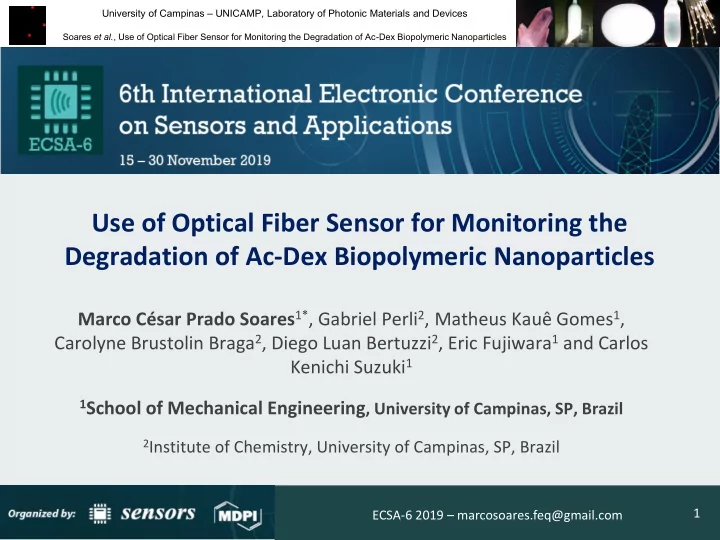
Use of Optical Fiber Sensor for Monitoring the Degradation of Ac-Dex Biopolymeric Nanoparticles

Marco César Prado Soares1*, Gabriel Perli2, Matheus Kauê Gomes1, Carolyne Brustolin Braga2, Diego Luan Bertuzzi2, Eric Fujiwara1 and Carlos Kenichi Suzuki1

1School of Mechanical Engineering, University of Campinas, SP, Brazil

2Institute of Chemistry, University of Campinas, SP, Brazil

University of Campinas – UNICAMP, Laboratory of Photonic Materials and Devices

Soares et al., Use of Optical Fiber Sensor for Monitoring the Degradation of Ac-Dex Biopolymeric Nanoparticles

ECSA-6 2019 – marcosoares.feq@gmail.com 1

slide-2
SLIDE 2

University of Campinas – UNICAMP, Laboratory of Photonic Materials and Devices Fujiwara et al., Design and Application of Optical Fiber Sensors for Force Myography

  • 1. Introduction

University of Campinas – UNICAMP, Laboratory of Photonic Materials and Devices Fujiwara et al., Characterization of Colloidal Silica by Optical Fiber Sensor University of Campinas – UNICAMP, Laboratory of Photonic Materials and Devices

Soares et al., Use of Optical Fiber Sensor for Monitoring the Degradation of Ac-Dex Biopolymeric Nanoparticles

ECSA-6 2019 – marcosoares.feq@gmail.com 2

Current research in nanomedicine:

  • Development and application of new biocompatible and biodegradable

materials;

  • Nanostructures produced from degradable polymers such as

polysaccharides:

  • carriers for pharmaceuticals;
  • tunability for releasing active compounds in response to pH changes;
slide-3
SLIDE 3

University of Campinas – UNICAMP, Laboratory of Photonic Materials and Devices Fujiwara et al., Design and Application of Optical Fiber Sensors for Force Myography

  • 1. Introduction – Acetalated Dextran (Ac-Dex)

University of Campinas – UNICAMP, Laboratory of Photonic Materials and Devices Fujiwara et al., Characterization of Colloidal Silica by Optical Fiber Sensor University of Campinas – UNICAMP, Laboratory of Photonic Materials and Devices

Soares et al., Use of Optical Fiber Sensor for Monitoring the Degradation of Ac-Dex Biopolymeric Nanoparticles

ECSA-6 2019 – marcosoares.feq@gmail.com 3

  • Promising example of pH-responsive polymer;
  • Easily processable by different emulsion techniques;
  • Ac-Dex nanoparticles (NPs) present the ability to encapsulate

both hydrophobic and hydrophilic molecules, depending only on the emulsion process

slide-4
SLIDE 4

University of Campinas – UNICAMP, Laboratory of Photonic Materials and Devices Fujiwara et al., Design and Application of Optical Fiber Sensors for Force Myography

  • 2. Polymer Synthesis and Nanoparticles

Preparation

University of Campinas – UNICAMP, Laboratory of Photonic Materials and Devices Fujiwara et al., Characterization of Colloidal Silica by Optical Fiber Sensor University of Campinas – UNICAMP, Laboratory of Photonic Materials and Devices

Soares et al., Use of Optical Fiber Sensor for Monitoring the Degradation of Ac-Dex Biopolymeric Nanoparticles

ECSA-6 2019 – marcosoares.feq@gmail.com 4

  • Two methods applied: single-emulsion (SE) and double-emulsion

(DE)

slide-5
SLIDE 5

University of Campinas – UNICAMP, Laboratory of Photonic Materials and Devices Fujiwara et al., Design and Application of Optical Fiber Sensors for Force Myography

  • 2. Optical Fiber Sensor for in-situ Assessment
  • f Degradation

University of Campinas – UNICAMP, Laboratory of Photonic Materials and Devices Fujiwara et al., Characterization of Colloidal Silica by Optical Fiber Sensor University of Campinas – UNICAMP, Laboratory of Photonic Materials and Devices

Soares et al., Use of Optical Fiber Sensor for Monitoring the Degradation of Ac-Dex Biopolymeric Nanoparticles

ECSA-6 2019 – marcosoares.feq@gmail.com 5

  • Based on Quasi-Elastic Light Scattering (QELS);
  • QELS is produced when particles are hit by light with wavelength comparable to their

dimensions;

  • From the IR signal it is possible to calculate the autocorrelation of the intensity, which is

related to the concentration and dimensions by Siegert relation:

G2 τ = A + Be−2Γmτ

Where A is the baseline, B is the coherence factor, and m is the average decay rate. According to the Stokes-Einstein equation:

Γm = Dq2

In which D is the translational diffusion coefficient and q is the magnitude of light scattering vector.

slide-6
SLIDE 6

University of Campinas – UNICAMP, Laboratory of Photonic Materials and Devices Fujiwara et al., Design and Application of Optical Fiber Sensors for Force Myography

  • 2. Optical Fiber Sensor for in-situ Assessment
  • f Degradation

University of Campinas – UNICAMP, Laboratory of Photonic Materials and Devices Fujiwara et al., Characterization of Colloidal Silica by Optical Fiber Sensor University of Campinas – UNICAMP, Laboratory of Photonic Materials and Devices

Soares et al., Use of Optical Fiber Sensor for Monitoring the Degradation of Ac-Dex Biopolymeric Nanoparticles

ECSA-6 2019 – marcosoares.feq@gmail.com 6

slide-7
SLIDE 7

University of Campinas – UNICAMP, Laboratory of Photonic Materials and Devices Fujiwara et al., Design and Application of Optical Fiber Sensors for Force Myography

  • 3. Nanoparticles Characterization

University of Campinas – UNICAMP, Laboratory of Photonic Materials and Devices Fujiwara et al., Characterization of Colloidal Silica by Optical Fiber Sensor University of Campinas – UNICAMP, Laboratory of Photonic Materials and Devices

Soares et al., Use of Optical Fiber Sensor for Monitoring the Degradation of Ac-Dex Biopolymeric Nanoparticles

ECSA-6 2019 – marcosoares.feq@gmail.com 7

slide-8
SLIDE 8

University of Campinas – UNICAMP, Laboratory of Photonic Materials and Devices Fujiwara et al., Design and Application of Optical Fiber Sensors for Force Myography

  • 3. Nanoparticles Characterization

University of Campinas – UNICAMP, Laboratory of Photonic Materials and Devices Fujiwara et al., Characterization of Colloidal Silica by Optical Fiber Sensor University of Campinas – UNICAMP, Laboratory of Photonic Materials and Devices

Soares et al., Use of Optical Fiber Sensor for Monitoring the Degradation of Ac-Dex Biopolymeric Nanoparticles

ECSA-6 2019 – marcosoares.feq@gmail.com 8

slide-9
SLIDE 9

University of Campinas – UNICAMP, Laboratory of Photonic Materials and Devices Fujiwara et al., Design and Application of Optical Fiber Sensors for Force Myography

  • 3. Optical Fiber Sensor Dynamic Evaluation

University of Campinas – UNICAMP, Laboratory of Photonic Materials and Devices Fujiwara et al., Characterization of Colloidal Silica by Optical Fiber Sensor University of Campinas – UNICAMP, Laboratory of Photonic Materials and Devices

Soares et al., Use of Optical Fiber Sensor for Monitoring the Degradation of Ac-Dex Biopolymeric Nanoparticles

ECSA-6 2019 – marcosoares.feq@gmail.com 9

  • (A) Reflected intensity IR;

and (B) G2 (τ) obtained for 10 mg of Ac-Dex SE /mL; (C) Mean decay rates m

  • m = 0.152C + 0.017 (R² =

0.9915, Ac-Dex SE) and m = 0.520C - 0.295 (R² = 0.9952, Ac-Dex DE), m in 10³ s-1 and C is in mg mL-1

  • Sensitivities: 0.152 x 10³

s-1mg-1mL (Ac-Dex SE) and 0.520 x 10³ s-1mg-

1mL (Ac-Dex DE)

slide-10
SLIDE 10

University of Campinas – UNICAMP, Laboratory of Photonic Materials and Devices Fujiwara et al., Design and Application of Optical Fiber Sensors for Force Myography

  • 3. Optical Fiber Sensor Dynamic Evaluation

University of Campinas – UNICAMP, Laboratory of Photonic Materials and Devices Fujiwara et al., Characterization of Colloidal Silica by Optical Fiber Sensor University of Campinas – UNICAMP, Laboratory of Photonic Materials and Devices

Soares et al., Use of Optical Fiber Sensor for Monitoring the Degradation of Ac-Dex Biopolymeric Nanoparticles

ECSA-6 2019 – marcosoares.feq@gmail.com 10

  • Due to the higher sensitivity, the

Ac-Dex DE particles (suspension with initial concentration of 4 mg/mL) were chosen for the degradation test;

  • Particles degrade in the

presence of the acid pH characteristic of the cancer tissues;

  • The process occurs in a tunable

way: degradation of 20.9% of the NPs after 12 h.

slide-11
SLIDE 11

University of Campinas – UNICAMP, Laboratory of Photonic Materials and Devices Fujiwara et al., Design and Application of Optical Fiber Sensors for Force Myography

  • 4. Conclusions

University of Campinas – UNICAMP, Laboratory of Photonic Materials and Devices Fujiwara et al., Characterization of Colloidal Silica by Optical Fiber Sensor University of Campinas – UNICAMP, Laboratory of Photonic Materials and Devices

Soares et al., Use of Optical Fiber Sensor for Monitoring the Degradation of Ac-Dex Biopolymeric Nanoparticles

ECSA-6 2019 – marcosoares.feq@gmail.com 11

  • Successful synthesis of Ac-Dex nanoparticles by two different methods: statistically

significant differences on the average diameter were obtained: 292 and 89 nm for Ac-Dex SE and Ac-Dex DE, respectively;

  • Analysis with the optical fiber sensor: two different sensitivities (0.152 x 10³ and 0.520 x 10³

s-1mg-1mL for SE and DE, respectively) due to the different diffusivities;

  • Continuous evaluation of Ac-Dex DE with the sensor:
  • Nanomaterial is adequate for drug-delivery, since it suffers a controlled degradation under

conditions that simulate those in tumoral tissues;

  • Optical fiber sensor is a feasible instrument for the in-situ monitoring of the colloidal system.
  • Future works: chemical modification of the optical fiber with targeting groups to co-evaluate

the colloidal properties while the release of active compounds under tumoral acidic conditions is quantified.

slide-12
SLIDE 12

University of Campinas – UNICAMP, Laboratory of Photonic Materials and Devices Fujiwara et al., Design and Application of Optical Fiber Sensors for Force Myography

Thank you for your attention!

FAPESP Grants 2017/20445-8, 2017/06146-8, 2017/06190-7 and 2017/24488-3

Questions?

marcosoares.feq@gmail.com fujiwara@fem.unicamp.br

University of Campinas – UNICAMP, Laboratory of Photonic Materials and Devices

Soares et al., Use of Optical Fiber Sensor for Monitoring the Degradation of Ac-Dex Biopolymeric Nanoparticles

ECSA-6 2019 – marcosoares.feq@gmail.com 12