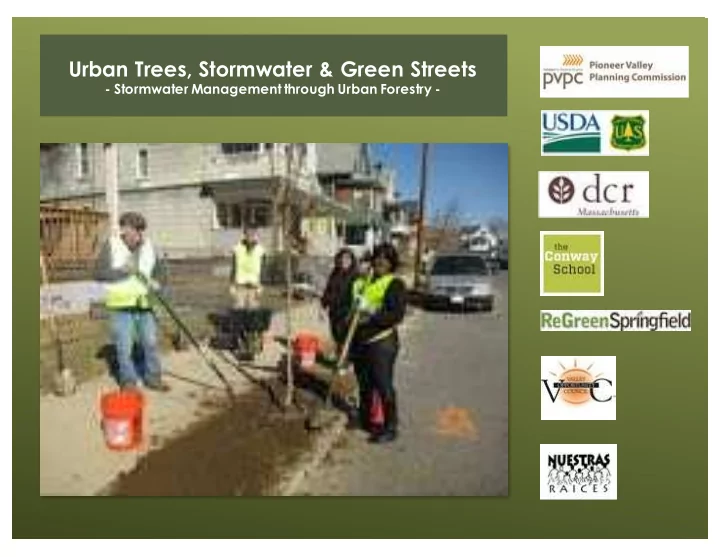
SLIDE 1 Urban Trees, Stormwater & Green Streets
- Stormwater Management through Urban Forestry -
SLIDE 2 TONIGHT’S DISCUSSION TOPICS
Watersheds
- The Urban Tree Canopy
- An Introduction to Green Streets
- Trees, More Trees and the Tree
Owners Manual
SLIDE 3 Table of Contents
______________________________
What Trees Do Benefits of the Urban Forest Components of a Watershed Urban Tree Canopy (UTC) Benefits of Green Streets Green Infrastructure Tools Tree Selection & Placement Planting Your Tree Properly Pruning Young Trees
SLIDE 4
- Aesthetics
- Screening
- Clean Air
- Reduce Runoff and Erosion
- Temper Climate
- Save Energy
- Create Wildlife
Habitat
- Improve Health
- Emotional Well Being
- Strengthen Community
- Economic Values
SLIDE 5 DID YOU KNOW?
- Trees give us oxygen, clean the air, and filter airborne pollutants.
- Trees conserve energy. Just three strategically placed trees can
decrease utility bills by 50%.
- Urban trees in the U.S. remove 711,000 tons of air pollution annually, at a
value of $3.8 billion.
- Trees and vegetation can raise property values up to 37%.
- Trees can reduce annual storm water runoff by 2% – 7%.
- The net cooling effect of a healthy tree is equivalent to 10 room-size air
conditioners operating 20 hours a day.
SLIDE 6 DID YOU KNOW?
- Trees clean the air by absorbing carbon dioxide, sulfur dioxide,
nitrous oxides and other pollutants.
- Trees shade cars and parking lots, reducing ozone emissions from
vehicles.
- Trees filter airborne pollutants and reduce the conditions that cause
asthma and other respiratory problems.
- Get trees. Get healthy. Children and youth living in greener
neighborhoods have lower body mass index.
- Trees reduce noise pollution by absorbing sounds.
- Urban trees in the U.S. store 700 million tons of carbon valued at $14
billion with an annual carbon sequestration rate of 22.8 million tons per year valued at $460 million annually.
SLIDE 7 HOW DO TREES BREATHE ?
! In leaves, water combines
with carbon dioxide and sunlight to make sugar — food for the tree. During this process, called photosynthesis, the tree also produces oxygen.
! Oxygen and water then
evaporate through the leaves — a process called transpiration.
! This is how a tree
breathes.
SLIDE 8 HOW DO TREES DRINK?
! Water in the soil passes into tiny hairlike roots. It enters the root
loaded with minerals from the soil, and is carried up the tree’s trunk all the way to the leaves.
SLIDE 9
ROOTS DO MORE THAN DRINK…
SLIDE 10 HOW MUCH WATER DOES A TREE DRINK?
! A healthy 100-foot-tall tree has about 200,000 leaves. A tree this
size can take 11,000 gallons of water from the soil and release it into the air again, as oxygen and water vapor, in a single growing season.
SLIDE 11
SLIDE 12
SLIDE 13
SLIDE 14 ! Leaving stream and river banks as natural as possible — with the soil undisturbed
and covered with trees, shrubs, wildflowers, mosses and ferns — helps prevent erosion.
! A stream bottom filled with pebbles — rather than a dirt-filled bottom — is one
sign of a healthy stream.
STREAM SIDE BUFFER
SLIDE 15 URBANIZING WATERSHEDS
!Increased !Impervious Surfaces
! Roads, roofs, pools,
sidewalks, parking lots
!Storm water !Flash Flooding !Peak Flow !Floodplain
development
SLIDE 16
IMPACT OF STORMWATER & IMPERVIOUS AREA
! More Extreme Droughts ! Lower Low Stream Flows ! More Frequent & Severe
Flooding
! Less Groundwater
Recharge
! Water Quality Impacts
SLIDE 17 THE URBAN STORM HYDROGRAPH
GREATER PEAKS & VOLUME
Urban&vs&Forested& Storm&Hydrographs&
50 100 150 200 250 300 350 400 2 4 6 8 10 12 14 16
Time Flow&Rate
Urban Forested
å
SLIDE 18 GOALS OF GREEN STREETS
- Greening & Urban Beautification
- Canopy Cover
- Urban Heat Island Mitigation
- Habitat & Food for Wildlife
- Traffic Calming
SLIDE 19 OFFERING A SOLUTION TO URBAN STORMWATER
GREEN STREETS
- Streets comprise a significant percentage of publicly owned
land in most communities, thereby offering a unique opportunity to incorporate green street elements that will not only protect the environment, but can improve community health and prosperity.
- Green streets incorporate a wide variety of design elements
including street trees, permeable pavements, bioretention, and swales. Successful application of green techniques will encourage soil and vegetation contact and infiltration and retention of stormwater.
SLIDE 20
SLIDE 21 BENEFITS OF GREEN STREETS
!
TREES ARE GOOD FOR THE ENVIRONMENT – ECOSYSTEM SERVICES
!
TREES ARE GOOD FOR BUSINESSES
!
TREES ARE GOOD FOR OUR NEIGHBORHOODS
!
TREES ARE GOOD FOR THE ECONOMY
SLIDE 22 !
HAPPIER AND HEALTHIER RESDIENTS
!
TREES HEAL AND HELP YOU LIVE LONGER!
!
TREES MAKE FOR A SAFER COMMUNITY
!
TREES ADD ECONOMIC V ALUE TO A COMMUNITY
!
TREES ADD TO PRIDE OF PLACE AND NEIGHBORHOOD PRIDE
BENEFITS OF GREEN STREETS
SLIDE 23
GREEN PARKING LOTS
SLIDE 24
GREEN PARKING LOTS
SLIDE 25
NYC GREEN STREETS
111th Street, Queens
SLIDE 26
NYC GREEN STREETS
Cross Bronx Expwy & Fulton Ave, Bronx
SLIDE 27
NYC GREEN STREETS
10th Ave & 14th St, Manhattan
SLIDE 28
NYC GREEN STREETS
Waldo & Greystone Aves, Bronx
SLIDE 29
Amboy Rd & Richmond Valley Rd, Staten Island
NYC GREEN STREETS
SLIDE 30
NYC GREEN STREETS
Nashville, Blvd., Manhattan
SLIDE 31
NYC GREEN STREETS
Nashville, Blvd., Manhattan
SLIDE 32
STORMWATER CAPTURE TOOLS
Pipe&Inlets Curb&Inlets Surface&Edging Trench&Drains Bioswale&Grading Deep&Excavation
SLIDE 33
GREEN INFRASTRUCTURE TOOLS
BIOSWALE)(WITH)TREES): A)bioswale is)a)linear)vegetated) swale)that)channels)stormwater,) infiltrating)and)filtering)it)with) vegetation)and)soils)as)it)travels.
SLIDE 34
BREAK&OUT:
BreakEouts)are)excavated)areas) filled)with)structural)soil,)often) under)sidewalks)or)roads.) Used)in)combination)with)other) green)infrastructure)tools)such)as) tree)trenches)or)stormwater planters,)breakEouts)provide)more) room)for)tree)roots)to)grow)in)tight) spaces,)increasing)the)longevity) and)survival)rate)of)urban)trees.
GREEN INFRASTRUCTURE TOOLS
SLIDE 35 COVERED TREE TRENCH:
A)covered)tree)trench)is)a)linear) system)of)trees)connected)by) structural)soil)underground)and) covered)with)permeable)pavers.) Stormwaterflows)into)the)trench) via)inlets)or)runnels)and)through) the)permeable)pavers,)infiltrating) into)the)soil.)The)continuous)mass)
- f)soil)combined)with)soil)breakE
- uts)under)sidewalks)and)streets)
gives)roots)more)room,)increasing) vitality.
SLIDE 36 OPEN,TREE,TRENCH:
like a covered tree trench, an
- pen tree trench is a linear
system of trees connected by structural soil underground, but it is filled with vegetation, not covered with permeable pavers. Stormwater flows into the trench via inlets and infiltrates into the
- soil. The continuous mass of soil in
combination with soil break-outs into sidewalks and streets gives roots more room, increasing vitality.
SLIDE 37
SLIDE 38
SLIDE 39
SLIDE 40
SLIDE 41
SLIDE 42
SLIDE 43
WHY PRUNE YOUR TREES
SLIDE 44
PRUNING TOOLS
SLIDE 45
SLIDE 46
ESTABLISHING A STRONG SCAFFOLD STRUCTURE
SLIDE 47 PRUNING YOUNG TREES
Making the Cut
- 1. Bottom Cut
- 2. Top cut
- 3. Finish cut
SLIDE 48
SLIDE 49