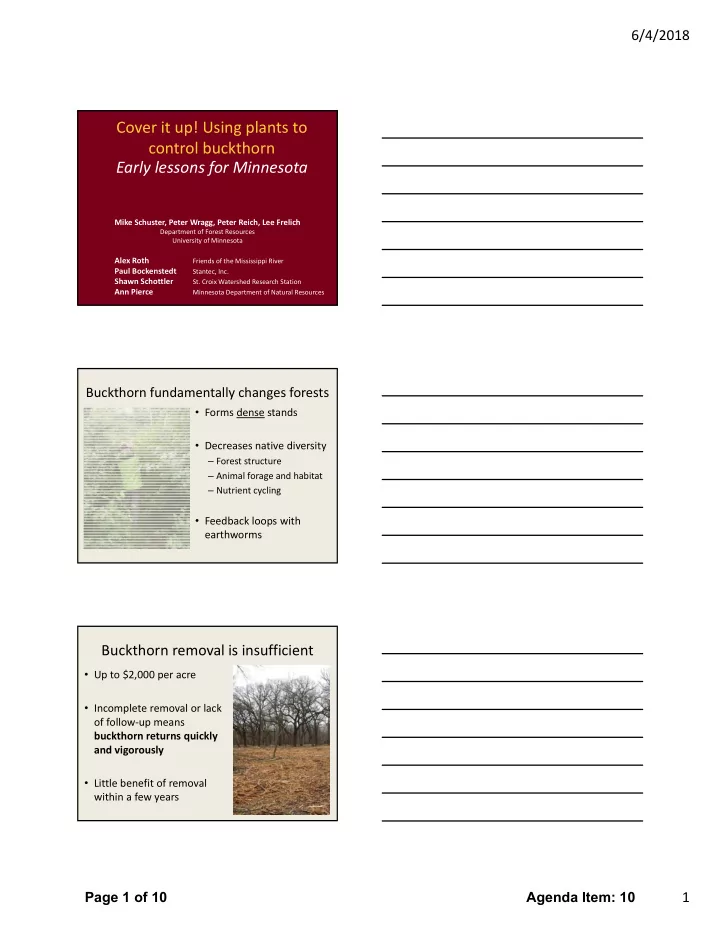
Cover it up! Using plants to control buckthorn Early lessons for - - PDF document

cover it up using plants to control buckthorn early
SMART_READER_LITE
LIVE PREVIEW

Cover it up! Using plants to control buckthorn Early lessons for - - PDF document

6/4/2018 Cover it up! Using plants to control buckthorn Early lessons for Minnesota Mike Schuster, Peter Wragg, Peter Reich, Lee Frelich Department of Forest Resources University of Minnesota Alex Roth Friends of the Mississippi River Paul


slide-1
SLIDE 1

6/4/2018 1

Cover it up! Using plants to control buckthorn

Mike Schuster, Peter Wragg, Peter Reich, Lee Frelich

Department of Forest Resources University of Minnesota

Alex Roth

Friends of the Mississippi River

Paul Bockenstedt

Stantec, Inc.

Shawn Schottler

  • St. Croix Watershed Research Station

Ann Pierce

Minnesota Department of Natural Resources

Early lessons for Minnesota

Buckthorn fundamentally changes forests

  • Forms dense stands
  • Decreases native diversity

– Forest structure – Animal forage and habitat – Nutrient cycling

  • Feedback loops with

earthworms

Buckthorn removal is insufficient

  • Up to $2,000 per acre
  • Incomplete removal or lack
  • f follow‐up means

buckthorn returns quickly and vigorously

  • Little benefit of removal

within a few years

Page 1 of 10 Agenda Item: 10

slide-2
SLIDE 2

6/4/2018 2

Challenges of Removal

There are some ways to control buckthorn but they are very expensive and/or cannot be used in all places

Repeated burning Repeat removal

Page 2 of 10 Agenda Item: 10

slide-3
SLIDE 3

6/4/2018 3

Understory Shade Canopy Shade

Buckthorn is shade‐tolerant, but still needs some light

Understory Shade Canopy Shade

How can we re‐vegetate forests to move them into Suppression or Exclusion zones?

Re‐vegetation is common in grasslands, but not in forests

Schuster et al. 2018

A) System Type G r a s s l a n d W

  • d

l a n d # publications 10 20 30 40

No Support Some Support Support

B) Reveg. Growth Form H e r b a c e

  • u

s W

  • d

y C) Invader Growth Form H e r b a c e

  • u

s W

  • d

y

Page 3 of 10 Agenda Item: 10

slide-4
SLIDE 4

6/4/2018 4

Identifying an effective re‐vegetation method to control buckthorn means…

  • Cost and labor savings for managers and

funders

  • Reduced herbicide applications
  • Increased forest health and diversity
  • Increased value of forests for wildlife and

people

How do different light environments affect buckthorn?

Canopy Shade

Canopy species combinations create a light gradient

Experiment in Cloquet, MN

Page 4 of 10 Agenda Item: 10

slide-5
SLIDE 5

6/4/2018 5

Conifers create denser shade than broadleafs 2+ years of buckthorn growth is sensitive to shading Buckthorn juvenile mortality also increases with shading Page 5 of 10 Agenda Item: 10

slide-6
SLIDE 6

6/4/2018 6

Conifer canopies offer strongest buckthorn suppression

Lesson for Minnesota

Species are not equal in their ability to create shade Managers may need to plant something different than what is already present

  • n‐site

How can these principles be applied via re‐vegetation? How do dense seeding and planting of native species affect buckthorn re‐establishment?

Page 6 of 10 Agenda Item: 10

slide-7
SLIDE 7

6/4/2018 7

Seeding experiment

Herbicide Seed Herbicide No Seed No Herbicide No Seed No Herbicide Seed 200’ 40’ or 80’ A B D C

Replicated 29 times across 7 sites

Seeding didn’t increase shade in first year Perennial species already showing greater cover this year Re‐vegetation by seeding is a multi‐year process

Lesson for Minnesota

Early May

unseeded seeded

Page 7 of 10 Agenda Item: 10

slide-8
SLIDE 8

6/4/2018 8

Planting experiment

Replicated 18 times across 3 sites +2 partner sites

Planting shrubs, trees, or sedges creates smaller buckthorn…

… because they increase shade

Page 8 of 10 Agenda Item: 10

slide-9
SLIDE 9

6/4/2018 9

… because they increase shade

unplanted sedge

Understory Shade Canopy Shade

fern tree shrub

… because they increase shade

Understory Shade Canopy Shade

Re‐vegetating with native species can impede re‐establishment of buckthorn

Lesson for Minnesota

Page 9 of 10 Agenda Item: 10

slide-10
SLIDE 10

6/4/2018 10

Shade reduces buckthorn seedling growth across all seeded and planted plots

Deep shade smothers buckthorn This amount of shading can be created with re‐vegetation (not just with big trees) Goal is to reach this level of shading quickly after buckthorn removal

Lesson for Minnesota

Page 10 of 10 Agenda Item: 10