
SLIDE 1
1
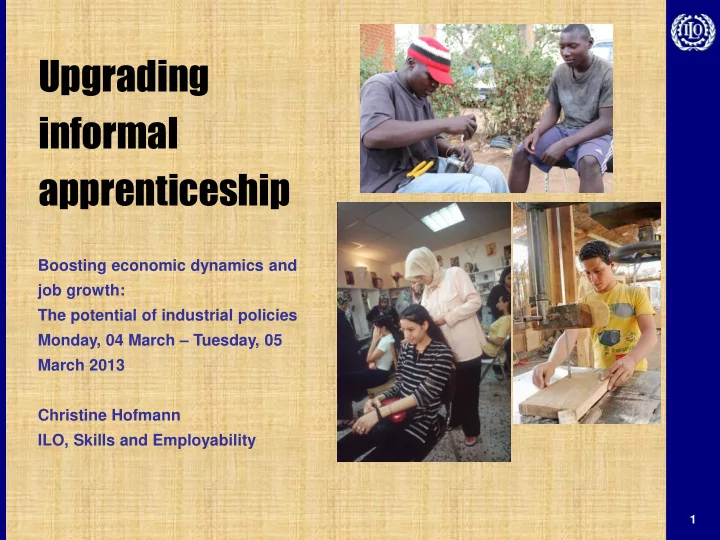
Upgrading informal apprenticeship
Boosting economic dynamics and job growth: The potential of industrial policies Monday, 04 March – Tuesday, 05 March 2013 Christine Hofmann ILO, Skills and Employability
Upgrading informal apprenticeship Boosting economic dynamics and - - PowerPoint PPT Presentation
Upgrading informal apprenticeship Boosting economic dynamics and job growth: The potential of industrial policies Monday, 04 March Tuesday, 05 March 2013 Christine Hofmann ILO, Skills and Employability 1 Five major elements of
1
Boosting economic dynamics and job growth: The potential of industrial policies Monday, 04 March – Tuesday, 05 March 2013 Christine Hofmann ILO, Skills and Employability
2
(apprentice) and trainer/ mentor (master craftsperson)
employability
countries with large informal economies
3
Source: Nordman and Pasquier-Daumier. 2012. Vocational education, on-the-job training and labour market integration of young workers in urban West Africa.
4
Source: Hofmann and Okolo. 2013 (forthcoming). Transitions in informal apprenticeship: Results from ILO research in several African countries, in: in: Akoojee, S.; Gonon, P.; Hauschildt, U.; Hofmann, C. (Eds.) 2013, forthcoming, Apprenticeship in a Globalised World: Premises, Promises and Pitfalls, International Network of Innovative Apprenticeship, Berlin
0% 5% 10% 15% 20% 25% 30% 35% 40% 45% 50%
Malawi Tunisia Egypt Estimate West Africa Germany United Kingdom
5
(associations, chambers etc.)
larger enterprises
between apprentice, company and government
with different specializations
chambers, community groups monitor the training agreement and mediate in case of contract breach
6
Facts:
federation (FENAB) organizes 50.000 craftspersons Two approaches to upgrading 1) Build on informal institution: Agreement between local municipality and local crafts associations to organize end-of- apprenticeship exams. 2) Create new formal institution: Dual apprenticeship in selected trades, funded by Results: 1) Successful candidates receive a certificate, names are broadcast by local radio station, strengthen quality concerns of craftspeople 2) 3000 formalized informal apprentices
7
systems across countries
Bangladesh
child soldiers on informal apprenticeship – jointly with IPEC)
Zimbabwe, Bangladesh, Benin, Burkina Faso, Tanzania, Egypt
8