Undirected Depth-First Search CSE 421 Introduction to Algorithms - - PDF document

undirected depth first search cse 421 introduction to
SMART_READER_LITE
LIVE PREVIEW

Undirected Depth-First Search CSE 421 Introduction to Algorithms - - PDF document

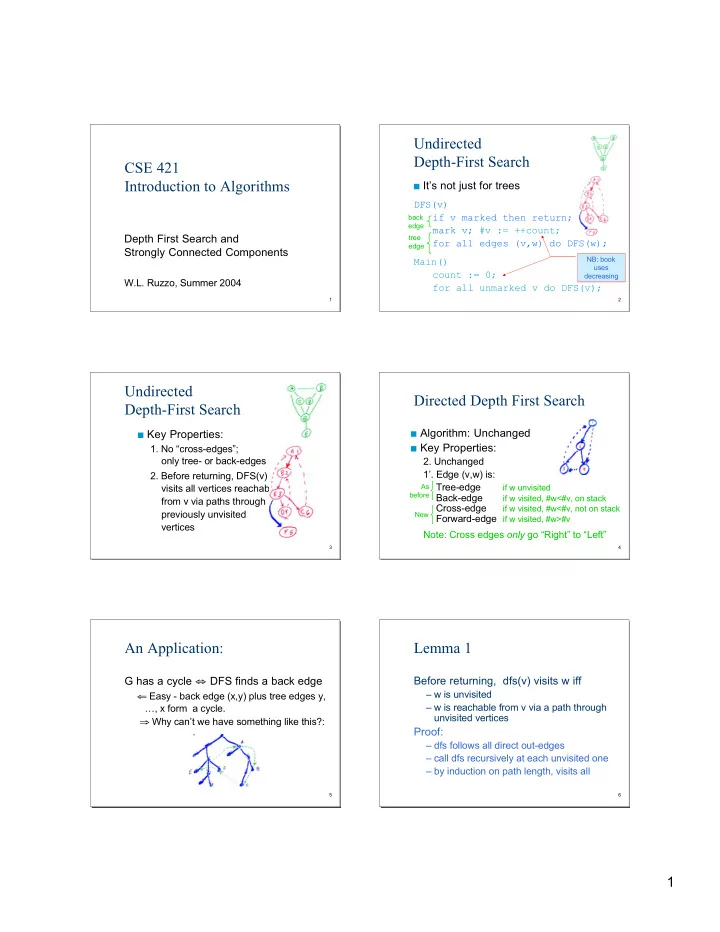
Undirected Depth-First Search CSE 421 Introduction to Algorithms Its not just for trees DFS(v) if v marked then return; back edge mark v; #v := ++count; Depth First Search and tree for all edges (v,w) do DFS(w); edge Strongly


slide-1
SLIDE 1

1

1

CSE 421 Introduction to Algorithms

Depth First Search and Strongly Connected Components

W.L. Ruzzo, Summer 2004

2

Undirected Depth-First Search

 It’s not just for trees

DFS(v) if v marked then return; mark v; #v := ++count; for all edges (v,w) do DFS(w); Main() count := 0; for all unmarked v do DFS(v);

back edge tree edge NB: book uses decreasing

3

Undirected Depth-First Search

 Key Properties:

  • 1. No “cross-edges”;
  • nly tree- or back-edges
  • 2. Before returning, DFS(v)

visits all vertices reachable from v via paths through previously unvisited vertices

4

 Algorithm: Unchanged  Key Properties:

  • 2. Unchanged

1’. Edge (v,w) is: Tree-edge

if w unvisited

Back-edge

if w visited, #w<#v, on stack

Cross-edge

if w visited, #w<#v, not on stack

Forward-edge if w visited, #w>#v Note: Cross edges only go “Right” to “Left”

Directed Depth First Search

As before New

5

An Application:

G has a cycle ⇔ DFS finds a back edge

⇐ Easy - back edge (x,y) plus tree edges y, …, x form a cycle. ⇒ Why can’t we have something like this?:

6

Lemma 1

Before returning, dfs(v) visits w iff

– w is unvisited – w is reachable from v via a path through unvisited vertices

Proof:

– dfs follows all direct out-edges – call dfs recursively at each unvisited one – by induction on path length, visits all

slide-2
SLIDE 2

2

7

Strongly Connected Components

 Defn: G is strongly connected if for all

u,v there is a (directed) path from u to v and from v to u. [Equivalently: there is a circuit through u and v.]

 Defn: a strongly connected component

  • f G is a maximal strongly connected

(vertex-induced) subgraph.

8

1 2 10 9 8 3 4 5 6 7 11 12 13

9

1 2 10 9 8 3 4 5 6 7 11 12 13

Note: collapsed graph is a DAG

10

Uses for SCC’s

 Optimizing compilers:

– SCC’s in program flow graph = loops – SCC’s in call graph = mutual recursion

 Operating Systems: If (u,v) means process u

is waiting for process v, SCC’s show deadlocks.

 Econometrics: SCC’s might show highly

interdependent sectors of the economy.

 Etc.

11

Directed Acyclic Graphs

 If we collapse each SCC to a

single vertex we get a directed graph with no cycles

– a directed acyclic graph or DAG

 Many problems on directed

graphs can be solved as follows:

– Compute SCC’s and resulting DAG – Do one computation on each SCC – Do another on the overall DAG – Example: Spreadsheet evaluation

1 2 10 9 8 3 4 5 6 7 11 12 13

1 2

10-12

3-9 13

12

Two Simple SCC Algorithms

  • u,v in same SCC iff there are

paths u → v & v → u

  • Transitive closure: O(n3)
  • DFS from every u, v: O(ne) = O(n3)
slide-3
SLIDE 3

3

13

Goal:

 Find all Strongly Connected

Components in linear time, i.e., time O(n+e) (Tarjan, 1972)

14

Definition

The root of an SCC is the first vertex in it visited by DFS. Equivalently, the root is the vertex in the SCC with the smallest DFS number.

15

Lemma 2

All members of an SCC are descendants of its root. Proof:

– all members are reachable from all others – so, all are reachable from its root – all are unvisited when root is visited – so, all are descendants of its root (Lemma 1)

Exercise: show that each SCC is a contiguous subtree.

16

Subgoal

 Can we identify some root?  How about the root of the first SCC

completely explored (returned from) by DFS?

 Key idea: no exit from first SCC

(first SCC is leftmost “leaf” in collapsed DAG)

17

Definition

x is an exit from v (from v’s subtree) if

– x is not a descendant of v, but – x is the head of a (cross- or back-) edge from a descendant of v (including v itself)

NOTE: #x < #v Ex: node #1 cannot have an exit.

v x

18

1 2 10 9 8 3 4 5 6 7 11 12 13

# root exits 1 1

  • 2

2

  • 3

3

  • 4, 5

3 3 6 3 3, 5 7 3 5 8, 9 3 7 10 10 2, 8 11, 12 10 10 13 13

slide-4
SLIDE 4

4

19

Lemma 3: Nonroots have exits

If v is not a root, then v has an exit. Proof:

– let r be root of v’s SCC – r is a proper ancestor of v (Lemma 2) – let x be the first vertex that is not a descendant of v on a path v → r . – x is an exit

Cor (contrapositive): If v has no exit, then v is a root.

NB: converse not true; some roots do have exits

r v x Idea: Follow cycle to root

20

Lemma 4: No Escaping 1st Root

If r is the first root from which dfs returns, then r has no exit Proof (by contradiction):

– Suppose x is an exit – let z be root of x’s SCC – r not reachable from z, else in same SCC – #z ≤ #x (z ancestor of x; Lemma 2) – #x < #r (x is an exit from r) – #z < #r, no z → r path, so return from z first – Contradiction

r x z ? Idea: Exit ⇒ Bigger Cycle

21

 All exits x from v have #x < #v  Suffices to find any of them, e.g. min #  Defn:

LOW(v) = min({ #x | x an exit from v} ∪ {#v})

 Calculate inductively:

LOW(v) = min of:

– #v – { LOW(w) | w a child of v } – { #x | (v,x) is a back- or cross-edge }

 1st root : LOW(v)=v

How to Find Exits (in 1st component)

w1 w2 w3 x1 x2 v

22

1 2 10 9 8 3 4 5 6 7 11 12 13

# root exits LOW 1 1

  • 2

2

  • 3

3

  • 3

4, 5 3 3 3 6 3 3, 5 3 7 3 5 5 8, 9 3 7 7 10 10 2, 8 11, 12 10 10 13 13

  • 1st root:

LOW(v)=v

23

Finding Other Components

 Key idea: No exit from

– 1st SCC – 2nd SCC, except maybe to 1st – 3rd SCC, except maybe to 1st and/or 2nd – ...

24

Lemma 3’

If v is not a root, then v has an exit . Proof:

– let r be root of v’s SCC – r is a proper ancestor of v (Lemma 2) – let x be the first vertex that is not a descendant of v on a path v → r . – x is an exit

Cor: If v has no exit , then v is a root.

v x r in v’s SCC in v’s SCC in v’s SCC

slide-5
SLIDE 5

5

25

If r is the first root from which dfs returns, then r has no exit Proof:

– Suppose x is an exit – let z be root of x’s SCC – r not reachable from z, else in same SCC – #z ≤ #x (z ancestor of x; Lemma 2) – #x < #r (x is an exit from r) – #z < #r, no z → r path, so return from z first – Contradiction except possibly to the first (k-1) components

Lemma 4’

kth i.e., x in first (k-1) r x z ?

26

How to Find Exits (in 1st component)

 All exits x from v have #x < #v  Suffices to find any of them, e.g. min #  Defn:

LOW(v) = min({ #x | x an exit from v } ∪ {#v})

 Calculate inductively:

LOW(v) = min of:

– #v – { LOW(w) | w a child of v } – { #x | (v,x) is a back- or cross-edge }

kth and x not in first (k-1) components

27

SCC Algorithm

SCC(v) #v = vertex_number++; v.low = #v; push(v) for all edges (v,w) if #w == 0 then SCC(w); v.low = min(v.low, w.low) // tree edge else if #w < #v && w.scc == 0 then v.low = min(v.low, #w) // cross- or back-edge if #v == v.low then // v is root of new scc scc#++; repeat w = pop(); w.scc = scc#; // mark SCC members until w==v #v = DFS number v.low = LOW(v) v.scc = component #

28

1 2 10 9 8 3 4 5 6 7 11 12 13

# root exits LOW 1 1

  • 1

2 2

  • 2

3 3

  • 3

4, 5 3 3 3 6 3 3, 5 3 7 3 5 5 8, 9 3 7 7 10 10 2, 8 10 11, 12 10 10 10 13 13

  • 13

29

Complexity

 Look at every edge once  Look at every vertex (except via in-

edge) at most once

 Time = O(n+e)

30

Where to start

 Unlike undirected DFS, start vertex matters  Add “outer loop”:

mark all vertices unvisited while there is unvisited vertex v do scc(v)

 Exercise: redo example starting from another

vertex, e.g. #11 or #13 (which become #1)

slide-6
SLIDE 6

6

31

Example

A F E C B D 1 2 3 4 5 6

dfs# v root exits low(v)

32

Example

v Low(v) v Low(v)