Outline for today Logic Programming Problem representation - - PowerPoint PPT Presentation

outline for today logic programming
SMART_READER_LITE
LIVE PREVIEW

Outline for today Logic Programming Problem representation - - PowerPoint PPT Presentation

Outline for today Logic Programming Problem representation Depth-First Search Iterative Deepening Lecture 7: Search Strategies: Breadth-First Search Problem representations Depth-first, breadth-first, and AND/OR search AND/OR


slide-1
SLIDE 1

Logic Programming

Lecture 7: Search Strategies: Problem representations Depth-first, breadth-first, and AND/OR search

James Cheney Logic Programming November 3, 2014

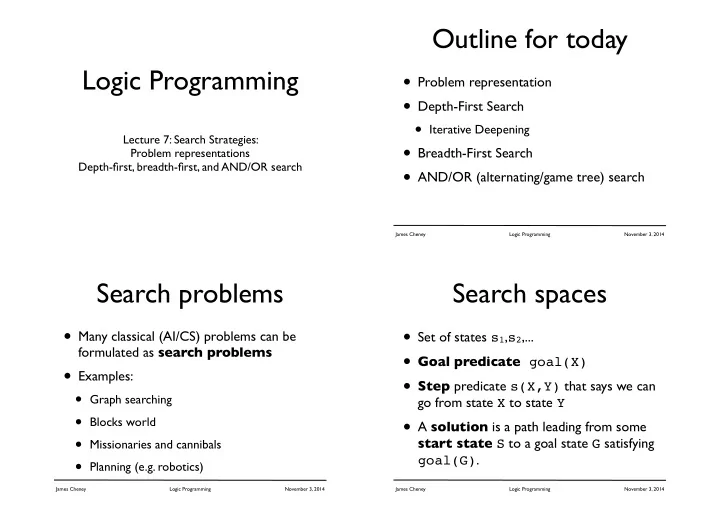
Outline for today

  • Problem representation
  • Depth-First Search
  • Iterative Deepening
  • Breadth-First Search
  • AND/OR (alternating/game tree) search

James Cheney Logic Programming November 3, 2014

Search problems

  • Many classical (AI/CS) problems can be

formulated as search problems

  • Examples:
  • Graph searching
  • Blocks world
  • Missionaries and cannibals
  • Planning (e.g. robotics)

James Cheney Logic Programming November 3, 2014

Search spaces

  • Set of states s1,s2,...
  • Goal predicate goal(X)
  • Step predicate s(X,Y) that says we can

go from state X to state Y

  • A solution is a path leading from some

start state S to a goal state G satisfying goal(G).

slide-2
SLIDE 2

James Cheney Logic Programming November 3, 2014

Example: Blocks world

A B C

[[c,b,a],[],[]]

James Cheney Logic Programming November 3, 2014

Example: Blocks world

A B C

[[b,a],[],[c]]

James Cheney Logic Programming November 3, 2014

Example: Blocks world

A B C

[[a],[b],[c]]

James Cheney Logic Programming November 3, 2014

Example: Blocks world

A B C

[[],[a,b],[c]]

slide-3
SLIDE 3

James Cheney Logic Programming November 3, 2014

Representation in Prolog

  • State is a list of stacks of blocks.

[[a,b,c],[],[]]

  • Transitions move a block from the top of one stack to

the top of another s([[A|As],Bs,Cs], [As,[A|Bs],Cs]). s([[A|As],Bs,Cs], [As,Bs,[A|Cs]]). ... goal([[],[],[a,b,c]]).

James Cheney Logic Programming November 3, 2014

An abstract problem space

c b a d f(d) f(g(d)) f(g(g(d))) ...

s(a,b). s(b,c). s(c,a). s(c,f(d)). s(f(N),f(g(N))). s(f(g(X)),X). goal(d).

g(d)

James Cheney Logic Programming November 3, 2014

Depth-first search

  • dfs(Node,Path)
  • Path is a path to a goal starting from Node

dfs(S,[S]) :- goal(S). dfs(S,[S|P]) :- s(S,T), dfs(T,P).

  • This should look familiar

James Cheney Logic Programming November 3, 2014

Problem 1: Cycles

A B C

slide-4
SLIDE 4

James Cheney Logic Programming November 3, 2014

Problem 1: Cycles

A B C

James Cheney Logic Programming November 3, 2014

Problem 1: Cycles

A B C

James Cheney Logic Programming November 3, 2014

Solution 1: Remember where you've been

  • Avoid cycles by avoiding previously visited states

dfs_noloop(Path,Node,[Node|Path]) :- goal(Node). dfs_noloop(Path,Node,Path1) :- s(Node,Node1),

  • \+(member(Node1,Path)),
  • dfs_noloop([Node|Path],Node1,Path1).

James Cheney Logic Programming November 3, 2014

Problem 2: Infinite state space

  • DFS has similar problems to Prolog proof search
  • We may miss solutions because state space is infinite
  • Even if state space is finite, may wind up finding

"easy" solution only after a long exploration of pointless part of search space

...

slide-5
SLIDE 5

James Cheney Logic Programming November 3, 2014

Solution 2: Depth bounding

  • Keep track of depth, stop if bound exceeded
  • Note: does not avoid loops (can do this too)

dfs_bound(_,Node,[Node]) :- goal(Node). dfs_bound(N,Node,[Node|Path]) :- N > 0, s(Node,Node1), M is N-1, dfs_bound(M,Node1,Path).

James Cheney Logic Programming November 3, 2014

Problem 3: What is a good bound?

  • Don't know this in advance, in general
  • Too low?
  • Might miss solutions
  • Too high?
  • Might spend a long time searching pointlessly

James Cheney Logic Programming November 3, 2014

Solution 3: Iterative deepening

dfs_id(N,Node,Path) :- dfs_bound(N,Node,Path) ; M is N+1, dfs_id(M,Node,Path).

James Cheney Logic Programming November 3, 2014

Breadth-first search

  • Keep track of all possible solutions, try shortest ones first
  • Maintain a "queue" of solutions

bfs([[Node|Path]|_], [Node|Path]) :- goal(Node). bfs([Path|Paths], S) :-

  • extend(Path,NewPaths),
  • append(Paths,NewPaths,Paths1),
  • bfs(Paths1,S).

bfs_start(N,P) :- bfs([[N]],P).

slide-6
SLIDE 6

James Cheney Logic Programming November 3, 2014

Extending paths

extend([Node|Path],NewPaths) :-

  • bagof([NewNode,Node|Path],
  • (s(Node,NewNode),
  • \+ (member(NewNode,[Node|Path]))),
  • NewPaths),
  • !.

%% if there are no next steps, %% bagof will fail and we'll fall through. extend(_Path,[]).

James Cheney Logic Programming November 3, 2014

Problem: Speed

  • Concatenating new paths to end of list is

slow

  • Avoid this using difference lists?
  • Will revisit next week

James Cheney Logic Programming November 3, 2014

AND/OR search

  • So far we've considered graph search

problems

  • Just want to find some path from start to end
  • Other problems have more structure
  • e.g. 2-player games
  • AND/OR search is a useful abstraction

James Cheney Logic Programming November 3, 2014

AND/OR search

  • Search space has 2 kinds of states:
  • OR: "we get to choose next state"
  • AND: "opponent gets to choose"
  • we need to be able to handle any opponent

move

slide-7
SLIDE 7

James Cheney Logic Programming November 3, 2014

Example: Tic tac toe

x x x x

... ... ... ... ...

James Cheney Logic Programming November 3, 2014

Representation

  • or(S,Nodes)
  • S is an OR node with possible next states Nodes
  • "Our move"
  • and(S,Nodes)
  • S is an AND node with possible next states Nodes
  • "Opponent moves"
  • goal(S)
  • S is a "win" for us

James Cheney Logic Programming November 3, 2014

Example: A simple game

a b c d e

and(a,[b,c]).

  • r(b,[d,a]).
  • r(c,[d,e]).

goal(e).

James Cheney Logic Programming November 3, 2014

Basic idea

andor(Node) :- goal(Node). andor(Node) :-

  • r(Node,Nodes),
  • member(Node1,Nodes),
  • andor(Node1).

andor(Node) :-

  • and(Node,Nodes),
  • solveall(Nodes).
slide-8
SLIDE 8

James Cheney Logic Programming November 3, 2014

Solutions

  • For each AND state, we need solutions for all

possible next states

  • For each OR state, we just need one choice
  • A "solution" is thus a tree, or strategy
  • Can adapt previous program to produce solution tree.
  • Can also incorporate iterative deepening, loop

avoidance, BFS

  • heuristic measures of "good" positions - min/max

James Cheney Logic Programming November 3, 2014

  • Further reading:
  • Bratko, Prolog Programming for Artificial

Intelligence

  • ch. 8 (difference lists), ch. 11 (DFS/BFS)
  • also Ch. 12 (BestFS), 13 (AND/OR)
  • Next time:
  • Higher-order logic programming